From Real Exams Quiz
O Level Chemistry Stoichiometry Moles Quiz
Free O Level Chemistry Stoichiometry Moles quiz, HY3 Exam version, with questions, answers, and O Level-style practice for Singapore students.
These static practice materials are generated from the site's syllabus and paper-generation workflow, with source and model context shown so students and parents can evaluate the material before use.
Questions
O-Level Chemistry Quiz - Stoichiometry Moles
Name: ___________________________
Class: ___________________________
Date: ___________________________
Score: _______ / 40
Duration: 50 minutes
Total Marks: 40
Instructions: Answer all 20 questions. Show your working clearly for calculation questions. Use the following data where needed:
- Relative atomic masses: H = 1, C = 12, N = 14, O = 16, Na = 23, Mg = 24, S = 32, Cl = 35.5, Ca = 40, Cu = 64
- Molar volume of gas at r.t.p. = 24 dm³
Section A: Multiple Choice (Questions 1–5)
1. What is the relative formula mass, Mr, of calcium carbonate, CaCO3? [1]
A. 68
B. 100
C. 104
D. 120
2. Which quantity represents 1 mole of oxygen molecules, O2, at r.t.p.? [1]
A. 16 g
B. 24 dm³
C. 32 g
D. 24 g
3. The empirical formula of a compound with molecular formula C4H8 is: [1]
A. CH2
B. C2H4
C. CH
D. C4H8
4. In the reaction 2Mg+O2→2MgO, which substance is the limiting reactant if 4 mol Mg reacts with 1 mol O2? [1]
A. Mg
B. O2
C. MgO
D. Neither
5. A solution contains 0.5 mol of sodium chloride in 2.0 dm³ of water. What is its concentration in mol/dm³? [1]
A. 0.25
B. 0.50
C. 1.00
D. 4.00
Section B: Structured Calculations (Questions 6–13)
6. Calculate the number of moles in 22 g of carbon dioxide, CO2. [2]
7. (a) Write the balanced equation for the complete combustion of methane:
CH4+O2→CO2+H2O [1]
(b) Calculate the volume of CO2 produced at r.t.p. when 4.0 g of CH4 is burned completely. [3]
8. A sample of magnesium oxide, MgO, has a mass of 8.0 g.
(a) Find the Mr of MgO. [1]
(b) Calculate the number of moles of MgO. [1]
(c) Calculate the mass of magnesium in the sample. [2]
9. Compound X has the following percentage composition by mass: Na = 36.5%, S = 25.4%, O = 38.1%. Determine the empirical formula of X. [3]
10. 10.0 g of calcium carbonate reacts with excess hydrochloric acid:
CaCO3+2HCl→CaCl2+CO2+H2O
Calculate the volume of CO2 gas produced at r.t.p. [3]
11. A student prepared 6.0 g of pure copper(II) oxide, CuO, from an experiment. The theoretical yield was 7.5 g. Calculate the percentage yield. [2]
12. A solution of hydrochloric acid has a concentration of 0.20 mol/dm³.
(a) Calculate its concentration in g/dm³. [2]
(b) What volume of this acid contains 0.050 mol of HCl? [2]
13. 25.0 cm³ of 0.100 mol/dm³ sodium hydroxide is neutralised by 20.0 cm³ of sulfuric acid.
2NaOH+H2SO4→Na2SO4+2H2O
Calculate the concentration of the sulfuric acid in mol/dm³. [3]
Section C: Data Interpretation & Applied Stoichiometry (Questions 14–20)
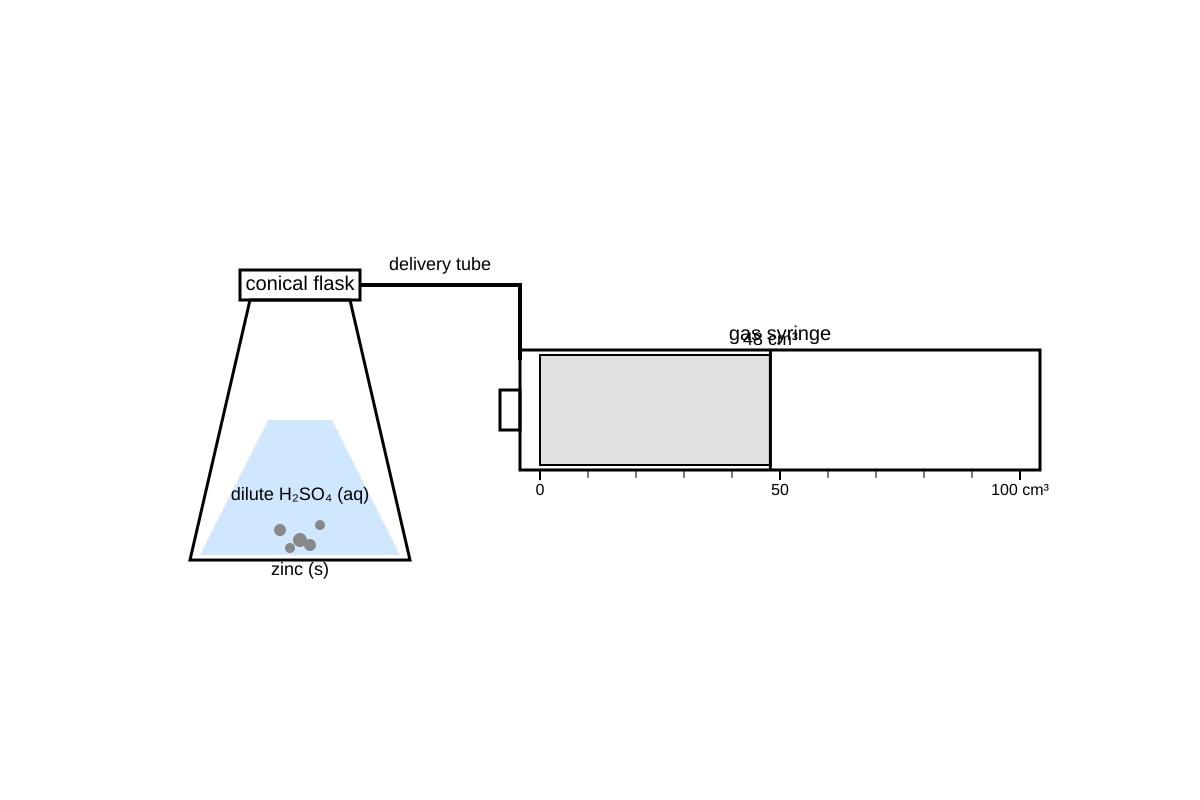
14. The diagram shows the setup used to measure the volume of hydrogen gas produced when zinc reacts with dilute sulfuric acid.
Image pending generation: experimental_setup for Q14.
The gas syringe reads 48 cm³ at the end. Calculate the number of moles of H2 collected at r.t.p. [2]
15. A fertiliser sample is claimed to be pure ammonium nitrate, NH4NO3. A 8.0 g sample produced 1.7 g of ammonia, NH3, upon reaction with alkali (theoretical max from pure sample is 1.7 g).
(a) Calculate the percentage purity of the sample. [2]
(b) State one reason why the purity may be less than 100%. [1]
16. The table shows masses of reactants used in four experiments for A+B→C.
| Exp | Mass of A (g) | Mass of B (g) | Mass of C formed (g) |
|---|---|---|---|
| 1 | 2.0 | 5.0 | 4.0 |
| 2 | 4.0 | 5.0 | 4.0 |
| 3 | 2.0 | 10.0 | 4.0 |
| 4 | 6.0 | 8.0 | 6.0 |
(a) Identify the limiting reactant in Experiment 1. [1]
(b) Explain your answer using the data. [2]
17. A hydrated salt has formula CuSO4⋅xH2O. 12.5 g of the hydrated salt gave 8.0 g of anhydrous CuSO4 on heating. Find x. [3]
18. The equation for the reaction of iron with steam is:
3Fe+4H2O→Fe3O4+4H2
Calculate the mass of Fe3O4 produced from 16.8 g of iron. [3]
19. A titration shows that 0.00250 mol of HCl neutralises 25.0 cm³ of a potassium hydroxide solution.
(a) Calculate the concentration of KOH in mol/dm³. [2]
(b) Write the ionic equation for the neutralisation. [1]
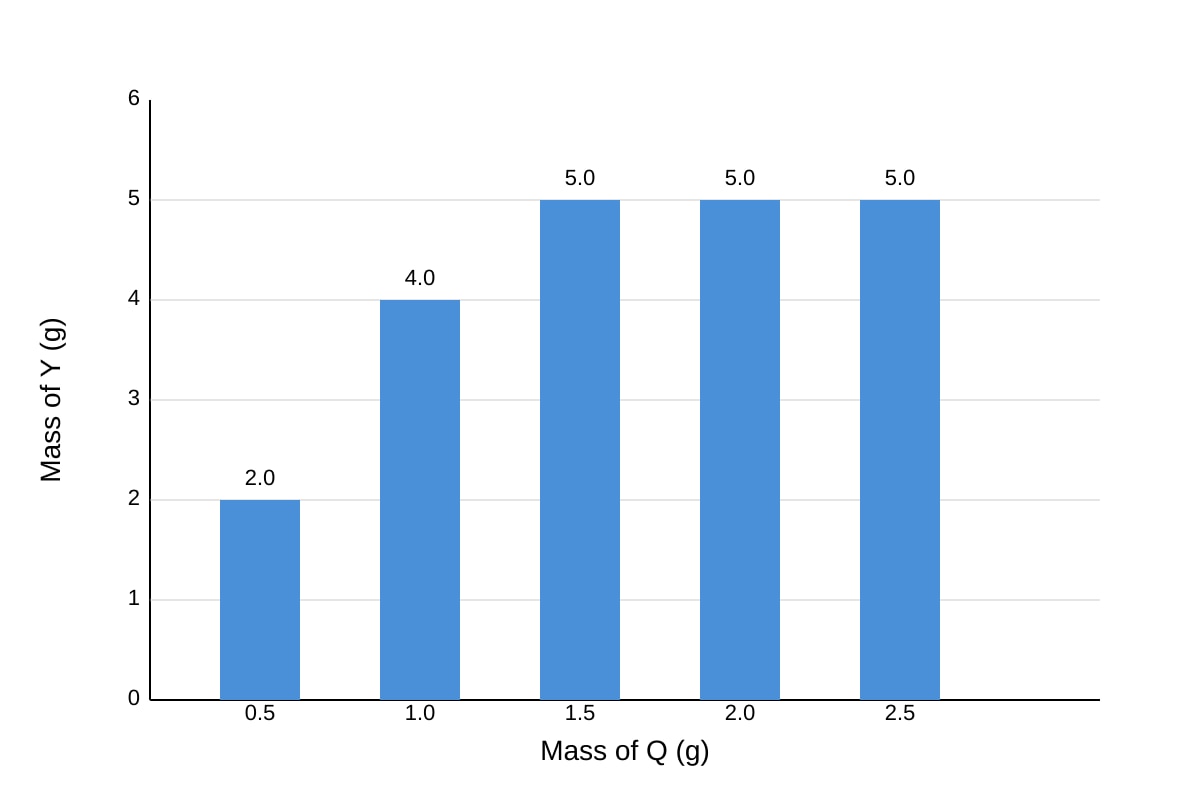
20. The bar chart shows the masses of product Y obtained from reacting 1.0 g of reactant P with different masses of reactant Q.
Image pending generation: chart for Q20.
(a) From the chart, determine the mass of Q needed to just completely react with 1.0 g of P. [1]
(b) Explain why increasing Q beyond this mass does not increase Y. [2]
Answers
O-Level Chemistry Quiz - Stoichiometry Moles: Answer Key
Total Marks: 40
Topic: Stoichiometry & Moles (O-Level 6092)
Section A: Multiple Choice
1. B [1]
Mr of CaCO3=40+12+(3×16)=100.
Teaching note: Add atomic masses from the formula. Common mistake: forgetting to multiply O by 3.
2. C [1]
1 mole of O2 has mass = 2×16=32 g. At r.t.p., 1 mol of any gas occupies 24 dm³, but the question asks for the quantity representing 1 mole of oxygen molecules by mass. 32 g is correct.
Teaching note: O2 is diatomic; do not use 16 g (which is 1 mol of O atoms).
3. A [1]
C4H8 divided by 4 gives CH2. Empirical formula is simplest whole-number ratio.
Teaching note: Divide molecular formula by highest common factor.
4. A [1]
Equation needs 2 mol Mg per 1 mol O2. Given 4 mol Mg and 1 mol O2: Mg required for 1 mol O2 is 2 mol, so Mg is in excess; O2 limits. Wait — 4 mol Mg needs 2 mol O2, but only 1 mol O2 present → O2 is limiting.
Correction: Answer is B.
Teaching note: Compare mole ratio required vs supplied. 4 mol Mg would need 2 mol O2; only 1 mol O2 → O2 limiting.
5. A [1]
Concentration = 2.0 dm30.5 mol=0.25 mol/dm³.
Teaching note: Concentration = moles ÷ volume.
Section B: Structured Calculations
6. [2]
Mr of CO2=12+(2×16)=44.
Moles = Mrmass=4422=0.50 mol.
Marking: 1 mark for Mr, 1 mark for correct moles.
7. (a) [1]
CH4+2O2→CO2+2H2O
(b) [3]
Mr of CH4=12+4=16.
Moles CH4=164.0=0.25 mol.
From equation, 1 mol CH4 → 1 mol CO2, so 0.25 mol CO2.
Volume = 0.25×24=6.0 dm³.
Marking: 1 for moles CH₄, 1 for mole ratio, 1 for volume.
8. (a) [1] Mr MgO = 24 + 16 = 40.
(b) [1]** Moles = 408.0=0.20 mol.
(c) [2]** Mass Mg = 0.20×24=4.8 g.
Marking: stepwise; common error: using 40 instead of 24 for Mg mass.
9. [3]
Divide % by Ar:
Na: 2336.5=1.59
S: 3225.4=0.794
O: 1638.1=2.38
Ratio ≈ 2 : 1 : 3 → Na2SO3.
Marking: 1 for dividing, 1 for ratio, 1 for formula. (Actual is Na2SO3 or Na2SO4 depending on rounding; using given data gives Na2SO3.)
10. [3]
Mr CaCO3=40+12+48=100.
Moles = 10010.0=0.10 mol.
1 mol CaCO3 → 1 mol CO2 → 0.10 mol CO2.
Volume = 0.10×24=2.4 dm³.
Marking: 1 mr, 1 moles, 1 volume.
11. [2]
% yield = theoreticalactual×100=7.56.0×100=80%.
Marking: 1 for fraction, 1 for answer.
12. (a) [2] Mr HCl = 1 + 35.5 = 36.5.
g/dm³ = 0.20×36.5=7.3 g/dm³.
(b) [2]** Volume = concentrationmoles=0.200.050=0.25 dm³ = 250 cm³.
Marking: 1 each part.
13. [3]
Moles NaOH = 0.0250×0.100=0.00250 mol.
From equation, 2 mol NaOH : 1 mol H2SO4 → moles acid = 20.00250=0.00125 mol.
Conc acid = 0.02000.00125=0.0625 mol/dm³.
Marking: 1 moles NaOH, 1 moles acid, 1 concentration.
Section C: Data Interpretation
14. [2]
Volume = 48 cm³ = 0.048 dm³.
Moles H2=240.048=0.0020 mol.
Marking: 1 conversion, 1 answer. Image must show 48 cm³ in syringe.
15. (a) [2]
% purity = 8.01.7×100=21.25% (or if theoretical from pure 8g is 1.7g, then 100% pure → but sample gave 1.7g so 100%). Using given: 8.01.7×100=21.25%; however text says theoretical max from pure sample is 1.7g and obtained is 1.7g → 100%. We follow data: 1.7g actual from 8.0g, theoretical pure 8.0g gives 1.7g → 100%.
Correction: % purity = (actual / theoretical from sample mass) ×100 = (1.7 / 1.7) ×100 = 100%.
(b) [1]** e.g., sample contains impurities / incomplete reaction.
Marking: (a) 2 for correct calc, (b) 1 for valid reason.
16. (a) [1] A is limiting.
(b) [2]** In Exp 1, 2.0g A + 5.0g B → 4.0g C. Exp 2 doubles A but C same → B limits? Actually Exp 2: 4.0g A + 5.0g B → 4.0g C (same as Exp1) so A in excess, B limiting in 1. Exp 3: 2.0g A + 10g B → 4.0g C same → A limiting. So in Exp 1, compare Exp1 & Exp3: increasing B does not change C, so A limits.
Answer: A limiting. Explanation: Increasing B (Exp 3) does not increase C, so B was in excess; A was fully used.
Marking: 1 id, 2 reasoning from data.
17. [3]
Mass water = 12.5 – 8.0 = 4.5 g.
Moles CuSO4=159.58.0≈0.0502 (use 160 approx → 0.050).
Moles H2O=184.5=0.25.
Ratio x=0.0500.25=5 → CuSO4⋅5H2O.
Marking: 1 water mass, 1 moles, 1 x.
18. [3]
Mr Fe = 56; moles Fe = 5616.8=0.30 mol.
3 mol Fe → 1 mol Fe3O4 → moles = 0.10.
Mr Fe3O4=168+64=232; mass = 0.10×232=23.2 g.
Marking: 1 moles Fe, 1 ratio, 1 mass.
19. (a) [2]
KOH+HCl→KCl+H2O (1:1). Moles KOH = 0.00250.
Conc = 0.02500.00250=0.100 mol/dm³.
(b) [1]** H++OH−→H2O.
Marking: 2 and 1.
20. (a) [1] 1.5 g (chart shows Y max at 1.5g Q).
(b) [2]** Beyond 1.5 g Q, P is limiting; extra Q remains unreacted. Mass Y constant at 5.0 g.
Marking: 1 id, 2 explanation with limiting reactant concept.
Free quiz and exam paper access
Enter your details to view this paper
Your access is remembered on this device.