From Real Exams Quiz
O Level Chemistry Redox Electrochemistry Quiz
Free O Level Chemistry Redox Electrochemistry quiz, HY3 Exam version, with questions, answers, and O Level-style practice for Singapore students.
These static practice materials are generated from the site's syllabus and paper-generation workflow, with source and model context shown so students and parents can evaluate the material before use.
Questions
O-Level Chemistry Quiz - Redox Electrochemistry
Name: ___________________________
Class: ___________________________
Date: ___________________________
Score: _______ / 40
Duration: 60 minutes
Total Marks: 40
Instructions:
- Answer all 20 questions.
- Section A: Multiple-choice (1 mark each). Section B: Structured short answers (1–3 marks). Section C: Data and calculation (2–4 marks).
- Write your answers clearly in the spaces provided.
- Show all working for calculation questions.
- Use chemical symbols and state symbols where appropriate.
Section A: Multiple Choice (Questions 1–5, 1 mark each)
1. Which of the following processes is an example of reduction?
A. Mg → Mg²⁺ + 2e⁻
B. Fe²⁺ → Fe³⁺ + e⁻
C. Cu²⁺ + 2e⁻ → Cu
D. 2I⁻ → I₂ + 2e⁻
2. In the reactivity series, which metal is the strongest reducing agent?
A. Copper
B. Silver
C. Potassium
D. Gold
3. During electrolysis of molten lead(II) bromide, at the cathode:
A. Bromide ions lose electrons
B. Lead ions gain electrons
C. Bromine is formed
D. Oxygen is produced
4. What is the oxidation state of manganese in KMnO₄?
A. +2
B. +4
C. +6
D. +7
5. A fuel cell converts:
A. Chemical energy to electrical energy
B. Electrical energy to chemical energy
C. Heat energy to light energy
D. Nuclear energy to electrical energy
Section B: Structured Short Answers (Questions 6–15)
6. State the meaning of the term "oxidation" in terms of electrons. [1]
7. Write the ionic half-equation for the discharge of hydroxide ions at the anode during electrolysis of aqueous sodium chloride. [1]
8. Iron is extracted from iron(III) oxide by reduction with carbon monoxide.
(a) Define "redox reaction". [1]
(b) Identify the reducing agent in this process. [1]
(a) ________________________________________________________
(b) ________________________________________________________
9. A student places a clean iron nail into copper(II) sulfate solution.
(a) What observation shows a redox reaction occurs? [1]
(b) Write the ionic equation for the reaction. [1]
(a) ________________________________________________________
(b) ________________________________________________________
10. During electrolysis of concentrated aqueous sodium chloride using inert electrodes, state the product at the anode and explain why. [2]
11. Give the oxidation state of sulfur in each of the following: [2]
(a) H₂S
(b) SO₂
(a) ____ (b) ____
12. Explain why zinc is used to galvanise iron. [2]
13. Write the half-equations and overall equation for the reaction between chlorine and bromide ions. [3]
Oxidation: ________________________________________________________
Reduction: ________________________________________________________
Overall: ________________________________________________________
14. A sample of molten aluminium oxide is electrolysed.
(a) Name the products at the cathode and anode. [2]
(b) Why must cryolite be added? [1]
(a) Cathode: ________ Anode: ________
(b) ________________________________________________________
15. State two differences between electrolysis of molten and aqueous sodium chloride. [2]
Section C: Data and Calculation (Questions 16–20)
16. In an experiment, 0.025 mol of electrons were passed through a copper(II) sulfate solution.
Calculate the mass of copper deposited at the cathode. (Ar Cu = 63.5) [3]
Working:
Mass = ________ g
17. The table below shows standard electrode potentials:
| Half-cell | E° / V |
|---|---|
| Zn²⁺/Zn | -0.76 |
| Cu²⁺/Cu | +0.34 |
| Fe²⁺/Fe | -0.44 |
(a) Construct the cell with the highest voltage and state its voltage. [2]
(b) Write the overall cell reaction. [1]
(a) Cell: ________ || ________ Voltage = ________ V
(b) ________________________________________________________
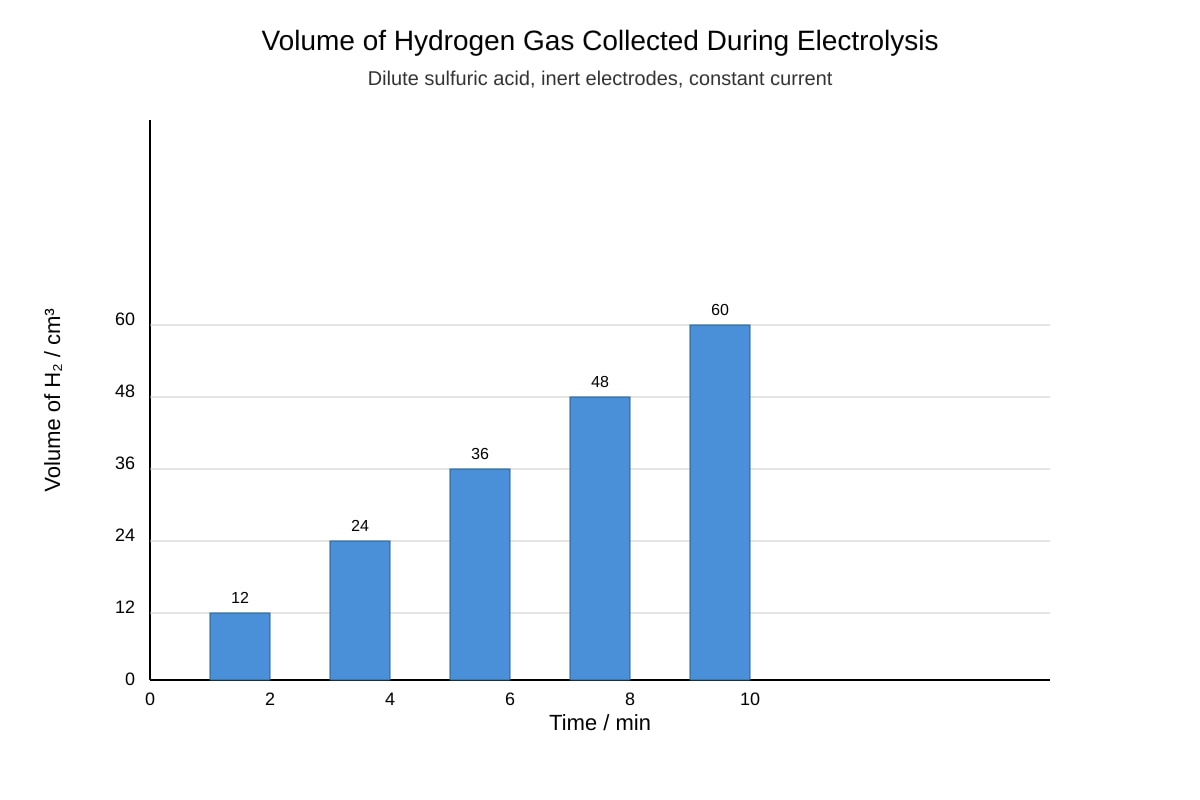
18.
Image pending generation: graph for Q18.
Using the graph, calculate the average rate of hydrogen production in cm³/min. [2]
Working:
Rate = ________ cm³/min
19. A hydrogen-oxygen fuel cell operates with the half-equations:
Anode: 2H₂ + 4OH⁻ → 4H₂O + 4e⁻
Cathode: O₂ + 2H₂O + 4e⁻ → 4OH⁻
(a) State the overall reaction. [1]
(b) Give one environmental advantage over a petrol engine. [1]
(a) ________________________________________________________
(b) ________________________________________________________
20. A strip of magnesium is placed in lead(II) nitrate solution.
(a) Write the ionic equation. [1]
(b) Calculate the maximum mass of lead that can be displaced by 0.120 g of Mg. (Ar Mg = 24.3, Ar Pb = 207.2) [3]
(a) ________________________________________________________
(b) Working:
Mass Pb = ________ g
Answers
O-Level Chemistry Quiz - Redox Electrochemistry: Answer Key
Total Marks: 40
Topic: Redox Electrochemistry
Section A: Multiple Choice
1. C [1]
Teaching note: Reduction is gain of electrons. Cu²⁺ + 2e⁻ → Cu shows Cu²⁺ gaining 2 electrons to become Cu(s). A and D are oxidation (loss of e⁻); B is oxidation of Fe²⁺ to Fe³⁺.
2. C [1]
Teaching note: Potassium is highest in the reactivity series among the options; most reactive metals are strongest reducing agents (easily lose e⁻).
3. B [1]
Teaching note: At cathode (negative), Pb²⁺ ions gain electrons: Pb²⁺ + 2e⁻ → Pb. Bromide is oxidised at anode.
4. D [1]
Teaching note: K = +1, O = -2 × 4 = -8. For neutral compound: +1 + Mn + (-8) = 0 → Mn = +7.
5. A [1]
Teaching note: Fuel cell is an electrochemical cell that converts chemical energy of reactants directly to electrical energy.
Section B: Structured Short Answers
6. [1] Oxidation is loss of electrons (OIL).
Marking: 1 mark for "loss of electrons" or "electrons are removed".
7. [1] 4OH⁻ → O₂ + 2H₂O + 4e⁻
Marking: Correct formula and e⁻ on right. State symbols optional at this level but encourage (aq).
8. [2]
(a) [1] A redox reaction is one where both reduction and oxidation occur simultaneously.
(b) [1] Carbon monoxide (CO).
Note: CO reduces Fe₂O₃ by accepting oxygen; itself oxidised to CO₂.
9. [2]
(a) [1] Reddish-brown copper deposits on nail / blue solution fades.
(b) [1] Fe + Cu²⁺ → Fe²⁺ + Cu
Note: Fe is more reactive, displaces Cu²⁺.
10. [2]
Product: Chlorine gas (Cl₂). [1]
Explanation: At anode, Cl⁻ is preferentially discharged over OH⁻ in concentrated NaCl due to higher concentration of Cl⁻; 2Cl⁻ → Cl₂ + 2e⁻. [1]
11. [2]
(a) [1] -2 (H is +1, so 2(+1) + S = 0 → S = -2)
(b) [1] +4 (2(+1) + S + 2(-2) = 0 → S = +4)
12. [2]
Zinc is more reactive than iron, so it acts as sacrificial protector; [1] even if coating is scratched, Zn oxidises first, preventing Fe rusting. [1]
13. [3]
Oxidation: 2Br⁻ → Br₂ + 2e⁻ [1]
Reduction: Cl₂ + 2e⁻ → 2Cl⁻ [1]
Overall: Cl₂ + 2Br⁻ → Br₂ + 2Cl⁻ [1]
14. [3]
(a) [2] Cathode: Aluminium (Al); Anode: Oxygen (O₂).
(b) [1] Cryolite lowers melting point of Al₂O₃, saving energy.
15. [2]
- Molten: products are Na and Cl₂; aqueous: products are H₂, Cl₂, NaOH. [1]
- In molten, Na⁺ reduced; in aqueous, H⁺ (from water) reduced instead at cathode. [1]
Section C: Data and Calculation
16. [3]
Step 1: Cu²⁺ + 2e⁻ → Cu, so 2 mol e⁻ deposit 1 mol Cu. [1]
Step 2: mol Cu = 0.025 / 2 = 0.0125 mol [1]
Step 3: mass = 0.0125 × 63.5 = 0.79375 ≈ 0.794 g [1]
Answer: 0.794 g
17. [3]
(a) [2] Highest voltage between Zn²⁺/Zn (-0.76) and Cu²⁺/Cu (+0.34): Cell = Zn | Zn²⁺ || Cu²⁺ | Cu, Voltage = 0.34 - (-0.76) = 1.10 V.
(b) [1] Zn + Cu²⁺ → Zn²⁺ + Cu
18. [2]
Step 1: From graph, at 10 min volume = 60 cm³. [1]
Step 2: Rate = 60 / 10 = 6.0 cm³/min. [1]
Answer: 6.0 cm³/min
19. [2]
(a) [1] 2H₂ + O₂ → 2H₂O
(b) [1] No CO₂ / pollutant emissions (only water produced).
20. [4]
(a) [1] Mg + Pb²⁺ → Mg²⁺ + Pb
(b) [3]
Step 1: mol Mg = 0.120 / 24.3 = 0.004938 mol [1]
Step 2: 1 mol Mg displaces 1 mol Pb, so mol Pb = 0.004938 mol [1]
Step 3: mass Pb = 0.004938 × 207.2 = 1.023 g ≈ 1.02 g [1]
Answer: 1.02 g
Free quiz and exam paper access
Enter your details to view this paper
Your access is remembered on this device.