From Real Exams Quiz
O Level Chemistry Organic Chemistry Quiz
Free O Level Chemistry Organic Chemistry quiz, HY3 Exam version, with questions, answers, and O Level-style practice for Singapore students.
These static practice materials are generated from the site's syllabus and paper-generation workflow, with source and model context shown so students and parents can evaluate the material before use.
Questions
O-Level Chemistry Quiz - Organic Chemistry
Name: ___________________________
Class: ___________________________
Date: ___________________________
Score: _______ / 40
Duration: 60 minutes
Total Marks: 40
Instructions:
- Answer all 20 questions.
- Section A: Multiple-choice (1 mark each).
- Section B: Short structured questions (1–3 marks each).
- Section C: Data and reaction scheme interpretation (2–3 marks each).
- Write your answers clearly in the spaces provided.
- Use chemical formulae and equations where requested.
Section A: Multiple Choice (Questions 1–5)
1. Which of the following is the general formula of an alkane?
A. CnH2n
B. CnH2n+2
C. CnH2n−2
D. CnHn
2. Ethanol can be oxidised to ethanoic acid using acidified potassium dichromate(VI). What is the colour change observed?
A. Green to orange
B. Orange to green
C. Blue to colourless
D. Colourless to blue
3. Which homologous series contains the functional group –COOH?
A. Alcohols
B. Alkenes
C. Carboxylic acids
D. Esters
4. The reaction between ethanol and ethanoic acid to form an ester requires a catalyst. Which catalyst is used?
A. Sodium hydroxide
B. Concentrated sulfuric acid
C. Platinum
D. Heat only
5. Which of the following is an addition polymer formed from ethene?
A. Poly(propene)
B. Poly(chloroethene)
C. Poly(ethene)
D. Nylon
Section B: Short Structured Questions (Questions 6–15)
6. (a) Draw the structural formula of propene. [1]
(b) State the type of hydrocarbon propene belongs to. [1]
7. Write a balanced chemical equation for the complete combustion of methane, CH4. [2]
8. State two physical properties of alkanes. [2]
9. Name the organic product formed when bromine water reacts with ethene. [1]
10. (a) Define homologous series. [1]
(b) Give one example of a homologous series and list two of its members. [2]
11. A student heats a mixture of ethanol and oxygen-free air over a catalyst to produce ethanal. Identify the type of reaction and write the equation. [2]
12. Name the ester formed from methanol and ethanoic acid. [1]
13. (a) What is the functional group of alcohols? [1]
(b) Write the formula of the alcohol with 3 carbon atoms. [1]
14. Crude oil is separated into fractions by fractional distillation. State the property that allows this separation. [1]
15. Give the name and structural formula of the alkene with 4 carbon atoms. [2]
Section C: Data and Reaction Scheme Interpretation (Questions 16–20)
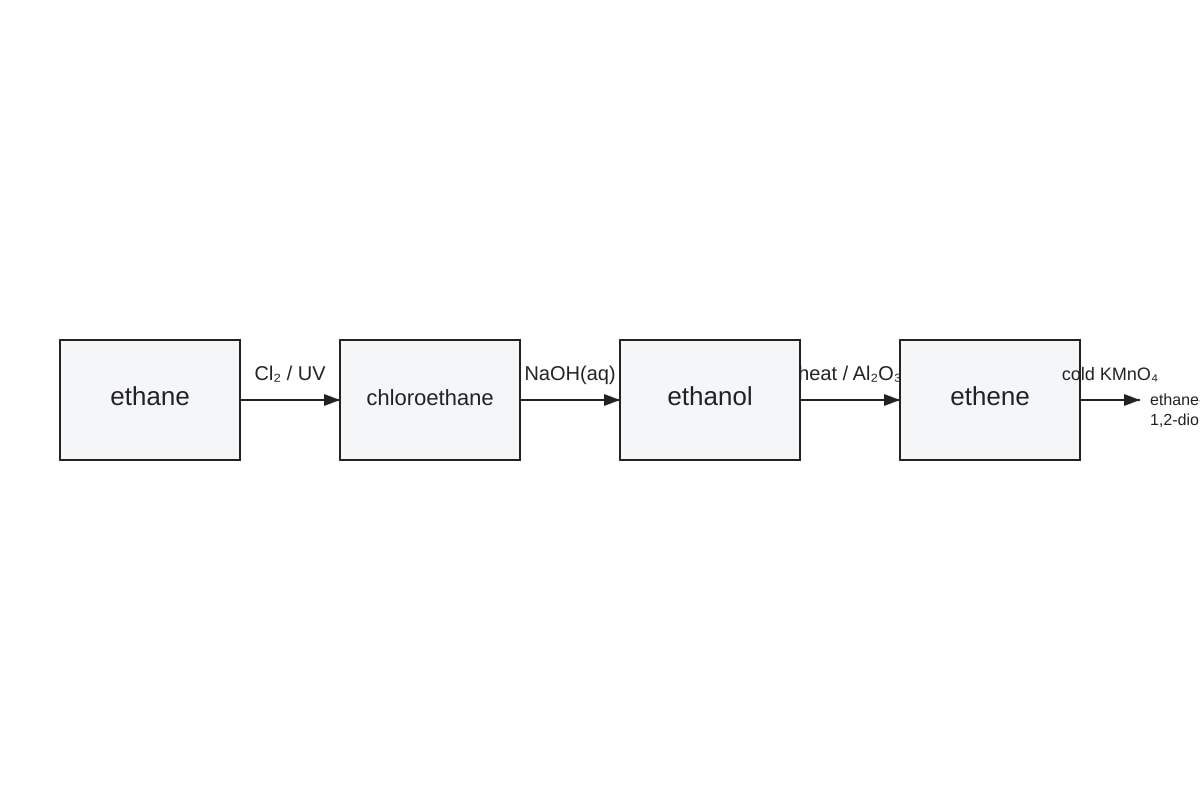
16. The flowchart shows the conversion of an alkane to other organic compounds.
Image pending generation: diagram for Q16.
(a) State the reagent and condition for the conversion of ethane to chloroethane. [1]
(b) State the type of reaction from ethanol to ethene. [1]
(c) Name the product from ethene with cold KMnO4. [1]
17. A student obtained the following data for four organic compounds:
| Compound | Boiling point (°C) | Functional group |
|---|---|---|
| A | 78 | –OH |
| B | 118 | –COOH |
| C | 65 | none (alkane) |
| D | 97 | –COO– |
(a) Identify which compound is an alcohol. [1]
(b) Explain why compound B has a higher boiling point than compound C. [2]
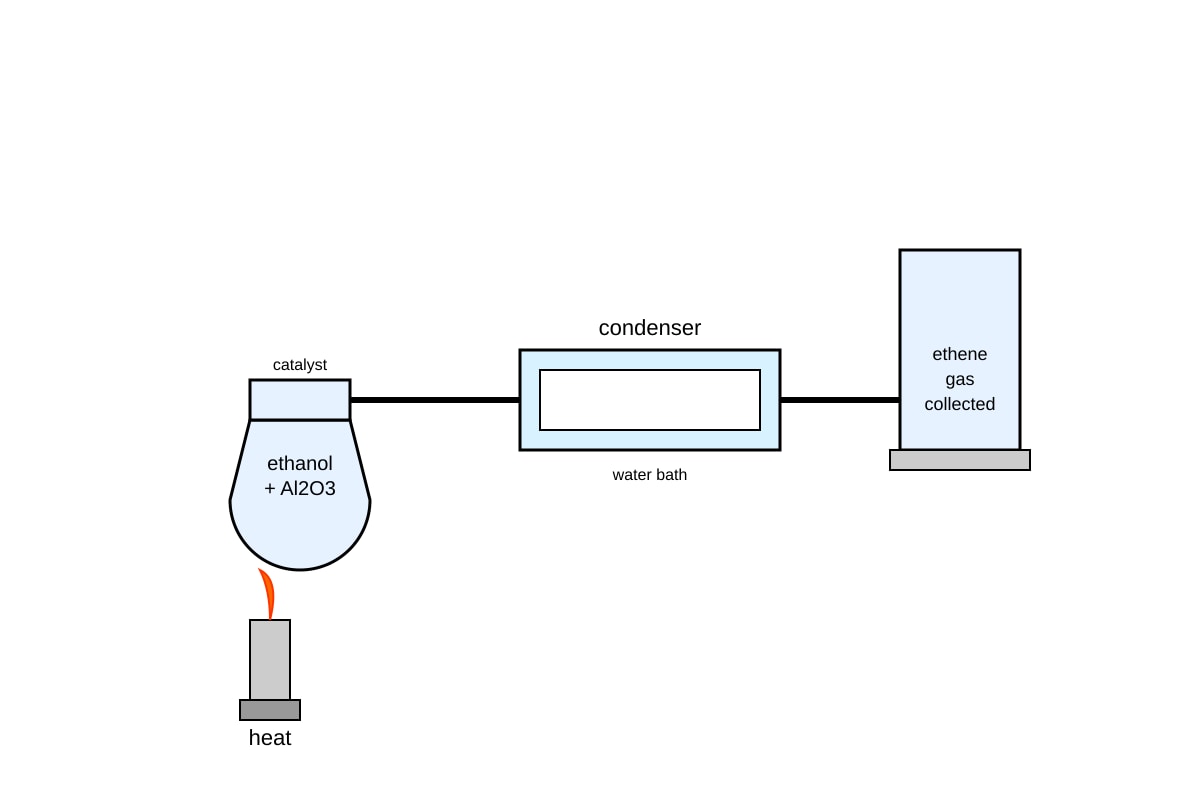
18. The diagram shows apparatus for the dehydration of ethanol.
Image pending generation: experimental_setup for Q18.
(a) Name the product gas collected. [1]
(b) State the role of aluminium oxide. [1]
(c) Write the equation for the dehydration. [1]
19. Vegetable oils can be hydrogenated to form margarine.
(a) State the reagent and condition used. [2]
(b) Explain why this process is called an addition reaction. [1]
20. A sample of hydrocarbon X has molecular formula C4H8.
(a) State the homologous series of X. [1]
(b) Draw one possible structural formula for X. [1]
(c) Describe a test to confirm X is unsaturated. [1]
Answers
O-Level Chemistry Quiz - Organic Chemistry: Answer Key
Total Marks: 40
Topic: Organic Chemistry (O-Level 6092)
Section A: Multiple Choice
1. B [1]
Teaching note: Alkanes are saturated hydrocarbons with single bonds only. General formula is CnH2n+2. Common mistake: choosing CnH2n (alkenes).
2. B [1]
Teaching note: Acidified K2Cr2O7 is orange. Cr6+ reduces to Cr3+ (green) during oxidation of ethanol to ethanoic acid.
3. C [1]
Teaching note: –COOH is carboxylic acid group. Alcohols have –OH, alkenes have C=C, esters have –COO–.
4. B [1]
Teaching note: Esterification uses concentrated H2SO4 as catalyst and dehydrating agent.
5. C [1]
Teaching note: Poly(ethene) from ethene monomer. Poly(propene) from propene, PVC from chloroethene, Nylon is condensation polymer.
Section B: Short Structured
6. (a) CH3−CH=CH2 [1]
(b) Alkene [1]
Note: Propene has 3 carbons, one C=C double bond.
7. CH4+2O2→CO2+2H2O [2]
Marking: 1 for correct products, 1 for balancing.
Teaching: Combustion needs O2, products CO2 + H2O for complete combustion.
8. Any two: low boiling points (small molecules), non-polar, insoluble in water, less dense than water, flammable. [2] (1 each)
Note: Do not accept "reactive" as physical.
9. 1,2-dibromoethane [1]
Teaching: Ethene + Br2 → CH2BrCH2Br (addition across double bond).
10. (a) Series of compounds with same functional group, similar chemical properties, differ by –CH2– unit. [1]
(b) Example: alkanes – methane, ethane. [2] (1 series, 1 for two members)
11. Oxidation; 2CH3CH2OH+O2→2CH3CHO+2H2O [2]
Note: Ethanal is aldehyde; partial oxidation.
12. Methyl ethanoate [1]
Teaching: alcohol (methanol) + acid (ethanoic) → methyl ethanoate.
13. (a) –OH (hydroxyl) [1]
(b) C3H7OH or CH3CH2CH2OH (propanol) [1]
14. Different boiling points / different volatility [1]
15. Butene; CH2=CHCH2CH3 (or CH3CH=CHCH3) [2] (1 name, 1 formula)
Section C: Data and Reaction Scheme
16. (a) Cl2, ultraviolet light [1]
(b) Elimination (dehydration) [1]
(c) Ethane-1,2-diol [1]
17. (a) A [1] (–OH group, bp 78)
(b) B has –COOH which forms hydrogen bonds strongly; C is alkane with only weak van der Waals. Higher intermolecular forces raise bp. [2]
18. (a) Ethene [1]
(b) Catalyst (dehydrating agent) [1]
(c) C2H5OH→C2H4+H2O [1]
19. (a) H2, nickel catalyst, high temp [2]
(b) H2 adds across C=C double bonds without losing atoms. [1]
20. (a) Alkene [1]
(b) CH2=CHCH2CH3 (any butene isomer) [1]
(c) Bromine water decolourises (orange to colourless) [1]
Marking summary: 20 questions, 40 marks. Section A = 5, B = 20, C = 15.
Free quiz and exam paper access
Enter your details to view this paper
Your access is remembered on this device.