From Real Exams Quiz
O Level Chemistry Organic Chemistry Quiz
Free O Level Chemistry Organic Chemistry quiz, DeepSeek Exam version, with questions, answers, and O Level-style practice for Singapore students.
These static practice materials are generated from the site's syllabus and paper-generation workflow, with source and model context shown so students and parents can evaluate the material before use.
Questions
Free quiz and exam paper access
Enter your details to view this paper
Your access is remembered on this device.
Answers
O-Level Chemistry Quiz - Organic Chemistry — Answer Key and Marking Scheme
Total Marks: 40
Section A: Short Answer and Structured Response (20 marks)
1. Methane, CH₄, is the first member of the alkane homologous series.
(a) State the general formula for alkanes. [1]
- Answer: CₙH₂ₙ₊₂
- Marking note: Accept "CₙH₂ₙ₊₂" only. Do not accept "CnH2n+2" without subscripts.
(b) Explain why methane is described as a saturated hydrocarbon. [2]
- Answer: Methane is a hydrocarbon because it contains only carbon and hydrogen atoms [1]. It is saturated because it contains only single covalent bonds between carbon atoms / no carbon-carbon double or triple bonds [1].
- Marking note: Award 1 mark for "contains only C and H" and 1 mark for "only single bonds" or "no C=C bonds". Accept "all carbon atoms are bonded to the maximum number of hydrogen atoms possible."
2. Ethene, C₂H₄, is an unsaturated hydrocarbon.
(a) Draw the full structural formula of ethene, showing all atoms and bonds. [1]
- Answer:
H H \ / C=C / \ H H - Marking note: Must show the C=C double bond and all four H atoms correctly bonded. Accept displayed formula showing all bonds.
(b) Describe a chemical test that can be used to distinguish between ethene and ethane. [3]
- Answer:
- Reagent: Aqueous bromine / bromine water [1]
- Observation with ethene: Aqueous bromine changes from brown/orange to colourless / is decolourised [1]
- Observation with ethane: Aqueous bromine remains brown/orange / no visible change [1]
- Marking note: Accept "bromine in organic solvent" or "bromine dissolved in tetrachloromethane". Do not accept "bromine liquid" alone. The colour change must be stated clearly for both gases.
3. Crude oil is a mixture of hydrocarbons that is separated into useful fractions by fractional distillation.
(a) Name the process used to break down long-chain hydrocarbons from crude oil into shorter, more useful hydrocarbons. [1]
- Answer: Cracking / catalytic cracking
- Marking note: Accept "thermal cracking" or "catalytic cracking."
(b) Write a balanced chemical equation for the complete combustion of octane, C₈H₁₈. [2]
- Answer: 2C₈H₁₈ + 25O₂ → 16CO₂ + 18H₂O
- Marking note: Award 1 mark for correct products (CO₂ and H₂O), 1 mark for correct balancing. Accept the equation with state symbols: 2C₈H₁₈(l) + 25O₂(g) → 16CO₂(g) + 18H₂O(l). Do not penalise missing state symbols.
4. Ethanol, C₂H₅OH, can be produced by two different methods.
(a) Name the process by which ethanol is produced from glucose using yeast. [1]
- Answer: Fermentation
- Marking note: Accept "anaerobic respiration of glucose by yeast."
(b) State the conditions required for this process. [2]
- Answer: Yeast [1] AND warm temperature (accept 25–37°C) [1] AND absence of oxygen / anaerobic conditions [1] (any two of three).
- Marking note: Award 1 mark each for any two correct conditions. "Enzymes in yeast" is acceptable as an alternative to "yeast."
(c) Give one advantage of producing ethanol by this method rather than by the hydration of ethene. [1]
- Answer: Uses renewable resources (glucose from plants/sugar cane) / ethene is obtained from crude oil which is non-renewable / fermentation is a more sustainable process / lower energy requirements.
- Marking note: Accept any valid advantage that references renewability, sustainability, or lower energy input. Do not accept "cheaper" without justification.
5. Ethanoic acid is a member of the carboxylic acid homologous series.
(a) Draw the structural formula of ethanoic acid, showing the functional group clearly. [1]
- Answer:
OR CH₃COOHH O | // H — C — C | \ H O — H - Marking note: Must show the –COOH functional group clearly. Accept displayed or condensed structural formula.
(b) Ethanoic acid reacts with ethanol in the presence of a catalyst to form an ester. Name the ester produced and state one use of esters. [2]
- Answer:
- Ester name: Ethyl ethanoate [1]
- Use: Perfumes / flavourings / food essences / solvents / plasticisers [1]
- Marking note: Accept any valid use of esters. Do not accept "making polyesters" as this refers to a different type of ester.
(c) Write a balanced chemical equation for the reaction between ethanoic acid and ethanol. [2]
- Answer: CH₃COOH + C₂H₅OH ⇌ CH₃COOC₂H₅ + H₂O
- Marking note: Award 1 mark for correct reactants and products, 1 mark for reversible arrow and correct balancing (equation is already balanced). Accept: CH₃COOH(l) + C₂H₅OH(l) ⇌ CH₃COOC₂H₅(l) + H₂O(l). The catalyst (concentrated H₂SO₄) may be written above the arrow but is not required.
Section B: Diagram and Data Interpretation (12 marks)
6. The diagram below shows the apparatus used for cracking a long-chain hydrocarbon.
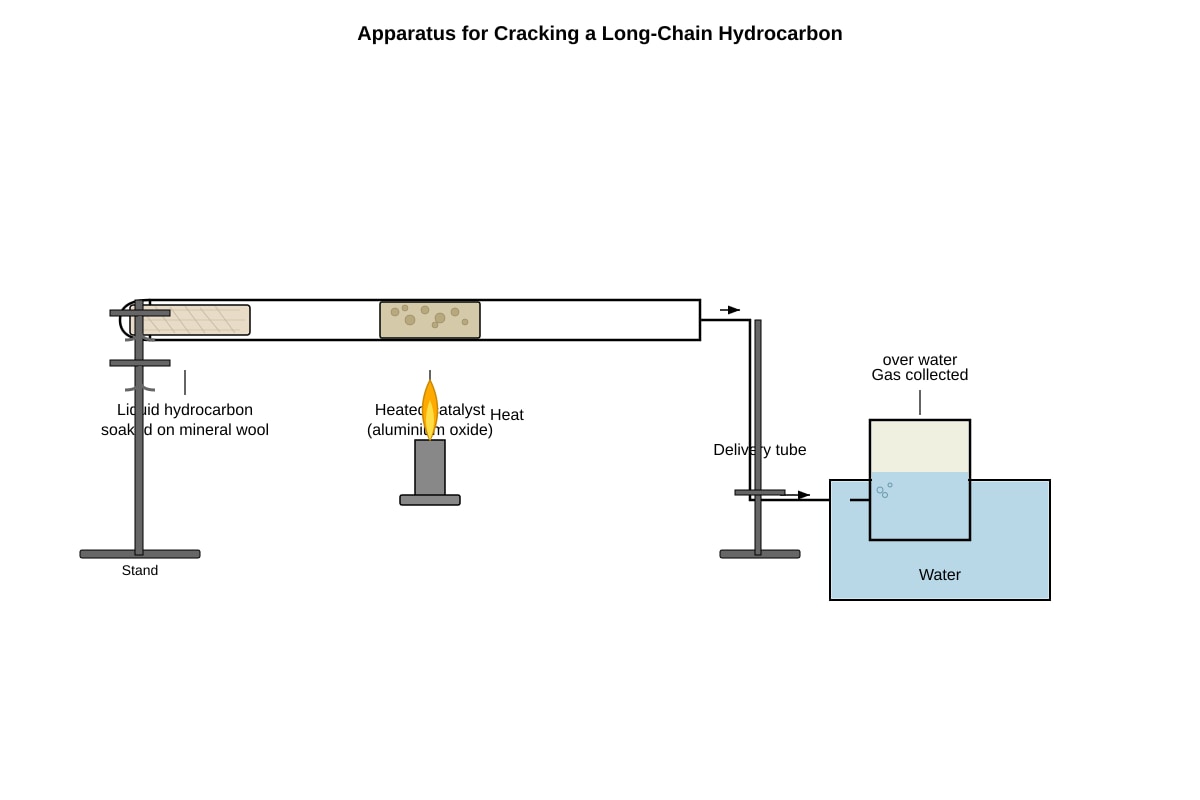
Generated diagram for this question.
(a) State the purpose of the mineral wool in this experiment. [1]
- Answer: To hold/absorb the liquid hydrocarbon / to provide a surface for the hydrocarbon to be heated / to allow even heating of the hydrocarbon.
- Marking note: Accept any answer that indicates the mineral wool acts as a support or absorbent material for the hydrocarbon.
(b) Name the catalyst used in this cracking process. [1]
- Answer: Aluminium oxide / Al₂O₃ / silicon dioxide / SiO₂ / zeolites
- Marking note: Accept any valid cracking catalyst. Aluminium oxide is the most common answer.
(c) The gas collected decolourised aqueous bromine. Explain what this observation indicates about the gas produced. [2]
- Answer: The gas contains an unsaturated hydrocarbon / an alkene [1]. Alkenes contain a C=C double bond which reacts with bromine in an addition reaction, causing the bromine to be decolourised [1].
- Marking note: Award 1 mark for identifying the presence of an alkene/unsaturated compound, and 1 mark for explaining that the C=C bond reacts with bromine. Accept "the gas contains ethene" as an example.
7. The table below shows the boiling points of four fractions obtained from the fractional distillation of crude oil.
(a) Describe the relationship between boiling point and the number of carbon atoms in the hydrocarbon molecules. [1]
- Answer: As the number of carbon atoms increases, the boiling point increases / there is a positive correlation between carbon number and boiling point.
- Marking note: Must state the trend clearly. Accept "larger molecules have higher boiling points."
(b) Explain this relationship in terms of intermolecular forces. [2]
- Answer: Larger molecules / molecules with more carbon atoms have stronger intermolecular forces of attraction / van der Waals' forces between molecules [1]. More energy is required to overcome these stronger forces, resulting in a higher boiling point [1].
- Marking note: Award 1 mark for identifying stronger intermolecular forces in larger molecules, and 1 mark for linking this to the energy required for boiling.
(c) State where in the fractionating column the diesel fraction is collected relative to the petrol fraction. Explain your answer. [2]
- Answer: Diesel is collected lower down the fractionating column / nearer the bottom than petrol [1]. Diesel has a higher boiling point than petrol, so it condenses at a higher temperature lower down the column where it is hotter [1].
- Marking note: Award 1 mark for correct relative position, 1 mark for explanation linking boiling point to condensation location.
8. The structural formulae of four organic compounds are shown below.
(a) Identify which compound, A, B, C, or D, is an alkene. Give a reason for your answer. [1]
- Answer: Compound B [1]. It contains a carbon-carbon double bond (C=C) [1].
- Marking note: Both the letter and reason must be correct for the mark.
(b) Identify which compound is a carboxylic acid. State the name of its functional group. [2]
- Answer:
- Compound: D [1]
- Functional group: Carboxyl group / –COOH [1]
- Marking note: Award 1 mark for correct compound, 1 mark for correct functional group name.
9. Propane (C₃H₈) is a fuel used in camping stoves.
(a) Write a balanced chemical equation for the complete combustion of propane. [2]
- Answer: C₃H₈ + 5O₂ → 3CO₂ + 4H₂O
- Marking note: Award 1 mark for correct products, 1 mark for correct balancing. Accept state symbols.
(b) State one environmental concern associated with the release of carbon dioxide from combustion. [1]
- Answer: Global warming / enhanced greenhouse effect / climate change.
- Marking note: Accept any valid environmental concern linked to CO₂.
10. But-1-ene is an alkene with the molecular formula C₄H₈.
(a) State the general formula for alkenes. [1]
- Answer: CₙH₂ₙ
- Marking note: Accept "CₙH₂ₙ" only.
(b) Draw the full structural formula of but-1-ene. [1]
- Answer:
OR CH₂=CH–CH₂–CH₃H H H H | | | | H-C=C-C-C-H | | H H - Marking note: Must show the C=C double bond at the end of the chain. Accept displayed or condensed structural formula.
Section C: Extended Response and Application (8 marks)
11. Poly(ethene) is a common addition polymer used to make plastic bags and bottles.
(a) Draw the structure of the monomer used to make poly(ethene). [1]
- Answer:
OR CH₂=CH₂H H \ / C=C / \ H H - Marking note: Must show the C=C double bond.
(b) Draw a section of the poly(ethene) polymer chain showing at least three repeating units. [2]
- Answer:
H H H H H H | | | | | | —C—C—C—C—C—C— | | | | | | H H H H H H - Marking note: Award 1 mark for correct repeating unit, 1 mark for showing at least three units with continuation bonds.
(c) Explain why poly(ethene) is non-biodegradable and describe one environmental problem caused by the disposal of poly(ethene) waste. [2]
- Answer: Poly(ethene) is non-biodegradable because it consists of long-chain hydrocarbon molecules with strong C–C and C–H bonds that microorganisms cannot break down / enzymes cannot digest [1]. Environmental problem: Accumulation in landfills / littering / harm to wildlife (e.g., ingestion by animals) / non-biodegradable waste persists in the environment [1].
- Marking note: Award 1 mark for explanation of non-biodegradability, 1 mark for a valid environmental problem.
(d) Suggest one method, other than recycling, by which the environmental impact of poly(ethene) waste can be reduced. [1]
- Answer: Incineration with energy recovery / use of biodegradable plastics / reducing usage of single-use plastics.
- Marking note: Accept any valid method that is not recycling.
12. A student carried out an experiment to compare the combustion of hexane (C₆H₁₄) and hex-1-ene (C₆H₁₂). Both hydrocarbons were burned in limited supply of air.
(a) Predict the difference in the appearance of the flames produced by hexane and hex-1-ene. Explain your prediction. [2]
- Answer: Hex-1-ene burns with a smokier / more yellow flame than hexane [1]. Hex-1-ene has a higher carbon-to-hydrogen ratio than hexane, so incomplete combustion produces more carbon particles (soot) which glow yellow [1].
- Marking note: Award 1 mark for correct prediction, 1 mark for explanation linking carbon-to-hydrogen ratio to soot production.
13. Ethanol can be oxidised to form ethanoic acid.
(a) Name a suitable oxidising agent for this reaction. [1]
- Answer: Acidified potassium dichromate(VI) / acidified potassium manganate(VII) / oxygen with catalyst.
- Marking note: Accept any valid oxidising agent.
(b) State the colour change observed when this oxidising agent is used. [1]
- Answer: Potassium dichromate(VI): orange to green. Potassium manganate(VII): purple to colourless.
- Marking note: Award 1 mark for correct colour change corresponding to the named oxidising agent.
14. Esters are formed by the reaction of a carboxylic acid and an alcohol.
(a) Name the catalyst used in esterification. [1]
- Answer: Concentrated sulfuric acid / concentrated H₂SO₄.
- Marking note: Accept "concentrated sulfuric acid" only.
(b) Write a balanced chemical equation for the formation of methyl ethanoate from ethanoic acid and methanol. [2]
- Answer: CH₃COOH + CH₃OH ⇌ CH₃COOCH₃ + H₂O
- Marking note: Award 1 mark for correct reactants and products, 1 mark for reversible arrow and correct balancing.
15. Cracking is used to produce alkenes from long-chain alkanes.
(a) Write a balanced chemical equation for the cracking of decane (C₁₀H₂₂) to produce ethene and one other hydrocarbon. [2]
- Answer: C₁₀H₂₂ → C₂H₄ + C₈H₁₈ (or any valid balanced equation with ethene and another hydrocarbon).
- Marking note: Award 1 mark for correct reactant, 1 mark for correct products and balancing. Accept any valid cracking equation producing ethene.
(b) Explain why alkenes are more reactive than alkanes. [1]
- Answer: Alkenes contain a C=C double bond which is an area of high electron density / can undergo addition reactions, whereas alkanes have only single bonds.
- Marking note: Award 1 mark for referencing the C=C double bond.
Section D: Data Analysis and Real-World Application (0 marks)
16. The table below shows the percentage composition by mass of a sample of natural gas.
(a) Calculate the mass of methane in 500 g of this natural gas sample. [1]
- Answer: Mass of methane = 85/100 × 500 g = 425 g.
- Marking note: Award 1 mark for correct answer with unit.
(b) Explain why natural gas is considered a cleaner fuel than coal. [2]
- Answer: Natural gas produces less carbon dioxide per unit of energy released / has a higher hydrogen-to-carbon ratio, so less CO₂ is produced [1]. It also produces less sulfur dioxide and particulates compared to coal [1].
- Marking note: Award 1 mark for lower CO₂ emissions, 1 mark for lower SO₂/particulate emissions.
17. The diagram below shows the structure of a triglyceride molecule.
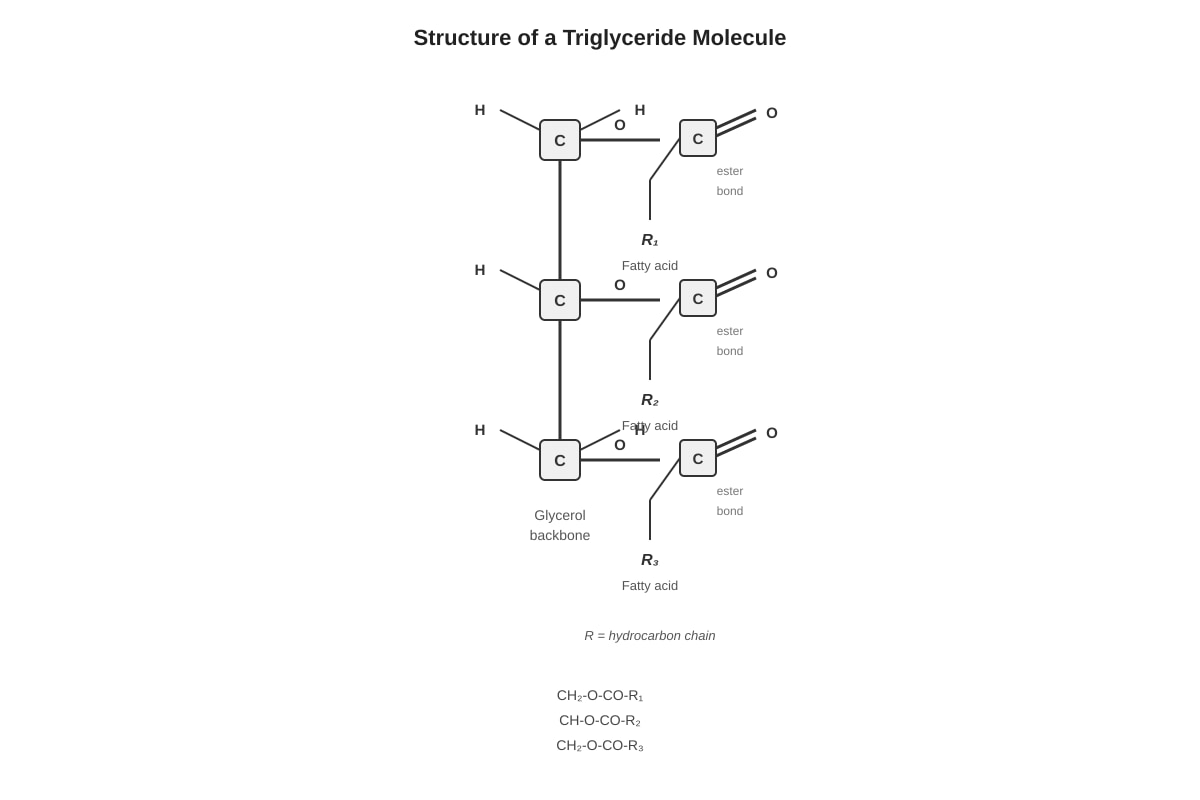
Generated diagram for this question.
(a) Name the type of reaction that breaks down triglycerides into glycerol and fatty acids. [1]
- Answer: Hydrolysis / acid hydrolysis / alkaline hydrolysis (saponification).
- Marking note: Accept any valid term for the breakdown reaction.
(b) State one use of fatty acids obtained from this reaction. [1]
- Answer: Making soaps / detergents / candles / cosmetics.
- Marking note: Accept any valid use of fatty acids.
18. A student adds a few drops of bromine water to a sample of cooking oil. The bromine water is decolourised.
(a) Explain what this observation indicates about the structure of the cooking oil molecules. [2]
- Answer: The cooking oil contains unsaturated molecules / molecules with C=C double bonds [1]. The bromine adds across the double bond in an addition reaction, causing the bromine water to be decolourised [1].
- Marking note: Award 1 mark for identifying unsaturation, 1 mark for explaining the addition reaction.
(b) Name the type of reaction that occurs between bromine and the cooking oil. [1]
- Answer: Addition reaction / electrophilic addition.
- Marking note: Accept "addition reaction".
19. Polypropene is a polymer used to make ropes and carpets.
(a) Draw the structure of the monomer, propene. [1]
- Answer:
OR CH₃–CH=CH₂H H | | H-C-C=C-H | | H H - Marking note: Must show the C=C double bond and the methyl group.
(b) Explain why polypropene is a thermoplastic. [2]
- Answer: Polypropene consists of long polymer chains held together by weak intermolecular forces / van der Waals' forces [1]. When heated, these weak forces are overcome, allowing the polymer to soften and be remoulded; it hardens upon cooling [1].
- Marking note: Award 1 mark for weak intermolecular forces, 1 mark for softening on heating and hardening on cooling.
20. The combustion of fossil fuels releases sulfur dioxide into the atmosphere.
(a) State one environmental problem caused by sulfur dioxide emissions. [1]
- Answer: Acid rain / respiratory problems in humans / damage to buildings and statues.
- Marking note: Accept any valid environmental problem.
(b) Explain how calcium carbonate can be used to reduce sulfur dioxide emissions from coal-fired power stations. [2]
- Answer: Calcium carbonate (limestone) is heated to form calcium oxide (CaO), which reacts with SO₂ to form calcium sulfite (CaSO₃) / calcium sulfate (CaSO₄) [1]. This removes SO₂ from the flue gases, preventing its release into the atmosphere [1].
- Marking note: Award 1 mark for the reaction with SO₂, 1 mark for removal from emissions. Accept equations: CaCO₃ → CaO + CO₂; CaO + SO₂ → CaSO₃.
END OF ANSWER KEY