From Real Exams Quiz
O Level Chemistry Atomic Structure Bonding Quiz
Free O Level Chemistry Atomic Structure Bonding quiz, HY3 Exam version, with questions, answers, and O Level-style practice for Singapore students.
These static practice materials are generated from the site's syllabus and paper-generation workflow, with source and model context shown so students and parents can evaluate the material before use.
Questions
Free quiz and exam paper access
Enter your details to view this paper
Your access is remembered on this device.
Answers
O-Level Chemistry Quiz - Atomic Structure Bonding: Answer Key
Total Marks: 40
Topic: Atomic Structure Bonding
Section A Answers (1 mark each)
1. 12
Teaching note: Neutrons = nucleon number − proton number = 23 − 11 = 12. The nucleon number is the total of protons + neutrons.
2. (or any carbon with proton number 6 and different nucleon number)
Teaching note: Isotopes have the same proton number but different nucleon number. Carbon always has 6 protons.
3. Ionic bonding
Teaching note: Magnesium oxide is formed by transfer of electrons from Mg to O, forming Mg²⁺ and O²⁻ held by electrostatic forces.
4. A pair of electrons (shared electron pair)
Teaching note: A covalent bond is a shared pair of electrons between two non-metal atoms.
5. Delocalised electrons (electrons in the "sea of electrons")
Teaching note: In metallic bonding, valence electrons are free to move throughout the metal lattice, carrying current.
Section B Answers (2 marks each)
6. Protons: 20, Electrons: 20, Neutrons: 20
Working: Proton number = 20 → 20 protons. Neutral atom → 20 electrons. Neutrons = 40 − 20 = 20.
Marking: 1 mark for protons/electrons correct, 1 mark for neutrons.
7.
Teaching note: Potassium (proton no. 19) loses 1 electron to achieve stable noble gas config, forming K⁺.
8. H• + •H → H••H (or H:H with crosses/dots shown)
Teaching note: Each H contributes 1 electron; they share a pair. Award 2 marks for correct shared pair diagram with both atoms showing 2 electrons.
9. Diamond has a giant covalent structure with many strong covalent bonds between carbon atoms in a tetrahedral network. A large amount of energy is needed to break these bonds, so melting point is very high.
Marking: 1 mark for giant covalent / strong covalent bonds, 1 mark for energy needed to break bonds.
10. Atoms of the same element with the same number of protons but different numbers of neutrons (therefore different nucleon numbers).
Marking: 1 mark same proton number, 1 mark different neutron/nucleon number.
Section C Answers (3–4 marks each)
11. 2,8,8 (3 marks)
Teaching note: Cl has 17 protons → 17 e⁻ as atom: 2,8,7. Gains 1 e⁻ to form Cl⁻ → 18 e⁻: 2,8,8.
Marking: 1 mark for 2,8,7 atom reference, 1 mark for gain of electron, 1 mark for 2,8,8.
12. (a) (2 marks)
(b) Dot-and-cross: Mg (2,8,2) loses 2 e⁻ to O (2,6) → Mg²⁺ (2,8) and O²⁻ (2,8,8); show transfer. (2 marks)
Teaching note: Mg transfers 2 electrons to O; ionic compound formed. Award for correct electron origin and final arrangements.
13. (a) X and Y (1 mark)
(b) 8 neutrons (1 mark: 14 − 6)
(c) X and Y both have proton number 6 (same element, carbon) but different nucleon numbers (12 vs 14), meaning different neutron numbers. This matches the definition of isotopes. (2 marks)
Marking: 1 for same proton no., 1 for different nucleon/neutron.
14. Graphite has a giant covalent structure of carbon atoms arranged in layers of hexagonal rings. Each carbon forms 3 covalent bonds, leaving 1 delocalised electron per atom (conducts electricity). Layers are held by weak van der Waals forces, so they slide over each other easily, making graphite a good lubricant. (4 marks)
Marking: 2 for structure (layers, covalent, delocalised e⁻), 2 for sliding/weak forces explanation.
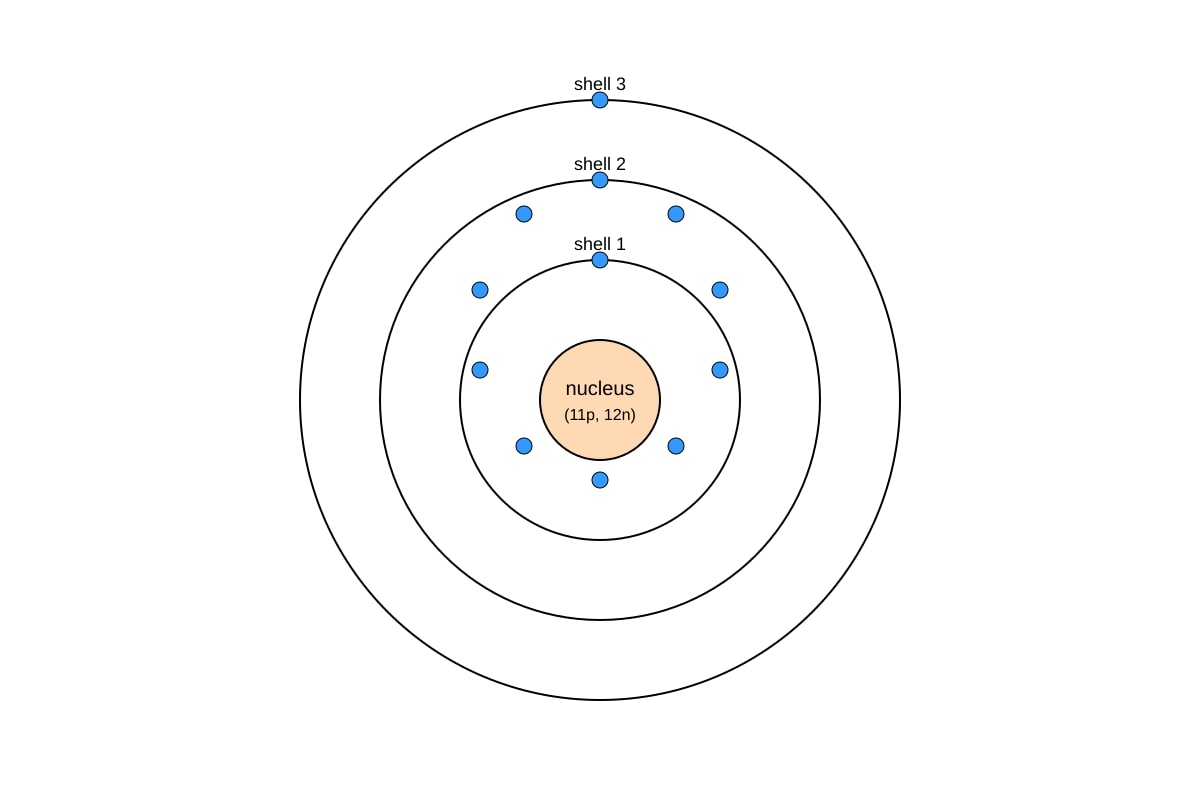
15. Electron arrangement: 2,8,1. Sodium atom loses 1 electron from outer shell to form Na⁺ (2,8), achieving stable octet like neon. (3 marks)
Teaching note: From diagram, shell 3 has 1 e⁻; loss gives 2,8.
Marking: 1 for 2,8,1, 1 for loss of 1 e⁻, 1 for Na⁺ stable config.
16. Ethanol consists of simple molecules with weak intermolecular forces (van der Waals / hydrogen bonds between molecules). Little energy is needed to overcome these forces, so it boils at low temperature. (3 marks)
Marking: 1 simple molecular, 1 weak forces, 1 low energy to separate.
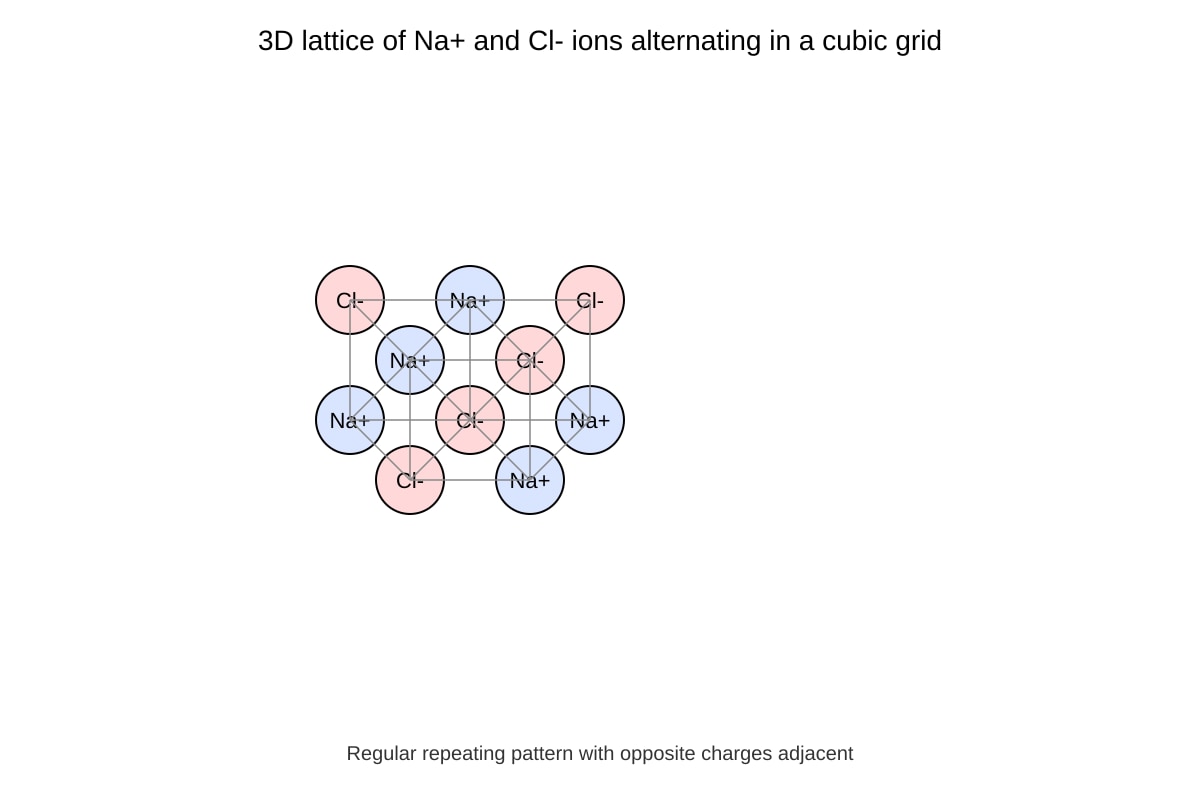
17. (a) Giant ionic lattice (1 mark)
(b) Solid NaCl: ions fixed in lattice, no mobile charge carriers → no conduction. Molten NaCl: ions free to move, carry current → conducts. (3 marks)
Marking: 1 fixed ions, 1 mobile when molten, 1 conduction due to moving ions.
18. (a) : giant covalent; : simple molecular. (2 marks)
(b) has a network of strong covalent bonds throughout requiring lots of energy to break; molecules held by weak intermolecular forces only. (2 marks)
19. (a) A mixture of a metal with another element. (1 mark)
(b) Zinc atoms disrupt the regular layers of copper atoms, making it harder for layers to slide, so brass is harder than pure copper. (3 marks)
Marking: 1 disruption of layers, 2 explanation of hardness.
20. (4 marks)
Working:
Step 1: Convert % to fractions: 20% = 0.20, 80% = 0.80.
Step 2: Multiply each mass by abundance: 10×0.20=2.0; 11×0.80=8.8.
Step 3: Sum = 10.8.
Marking: 1 for %→decimal, 1 per product, 1 for sum.