AI Generated Exam Paper
O Level Chemistry Practice Paper 5
Free O Level Chemistry Practice Paper 5, HY3 AI version, with questions, answers, and O Level-style practice for Singapore students.
These static practice materials are generated from the site's syllabus and paper-generation workflow, with source and model context shown so students and parents can evaluate the material before use.
Questions
TuitionGoWhere Practice Paper - Chemistry O-Level
TuitionGoWhere Practice Paper (AI) — Version 5
Subject: Chemistry
Level: O-Level
Paper: Practice Paper (Topic: Acids, Bases & Salts)
Duration: 1 hour 15 minutes
Total Marks: 60
Name: __________________________
Class: __________________________
Date: __________________________
Instructions:
- This practice paper contains 20 questions across three sections.
- Section A: 8 short structured questions (2 marks each) = 16 marks
- Section B: 8 questions (marks vary 3–4) = 28 marks
- Section C: 4 extended questions (marks vary 3–4) = 16 marks
- Total = 60 marks.
- Use a calculator where needed. Show all working clearly.
- State chemical equations with state symbols where requested.
Section A (16 marks)
Answer all questions. Each question carries 2 marks.
1. State the ion produced by all acids in aqueous solution and the ion produced by all alkalis in aqueous solution. [2]
2. A sample of soil is found to have pH 4.5. Name a substance that could be added to the soil to reduce its acidity. [2]
3. Write the chemical equation, with state symbols, for the reaction between hydrochloric acid and sodium hydroxide solution. [2]
4. Copper is placed in dilute sulfuric acid and left for one hour. No visible change is observed. Explain why copper does not react. [2]
5. Name the salt formed when nitric acid reacts with potassium hydroxide. [2]
6. A student adds a few drops of Universal Indicator to ethanoic acid. State the colour observed. [2]
7. Give one difference between a strong acid and a weak acid in terms of ionisation. [2]
8. State the colour change of litmus paper when placed in an alkaline solution. [2]
Section B (28 marks)
Answer all questions. Marks shown in brackets.
9. A student prepares a pure, dry sample of magnesium sulfate from magnesium oxide and dilute sulfuric acid. Describe the steps involved. [3]
10. Ethanoic acid and hydrochloric acid both have concentration 0.10 mol/dm³. Explain why ethanoic acid has a higher pH than hydrochloric acid. [2]
11. In a titration, 25.0 cm³ of 0.100 mol/dm³ sodium hydroxide neutralises 20.0 cm³ of sulfuric acid. Calculate the concentration of the sulfuric acid and name a suitable indicator. [4]
12. A student is given two white solids: sodium carbonate and sodium chloride. Describe a test to identify which is the carbonate. [3]
13. Write the equation for the reaction between zinc and dilute hydrochloric acid, with state symbols. [2]
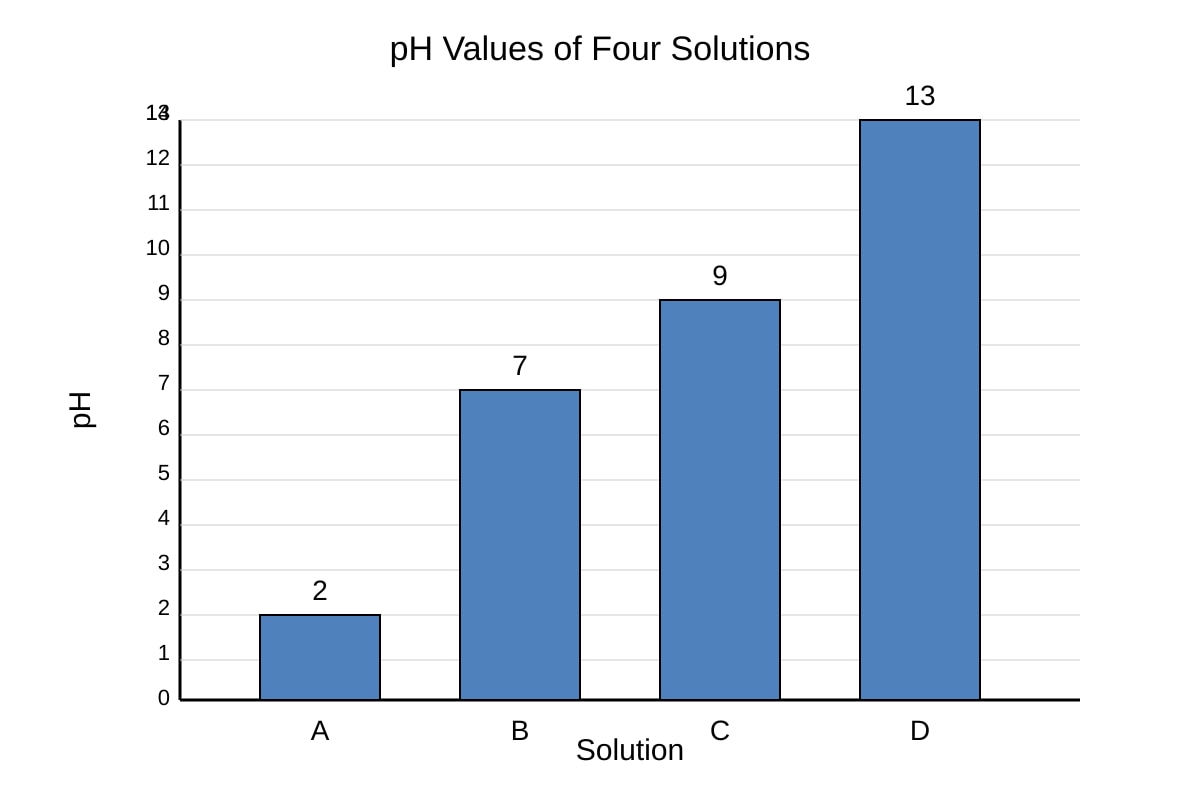
14. The following diagram shows a pH meter reading of four solutions.
Image pending generation: graph for 14.
State which solution is the strongest alkali and which is the strongest acid. [2]
15. A farmer adds calcium hydroxide to his fields. State one reason why this is done. [2]
16. A student adds excess copper(II) oxide to dilute sulfuric acid to prepare copper(II) sulfate. Outline how the pure dry salt is obtained after the reaction mixture is filtered. [3]
Section C (16 marks)
Answer all questions. Marks shown in brackets.
17. A sample of industrial waste water contains sulfuric acid. A student carries out a titration using 0.050 mol/dm³ barium hydroxide to find the concentration of the acid. 20.0 cm³ of waste water requires 16.0 cm³ of barium hydroxide for complete neutralisation.
(a) Write the equation for the reaction. [1]
(b) Calculate the concentration of sulfuric acid in mol/dm³. [3]
18. A student wants to prepare lead(II) chloride, an insoluble salt. Describe how precipitation is used and give the equation. [4]
19. The table shows pH values of solutions made by dissolving equal masses of oxides in water.
| Oxide | pH |
|---|---|
| X | 3 |
| Y | 11 |
State whether X and Y are acidic or basic oxides and explain. [3]
20. A student adds magnesium ribbon to dilute ethanoic acid and observes bubbles. Write the equation and identify the gas. [3]
Answers
TuitionGoWhere Practice Paper - Chemistry O-Level (Answers)
Version 5 — Topic: Acids, Bases & Salts
Section A Answers (16 marks)
1. [2 marks]
- Acids produce H⁺(aq) (hydrogen ions). [1]
- Alkalis produce OH⁻(aq) (hydroxide ions). [1]
Teaching note: By Arrhenius definition, acidity comes from H⁺ in water; alkalinity from OH⁻. Common mistake: writing H₂ or OH without charge.*
2. [2 marks]
- A base such as calcium hydroxide (or calcium oxide, magnesium oxide, slaked lime). [1]
- It neutralises acid, raising pH toward 7. [1]
Teaching note: Soil pH < 7 is acidic; adding base reduces H⁺ concentration.*
3. [2 marks]
HCl(aq) + NaOH(aq) → NaCl(aq) + H₂O(l) [2 for correct eq + states]
Marking: 1 for formula, 1 for state symbols. Common error: missing (l) for water.
4. [2 marks]
- Copper is below hydrogen in the reactivity series. [1]
- It cannot displace H⁺ from acid, so no reaction. [1]
Teaching note: Unreactive metals do not liberate H₂ from dilute acids.
5. [2 marks]
- Potassium nitrate, KNO₃. [2]
From HNO₃ + KOH → KNO₃ + H₂O.
6. [2 marks]
- Orange / red (Universal Indicator in acid ~pH 3–4 gives orange-red). [2]
Ethanoic acid is weak acid pH ~3.
7. [2 marks]
- Strong acid ionises completely; weak acid partially ionises. [2]
e.g., HCl → H⁺ + Cl⁻ (full); CH₃COOH ⇌ H⁺ + CH₃COO⁻ (partial).
8. [2 marks]
- Litmus turns blue in alkali. [2]
Section B Answers (28 marks)
9. [3 marks]
- Add excess MgO to warm dilute H₂SO₄ until no more dissolves. [1]
- Filter off excess MgO. [1]
- Evaporate filtrate and crystallise, filter, wash, dry. [1]
Method: soluble salt from insoluble base + acid.
10. [2 marks]
- Ethanoic acid is weak, partially ionised → fewer H⁺. [1]
- HCl strong, fully ionised → more H⁺ → lower pH. [1]
11. [4 marks]
Equation: 2NaOH + H₂SO₄ → Na₂SO₄ + 2H₂O [1]
Moles NaOH = 0.100 × 25.0/1000 = 0.00250 mol [1]
Moles H₂SO₄ = 0.00250 / 2 = 0.00125 mol [1]
Conc H₂SO₄ = 0.00125 / (20.0/1000) = 0.0625 mol/dm³ [1]
Indicator: methyl orange or phenolphthalein (strong–strong).
Common mistake: forgetting 2:1 ratio.
12. [3 marks]
- Add dilute acid (e.g., HCl) to each. [1]
- Carbonate fizzes (CO₂ gas). [1]
- Chloride shows no fizzing. [1]
13. [2 marks]
Zn(s) + 2HCl(aq) → ZnCl₂(aq) + H₂(g) [2]
14. [2 marks]
- Strongest alkali: D (pH 13). [1]
- Strongest acid: A (pH 2). [1]
From placeholder bar heights.
15. [2 marks]
- To neutralise acidic soil / provide Ca²⁺ nutrient. [2]
16. [3 marks]
- Heat filtrate to evaporate water until crystals appear. [1]
- Cool to crystallise. [1]
- Filter, wash, dry crystals. [1]
Section C Answers (16 marks)
17. [4 marks]
(a) H₂SO₄ + Ba(OH)₂ → BaSO₄ + 2H₂O [1]
(b) Moles Ba(OH)₂ = 0.050 × 16.0/1000 = 8.0×10⁻⁴ mol [1]
Moles H₂SO₄ = 8.0×10⁻⁴ mol (1:1) [1]
Conc = 8.0×10⁻⁴ / (20.0/1000) = 0.040 mol/dm³ [1]
18. [4 marks]
- Mix Pb(NO₃)₂(aq) + 2HCl(aq) → PbCl₂(s) + 2HNO₃(aq). [2]
- Filter precipitate, wash with water, dry. [2]
19. [3 marks]
- X acidic oxide (pH 3). [1]
- Y basic oxide (pH 11). [1]
- Oxides dissolving to pH<7 are acidic; >7 basic. [1]
20. [3 marks]
Mg + 2CH₃COOH → Mg(CH₃COO)₂ + H₂ [2]
Gas: hydrogen, H₂. [1]
Free quiz and exam paper access
Enter your details to view this paper
Your access is remembered on this device.