AI Generated Exam Paper
O Level Chemistry Practice Paper 4
Free O Level Chemistry Practice Paper 4, HY3 AI version, with questions, answers, and O Level-style practice for Singapore students.
These static practice materials are generated from the site's syllabus and paper-generation workflow, with source and model context shown so students and parents can evaluate the material before use.
Questions
Free quiz and exam paper access
Enter your details to view this paper
Your access is remembered on this device.
Answers
TuitionGoWhere Practice Paper - Chemistry O-Level (Answers)
Version 4 of 5 — Answer Key
Section A Answers
1. [1] B
Teaching note: Neutralisation is acid + base → salt + water. Option B is . A is metal + water; C is thermal decomposition; D is displacement.
2. [1] (hydrogen ion)
Teaching note: Acids produce hydrogen ions in aqueous solution by definition.
3. [2] Copper is below hydrogen in the reactivity series / less reactive than hydrogen, so it cannot displace from dilute acid; therefore no reaction occurs.
Marking: 1 mark for position in series, 1 mark for no displacement / no reaction.
4. [2]
Marking: 1 for correct formulae and balancing, 1 for state symbols. Common trap: writing instead of .
5. [1] An acid that only partially ionises / dissociates in water.
Teaching note: Weak ≠ dilute. It refers to degree of ionisation.
6. [1] Acidic
Teaching note: pH < 7 is acidic.
7. [1] Potassium nitrate ()
Teaching note: Acid (nitric) + alkali (potassium hydroxide) → salt (potassium nitrate) + water.
8. [1] With sodium carbonate: effervescence / gas produced; with sodium chloride: no visible reaction.
Marking: any correct observable difference.
Section B Answers
9. [3]
- Add excess zinc oxide to dilute sulfuric acid, warm gently until no more dissolves. (1)
- Filter to remove excess solid. (1)
- Evaporate filtrate and crystallise; filter, wash, dry crystals. (1)
Teaching note: Soluble salt from insoluble base uses excess base method.
10. [2] Ethanoic acid is weak so partially ionises, fewer ; HCl is strong, fully ionises, more . Lower → higher pH. (1+1)
11. [3]
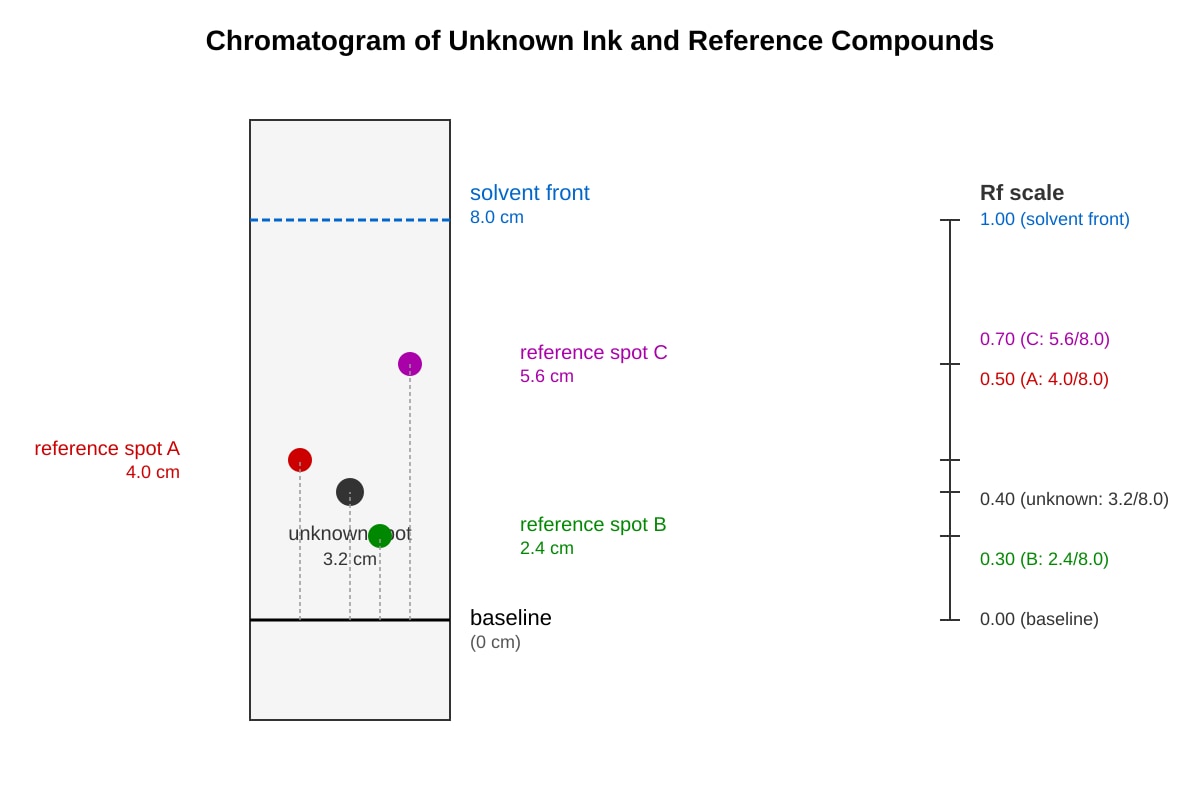
Rf = distance spot / distance solvent front = 3.2 / 8.0 = 0.40. (1)
Rf of B = 2.4 / 8.0 = 0.30. (1)
Rf values differ, so unknown cannot be B. (1)
Teaching note: One spot means single component but identity needs Rf match.
12. [3] Add dilute HCl to each: magnesium carbonate fizzes (CO₂), aluminium oxide does not. (2) Alternatively, thermal test. (1 for test, 2 for correct observations/distinction)
13. [4]
(1)
Moles NaOH = 0.100 × 25.0/1000 = 0.00250 mol (1)
Moles = 0.00250 / 2 = 0.00125 mol (1)
Conc = 0.00125 / (20.0/1000) = 0.0625 mol/dm³; indicator: methyl orange or phenolphthalein (1)
14. [2] Lemon juice: litmus red; soap: litmus blue. (1+1)
Section C Answers
15. [3] Add calcium hydroxide / slaked lime. (1) It is a base that neutralises acid: . (2) Raises pH to near neutral.
16. [2]
Teaching note: Spectator ions omitted.
17. [3] Mix lead(II) nitrate and sodium chloride solutions. (1) Filter precipitate of lead(II) chloride. (1) Wash with distilled water and dry. (1) Insoluble salt by precipitation.
18. [3] Expected if strong = 2 × 0.05 = 0.10 mol/dm³ → pH ≈ 1.0. Measured 1.2 close to strong. (2) So suggests strong acid. (1) Teaching: sulfuric acid is strong diprotic.
19. [4]
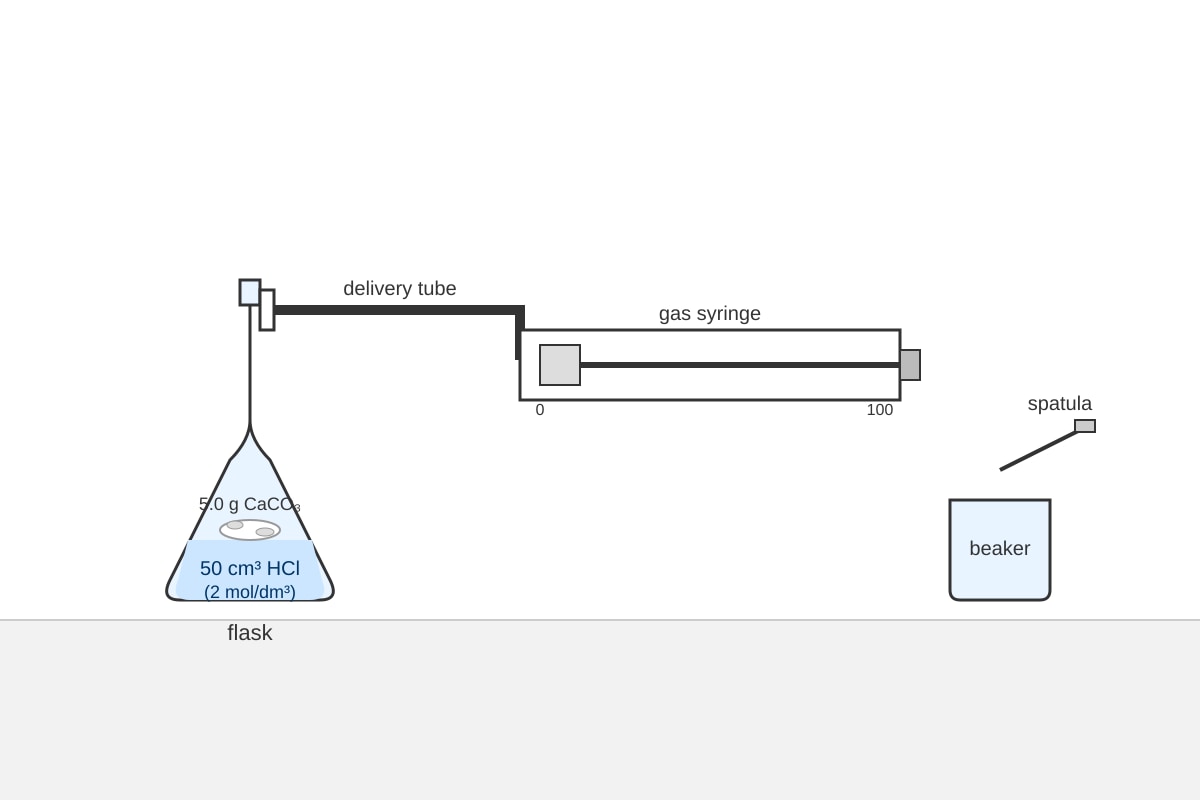
Moles HCl = 2 × 50/1000 = 0.100 mol (1)
Moles CaCO₃ = 5.0 / 100 = 0.0500 mol (1)
Limiting: CaCO₃ (1:2 ratio needs 0.100 mol HCl, exact) → 0.0500 mol CO₂ (1)
Volume = 0.0500 × 24 = 1.20 dm³ (1)
20. [5] HCl conducts better / higher conductivity. (1) Strong acid fully ionises → more ions. (2) Ethanoic weak → fewer ions. (2) Marking descriptors: statement 1, reasoning strong 2, reasoning weak 2.