AI Generated Exam Paper
O Level Chemistry Practice Paper 3
Free O Level Chemistry Practice Paper 3, HY3 AI version, with questions, answers, and O Level-style practice for Singapore students.
These static practice materials are generated from the site's syllabus and paper-generation workflow, with source and model context shown so students and parents can evaluate the material before use.
Questions
Free quiz and exam paper access
Enter your details to view this paper
Your access is remembered on this device.
Answers
TuitionGoWhere Practice Paper - Chemistry O-Level (Answers)
Version 3 of 5 — Answer Key
Section A
1. [2 marks] A weak acid is one that only partially ionises (dissociates) in aqueous solution, producing few H⁺ ions.
Teaching note: Contrast with strong acid (complete ionisation). Mark: 1 for "partial ionisation", 1 for "few H⁺ / aqueous".
2. [2 marks] H⁺(aq) + OH⁻(aq) → H₂O(l)
Teaching note: Ionic equation removes spectator ions Na⁺ and Cl⁻. Mark: 1 formula, 1 state symbol.
3. [2 marks] Potassium nitrate (KNO₃)
Teaching note: Acid (nitric) + alkali (KOH) → salt (nitrate of metal). Mark: 2 for correct name.
4. [2 marks] Effervescence / bubbles of gas (hydrogen) seen; metal dissolves.
Teaching note: Mg + H₂SO₄ → MgSO₄ + H₂. Mark: 1 observation, 1 gas id.
5. [2 marks] Copper is below hydrogen in reactivity series; cannot displace H⁺ from acid.
Teaching note: No redox possible. Mark: 1 position, 1 explanation.
6. [2 marks] Acidic.
Teaching note: pH < 7 acidic. Mark: 2.
7. [2 marks] CaCl₂ (calcium chloride)
Teaching note: CaCO₃ + 2HCl → CaCl₂ + CO₂ + H₂O. Mark: 2.
8. [2 marks] Methyl orange (or phenolphthalein).
Teaching note: Strong acid–strong base. Mark: 2.
9. [2 marks] Blue.
Teaching note: Litmus red in acid, blue in alkali. Mark: 2.
10. [2 marks] Acid + base → salt + water.
Teaching note: Neutralisation definition. Mark: 2.
Section B
11. [4 marks]
- Add excess ZnO to dilute H₂SO₄ until no more dissolves. [1]
- Filter off excess ZnO. [1]
- Evaporate filtrate to crystallisation point; cool. [1]
- Filter crystals, wash, dry. [1]
Teaching note: Excess ensures acid fully neutralised; crystallisation gives pure salt.
12. [3 marks] Ethanoic acid is weak, partially ionised → fewer H⁺. [1] HCl strong, fully ionised → more H⁺. [1] Lower [H⁺] means higher pH. [1]
13. [4 marks] Add dilute HCl to each: MgCO₃ fizzes (CO₂), Al₂O₃ no fizz. [2] Or flame test: Mg gives no colour, Al₂O₃ no distinct. [2]
Teaching note: Carbonate + acid → CO₂ is key test.
14. [3 marks] Fe(s) + 2HCl(aq) → FeCl₂(aq) + H₂(g) [3]
Teaching note: Fe is divalent here; state symbols required.
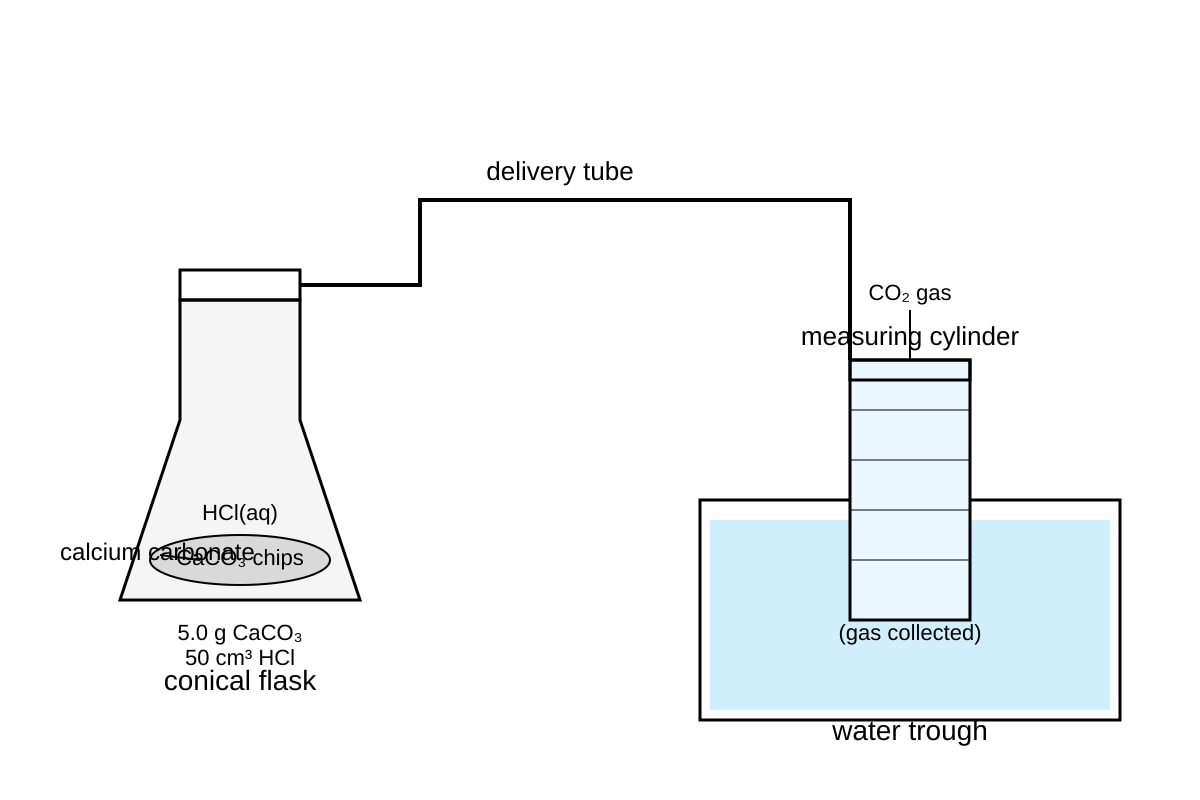
15. [4 marks] Gas: carbon dioxide CO₂. [2] Test: bubble into limewater; turns milky/cloudy. [2]
Image note: Setup must show gas delivery to collected gas; CO₂ from CaCO₃ + 2HCl.
16. [6 marks] A red [1.5], B green [1.5], C green-blue [1.5], D purple [1.5] (universal indicator colours).
Section C
17. [5 marks]
2NaOH + H₂SO₄ → Na₂SO₄ + 2H₂O [1]
n(NaOH)=0.100×25/1000=0.00250 mol [1]
n(H₂SO₄)=0.00250/2=0.00125 mol [1]
c=0.00125/(20/1000)=0.0625 mol/dm³ [1]
Indicator: methyl orange [1]
18. [3 marks] HCl strong fully ionised → high [H⁺] → pH 2. [1.5] CH₃COOH weak partially ionised → low [H⁺] → pH 4. [1.5]
19. [4 marks] Ba(OH)₂ + 2HCl → BaCl₂ + 2H₂O [2]
n Ba(OH)₂=0.05×0.03=0.0015; n HCl=0.10×0.03=0.0030; ratio 1:2 ✓ [2]
20. [4 marks]
Na₂CO₃ + 2HCl → 2NaCl + CO₂ + H₂O
n Na₂CO₃ = n CO₂ = 0.020 mol [1]
M(Na₂CO₃)=106 g/mol; mass=0.020×106=2.12 g [1]
Purity = 2.12/2.65×100 = 80.0% [2]
End of Answer Key