AI Generated Exam Paper
O Level Chemistry Practice Paper 2
Free O Level Chemistry Practice Paper 2, HY3 AI version, with questions, answers, and O Level-style practice for Singapore students.
These static practice materials are generated from the site's syllabus and paper-generation workflow, with source and model context shown so students and parents can evaluate the material before use.
Questions
TuitionGoWhere Practice Paper - Chemistry O-Level
TuitionGoWhere Practice Paper (AI) — Version 2 of 5
Subject: Chemistry
Level: O-Level
Paper: Practice Paper (Topic: Acids, Bases & Salts)
Duration: 1 hour 15 minutes
Total Marks: 60
Name: ___________________________
Class: ___________________________
Date: ___________________________
Instructions:
- Answer all questions in the spaces provided.
- Use a calculator where necessary.
- Show all working clearly for calculation questions.
- Use chemical symbols, formulae, and state symbols where appropriate.
- This practice paper is syllabus-first generated content and is not derived from official past-year papers.
Section A: Multiple Choice and Short Structured (20 marks)
1. Which of the following equations represents a neutralisation reaction? [1]
A. 2Na+2H2O→2NaOH+H2
B. HCl+NaOH→NaCl+H2O
C. CaCO3→CaO+CO2
D. Zn+CuSO4→ZnSO4+Cu
2. State the ion produced by an acid in aqueous solution. [1]
3. Copper is left unreacted after treatment with dilute sulfuric acid. Explain why. [2]
4. Write the balanced equation, with state symbols, for the reaction between ethanoic acid and zinc. [2]
5. Define a weak acid. [1]
6. A solution has pH = 3. State whether it is acidic, alkaline, or neutral. [1]
7. Name the salt formed when nitric acid reacts with potassium hydroxide. [1]
8. Which indicator would be suitable for a strong acid–strong alkali titration: methyl orange or litmus? [1]
9. Give one observation when a carbonate reacts with an acid. [1]
10. State the colour of Universal Indicator in a solution of pH 9. [1]
Section B: Structured Response and Data (22 marks)
11. A student prepares a pure, dry sample of zinc sulfate from zinc oxide and dilute sulfuric acid. Describe the method. [3]
12. Ethanoic acid and hydrochloric acid both have concentration 0.1 mol/dm³. Explain why ethanoic acid has a higher pH. [2]
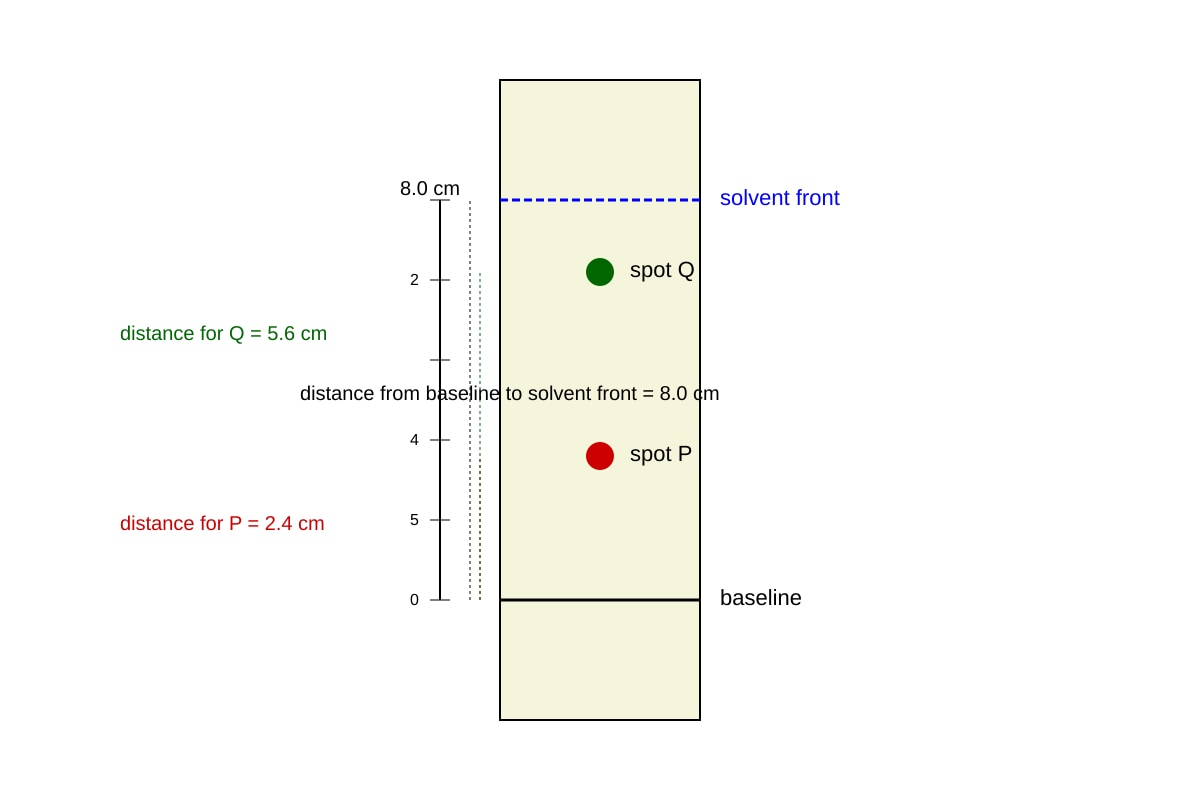
13. A mixture of two inks was separated by paper chromatography using water as solvent. The chromatogram is shown below.
Image pending generation: diagram for 13.
Calculate the Rf value of spot Q. [2]
14. A student has two white solids: aluminium oxide and magnesium carbonate. Describe a test to identify each. [3]
15. 25.0 cm³ of 0.100 mol/dm³ sodium hydroxide neutralises 20.0 cm³ of sulfuric acid. Calculate the concentration of the acid. [4]
16. State the pH change when an alkali is added slowly to an acid, and explain. [2]
17. Name the gas produced when hydrochloric acid reacts with magnesium. [1]
18. Write the ionic equation for the reaction of hydrochloric acid with sodium hydroxide. [2]
Section C: Applied and Extended (18 marks)
19. A farmer finds his soil is too acidic for planting. Suggest a substance he could add to neutralise the soil and explain the chemistry. [3]
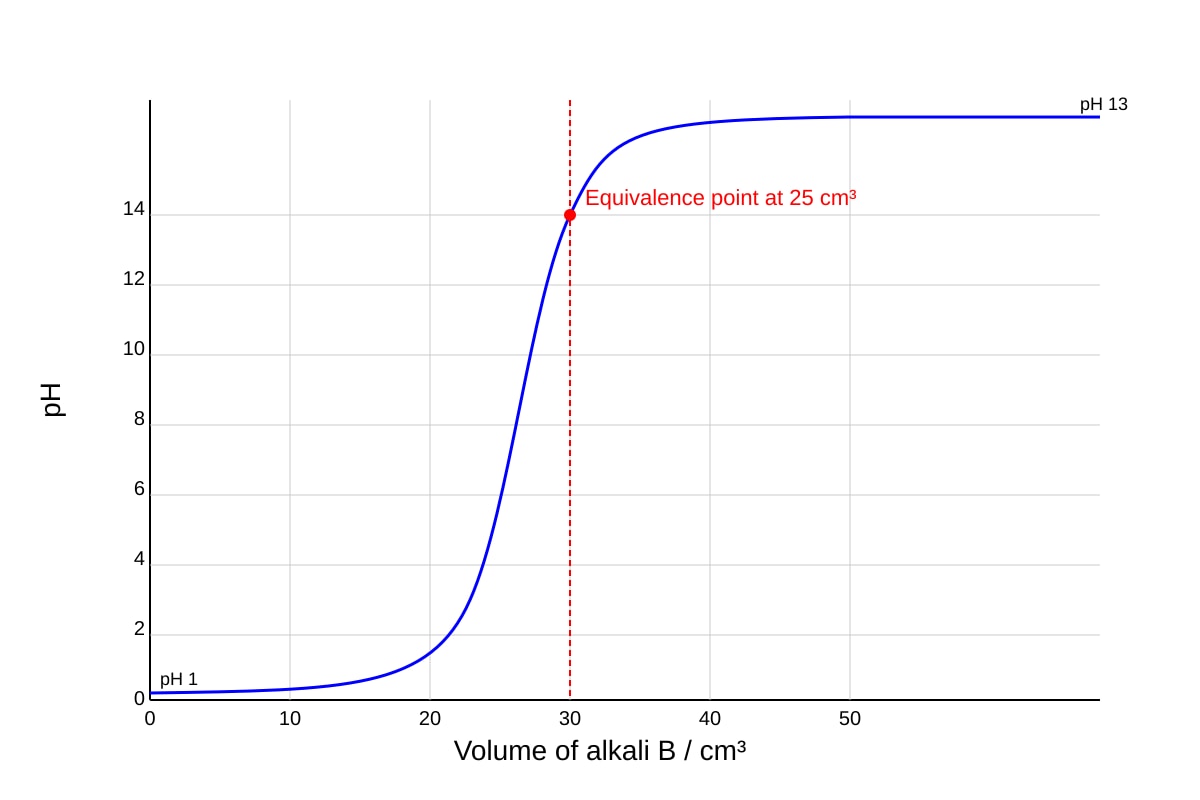
20. The graph shows pH change during titration of acid A with alkali B.
Image pending generation: graph for 20.
(a) State the volume at which neutralisation is complete. [1]
(b) Deduce one property of acid A and alkali B from the graph. [2]
(c) Suggest a suitable indicator for this titration. [1]
Total Marks: 60
Answers
Answer Key — TuitionGoWhere Practice Paper Chemistry O-Level (Version 2)
Total Marks: 60
Section A
1. B [1]
Teaching note: Neutralisation is acid + base → salt + water. Option B is HCl+NaOH→NaCl+H2O. Others are redox or decomposition.
2. H+ (hydrogen ion) [1]
Teaching note: Acids produce H+ ions in water.
3. [2] Copper is below hydrogen in the reactivity series / less reactive than hydrogen, so it cannot displace H+ from dilute acid.
Marking: 1 mark position in series, 1 mark explanation of no displacement.
4. 2CH3COOH(aq)+Zn(s)→Zn(CH3COO)2(aq)+H2(g) [2]
Marking: 1 balance & formula, 1 state symbols. Common trap: missing 2 before ethanoic acid.
5. A weak acid is only partially ionised in aqueous solution. [1]
6. Acidic [1]
7. Potassium nitrate (KNO3) [1]
8. Methyl orange [1] (litmus not precise for titration endpoint)
9. Effervescence / bubbles of gas (CO2) [1]
10. Blue / green-blue [1] (pH 9 is alkaline)
Section B
11. [3]
- Add excess ZnO to dilute H2SO4 until no more dissolves (1)
- Filter to remove excess ZnO (1)
- Evaporate filtrate and crystallise, filter, wash, dry (1)
Teaching: soluble salt from insoluble base uses excess base method.
12. [2] Ethanoic acid partially ionises → fewer H+; HCl fully ionises → more H+. Higher H+ = lower pH, so ethanoic has higher pH. (1 each)
13. Rf = distance travelled by spot / distance by solvent = 5.6 / 8.0 = 0.70 [2]
Working: 5.6 cm ÷ 8.0 cm = 0.70.
14. [3] Add dilute acid to each: MgCO₃ fizzes (CO2), Al₂O₃ no fizz (1+1). Or use thermal decomposition. Mark: test 1, observation each 1.
15. [4]
2NaOH+H2SO4→Na2SO4+2H2O
n(NaOH) = 0.100 × 25.0/1000 = 0.00250 mol
n(H2SO4) = 0.00250 / 2 = 0.00125 mol
c = 0.00125 / (20.0/1000) = 0.0625 mol/dm³
Marking: eq 1, mol 1, div 1, conc 1.
16. pH increases [1]; H+ neutralised by OH− [1].
17. Hydrogen, H2 [1]
18. H++OH−→H2O [2] (state symbols optional)
Section C
19. [3] Add calcium hydroxide / slaked lime (1). It is a base that reacts with acid (1) forming neutral salt + water (1).
20. (a) 25 cm³ [1]
(b) Acid A strong (low start pH), alkali B strong (high final pH) [2]
(c) Methyl orange or phenolphthalein [1]
Free quiz and exam paper access
Enter your details to view this paper
Your access is remembered on this device.