AI Generated Exam Paper
O Level Chemistry Practice Paper 2
Free O Level Chemistry Practice Paper 2, DeepSeek AI version, with questions, answers, and O Level-style practice for Singapore students.
These static practice materials are generated from the site's syllabus and paper-generation workflow, with source and model context shown so students and parents can evaluate the material before use.
Questions
Free quiz and exam paper access
Enter your details to view this paper
Your access is remembered on this device.
Answers
TuitionGoWhere Practice Paper - Chemistry O-Level
Answer Key and Marking Scheme (Version 2)
Subject: Chemistry Level: O-Level Topic Focus: Acids, Bases & Salts Total Marks: 60
Section A: Multiple Choice and Short Answer (20 marks)
Question 1 [1 mark]
Answer: A
Explanation: The ionic equation for neutralisation is H⁺(aq) + OH⁻(aq) → H₂O(l). Option B is the full equation, not the ionic equation. Option C is the complete ionic equation with spectator ions. Option D is incorrect because O²⁻ ions do not exist freely in aqueous solution.
Question 2 [1 mark]
Answer: C
Explanation: Copper is below hydrogen in the reactivity series and cannot displace hydrogen ions from acids. Magnesium, zinc, and iron are all above hydrogen and will react with dilute acids to produce hydrogen gas.
Question 3 [1 mark]
Answer: B
Explanation: Aluminium oxide (Al₂O₃) is amphoteric, meaning it reacts with both acids and bases. Sodium oxide is basic, sulfur dioxide is acidic, and carbon monoxide is neutral.
Question 4 [1 mark]
Answer: C
Explanation: A solution with pH 3 is acidic, meaning it contains more H⁺ ions than OH⁻ ions. pH alone does not indicate whether an acid is strong or weak; that depends on the degree of ionisation.
Question 5 [2 marks]
Answer:
- Definition: A weak acid is an acid that only partially ionises/dissociates in water to produce H⁺ ions. [1 mark]
- Example: Ethanoic acid (CH₃COOH) / carbonic acid (H₂CO₃) / citric acid [1 mark]
Marking notes: Accept any valid weak acid. Do not accept hydrochloric acid, sulfuric acid, or nitric acid (these are strong acids). The definition must include the idea of partial/incomplete ionisation.
Question 6 [2 marks]
(a) The solution is alkaline/basic. [1 mark]
(b) Hydroxide ion / OH⁻ [1 mark]
Marking notes: For (a), accept "alkaline" or "basic". For (b), accept OH⁻ or hydroxide ion.
Question 7 [2 marks]
Answer: Zn(s) + H₂SO₄(aq) → ZnSO₄(aq) + H₂(g)
Marking notes:
- Correct formulae: 1 mark
- Correct state symbols: 1 mark
- Accept Zn(s) + 2H⁺(aq) → Zn²⁺(aq) + H₂(g) as the ionic equation (award full marks if state symbols are correct).
Question 8 [2 marks]
Answer: Calcium hydroxide is a base that neutralises the excess acid in the soil. [1 mark] Word equation: calcium hydroxide + acid (in soil) → calcium salt + water [1 mark]
Marking notes: Accept any reasonable word equation showing neutralisation. The key concept is that calcium hydroxide neutralises acidic soil, raising the pH to a level suitable for crop growth.
Question 9 [4 marks]
(a) Moles of Mg = mass / Ar = 0.60 / 24 = 0.025 mol [1 mark]
(b) From equation: 1 mol Mg produces 1 mol H₂ Moles of H₂ = 0.025 mol [1 mark] Volume of H₂ = moles × 24 = 0.025 × 24 = 0.60 dm³ [1 mark] (Also accept 600 cm³)
(c) Any one of: [1 mark]
- Effervescence/bubbles/fizzing
- Magnesium ribbon dissolves/disappears
- Solution gets warm/temperature increases
- Colourless solution forms
Marking notes: For (b), award 1 mark for correct mole ratio and 1 mark for correct volume calculation. Accept 0.60 dm³ or 600 cm³. For (c), accept any valid observation.
Question 10 [4 marks]
(a) Add dilute hydrochloric acid (or any dilute strong acid) to separate samples of each solid. [1 mark for correct test]
(b)
- Solid X (sodium carbonate): Effervescence/bubbles of gas produced. The gas turns limewater milky. [1 mark]
- Solid Y (sodium chloride): No visible reaction / no effervescence. [1 mark]
Marking notes: Award full marks for any valid distinguishing test. Alternative acceptable tests include:
- Flame test (sodium carbonate and sodium chloride both give yellow flame, so this does NOT distinguish them)
- Testing pH of aqueous solutions (both are approximately neutral to slightly alkaline, so this is unreliable)
The acid test is the most reliable distinguishing test because carbonates react with acids to produce CO₂ while chlorides do not.
Section B: Structured Questions (24 marks)
Question 11 [6 marks]
(a)
- Nitrogen: From the fractional distillation of liquid air / from the atmosphere [1 mark]
- Hydrogen: From natural gas (methane) / from cracking of hydrocarbons / from electrolysis of water [1 mark]
(b) A lower temperature would increase the yield of ammonia (since the forward reaction is exothermic), but the rate of reaction would be too slow. [1 mark] A temperature of 450°C is a compromise that gives a reasonably fast rate of reaction while still producing an acceptable yield of ammonia. [1 mark]
(c) 2NH₃(g) + H₂SO₄(aq) → (NH₄)₂SO₄(aq) [2 marks]
Marking notes: For (b), both rate and yield must be discussed. For (c), award 1 mark for correct formulae and 1 mark for correct balancing. State symbols are not essential for full marks in this part but are good practice.
Question 12 [6 marks]
(a) CuO(s) + H₂SO₄(aq) → CuSO₄(aq) + H₂O(l) [2 marks]
Marking notes: 1 mark for correct formulae, 1 mark for correct state symbols.
(b) Filtration is necessary to remove the excess/unreacted copper(II) oxide. [1 mark] Copper(II) oxide is insoluble, so it remains as a solid residue on the filter paper while the copper(II) sulfate solution passes through as the filtrate. [1 mark]
(c) If the solution is heated to complete dryness, the water of crystallisation will be driven off. [1 mark] This would produce anhydrous copper(II) sulfate (white powder) instead of the desired hydrated copper(II) sulfate crystals (blue crystals, CuSO₄·5H₂O). [1 mark]
Marking notes: The key point is that hydrated crystals contain water of crystallisation which is lost on strong heating. Accept any answer that mentions loss of water of crystallisation or formation of anhydrous salt instead of crystals.
Question 13 [6 marks]
(a) Titrations 2 and 3 should be used. [1 mark] These two results are concordant (within 0.10 cm³ of each other). Titration 1 (24.50 cm³) is not concordant with the other two and is likely a rough titration or contains an error. [1 mark]
(b) Average volume = (23.60 + 23.60) / 2 = 23.60 cm³ [1 mark]
(c) Moles of HCl = (23.60 / 1000) × 0.100 = 0.00236 mol [1 mark] From equation, 1 mol HCl reacts with 1 mol NaOH Moles of NaOH = 0.00236 mol [1 mark] Concentration of NaOH = 0.00236 / (25.0 / 1000) = 0.0944 mol/dm³ [1 mark]
Marking notes: Award marks for correct method even if the final answer has a minor arithmetic error. The answer should be given to 3 significant figures (0.0944 mol/dm³). Accept 0.0944 or 0.094 mol/dm³.
Question 14 [6 marks]
(a) Hydrochloric acid is a strong acid that completely ionises/dissociates in water, so all HCl molecules produce H⁺ ions. [1 mark] Ethanoic acid is a weak acid that only partially ionises/dissociates in water, so only a small fraction of CH₃COOH molecules produce H⁺ ions. [1 mark] Therefore, at the same concentration, hydrochloric acid has a higher concentration of H⁺ ions than ethanoic acid, resulting in a lower pH. [1 mark]
(b)(i) pH of solution Q is approximately 7 (neutral). [1 mark]
(b)(ii) Solution R (violet) contains the highest concentration of hydroxide ions. [1 mark] Violet indicates a high pH (approximately 14), which means the solution is strongly alkaline and contains a high concentration of OH⁻ ions. [1 mark]
Marking notes: For (a), the key distinction is complete vs. partial ionisation. Do not accept answers that confuse "weak" with "dilute". For (b)(ii), the explanation must link the colour to pH and then to OH⁻ concentration.
Section C: Data-Based and Extended Response (16 marks)
Question 15 [8 marks]
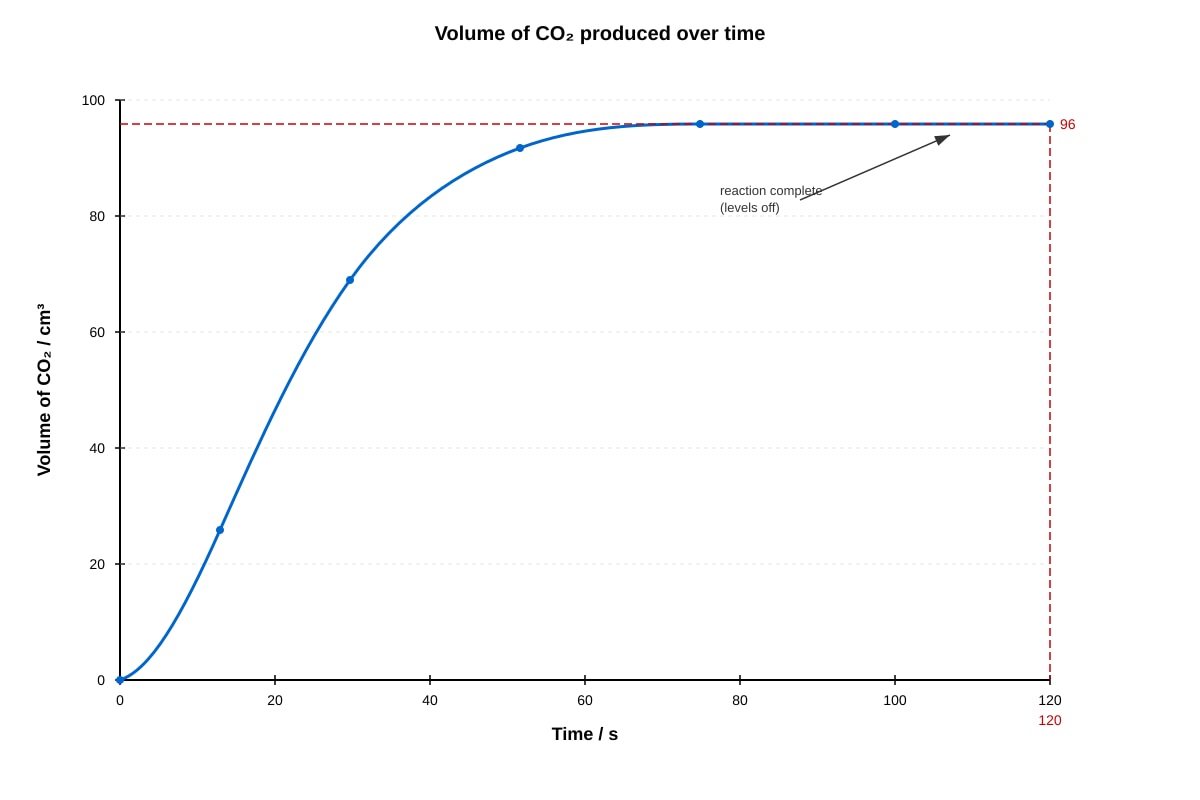
(a) 96 cm³ [1 mark]
(b) As the reaction proceeds, the concentration of hydrochloric acid decreases because HCl is being used up. [1 mark] According to collision theory, with fewer HCl particles per unit volume, the frequency of effective collisions between HCl particles and calcium carbonate particles decreases, so the rate of reaction decreases. [1 mark]
(c) [Sketch should show:]
- A steeper initial gradient than the original curve [1 mark]
- The curve levelling off at the same final volume (96 cm³) [1 mark]
Marking notes: The curve must start at the origin, rise more steeply, and plateau at the same volume. The same mass of CaCO₃ is used, so the same total volume of CO₂ is produced; only the rate changes.
(d) Mr of CaCO₃ = 40 + 12 + (3 × 16) = 100 [1 mark] Moles of CaCO₃ = 0.50 / 100 = 0.0050 mol [1 mark] From equation: 1 mol CaCO₃ produces 1 mol CO₂ Moles of CO₂ = 0.0050 mol Volume of CO₂ = 0.0050 × 24 = 0.12 dm³ = 120 cm³ [1 mark]
Marking notes: Award 1 mark for Mr, 1 mark for moles calculation, and 1 mark for final volume. Accept 0.12 dm³ or 120 cm³. The theoretical volume (120 cm³) is greater than the experimental volume (96 cm³), which could be discussed but is not required for the marks.
Question 16 [8 marks]
(a) A dibasic acid is an acid that produces two H⁺ ions per molecule of acid when it ionises/dissociates in water. [1 mark]
(b) H₂SO₄(aq) + 2NaOH(aq) → Na₂SO₄(aq) + 2H₂O(l) [2 marks]
Marking notes: 1 mark for correct formulae, 1 mark for correct balancing and state symbols.
(c) Starting materials: Barium chloride solution (BaCl₂) / barium nitrate solution (Ba(NO₃)₂) and sodium sulfate solution (Na₂SO₄) / any soluble sulfate. [1 mark for naming two suitable soluble salts]
Method:
- Mix aqueous solutions of barium chloride (or barium nitrate) and sodium sulfate (or any soluble sulfate) in a beaker. A white precipitate of barium sulfate forms immediately. [1 mark]
- Stir the mixture to ensure complete reaction. [1 mark]
- Filter the mixture to separate the insoluble barium sulfate precipitate from the solution. [1 mark]
- Wash the residue on the filter paper with distilled water to remove any soluble impurities. [1 mark]
- Dry the residue between sheets of filter paper or in a warm oven to obtain pure, dry barium sulfate. [1 mark]
Marking notes: Award marks for:
- Correct choice of starting materials (must be two soluble salts, one containing Ba²⁺ and one containing SO₄²⁻)
- Precipitation step
- Filtration
- Washing
- Drying
The key principle is that barium sulfate is insoluble and is prepared by precipitation (mixing two aqueous solutions containing the required ions). The ionic equation is Ba²⁺(aq) + SO₄²⁻(aq) → BaSO₄(s).
END OF ANSWER KEY
Total marks: 60 This answer key was generated by TuitionGoWhere AI for Practice Paper Version 2.