AI Generated Exam Paper
O Level Chemistry Practice Paper 1
Free O Level Chemistry Practice Paper 1, DeepSeek AI version, with questions, answers, and O Level-style practice for Singapore students.
These static practice materials are generated from the site's syllabus and paper-generation workflow, with source and model context shown so students and parents can evaluate the material before use.
Questions
Free quiz and exam paper access
Enter your details to view this paper
Your access is remembered on this device.
Answers
TuitionGoWhere Practice Paper - Chemistry O-Level
Answer Key and Marking Scheme
Paper: Practice Paper 1 (Version 1 of 5) Total Marks: 80
Section A: Structured Questions (40 marks)
Question 1 (8 marks)
(a) Mg(s) + 2HCl(aq) → MgCl₂(aq) + H₂(g) [2]
Marking:
- Correct formulae and balancing: 1 mark
- Correct state symbols: 1 mark
- Accept: Mg(s) + 2H⁺(aq) → Mg²⁺(aq) + H₂(g) for ionic equation (but full equation requested)
(b) Copper is below hydrogen in the reactivity series / copper is less reactive than hydrogen. [1] Therefore, copper cannot displace hydrogen ions from the acid / copper does not react with acids to produce hydrogen gas. [1]
Marking:
- Reference to position in reactivity series relative to hydrogen: 1 mark
- Explanation linking position to inability to displace H⁺: 1 mark
(c) Test: Insert a burning splint into the gas / bring a lighted splint to the mouth of the test tube. [1] Observation: The gas burns with a 'squeaky pop' sound / the burning splint is extinguished with a popping sound. [1]
Marking:
- Correct test description: 1 mark
- Correct observation: 1 mark
(d) 2CH₃COOH(aq) + Zn(s) → Zn(CH₃COO)₂(aq) + H₂(g) [2]
Marking:
- Correct formula for zinc ethanoate: 1 mark
- Correct balancing and state symbols: 1 mark
- Accept: Zn(CH₃COO)₂ or Zn(C₂H₃O₂)₂
Question 2 (8 marks)
(a) Neutralisation (reaction) [1]
Marking:
- Accept: acid-base reaction
(b) Steps and reasons:
- Add excess copper(II) oxide to warm dilute sulfuric acid and stir. [1] Reason: To ensure all the acid reacts / to ensure complete reaction. [1]
- Filter the mixture to remove unreacted copper(II) oxide. [1] Reason: Copper(II) oxide is insoluble and can be separated by filtration. [1]
- Heat the filtrate to evaporate most of the water / concentrate the solution. [1] Reason: To obtain a saturated solution for crystallisation. [1]
- Allow the solution to cool and crystallise. Filter and dry the crystals between filter papers. [1] Reason: To obtain pure, dry crystals. [1]
Marking:
- Award up to 4 marks for correct steps with appropriate reasons
- Must include: add excess, filter, heat/evaporate, crystallise/dry
- Award marks proportionally for partially complete answers
(c) To ensure all the sulfuric acid reacts completely / to ensure the acid is the limiting reactant / so that no acid remains in the product. [1]
Marking:
- Any valid reason referencing complete reaction of acid: 1 mark
(d) Percentage yield = (actual yield / theoretical yield) × 100% [1] = (4.80 / 6.00) × 100% = 80.0% [1]
Marking:
- Correct formula: 1 mark
- Correct answer with appropriate significant figures: 1 mark
- Accept: 80%
Question 3 (9 marks)
(a) N₂(g) + 3H₂(g) ⇌ 2NH₃(g) [2]
Marking:
- Correct formulae: 1 mark
- Correct balancing and reversible arrow: 1 mark
- State symbols not essential but good practice
(b) A reversible reaction is one in which the products can react to re-form the reactants / a reaction that can proceed in both forward and backward directions. [1]
Marking:
- Clear definition: 1 mark
(c) Temperature: 450°C [1] Pressure: 200–250 atmospheres [1]
Marking:
- Accept: 400–500°C for temperature
- Accept: 150–300 atm for pressure
(d) The forward reaction is exothermic (ΔH is negative). [1] According to Le Chatelier's principle, increasing temperature favours the endothermic (reverse) reaction, decreasing the yield of ammonia. A higher temperature would therefore reduce the equilibrium yield even though the rate increases. [1]
Marking:
- Reference to exothermic nature: 1 mark
- Explanation using Le Chatelier's principle: 1 mark
(e) Name: Ammonium chloride [1] Equation: NH₃(g) + HCl(g) → NH₄Cl(s) [1]
Marking:
- Correct name: 1 mark
- Correct equation with state symbols: 1 mark
Question 4 (8 marks)
(a) Yellow to orange/pink/red (at the end-point) [1]
Marking:
- Accept: yellow to peach/salmon/red
- Must indicate the colour change direction
(b)(i) Titrations 2 and 3 should be used. [1] Titration 1 is a rough titration / Titration 1 is not consistent with the others / Titrations 2 and 3 are concordant (within 0.30 cm³ of each other). [1]
Marking:
- Correct identification: 1 mark
- Valid explanation: 1 mark
(b)(ii) Average = (23.50 + 23.80) / 2 = 23.65 cm³ [1]
Marking:
- Correct calculation: 1 mark
- Accept: 23.7 cm³ (to appropriate significant figures)
(c) Moles HCl = (23.65/1000) × 0.100 = 0.002365 mol [1] From equation, moles NaOH = moles HCl = 0.002365 mol Concentration NaOH = 0.002365 / (25.0/1000) = 0.0946 mol/dm³ [1]
Marking:
- Correct mole calculation: 1 mark
- Correct concentration with working: 1 mark
- Accept: 0.0946–0.0950 mol/dm³ depending on rounding
(d) The volume of sulfuric acid needed would be half the volume of hydrochloric acid / 11.825 cm³. [1] Explanation: From the equation, 1 mol H₂SO₄ reacts with 2 mol NaOH, while 1 mol HCl reacts with 1 mol NaOH. Therefore, half the number of moles of H₂SO₄ is needed compared to HCl. Since both acids have the same concentration, half the volume is required. [1]
Marking:
- Correct prediction: 1 mark
- Correct explanation referencing mole ratio: 1 mark
Question 5 (7 marks)
(a) Acidic: pH less than 7 / pH 0–6 Alkaline: pH greater than 7 / pH 8–14 [1]
Marking:
- Both ranges correct: 1 mark
(b)(i) Solution X [1]
(b)(ii) Solution Y [1]
(b)(iii) Solution Z [1]
(c) Hydrochloric acid is a strong acid that ionises/dissociates completely in water to produce H⁺ ions. [1] Ethanoic acid is a weak acid that ionises/dissociates only partially in water. [1] At the same concentration (0.1 mol/dm³), the strong acid produces a higher concentration of H⁺ ions than the weak acid. Since pH is a measure of H⁺ ion concentration (lower pH = higher [H⁺]), the weak acid has a higher pH. [1]
Marking:
- Strong acid definition/explanation: 1 mark
- Weak acid definition/explanation: 1 mark
- Link between degree of ionisation, [H⁺], and pH: 1 mark
Section B: Free-Response Questions (30 marks)
Question 6 (15 marks)
(a) Preparation method:
- Mix barium chloride solution and sodium sulfate solution in a beaker. A white precipitate of barium sulfate forms. [1]
- Equation: BaCl₂(aq) + Na₂SO₄(aq) → BaSO₄(s) + 2NaCl(aq) [1]
- Filter the mixture to separate the precipitate. [1]
- Wash the residue with distilled water to remove any soluble impurities (NaCl). [1]
- Dry the residue between filter papers or in a warm oven. [1]
Marking:
- Mixing solutions: 1 mark
- Correct balanced equation: 1 mark
- Filtration step: 1 mark
- Washing step with reason: 1 mark
- Drying step: 1 mark
(b) Titration is most suitable because both reactants (sodium hydroxide and the acid) are soluble. [1] With two soluble reactants, there is no insoluble excess to remove by filtration. Titration allows precise determination of the exact volumes needed for complete neutralisation without any excess reactant. [1] The acid that should be used is carbonic acid (H₂CO₃) / carbon dioxide dissolved in water. [1]
Marking:
- Reason related to solubility of both reactants: 1 mark
- Explanation of why titration is needed: 1 mark
- Correct acid: 1 mark
- Accept: CO₂ + H₂O (to form H₂CO₃)
(c)(i) Steps:
- Add excess zinc metal to dilute sulfuric acid in a beaker. [1]
- Stir/warm the mixture until no more effervescence/bubbles are observed (all acid has reacted). [1]
- Filter the mixture to remove the excess/unreacted zinc metal. [1]
- Heat the filtrate to evaporate most of the water, then allow to cool and crystallise. Filter and dry the crystals. [1]
Marking:
- Add excess zinc: 1 mark
- Wait for reaction to complete: 1 mark
- Filter to remove excess: 1 mark
- Crystallisation and drying: 1 mark
(c)(ii) Zn(s) + 2H⁺(aq) → Zn²⁺(aq) + H₂(g) [1]
Marking:
- Correct ionic equation with state symbols: 1 mark
(d) NH₃(aq) + HNO₃(aq) → NH₄NO₃(aq) [2]
Marking:
- Correct formulae: 1 mark
- Correct balancing and state symbols: 1 mark
Question 7 (15 marks)
(a) An amphoteric oxide is an oxide that can react with both acids and bases/alkalis to form a salt and water. [1]
Marking:
- Clear definition mentioning reaction with both acids and bases: 1 mark
(b)(i) Type: Basic oxide [1] Equation: Na₂O(s) + 2HCl(aq) → 2NaCl(aq) + H₂O(l) [2] OR Na₂O(s) + H₂SO₄(aq) → Na₂SO₄(aq) + H₂O(l)
Marking:
- Correct type: 1 mark
- Correct balanced equation with state symbols: 2 marks (1 for formulae, 1 for balancing)
(b)(ii) Type: Amphoteric oxide [1] With acid: ZnO(s) + 2HCl(aq) → ZnCl₂(aq) + H₂O(l) [1] With base: ZnO(s) + 2NaOH(aq) + H₂O(l) → Na₂Zn(OH)₄(aq) [1] OR ZnO(s) + 2NaOH(aq) → Na₂ZnO₂(aq) + H₂O(l)
Marking:
- Correct type: 1 mark
- One correct equation: 1 mark
- Second correct equation: 1 mark
- Accept either sodium zincate formula
(b)(iii) Type: Acidic oxide [1] Equation: SO₂(g) + 2NaOH(aq) → Na₂SO₃(aq) + H₂O(l) [2] OR SO₂(g) + H₂O(l) → H₂SO₃(aq)
Marking:
- Correct type: 1 mark
- Correct balanced equation: 2 marks
(c) Carbon monoxide does not react with acids or alkalis because it does not have acidic or basic properties / it is neither an acidic oxide nor a basic oxide. [1] It does not form an acid when dissolved in water and does not neutralise acids or bases. [1]
Marking:
- Reference to lack of acidic/basic character: 1 mark
- Further explanation: 1 mark
(d) Method:
- Heat silicon dioxide strongly with a base such as sodium hydroxide or calcium oxide. [1]
- If silicon dioxide is an acidic oxide, it will react with the base to form a salt. [1]
- Equation: SiO₂(s) + 2NaOH(l) → Na₂SiO₃(l) + H₂O(g) [1] OR SiO₂(s) + CaO(s) → CaSiO₃(s) The reaction demonstrates that SiO₂ behaves as an acidic oxide by reacting with a base.
Marking:
- Description of method using a base: 1 mark
- Expected observation/outcome: 1 mark
- Correct equation: 1 mark
Section C: Data-Based / Extended Response Question (10 marks)
Question 8 (10 marks)
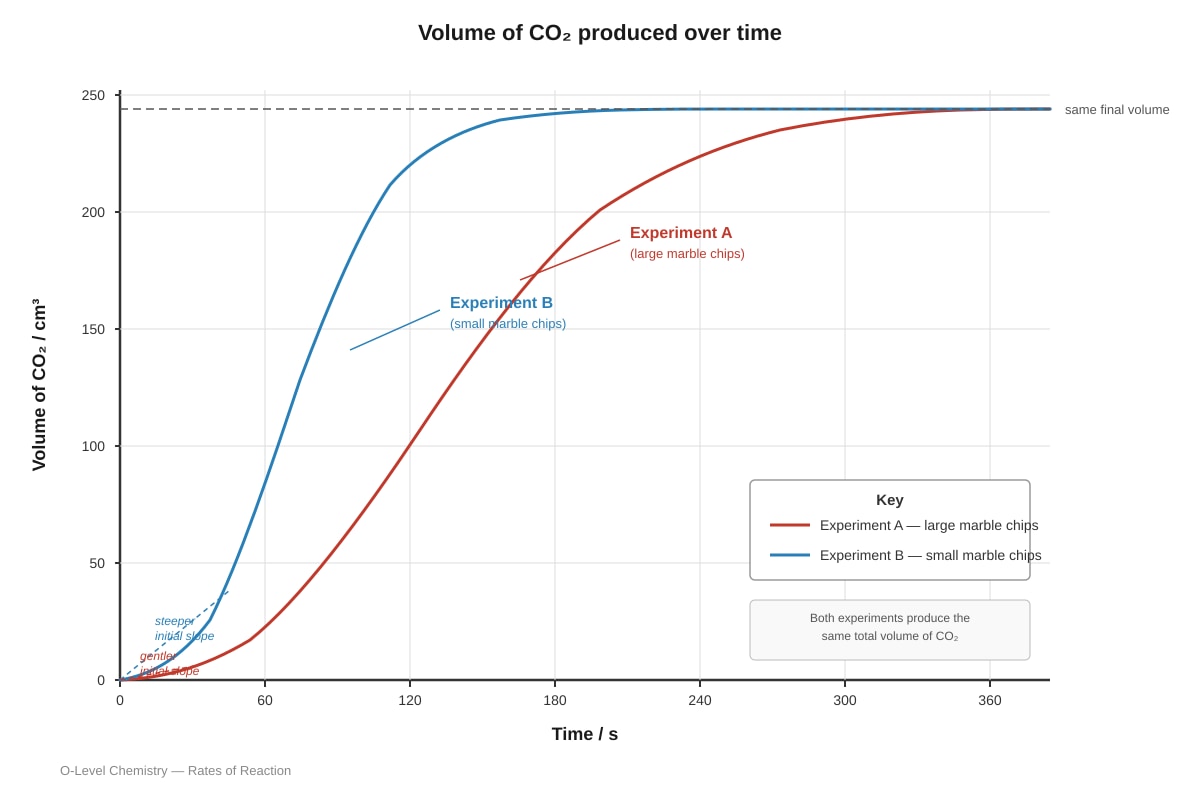
(a) Graph sketch:
- Both curves start at origin (0,0)
- Curve B (small chips) rises more steeply initially than Curve A (large chips)
- Both curves level off at the same final volume of CO₂
- Axes correctly labelled: y-axis = Volume of CO₂ / cm³; x-axis = Time / s
- Curves clearly labelled A and B
Marking:
- Both curves starting at origin: 1 mark
- Curve B steeper than Curve A: 1 mark
- Both curves reaching same final volume: 1 mark
(b) Explanation using collision theory:
- Smaller marble chips have a larger total surface area than larger chips of the same mass. [1]
- With a larger surface area, more calcium carbonate particles are exposed and available to collide with HCl particles at any given time. [1]
- This leads to a higher frequency of effective collisions per unit time, resulting in a faster initial rate of reaction. [1]
Marking:
- Reference to increased surface area: 1 mark
- Link to more exposed particles: 1 mark
- Link to increased frequency of effective collisions: 1 mark
(c) The final volume of carbon dioxide is the same in both experiments. [1] Explanation: The same mass (5.0 g) of calcium carbonate is used in both experiments. Since the same amount of limiting reactant (CaCO₃) is present, the same amount of CO₂ is produced when the reaction goes to completion. The particle size affects only the rate, not the total amount of product. [1]
Marking:
- Correct statement: 1 mark
- Correct explanation referencing same mass of CaCO₃: 1 mark
(d)(i) The initial rate of reaction remains the same / is unchanged. [1] Explanation: The concentration of HCl is unchanged (still 1.0 mol/dm³) and the surface area of marble chips is unchanged. The volume of acid does not affect the initial rate; only concentration, temperature, and surface area affect the rate.
Marking:
- Correct prediction: 1 mark
(d)(ii) The final volume of CO₂ increases / is greater. [1] Explanation: With 100 cm³ of HCl instead of 50 cm³, there are more moles of HCl available (0.100 mol vs. 0.050 mol). In Experiment A, HCl was the limiting reactant. With more HCl, more CaCO₃ can react, producing more CO₂.
Marking:
- Correct prediction: 1 mark
Question 9 (10 marks)
(a) Catalyst: Vanadium(V) oxide / V₂O₅ [1] Temperature: 450°C [1]
Marking:
- Correct catalyst: 1 mark
- Correct temperature (accept 400–500°C): 1 mark
(b) According to Le Chatelier's principle, if a system at equilibrium is subjected to a change, the system will shift to oppose/counteract the change. [1] Increasing pressure favours the side with fewer gas molecules/moles of gas. [1] On the left side: 2 + 1 = 3 moles of gas. On the right side: 2 moles of gas. Therefore, increasing pressure shifts the equilibrium to the right, increasing the yield of SO₃. [1]
Marking:
- Statement of Le Chatelier's principle: 1 mark
- Identification of fewer moles on product side: 1 mark
- Correct prediction of equilibrium shift: 1 mark
(c) Reason: A very high pressure is expensive to generate and maintain / requires stronger, more expensive equipment / poses safety risks. [1] Explanation: Although a higher pressure increases yield, the additional cost of generating very high pressures outweighs the benefit of the increased yield. A moderately high pressure (2 atm) gives a satisfactory yield at a reasonable cost. [1]
Marking:
- Valid reason (cost, safety, equipment): 1 mark
- Explanation balancing cost vs. yield: 1 mark
(d)(i) The reaction of SO₃ with water is highly exothermic and violent / produces a fine mist of sulfuric acid droplets that is difficult to condense and collect. [1]
Marking:
- Reference to violent/exothermic reaction or mist formation: 1 mark
(d)(ii) SO₃(g) + H₂O(l) → H₂SO₄(aq) [1]
Marking:
- Correct equation: 1 mark
- State symbols not essential
(e) A strong acid is one that ionises/dissociates completely in aqueous solution to produce H⁺ ions. [1] Example: HCl(aq) → H⁺(aq) + Cl⁻(aq) (complete ionisation) A weak acid ionises/dissociates only partially in aqueous solution. [1] At the same concentration, a strong acid has a higher concentration of H⁺ ions than a weak acid, resulting in a lower pH. The strong acid will also react more vigorously with metals/carbonates and have higher electrical conductivity. [1]
Marking:
- Definition of strong acid (complete ionisation): 1 mark
- Definition of weak acid (partial ionisation): 1 mark
- Comparison of properties at same concentration: 1 mark
END OF ANSWER KEY