AI Generated Exam Paper
O Level Chemistry Practice Paper 1
Free O Level Chemistry Practice Paper 1, AI version, with questions, answers, and O Level-style practice for Singapore students.
These static practice materials are generated from the site's syllabus and paper-generation workflow, with source and model context shown so students and parents can evaluate the material before use.
Questions
Free quiz and exam paper access
Enter your details to view this paper
Your access is remembered on this device.
Answers
TuitionGoWhere Practice Paper - Chemistry O-Level - MARKING SCHEME
Total Marks: 80
Section A [40 marks]
Question 1 [16 marks]
(a) Complete the following table about acids and bases. [4]
| Property | Strong Acid | Weak Acid | Strong Base |
|---|---|---|---|
| Degree of ionization | Complete | Partial [1] | Complete |
| pH range (0.1 mol/dm³) | 0-2 [1] | 2-6 | 12-14 [1] |
| Example | HCl | CH₃COOH/ethanoic acid [1] | NaOH/KOH [1] |
Marking notes: Accept any correct weak acid or strong base example.
(b)(i) Write a balanced chemical equation for this reaction. [2]
Answer: H₂SO₄ + 2KOH → K₂SO₄ + 2H₂O [2]
Marking notes: Correct formulae [1], balanced equation [1]. Accept state symbols.
(b)(ii) Write the ionic equation for neutralization. [2]
Answer: H⁺ + OH⁻ → H₂O [2]
Marking notes: Correct ions with charges [1], correct product [1].
(c)(i) Calculate the concentration of the sulfuric acid. [4]
Answer: Equation: H₂SO₄ + 2KOH → K₂SO₄ + 2H₂O Moles of KOH = 0.100 × 25.0/1000 = 0.00250 mol [1] From equation: 1 mol H₂SO₄ reacts with 2 mol KOH Moles of H₂SO₄ = 0.00250/2 = 0.00125 mol [1] Concentration of H₂SO₄ = 0.00125/(12.5/1000) [1] = 0.100 mol/dm³ [1]
Marking notes: Award marks for correct method even if arithmetic errors.
(c)(ii) Suggest a suitable indicator for this titration and explain your choice. [2]
Answer: Indicator: Methyl orange/phenolphthalein [1] Explanation: This is a strong acid-strong base titration, so any indicator that changes color around pH 7 is suitable [1]
Marking notes: Accept universal indicator. Must explain suitability for strong acid-strong base.
Question 2 [17 marks]
(a)(i) Write a balanced chemical equation for this reaction. [2]
Answer: ZnCO₃ + 2HCl → ZnCl₂ + H₂O + CO₂ [2]
Marking notes: Correct formulae [1], balanced equation [1].
(a)(ii) Describe the complete method to prepare pure, dry crystals of zinc chloride. [6]
Answer: Step 1: Add excess zinc carbonate to dilute hydrochloric acid [1] Step 2: Stir until no more zinc carbonate dissolves/effervescence stops [1] Step 3: Filter to remove unreacted zinc carbonate [1] Step 4: Heat the filtrate gently to evaporate water until crystals start to form [1] Step 5: Allow to cool and crystallize [1] Step 6: Filter the crystals and dry between filter papers [1]
Marking notes: Key steps: excess reactant, filtration, evaporation, crystallization, drying.
(b)(i) Write a balanced chemical equation for this reaction. [2]
Answer: AgNO₃ + NaCl → AgCl + NaNO₃ [2]
Marking notes: Correct formulae [1], balanced equation [1].
(b)(ii) Explain why a different method is needed to prepare silver chloride compared to zinc chloride. [2]
Answer: Silver chloride is insoluble in water [1], so it forms a precipitate and can be prepared by precipitation method, whereas zinc chloride is soluble [1].
Marking notes: Must mention solubility difference and relate to method.
(c) State the solubility of the following salts in water: [3]
Answer: Potassium sulfate: Soluble [1] Lead(II) chloride: Insoluble [1] Calcium carbonate: Insoluble [1]
Marking notes: Accept "slightly soluble" for lead(II) chloride.
Question 3 [7 marks]
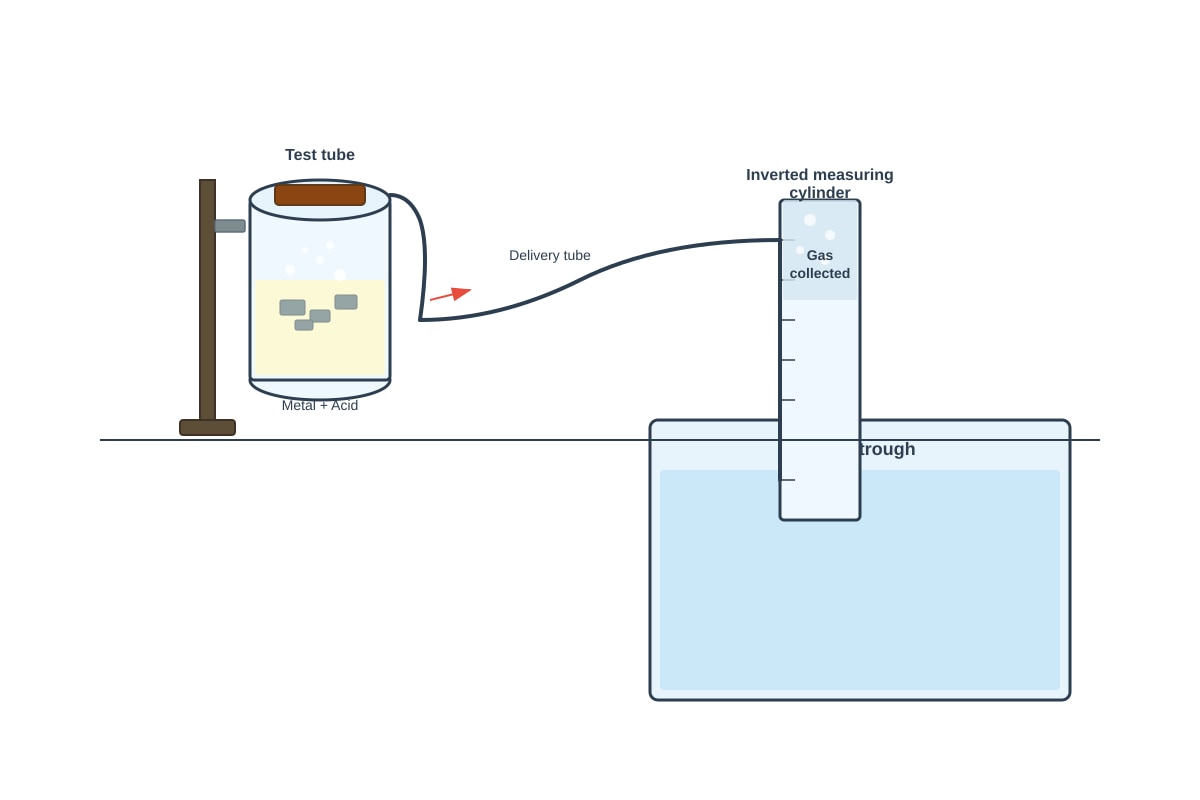
(a) Name the gas collected in this experiment. [1]
Answer: Hydrogen [1]
(b) Write the test for this gas. [2]
Answer: Test: Apply a lighted/burning splint [1] Positive result: Burns with a squeaky pop [1]
Marking notes: Must mention both test and result.
(c)(i) Write a balanced chemical equation for this reaction. [2]
Answer: Zn + 2HCl → ZnCl₂ + H₂ [2]
Marking notes: Correct formulae [1], balanced equation [1].
(c)(ii) Calculate the volume of gas produced at RTP. [3]
Answer: Moles of Zn = 0.65/65 = 0.010 mol [1] From equation: 1 mol Zn produces 1 mol H₂ Moles of H₂ = 0.010 mol [1] Volume of H₂ = 0.010 × 24 = 0.24 dm³ [1]
Marking notes: Award method marks even with arithmetic errors.
(d)(i) State what would be observed. [1]
Answer: No reaction/no gas evolved/no change [1]
(d)(ii) Explain this observation using the reactivity series. [2]
Answer: Copper is below hydrogen in the reactivity series [1], so it cannot displace hydrogen from acids [1].
Marking notes: Must mention reactivity series and position relative to hydrogen.
Section B [40 marks]
Question 4 [15 marks]
(a)(i) Write a balanced chemical equation for the Haber process. [2]
Answer: N₂ + 3H₂ ⇌ 2NH₃ [2]
Marking notes: Correct formulae [1], balanced with reversible arrow [1].
(a)(ii) State two conditions used in the Haber process. [2]
Answer: Condition 1: High temperature (400-500°C) [1] Condition 2: High pressure/iron catalyst [1]
Marking notes: Accept any two correct conditions from: high temperature, high pressure, iron catalyst.
(b)(i) Write an equation to show how ammonia forms an alkaline solution. [2]
Answer: NH₃ + H₂O → NH₄⁺ + OH⁻ [2]
Marking notes: Correct formulae and charges [1], correct products [1].
(b)(ii) State the pH range of aqueous ammonia. [1]
Answer: 8-11/above 7 [1]
Marking notes: Accept any range above 7.
(c)(i) Describe the test for ammonia gas. [2]
Answer: Test: Hold damp red litmus paper in the gas [1] Positive result: Red litmus turns blue [1]
Marking notes: Must specify damp red litmus and color change.
(c)(ii) Write a balanced chemical equation for the reaction between ammonium chloride and sodium hydroxide. [2]
Answer: NH₄Cl + NaOH → NaCl + NH₃ + H₂O [2]
Marking notes: Correct formulae [1], balanced equation [1].
(d)(i) Write a balanced chemical equation for this reaction. [2]
Answer: 4NH₃ + 5O₂ → 4NO + 6H₂O [2]
Marking notes: Correct formulae [1], balanced equation [1].
(d)(ii) Name the catalyst used in this reaction. [1]
Answer: Platinum [1]
(d)(iii) State one large-scale use of nitric acid. [1]
Answer: Manufacture of fertilizers/explosives [1]
Marking notes: Accept any correct industrial use.
Question 5 [14 marks]
(a)(i) Identify the metal ion in each solution. [3]
Answer: Solution A: Al³⁺/aluminum ion [1] Solution B: Cu²⁺/copper(II) ion [1] Solution C: Fe²⁺/iron(II) ion [1]
Marking notes: Accept correct names or formulae.
(a)(ii) Write an ionic equation for the formation of the precipitate in solution B. [2]
Answer: Cu²⁺ + 2OH⁻ → Cu(OH)₂ [2]
Marking notes: Correct ions and charges [1], correct precipitate [1].
(b)(i) Describe the test for chloride ions. [3]
Answer: Reagent: Dilute nitric acid followed by silver nitrate solution [1] Observation: White precipitate forms [1] Confirmatory test: Precipitate dissolves in dilute ammonia solution [1]
Marking notes: Must include acidification step and confirmatory test.
(b)(ii) Describe the test for sulfate ions. [2]
Answer: Reagent: Dilute nitric acid followed by barium nitrate/barium chloride solution [1] Observation: White precipitate forms [1]
Marking notes: Must include acidification step.
(c) Describe how you would distinguish between these two compounds using chemical tests. [4]
Answer: Test: Add dilute hydrochloric acid [1] Observation with sodium carbonate: Effervescence/bubbles/CO₂ gas evolved [1] Observation with sodium sulfate: No reaction/no gas evolved [1] Conclusion: The compound that produces gas is sodium carbonate [1]
Marking notes: Must include test, observations for both compounds, and conclusion.
Question 6 [11 marks]
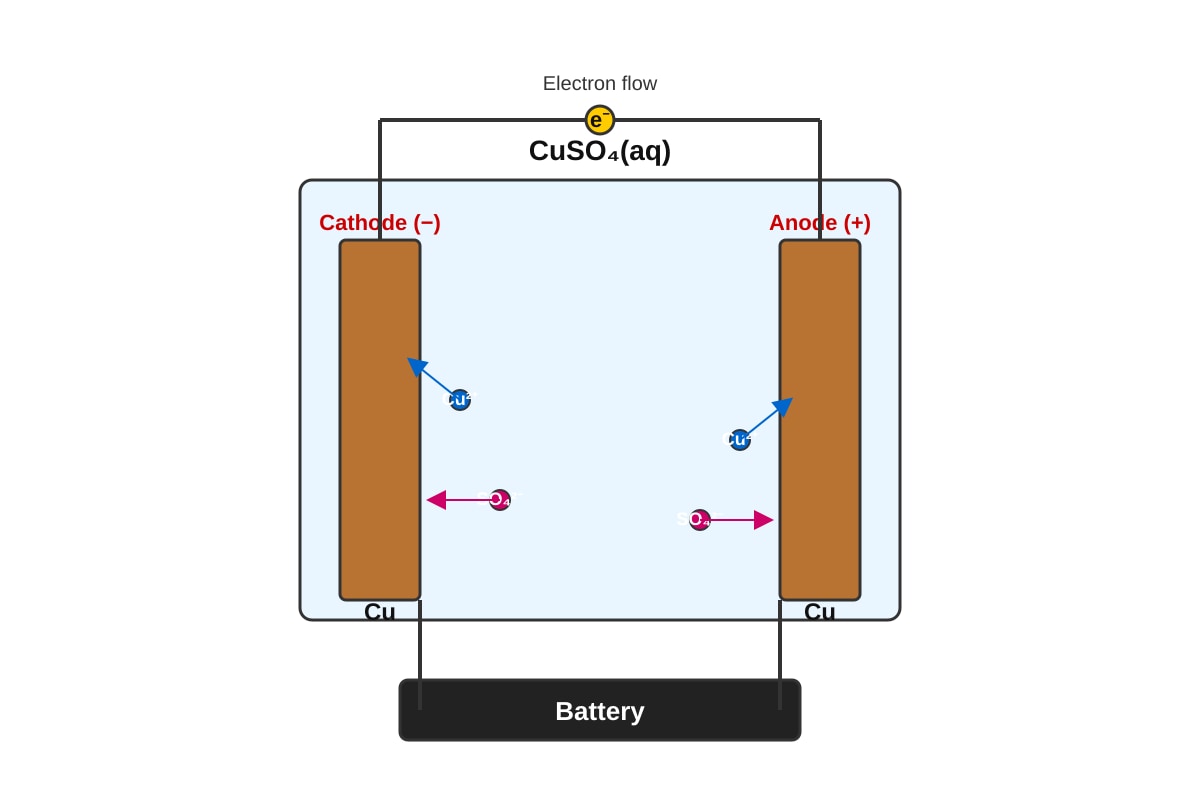
(a)(i) State what happens at the cathode during this electrolysis. [2]
Answer: Copper ions are reduced/gain electrons [1] and copper metal is deposited [1]
Marking notes: Must mention both reduction and deposition.
(a)(ii) Write the electrode equation for the reaction at the anode. [2]
Answer: Cu → Cu²⁺ + 2e⁻ [2]
Marking notes: Correct formulae and charges [1], balanced electrons [1].
(a)(iii) Explain what happens to the concentration of copper(II) sulfate solution during this process. [2]
Answer: The concentration remains constant [1] because copper ions are removed at the cathode but replaced by copper ions from the anode [1]
Marking notes: Must explain why concentration stays constant.
(b)(i) Name the products formed at each electrode. [2]
Answer: Cathode: Hydrogen [1] Anode: Oxygen [1]
(b)(ii) Write electrode equations for the reactions at both electrodes. [4]
Answer: Cathode: 2H⁺ + 2e⁻ → H₂ [2] Anode: 4OH⁻ → O₂ + 2H₂O + 4e⁻ [2]
Marking notes: Award 2 marks for each correct equation (formulae and balancing).
(c) State one industrial use of electrolysis. [1]
Answer: Electroplating/purification of metals/extraction of metals [1]
Marking notes: Accept any correct industrial application.
END OF MARKING SCHEME
Grade Boundaries (Suggested):
- A: 72-80 marks (90-100%)
- B: 64-71 marks (80-89%)
- C: 56-63 marks (70-79%)
- D: 48-55 marks (60-69%)
- E: 40-47 marks (50-59%)