From Real Exams Exam Paper
O Level Chemistry Practice Paper 4
Free O Level Chemistry Practice Paper 4, HY3 Exam version, with questions, answers, and O Level-style practice for Singapore students.
These static practice materials are generated from the site's syllabus and paper-generation workflow, with source and model context shown so students and parents can evaluate the material before use.
Questions
TuitionGoWhere Exam Practice (AI) - Chemistry O-Level
TuitionGoWhere Secondary School (AI)
Subject: Chemistry
Level: O-Level
Paper: Practice Paper (Version 4 of 5)
Duration: 1 hour 15 minutes
Total Marks: 60
Name: ______________________
Class: ______________________
Date: ______________________
Instructions:
- Answer all questions in the spaces provided.
- Use blue or black pen.
- Show all working clearly where calculations are required.
- State symbols should be included in chemical equations where requested.
- The total mark for this paper is 60.
Section A: Multiple Choice and Short Structured (Questions 1–8) [16 marks]
1. Which of the following equations represents a neutralisation reaction? [1]
A. 2Na+2H2O→2NaOH+H2
B. HCl+NaOH→NaCl+H2O
C. CaCO3→CaO+CO2
D. Zn+CuSO4→ZnSO4+Cu
2. Explain what is meant by the term "weak acid". [1]
3. Write the equation for the reaction between ethanoic acid and zinc. Include state symbols. [1]
4. Copper is left unreacted after treatment with dilute sulfuric acid. Explain why. [1]
5. A student adds dilute hydrochloric acid to a sample of magnesium carbonate. What would be observed? [1]
6. Name the salt formed when nitric acid reacts with potassium hydroxide. [1]
7. Which indicator is commonly used to estimate the pH of a solution across a wide range? [1]
8. Classify each of the following as a strong or weak acid:
(a) hydrochloric acid [1]
(b) ethanoic acid [1]
(c) sulfuric acid [1]
Section B: Data-Based and Structured Response (Questions 9–14) [22 marks]
9. A chromatogram was obtained using a mixture of water and ethanol to separate an ink sample. Only one spot appeared. The reference Rf values from the paper are:
- Compound X: 0.45
- Compound Y: 0.72
- Compound Z: 0.31
The spot travelled 3.6 cm and the solvent front travelled 8.0 cm. Using evidence, explain why the ink cannot be Compound Y. [2]
10. A student has two white solids: aluminium oxide and magnesium carbonate. Suggest a method to identify each sample and state the expected observations. [3]
11. The pH values of four solutions are given below:
- Solution P: pH 2
- Solution Q: pH 7
- Solution R: pH 9
- Solution S: pH 13
(a) Which solution is a strong alkali? [1]
(b) Which solution could be a weak acid? [1]
(c) Explain your answer to (b) using the pH scale. [2]
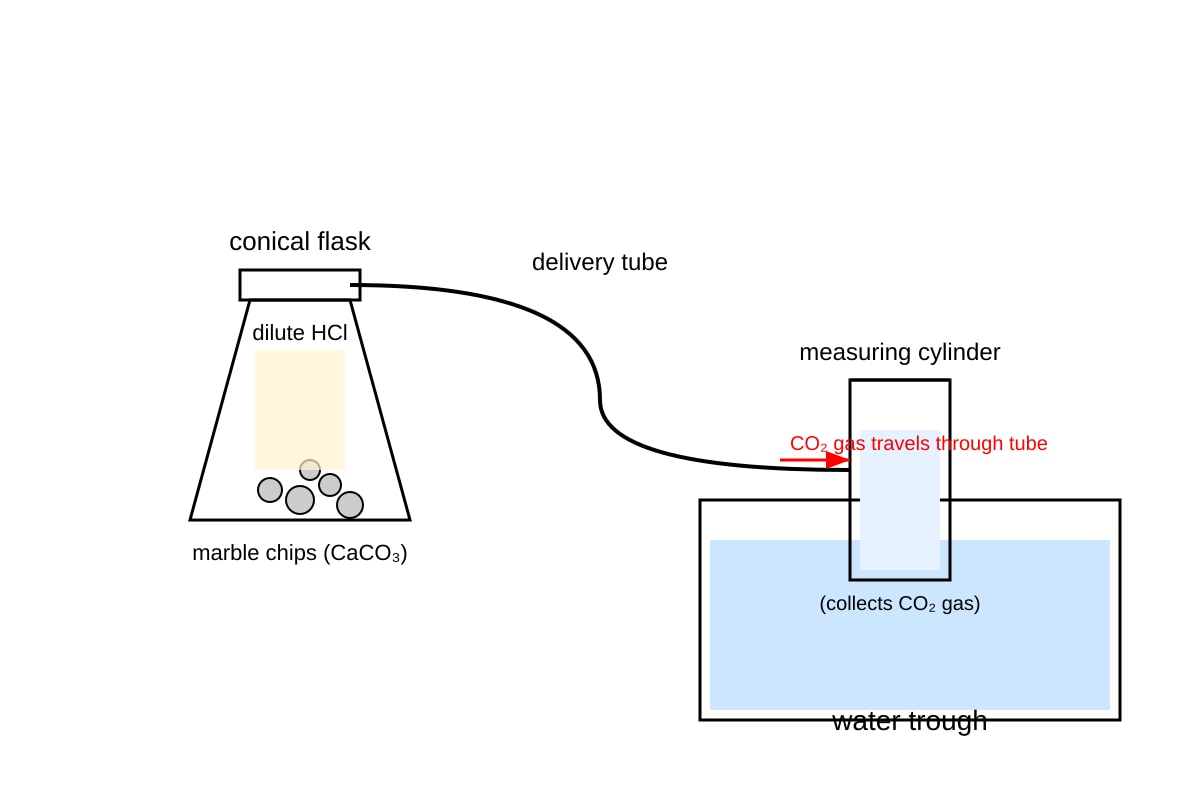
12. The following diagram shows the setup for the reaction between marble chips and dilute hydrochloric acid.
Image pending generation: experimental_setup for Q12.
(a) Name the gas produced. [1]
(b) Write the balanced equation for the reaction. [1]
(c) How would the rate change if powdered chalk were used instead of chips? Explain. [2]
13. A farmer finds his soil is too acidic for planting. He decides to add calcium oxide.
(a) Name the type of substance calcium oxide is in this context. [1]
(b) Explain how it neutralises the soil. [2]
(c) Write the equation for the reaction with acid (use H⁺ to represent acid). [1]
14. A titration was carried out to find the concentration of sulfuric acid. 25.0 cm³ of 0.100 mol/dm³ sodium hydroxide was neutralised by 20.0 cm³ of sulfuric acid.
2NaOH+H2SO4→Na2SO4+2H2O
Calculate the concentration of the sulfuric acid in mol/dm³. [3]
Section C: Extended Structured (Questions 15–20) [22 marks]
15. A student prepares a sample of lead(II) sulfate by adding excess lead(II) nitrate to dilute sulfuric acid.
(a) Name the method used. [1]
(b) Describe how the solid is separated and dried. [2]
(c) Why is lead(II) nitrate used in excess? [1]
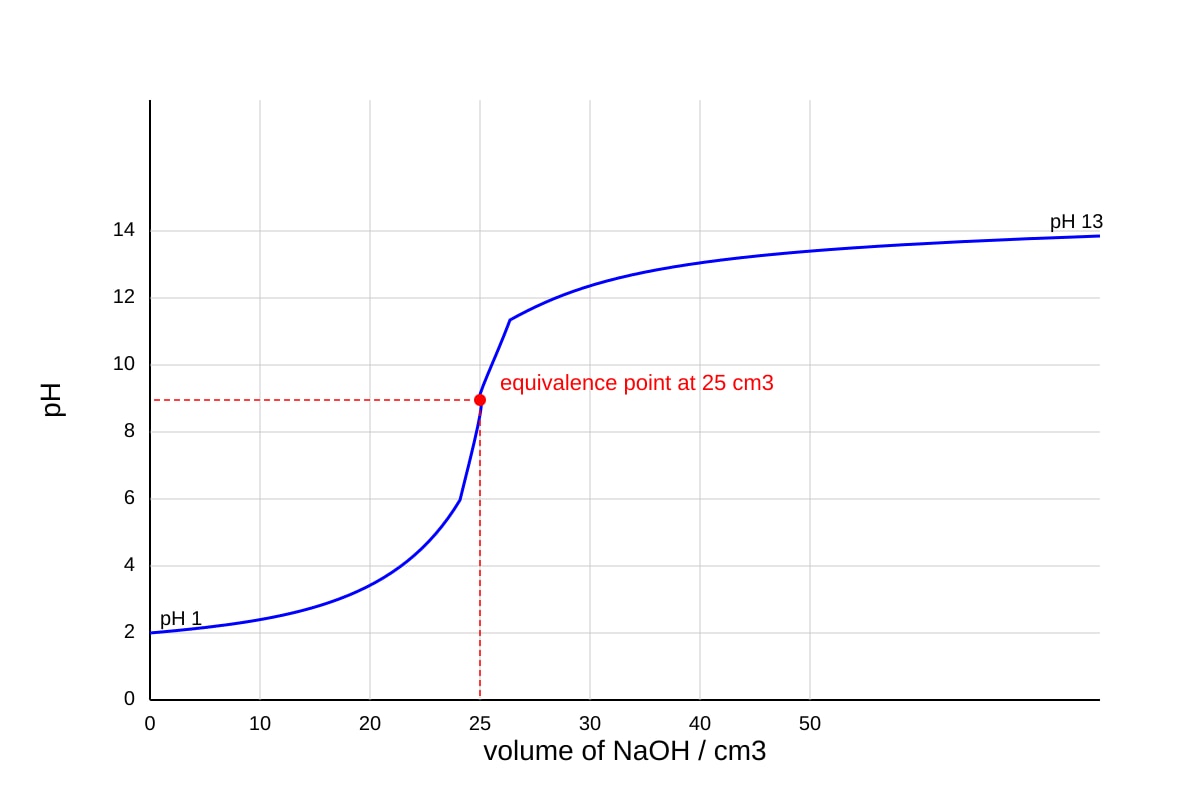
16. The graph below shows the pH change when sodium hydroxide is added to hydrochloric acid.
Image pending generation: graph for Q16.
(a) State the volume of NaOH at which neutralisation occurs. [1]
(b) Explain the shape of the graph near the equivalence point. [2]
(c) What is the colour of methyl orange at the start and at the end? [2]
17. A solution contains ions of copper(II), sulfate, and hydrogen.
(a) Write the ionic equation for the reaction with hydroxide ions to form a precipitate. [1]
(b) What is the formula of the precipitate? [1]
(c) How can sulfate ions be confirmed in the lab? [2]
18. Compare the electrical conductivity of hydrochloric acid and ethanoic acid of same concentration.
(a) Which conducts better? [1]
(b) Explain your answer in terms of ions. [2]
(c) How does dilution affect the degree of ionisation of a weak acid? [1]
19. A student adds zinc to dilute sulfuric acid and collects 48 cm³ of hydrogen gas at r.t.p.
Zn+H2SO4→ZnSO4+H2
(a) Calculate the moles of hydrogen produced. (1 mol gas = 24 dm³ at r.t.p.) [2]
(b) Calculate the mass of zinc reacted. (Ar Zn = 65) [2]
(c) State one observation during the reaction. [1]
20. A salt is made from a metal oxide and nitric acid.
(a) Write a general equation for the reaction. [1]
(b) Name the type of salt produced. [1]
(c) Give one use of this type of salt in everyday life. [1]
Answers
TuitionGoWhere Exam Practice (AI) - Chemistry O-Level
Answer Key (Version 4 of 5)
Total Marks: 60
Section A Answers
1. [1] B
Teaching note: Neutralisation is acid + base → salt + water. Option B shows HCl (acid) + NaOH (base) → NaCl (salt) + H₂O. Others are displacement, decomposition, or redox not producing salt+water directly.
Common mistake: Picking A (acid + metal → salt + H₂, not neutralisation).
2. [1] A weak acid is only partially ionised in aqueous solution.
Teaching note: Strong acids ionise completely; weak acids (e.g., CH₃COOH) release only some H⁺ ions.
3. [1] 2CH3COOH(aq)+Zn(s)→Zn(CH3COO)2(aq)+H2(g)
Teaching note: Zinc is divalent, needs 2 ethanoate ions. Balance H₂ gas. State symbols required.
4. [1] Copper is below hydrogen in the reactivity series, so it cannot displace H⁺ from dilute acid.
Teaching note: Unreactive metals do not react with dilute acids to give H₂.
5. [1] Effervescence (bubbles of CO₂ gas).
Teaching note: Carbonate + acid → salt + water + CO₂.
6. [1] Potassium nitrate (KNO3).
Teaching note: Acid (HNO₃) + alkali (KOH) → salt with nitrate and potassium.
7. [1] Universal Indicator.
Teaching note: Gives a colour range across pH 1–14.
8. [3 total]
(a) Strong [1]
(b) Weak [1]
(c) Strong [1]
Teaching note: HCl and H₂SO₄ are strong; CH₃COOH is weak.
Section B Answers
9. [2]
Rf = distance spot / distance solvent = 3.6 / 8.0 = 0.45. [1]
Compound Y has Rf 0.72, which does not match 0.45, so ink cannot be Y. [1]
Teaching note: Rf must equal reference to identify. One spot only shows single component but identity needs Rf match.
10. [3]
Add dilute HCl to each sample. [1]
MgCO₃: effervescence (CO₂ released). [1]
Al₂O₃: no visible reaction. [1]
Teaching note: Carbonates fizz with acid; oxides generally do not (amphoteric Al₂O₃ may dissolve slowly but no gas).
11. [4]
(a) S (pH 13) [1]
(b) None strongly; but if forced, R (pH 9) is weak alkali not acid; weak acid would be pH 3–6 not given. Accept "none" if justified. [1]
(c) Weak acid has pH 3–6; given values are 2 (strong acid), 7 (neutral), 9 and 13 (alkalis). So no weak acid present. [2]
Marking: 2 marks for correct explanation of pH bands.
12. [4]
(a) Carbon dioxide, CO₂ [1]
(b) CaCO3(s)+2HCl(aq)→CaCl2(aq)+CO2(g)+H2O(l) [1]
(c) Faster rate [1] because powder has larger surface area, more collisions. [1]
Teaching note: Surface area increases rate.
13. [4]
(a) Base (or alkali if dissolved) [1]
(b) CaO reacts with H⁺ in soil acid: CaO+2H+→Ca2++H2O neutralising. [2]
(c) CaO+2H+→Ca2++H2O [1]
14. [3]
Moles NaOH = C×V = 0.100 × (25.0/1000) = 0.00250 mol [1]
From eq: 2 mol NaOH : 1 mol H₂SO₄ → mol H₂SO₄ = 0.00250/2 = 0.00125 mol [1]
Conc H₂SO₄ = mol / V(dm³) = 0.00125 / (20.0/1000) = 0.0625 mol/dm³ [1]
Answer: 0.0625 mol/dm³.
Section C Answers
15. [4]
(a) Precipitation [1]
(b) Filter under gravity, wash with distilled water, dry in warm oven or air. [2]
(c) To ensure all sulfate reacts / complete precipitation. [1]
16. [5]
(a) 25 cm³ [1]
(b) Near eq point small addition causes large pH jump due to near-neutral solution. [2]
(c) Start: red (pH 1, methyl orange red below 3.1); End: yellow (pH 13, yellow above 4.4). [2]
17. [4]
(a) Cu2+(aq)+2OH−(aq)→Cu(OH)2(s) [1]
(b) Cu(OH)2 [1]
(c) Add Ba(NO₃)₂ solution; white ppt of BaSO₄ confirms sulfate. [2]
18. [4]
(a) Hydrochloric acid [1]
(b) HCl fully ionised → more free H⁺/Cl⁻ ions carry charge; ethanoic partially ionised → fewer ions. [2]
(c) Dilution increases degree of ionisation of weak acid. [1]
19. [5]
(a) mol H₂ = 48/1000 dm³ ÷ 24 = 0.00200 mol [2]
(b) mol Zn = mol H₂ = 0.00200; mass = 0.00200 × 65 = 0.130 g [2]
(c) Bubbles of gas / zinc dissolves. [1]
20. [3]
(a) Metal oxide + 2HNO₃ → metal nitrate + H₂O [1]
(b) Nitrate [1]
(c) Fertiliser / food preservative (e.g., potassium nitrate). [1]
Total marks awarded: 60 — matches paper total.
Free quiz and exam paper access
Enter your details to view this paper
Your access is remembered on this device.