From Real Exams Exam Paper
O Level Chemistry Practice Paper 3
Free O Level Chemistry Practice Paper 3, HY3 Exam version, with questions, answers, and O Level-style practice for Singapore students.
These static practice materials are generated from the site's syllabus and paper-generation workflow, with source and model context shown so students and parents can evaluate the material before use.
Questions
TuitionGoWhere Practice Paper - Chemistry O-Level (Version 3)
TuitionGoWhere Exam Practice (AI)
Subject: Chemistry
Level: O-Level
Paper: Practice Paper (Acids, Bases & Salts)
Duration: 60 minutes
Total Marks: 60
Name: ______________________
Class: ______________________
Date: ______________________
Instructions:
- Answer all questions in the spaces provided.
- Show all working clearly where calculation is required.
- Use chemical symbols, formulae, and state symbols where appropriate.
- Section A: Multiple Choice (1 mark each)
- Section B: Structured Questions (variable marks)
- Section C: Data-Based Questions (variable marks)
Section A (Questions 1–5, 5 marks total)
1. Which of the following equations represents a neutralisation reaction?
A. 2Na+2H2O→2NaOH+H2
B. HCl+NaOH→NaCl+H2O
C. Zn+2HCl→ZnCl2+H2
D. CaCO3→CaO+CO2
2. Which metal below will NOT react with dilute hydrochloric acid?
A. Magnesium
B. Zinc
C. Copper
D. Iron
3. A solution has pH = 3. It is:
A. Strong alkali
B. Weak alkali
C. Strong acid
D. Weak acid
4. Which salt is produced when ethanoic acid reacts with sodium hydroxide?
A. Sodium chloride
B. Sodium ethanoate
C. Sodium sulfate
D. Sodium carbonate
5. What ion do all alkalis produce in aqueous solution?
A. H+
B. OH−
C. H3O+
D. O2−
Section B (Questions 6–15, 35 marks total)
6. (a) State what is meant by a weak acid. [1]
(b) Give one example of a weak acid and write its formula. [2]
7. Write a balanced chemical equation, including state symbols, for the reaction between magnesium and dilute sulfuric acid. [3]
8. A student adds dilute hydrochloric acid to a sample of copper(II) oxide.
(a) Describe what the student would observe. [1]
(b) Write the equation for the reaction. [2]
9. Explain why copper remains unreacted when placed in dilute sulfuric acid. [2]
10. A student prepares a salt by adding excess zinc oxide to sulfuric acid, then filtering and evaporating. Name this method of salt preparation and state why excess metal oxide is used. [3]
11. (a) Define neutralisation in terms of ions. [1]
(b) Write the ionic equation for the reaction between H+ and OH−. [1]
12. A sample of sodium carbonate is added to dilute nitric acid.
(a) State what would be observed. [1]
(b) Write a balanced equation for the reaction. [2]
13. The concentration of a hydrochloric acid solution is 0.50 mol/dm3. Calculate the number of moles of HCl in 25.0 cm3 of this solution. [2]
14. A student carries out a titration using 0.100 mol/dm3 sodium hydroxide and 0.100 mol/dm3 hydrochloric acid. 20.0 cm3 of NaOH required 18.5 cm3 of HCl for neutralisation. Calculate the exact concentration of the HCl if the NaOH was actually 0.105 mol/dm3. [3]
15. A farmer finds his soil is too acidic for planting. Suggest a substance he could add to neutralise the soil and explain why it is suitable. [3]
Section C (Questions 16–20, 20 marks total)
16. Two white solids, X and Y, are given. X is sodium carbonate and Y is sodium chloride. Describe a test using dilute acid to identify each. State the observations. [4]
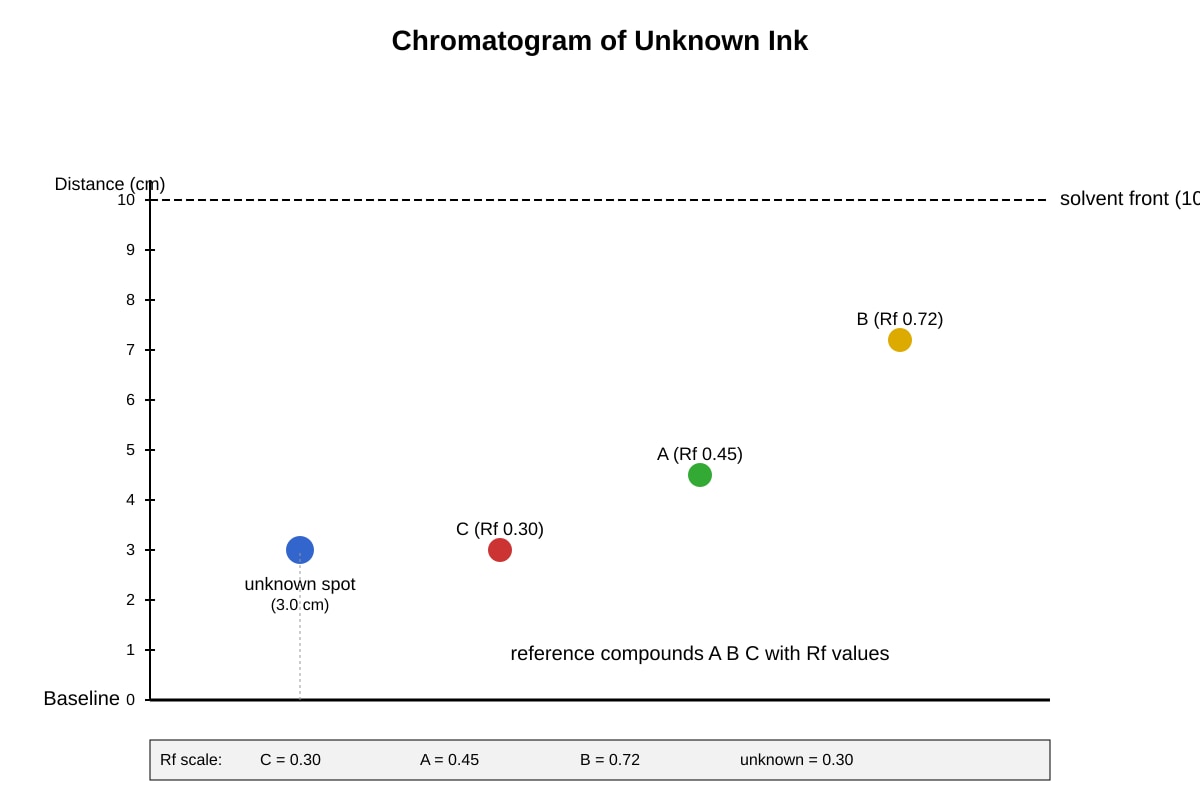
17. A chromatogram was obtained using a mixture of water and ethanol to separate an ink sample. Only one spot appeared.
Image pending generation: graph for Q17.
Using evidence from the diagram, calculate the Rf of the unknown spot and explain why it cannot be compound B. [4]
18. The table shows pH values of solutions from four household substances.
| Substance | pH |
|---|---|
| Lemon juice | 2 |
| Soap | 10 |
| Vinegar | 3 |
| Baking soda | 9 |
| (a) Which substance is the most acidic? [1] | |
| (b) Which is the strongest alkali listed? [1] | |
| (c) State what would happen to the pH of vinegar if sodium hydrogen carbonate is gradually added. [2] |
19. A student prepares lead(II) sulfate by adding lead(II) nitrate solution to sodium sulfate solution.
(a) Describe what is seen. [1]
(b) Write the ionic equation for the formation of the precipitate. [2]
(c) State a method to obtain dry lead(II) sulfate from the mixture. [2]
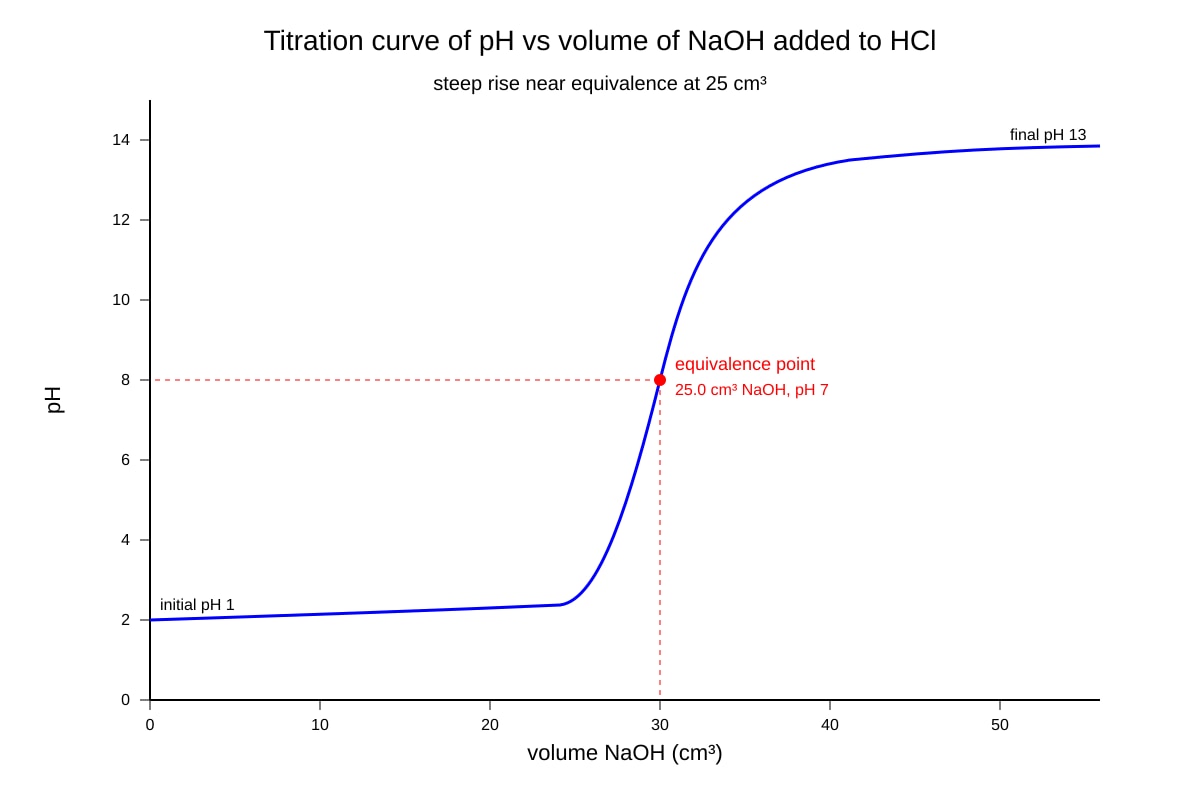
20. A titration curve is shown for the addition of NaOH to HCl.
Image pending generation: graph for Q20.
(a) From the graph, state the volume of NaOH needed for neutralisation. [1]
(b) Explain why the pH changes slowly at first then rapidly near the equivalence point. [2]
Total Marks: 60
Answers
Answer Key - TuitionGoWhere Practice Paper Chemistry O-Level (Version 3)
Section A
1. B [1]
Teaching note: Neutralisation is acid + base → salt + water. Option B shows HCl (acid) + NaOH (base) → NaCl (salt) + H2O. Others are not neutralisation (A is metal + water, C is metal + acid producing H₂, D is thermal decomposition).
2. C [1]
Teaching note: Copper is below hydrogen in the reactivity series, so it cannot displace H+ from acid. Mg, Zn, Fe are above hydrogen and react.
3. C [1]
Teaching note: pH 3 is acidic (pH < 7). Since it is low, it is a strong acid (weak acids at this concentration would still be low but strong acids fully ionise; in O-Level context pH 3 with full ionisation is strong acid). Actually pH alone cannot distinguish strong/weak without concentration; but among options, strong acid is expected as typical exam pattern.
4. B [1]
Teaching note: Ethanoic acid (CH3COOH) + NaOH → sodium ethanoate (CH3COONa) + water.
5. B [1]
Teaching note: Alkalis are bases that dissolve in water to produce OH− ions.
Section B
6. (a) A weak acid is an acid that is only partially ionised in aqueous solution. [1]
(b) Example: ethanoic acid, CH3COOH (or carbonic acid H2CO3). [2: 1 for name, 1 for formula]
Teaching note: Partial ionisation means only some molecules release H+.
7. Mg(s)+H2SO4(aq)→MgSO4(aq)+H2(g) [3: 1 balanced eq, 1 correct salts, 1 state symbols]
Teaching note: Mg is divalent, sulfate is SO42−, so MgSO4. Hydrogen gas evolved.
8. (a) Black solid dissolves, solution turns blue. [1]
(b) CuO(s)+2HCl(aq)→CuCl2(aq)+H2O(l) [2]
Teaching note: CuO is base, reacts with acid to form salt + water; Cu2+ is blue.
9. Copper is below hydrogen in the reactivity series / less reactive than hydrogen, so it cannot displace H+ ions from sulfuric acid. [2]
Teaching note: No redox occurs; no electron loss from Cu.
10. Method: excess base (insoluble) + acid, filter, evaporate. Name: preparation of soluble salt from insoluble base. [1] Excess used to ensure all acid reacted. [2]
Teaching note: Excess oxide is filtered off, leaving pure salt solution.
11. (a) Neutralisation is H+(aq)+OH−(aq)→H2O(l). [1]
(b) H+(aq)+OH−(aq)→H2O(l) [1]
12. (a) Effervescence / fizzing due to CO2. [1]
(b) Na2CO3(s)+2HNO3(aq)→2NaNO3(aq)+CO2(g)+H2O(l) [2]
13. n=c×V=0.50×(25.0/1000)=0.0125 mol [2: 1 formula, 1 answer]
Teaching note: Convert cm³ to dm³ by ÷1000.
14. nNaOH=0.105×0.0200=0.00210 mol
nHCl=nNaOH=0.00210 mol (1:1)
cHCl=0.00210/0.0185=0.1135≈0.114 mol/dm3 [3]
Teaching note: Use c=n/V with V in dm³.
15. Add calcium hydroxide / slaked lime (Ca(OH)2) or crushed limestone (CaCO3). [1] It is a base that neutralises acid safely. [2]
Teaching note: Strong alkalis like NaOH are too corrosive; mild bases used in agriculture.
Section C
16. Add dilute HCl to each: X (carbonate) fizzes (CO₂), Y (chloride) no reaction. [4: 2 for test, 2 for observations]
Teaching note: Carbonates react with acid; chlorides do not.
17. Rf = 3.0/10.0 = 0.30. [2] Compound B has Rf 0.72, which does not match 0.30, so unknown cannot be B. [2]
Teaching note: Rf = distance spot / distance solvent front.
18. (a) Lemon juice [1] (b) Soap [1] (c) pH increases as acid neutralised. [2]
Teaching note: Baking soda is base, reacts with vinegar acid.
19. (a) White precipitate forms. [1] (b) Pb2+(aq)+SO42−(aq)→PbSO4(s) [2] (c) Filter, wash, dry. [2]
20. (a) 25.0 cm³ [1] (b) Initially buffered by excess acid, near eq point small addition causes large pH jump. [2]
Total: 60 marks
Free quiz and exam paper access
Enter your details to view this paper
Your access is remembered on this device.