TuitionGoWhere Practice Paper - Chemistry O-Level (Version 2)
TuitionGoWhere Exam Practice (AI)
Subject: Chemistry
Level: O-Level
Paper: Practice Paper 2 (Structured & Free Response)
Duration: 1 hour 15 minutes
Total Marks: 60
Name: ___________________________
Class: ___________________________
Date: ___________________________
Instructions:
- Answer all questions in the spaces provided.
- Show all working clearly where calculations are involved.
- Use appropriate chemical symbols, formulae, and state symbols.
- Marks allocated are shown at the end of each question or part.
Section A: Multiple Choice and Short Answer (16 marks)
1. Which of the following equations represents a neutralisation reaction? [1]
A. 2Na+2H2O→2NaOH+H2
B. HCl+NaOH→NaCl+H2O
C. Zn+2HCl→ZnCl2+H2
D. CaCO3→CaO+CO2
2. State the meaning of the term "weak acid". [1]
3. Copper is left unreacted after treatment with dilute sulfuric acid. Explain why. [1]
4. Write a balanced equation for the reaction between ethanoic acid and zinc. Include state symbols. [1]
5. An alkali produces which ion in aqueous solution? [1]
A. H+
B. OH−
C. H3O+
D. Cl−
6. A student adds dilute hydrochloric acid to a sample of magnesium carbonate. What observation shows a reaction? [1]
7. Name the salt formed when nitric acid reacts with potassium hydroxide. [1]
8. State the colour of Universal Indicator in a solution of pH 3. [1]
9. Which method can be used to prepare a soluble salt from an insoluble base? [1]
A. Evaporation of a solution
B. Reaction of acid with excess insoluble base, filtration, crystallisation
C. Mixing two soluble salts
D. Titration only
10. Write the ionic equation for the neutralisation of an acid by an alkali. [1]
11. Give one example of a strong acid and one example of a weak acid. [2]
12. A sample gives no effervescence with dilute acid. State one type of substance it could be. [1]
13. What is the pH of a neutral solution at 25 °C? [1]
14. State the formula of the sulphate ion. [1]
15. Which metal below reacts with cold water? [1]
A. Copper
B. Silver
C. Potassium
D. Gold
16. State the name of the salt Cu(NO3)2. [1]
Section B: Structured Questions (24 marks)
17. A student is given two white solids: aluminium oxide and magnesium carbonate. Describe a test to identify each, stating the observations. [3]
18. A chromatogram was obtained using a mixture of water and ethanol to separate an ink sample. Only one spot was seen. The reference compounds had Rf values: Compound X = 0.45, Compound Y = 0.72. The spot travelled 3.6 cm and the solvent front 8.0 cm. Using evidence, explain why the ink cannot be Compound Y. [2]
19. 25.0 cm³ of 0.100 mol/dm³ hydrochloric acid was titrated with 0.100 mol/dm³ sodium hydroxide. Calculate the volume of sodium hydroxide needed for neutralisation. [3]
(Show all working.)
20. A student prepared copper(II) sulfate by adding excess copper(II) oxide to warm dilute sulfuric acid. Outline the steps to obtain pure dry crystals. [3]
21. Explain the difference between a strong acid and a weak acid in terms of ionisation, using hydrochloric acid and ethanoic acid as examples. [3]
22. Write equations for:
(a) magnesium with dilute sulfuric acid [1]
(b) sodium hydroxide with nitric acid [1]
(c) the ionic equation for part (b) [1]
23. 5.0 g of calcium carbonate reacts with excess hydrochloric acid:
CaCO3+2HCl→CaCl2+CO2+H2O
Calculate the volume of CO2 produced at r.t.p. (Molar mass of CaCO3 = 100 g/mol; 1 mol gas = 24 dm³ at r.t.p.) [3]
24. State and explain the method to prepare lead(II) sulfate, an insoluble salt, from lead(II) nitrate and sodium sulfate solutions. [3]
Section C: Data-Based and Extended (20 marks)
25. The table shows pH values of solutions after adding equal volumes of 0.1 mol/dm³ acid to 0.1 mol/dm³ sodium hydroxide.
| Acid used | pH after mixing |
|---|
| HCl | 7 |
| CH₃COOH | 9 |
(a) Why is the pH 7 with HCl but 9 with CH₃COOH? [2]
(b) Which acid is weak? Give a reason. [2]
26.
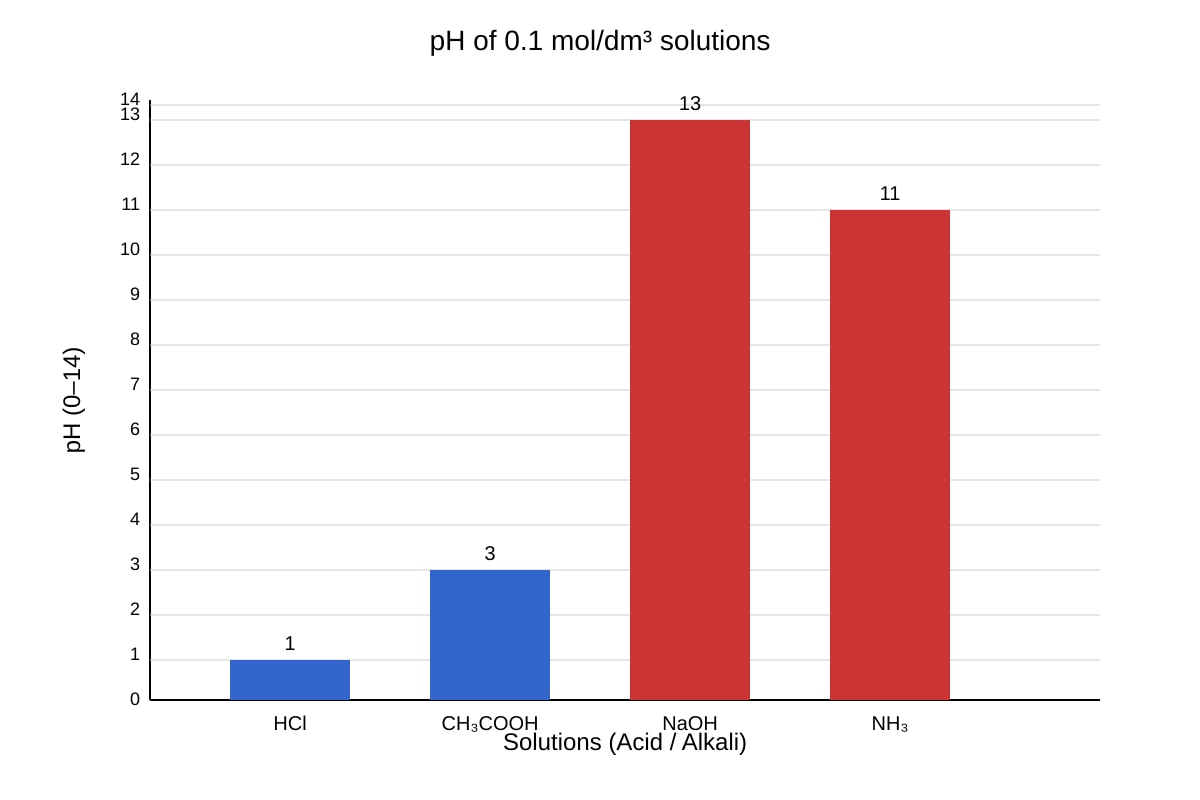
Generated graph for Q26.
Using the graph, state which is the weak alkali and explain. [2]
27. A student suggests: "All salts are neutral." Discuss whether this statement is correct with two examples. [4]
28. A factory discharges waste containing sulfuric acid into a river. Suggest a substance to neutralise it and explain the environmental benefit. [3]
29. 10.0 g of impure zinc (only zinc reacts with acid) reacts completely with hydrochloric acid:
Zn+2HCl→ZnCl2+H2
The hydrogen collected measures 2.88 dm³ at r.t.p. Calculate the percentage purity of the zinc. (Ar: Zn = 65; 1 mol gas = 24 dm³ at r.t.p.) [4]
30. Plan an experiment to compare the rate of reaction of magnesium with dilute hydrochloric acid and dilute ethanoic acid of equal concentration. State the variable measured and how the results would show the stronger acid. [3]
Total Marks: 60