From Real Exams Exam Paper
O Level Chemistry Practice Paper 1
Free O Level Chemistry Practice Paper 1, HY3 Exam version, with questions, answers, and O Level-style practice for Singapore students.
These static practice materials are generated from the site's syllabus and paper-generation workflow, with source and model context shown so students and parents can evaluate the material before use.
Questions
Free quiz and exam paper access
Enter your details to view this paper
Your access is remembered on this device.
Answers
TuitionGoWhere Practice Paper - Chemistry O-Level (Answers)
Version: 1 of 5
Total Marks: 60
Section A (16 marks)
1. [1] B
Teaching note: Neutralisation is acid + base → salt + water. Option B is HCl (acid) + NaOH (alkali/base) → NaCl (salt) + H₂O. A is metal + acid (not neutralisation), C is thermal decomposition, D is combustion.
2. [1] A weak acid is an acid that is only partially ionised in aqueous solution.
Teaching note: Partial ionisation means only some acid molecules release H⁺ ions; equilibrium lies to the left.
3. [1] Copper is below hydrogen in the reactivity series / less reactive than hydrogen, so it cannot displace H⁺ from the acid.
Teaching note: Metals above hydrogen react with dilute acids to give H₂; copper does not.
4. [1] Mg + 2CH₃COOH → Mg(CH₃COO)₂ + H₂↑ with states: Mg(s) + 2CH₃COOH(aq) → Mg(CH₃COO)₂(aq) + H₂(g)
Teaching note: Mg is divalent; 2 ethanoic acid molecules needed. Common trap: wrong salt formula Mg(CH₃COO).
5. [1] Effervescence / bubbles of gas (CO₂) seen.
Teaching note: Carbonates react with acids to produce carbon dioxide gas.
6. [1] Potassium nitrate (KNO₃).
Teaching note: Acid (nitric → nitrate) + alkali (potassium hydroxide → potassium) gives salt potassium nitrate.
7. [1] Hydroxide ion, OH⁻.
Teaching note: Alkalis are bases that dissolve in water to release OH⁻ ions.
8. [1] Red.
Teaching note: pH 3 is strongly acidic; Universal Indicator is red/orange-red at pH 1–3.
Section B (24 marks)
9. [2]
(a) Rf = distance travelled by spot / distance travelled by solvent = 3.6 / 10.0 = 0.36 [1]
(b) The Rf of the spot is 0.36, which does not match copper(II) sulfate (0.42) or cobalt chloride (0.18), so the ink cannot be pure copper(II) sulfate. [1]
Teaching note: One spot only shows one component moved, but Rf comparison eliminates CuSO₄.
10. [2] Add dilute hydrochloric acid to each sample. Magnesium carbonate fizzes (CO₂ produced), aluminium oxide does not react / no effervescence. [2 marks: 1 for test, 1 for different observations]
Teaching note: Carbonates + acid → salt + water + CO₂; oxides generally do not fizz.
11. [4]
(a) 2NaOH + H₂SO₄ → Na₂SO₄ + 2H₂O [1]
(b) Moles NaOH = 0.100 × (25.0/1000) = 0.00250 mol [1]
From equation, mol H₂SO₄ = 0.00250 / 2 = 0.00125 mol [1]
Conc H₂SO₄ = 0.00125 / (20.0/1000) = 0.0625 mol/dm³ [1]
Teaching note: Use n = C × V in dm³; 2:1 ratio NaOH:H₂SO₄.
12. [4]
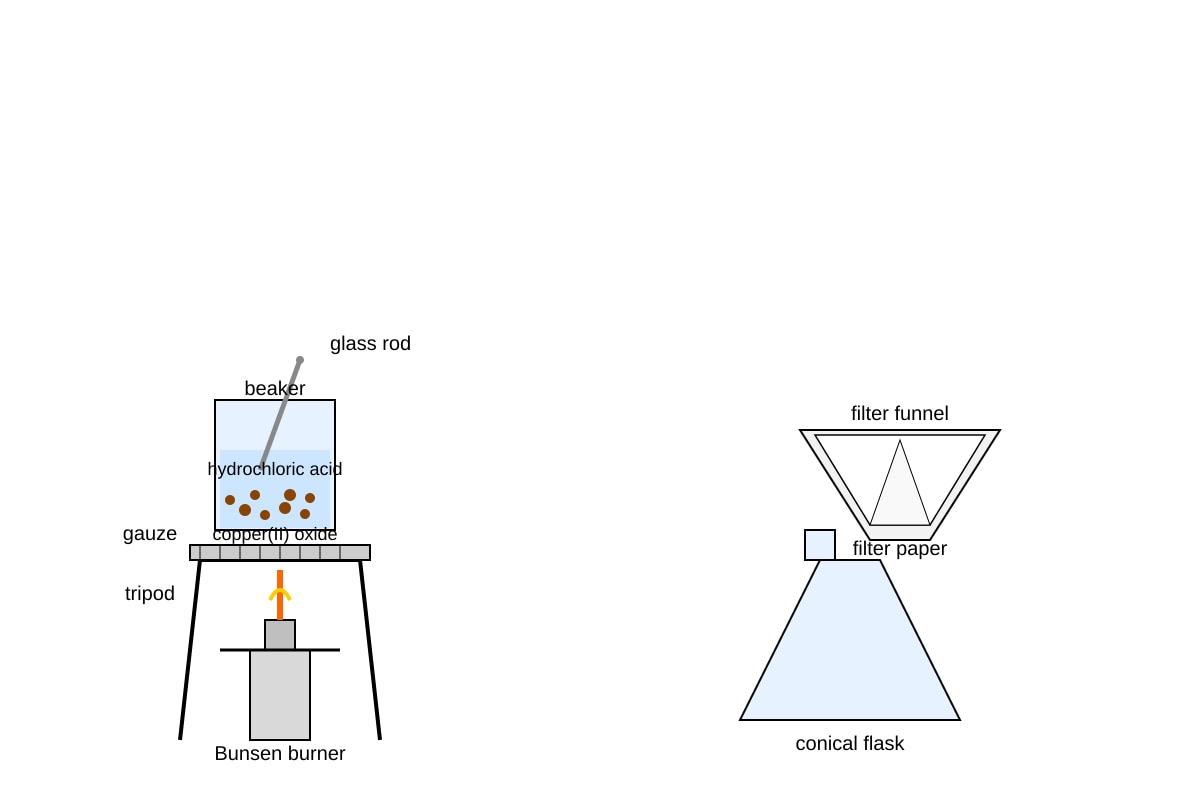
(a) Copper(II) oxide, CuO [1]
(b) To ensure all acid reacts / to make sure acid is fully neutralised [1]
(c) Filter the mixture to remove excess CuO; evaporate filtrate to saturation; leave to crystallise; filter crystals; dry between paper towels [2]
Teaching note: Insoluble base + acid → soluble salt; excess removed by filtration.
13. [2] Strong acid ionises completely (100%) in water releasing all H⁺; weak acid ionises partially (reversible) so only some H⁺ released. [2: 1 each]
Teaching note: Ionisation degree distinguishes them, not concentration.
14. [2] Add calcium hydroxide / slaked lime (Ca(OH)₂) or calcium oxide. Equation: Ca(OH)₂ + 2H⁺ → Ca²⁺ + 2H₂O (or with acid formula). [2: 1 substance, 1 equation]
Teaching note: Soil neutralised with cheap alkali; do not use sodium hydroxide (too soluble/harsh).
15. [3]
(a) D (pH 13) [1]
(b) B (pH 7) [1]
(c) D < C < B < A (since higher pH = lower [H⁺]) [1]
Teaching note: [H⁺] inversely related to pH.
Section C (20 marks)
16. [5]
(a) ZnO + H₂SO₄ → ZnSO₄ + H₂O [1]
(b) Filter to remove excess ZnO; heat filtrate to evaporate water until saturated; cool to crystallise; filter crystals; dry [3]
(c) To ensure all acid is neutralised [1]
Teaching note: Excess insoluble base drives reaction to completion.
17. [6]
(a) n(HCl) = 1.00 × (50.0/1000) = 0.0500 mol [1]
(b) From equation, 2 mol HCl : 1 mol CaCO₃, so n(CaCO₃) = 0.0500 / 2 = 0.0250 mol [2]
(c) M(CaCO₃) = 40+12+48 = 100 g/mol; mass = 0.0250 × 100 = 2.50 g [1]
Purity = (2.50 / 5.00) × 100% = 50.0% [2]
Teaching note: Inert impurity does not react; purity from mass ratio.
18. [3]
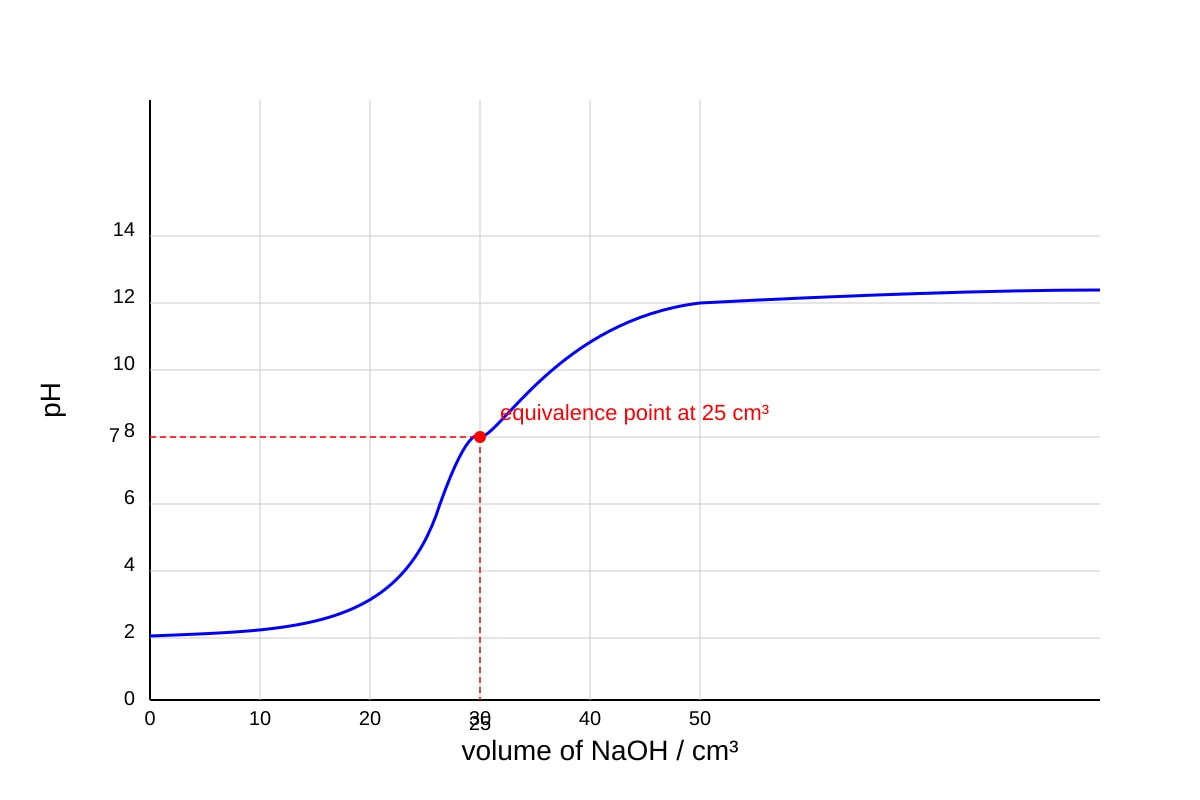
(a) pH 7 [1]
(b) 25 cm³ [1]
(c) Colourless to pink [1]
Teaching note: Phenolphthalein colourless in acid, pink in alkali; endpoint near pH 8.3 but equivalence 7.
19. [3] Add dilute HCl; observation: effervescence (bubbles); equation: CO₃²⁻ + 2H⁺ → CO₂ + H₂O (or full: CaCO₃ + 2HCl → CaCl₂ + CO₂ + H₂O). [3: reagent 1, observation 1, equation 1]
Teaching note: CO₂ turns limewater milky as confirm test.
20. [4]
(a) Precipitation [1]
(b) Ba²⁺ + SO₄²⁻ → BaSO₄(s) [1]
(c) Filter precipitate; wash with distilled water; dry in oven or warm air [2]
Teaching note: Both reactants soluble; product barium sulfate insoluble.