AI Generated Quiz
O Level Biology Plant Biology Quiz
Free O Level Biology Plant Biology quiz, HY3 AI version, with questions, answers, and O Level-style practice for Singapore students.
These static practice materials are generated from the site's syllabus and paper-generation workflow, with source and model context shown so students and parents can evaluate the material before use.
Questions


Free quiz and exam paper access
Enter your details to view this paper
Your access is remembered on this device.
Answers
O-Level Biology Quiz - Plant Biology (Answer Key)
Total Marks: 40
Topic: Plant Biology (Syllabus 6093, Theme III)
Section A
1. C [1]
Chloroplasts are present in plant cells (site of photosynthesis) but absent in animal cells. Animal cells have membrane, nucleus, mitochondria.
2. B [1]
Osmosis is the movement of water across a partially permeable membrane from dilute to concentrated solution. Root hair absorbs soil water by osmosis.
3. B [1]
Carbon dioxide is taken in via stomata and used in photosynthesis to make glucose.
4. B [1]
Xylem transports water and dissolved mineral salts from roots upward to leaves. Phloem transports sugars.
5. A [1]
Guard cells flank stomata and change shape to open/close them, controlling gas exchange and water loss.
Section B
6. [2]
- Long projection / elongated shape → increases surface area for absorption [1]
- Thin wall / many mitochondria (for active transport) [1]
(Mark any two correct adaptations.)
7. [2]
Mineral ion concentration in soil is usually lower than inside the root hair cell [1], so ions must move against the concentration gradient, which requires energy (ATP) from respiration — this is active transport, not diffusion (which is passive, down gradient) [1].
8. [3]
Soil → root hair cell (by osmosis) [1] → cortex → xylem vessel [1] → up the stem → leaf mesophyll [1].
9. [3]
Water moved out of the cell by osmosis [1] because the salt solution was more concentrated (lower water potential) than the cell sap [1]; the cell became plasmolysed (membrane pulled from wall) [1].
10. [2]
Carbon dioxide + water → glucose + oxygen [1]
(With light and chlorophyll) [1]
Equation:
11. [2]
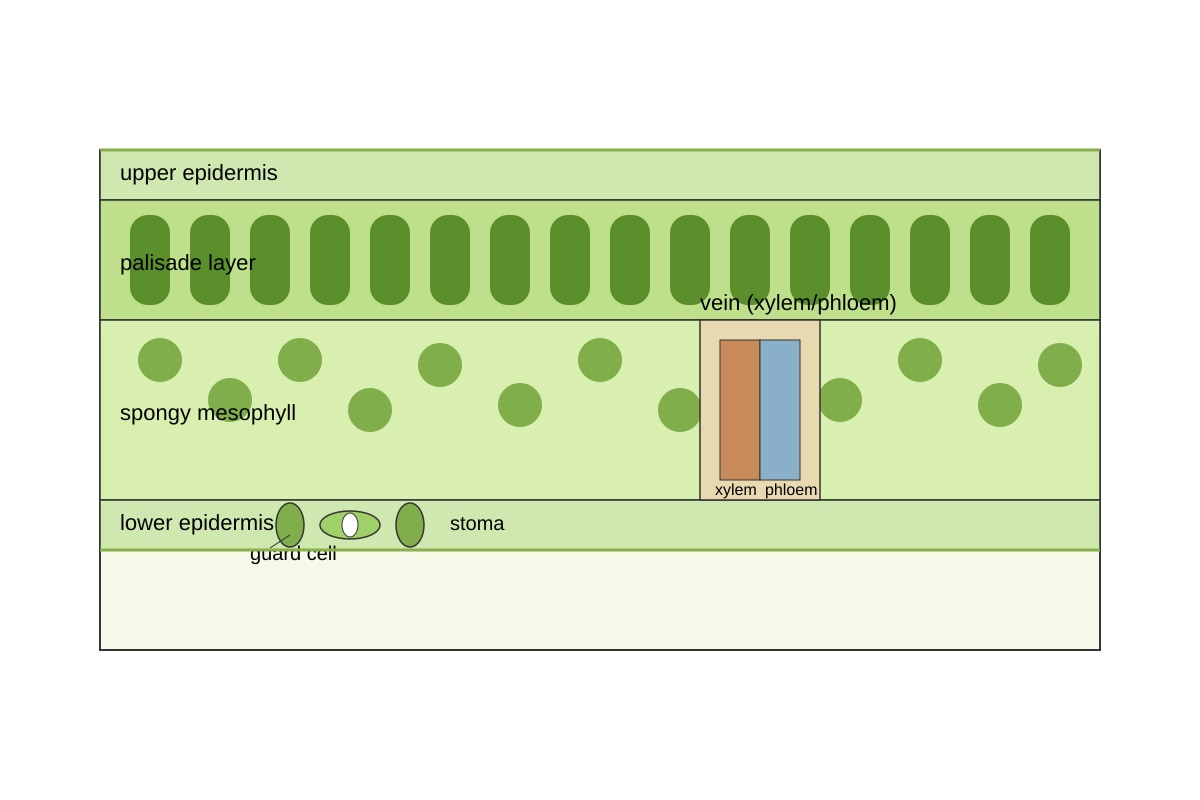
Flat shape gives large surface area for diffusion of gases [1]; air spaces inside leaf allow gases to circulate to cells [1].
12. [2]
- Hollow (no cytoplasm) and dead → uninterrupted water column [1]
- Thickened with lignin / narrow → supports and prevents collapse [1]
(Other: pits for sideways movement.)
13. [3]
Transpiration pulls water from leaves (evaporation from mesophyll) [1]; this creates tension in xylem [1]; continuous column drawn up from roots (transpiration pull / cohesion-tension) [1].
Section C
14. [2]
Palisade mesophyll [1]; contains most chloroplasts / columnar cells packed with chloroplasts for light absorption [1].
15. [3]
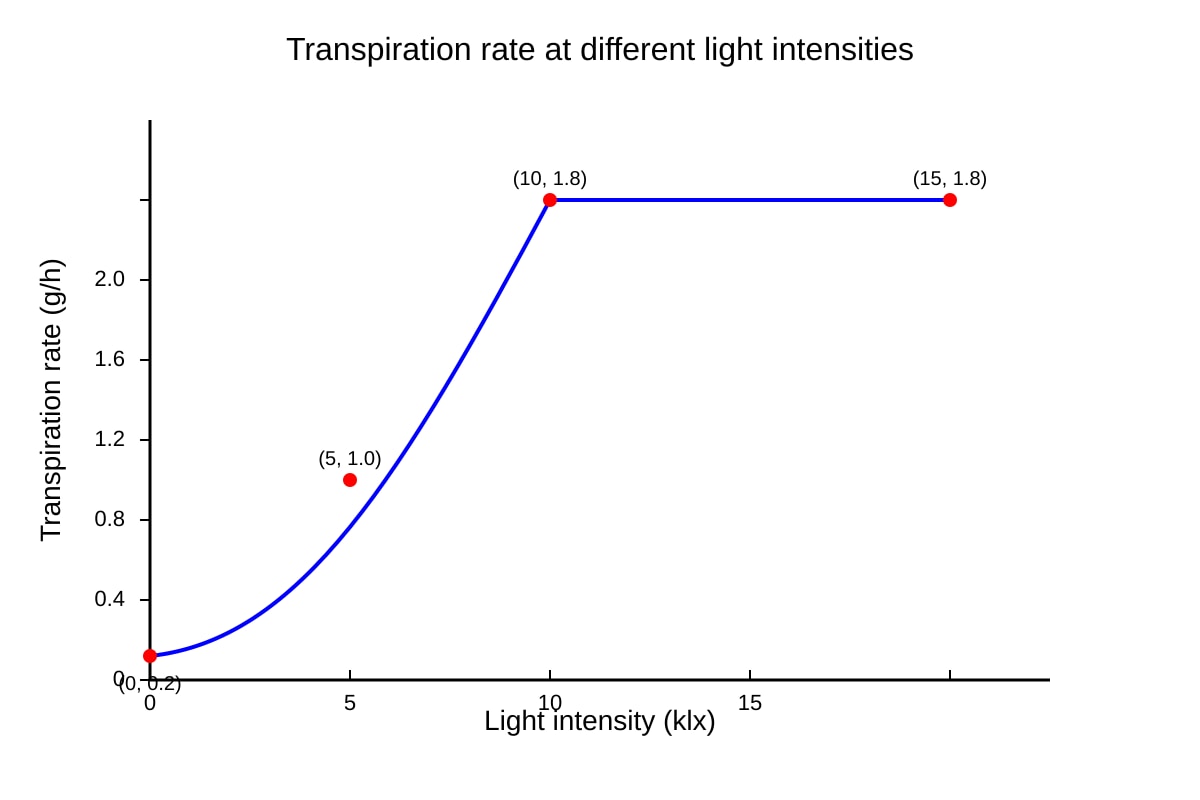
Higher light opens stomata and warms leaf, increasing evaporation → higher transpiration [1]; also more photosynthesis uses water [1]; at high light stomata may limit or humidity near leaf saturates so rate plateaus [1].
16. [3]
As distance increases, bubble rate decreases (inverse relationship) [1]; farther lamp = lower light intensity [1]; light is limiting photosynthesis so less oxygen produced (fewer bubbles) [1].
17. [2]
Root hairs are on mature epidermal cells behind tip [1]; tip has meristem (dividing cells) not yet differentiated for absorption [1].
18. [2]
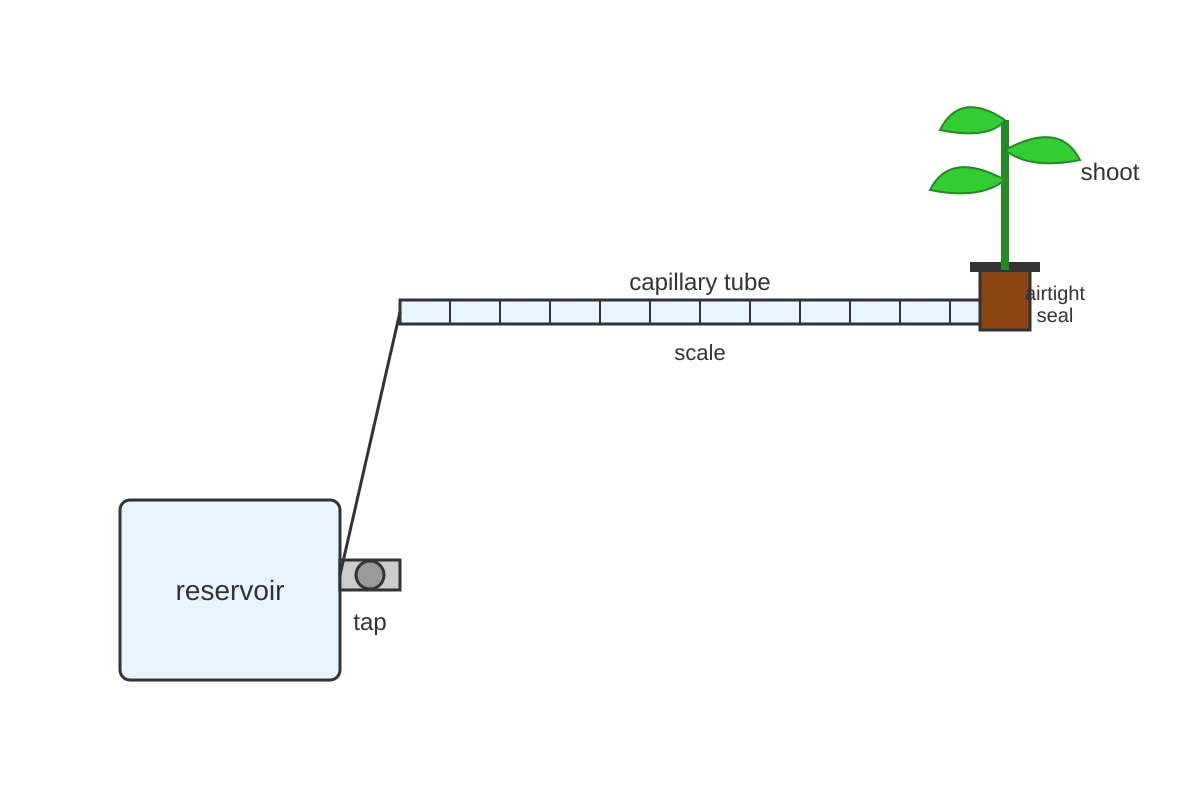
Any two: temperature, humidity, air movement, light intensity, species/size of shoot [1 each].
19. [2]
Light-dependent: thylakoid / grana [1]; light-independent: stroma [1].
20. [3]
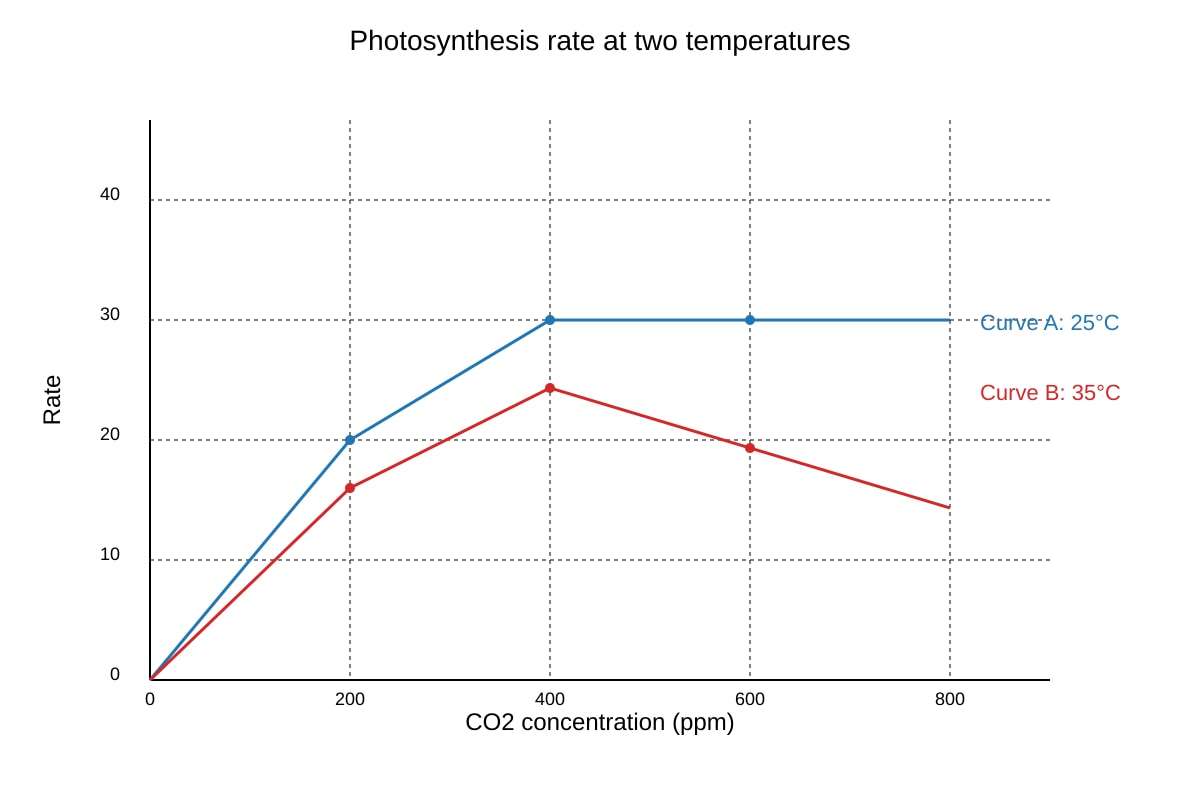
At 35°C enzymes (Rubisco) less efficient / begin to denature [1]; respiration increases more than photosynthesis using products [1]; so net rate lower despite high CO₂ [1].
Common mistakes to flag:
- Confusing xylem (water) with phloem (food).
- Writing diffusion for ion uptake (must be active).
- Plasmolysis described as bursting (that is animal cell lysis).
- Not stating "against gradient" in active transport.