AI Generated Quiz
O Level Biology Genetics Inheritance Quiz
Free O Level Biology Genetics Inheritance quiz, HY3 AI version, with questions, answers, and O Level-style practice for Singapore students.
These static practice materials are generated from the site's syllabus and paper-generation workflow, with source and model context shown so students and parents can evaluate the material before use.
Questions
Free quiz and exam paper access
Enter your details to view this paper
Your access is remembered on this device.
Answers
O-Level Biology Quiz - Genetics Inheritance (Answer Key)
Total Marks: 40
Syllabus-first practice generated from LLM-inferred templates. Not past-year derived.
Section A (1 mark each)
1. B (Ff)
Teaching note: Heterozygous means one dominant and one recessive allele. F = free (dominant), f = attached (recessive), so Ff.
Common mistake: choosing FF (homozygous dominant).
2. C (Mitosis)
Teaching note: Mitosis produces two diploid daughter cells genetically identical to parent. Meiosis produces non-identical gametes.
3. A (segment of DNA coding for a polypeptide)
Teaching note: A gene is a length of DNA that codes for a protein/polypeptide; alleles are different forms of the same gene.
4. B (46)
Teaching note: Human somatic cells are diploid (2n = 46); gametes have 23.
5. B (carried on the X chromosome)
Teaching note: Colour blindness is X-linked recessive; males have one X so a single recessive allele expresses the trait.
Section B (2 marks each)
6. Phenotype = observable characteristics of an organism (1) resulting from genotype + environment (1).
Teaching note: e.g., tall plant is phenotype; TT is genotype.
7. Two differences (1 each):
- Meiosis produces 4 haploid cells; mitosis produces 2 diploid cells.
- Meiosis involves crossing over / homologous pairing; mitosis does not.
- Meiosis gives genetic variation; mitosis gives identical cells.
(Any two correct.)
8. Genotypes: Rr and rr (1 each).
Working: Rr × rr → gametes R, r and r, r → offspring Rr, rr, Rr, rr → 50% Rr, 50% rr.
9. Males have one X chromosome (1); recessive X-linked allele expressed if present because no second X to mask it (1).
Teaching note: Females need two copies (X^h X^h) to show disorder.
10. Homozygous = two identical alleles for a gene (1). Example: TT or tt (1).
Section C
11. [4 marks]
(a) Parent genotypes: TT and tt (1).
(b) Genetic diagram:
      T    T   (from TT)
    ---------
 t |  Tt   Tt
 t |  Tt   Tt
All F1 = Tt (2 marks for correct diagram + labels).
(c) Phenotype ratio: 100% tall (1).
12. [3 marks]
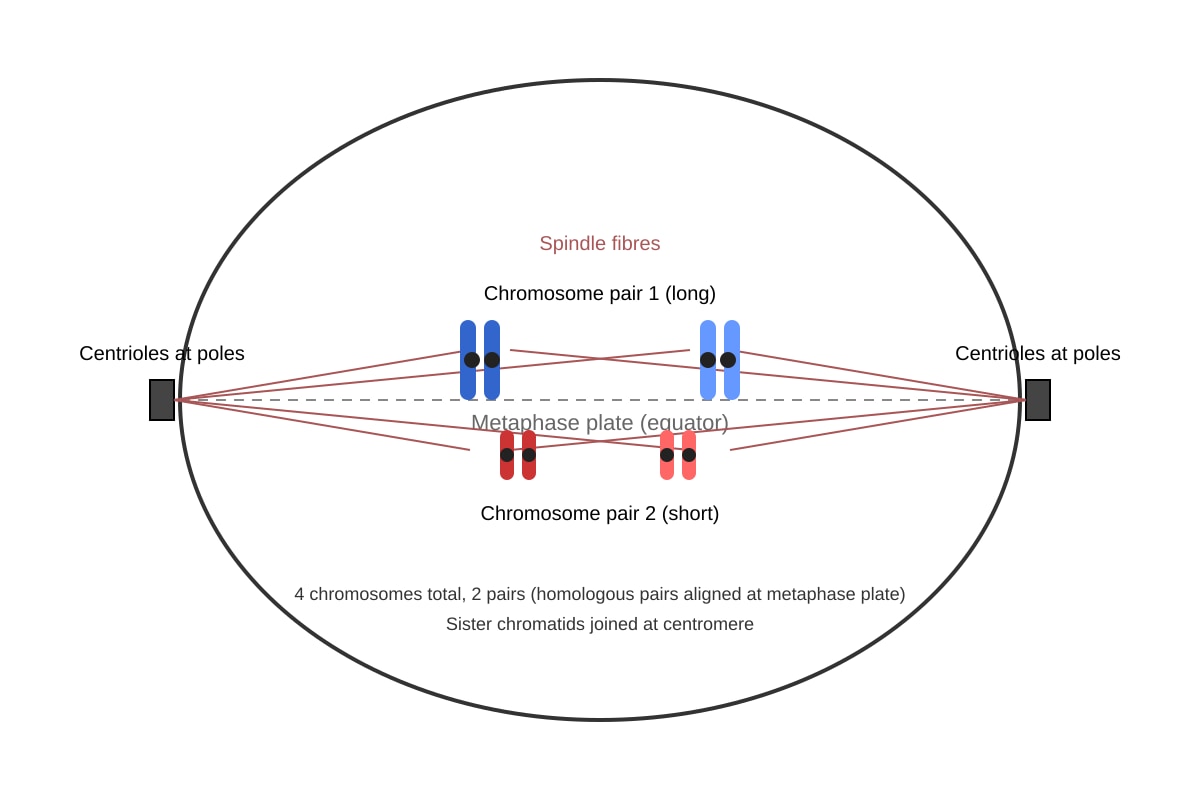
(a) Metaphase I of meiosis (1).
(b) Homologous chromosomes align at equator / spindle attaches (1).
(c) 4 daughter cells (1).
Image must show paired homologues at plate; answer verified by that.
13. [5 marks]
(a) Possible genotypes: I^A I^B, I^A i, I^B i, ii (2 marks: all four listed).
(b) Probability blood group O = 25% (1) (ii from i × i).
(c) Codominance: I^A and I^B both expressed in heterozygote (I^A I^B = AB) (1); neither masks other (1).
14. [4 marks]
(a) Punnett square:
      C    c
    ---------
 C |  CC   Cc
 c |  Cc   cc
``` (2)
(b) Affected (cc) = 25% (1).
(c) Carrier (Cc) = 50% (1).

**15. [3 marks]**
- DNA carries genetic information (1).
- Copied and passed to daughter cells / gametes (1).
- Sequence of bases codes for proteins determining traits (1).

**16. [5 marks]**
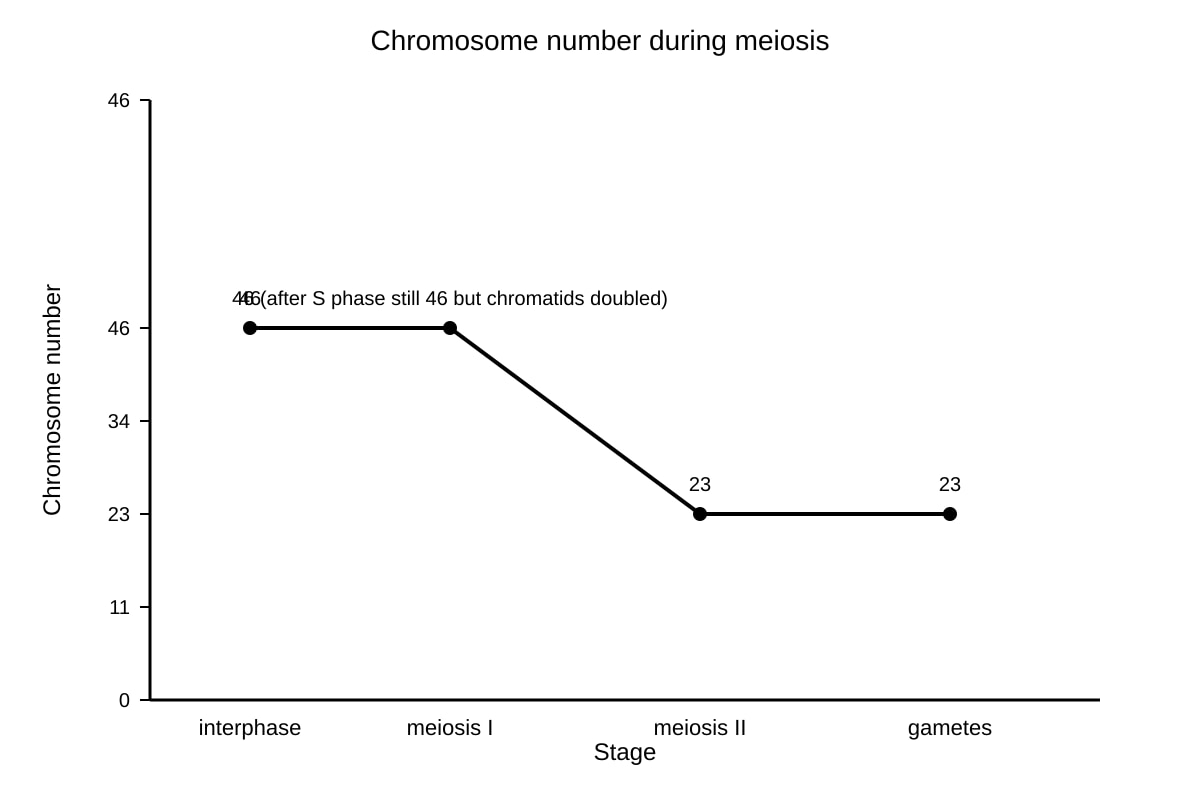
(a) 46 (1).
(b) After meiosis I homologous chromosomes separate into two cells, each gets 23 chromosomes (2).
(c) Halves chromosome number so fertilisation restores diploid (2).

**17. [3 marks]**
- Alleles separate during meiosis (1).
- Each gamete gets one allele of each gene (1).
- Random assortment gives variation (1).

**18. [4 marks]**
(a) Cross:
  X^H    Y
---------
X^H | X^H X^H X^H Y X^h | X^H X^h X^h Y
(b) Sons affected: 50% (X^h Y) (1).
(c) Daughters carriers: 50% (X^H X^h) (1).

**19. [3 marks]**
- Statement false (1).
- Recessive traits can skip generations (carriers unaffected) (1).
- Dominant usually appears every generation if expressed (1).

**20. [5 marks]**
(a) q² = 0.36 → q = √0.36 = 0.6 (1).
(b) p = 1 – q = 0.4 (1).
(c) 2pq = 2 × 0.4 × 0.6 = 0.48 → 48% (2).
(d) No mutation / random mating / large population (1).