AI Generated Quiz
O Level Biology Evolution Diversity Quiz
Free O Level Biology Evolution Diversity quiz, HY3 AI version, with questions, answers, and O Level-style practice for Singapore students.
These static practice materials are generated from the site's syllabus and paper-generation workflow, with source and model context shown so students and parents can evaluate the material before use.
Questions
Free quiz and exam paper access
Enter your details to view this paper
Your access is remembered on this device.
Answers
O-Level Biology Quiz - Evolution Diversity: Answer Key
Total Marks: 40
Topic: Evolution Diversity (syllabus-first, AI-generated from Stage 4 inferred patterns; not claimed as past-year derived)
1. [1] Natural selection is driven by environmental pressures without human intervention, whereas artificial selection is driven by humans choosing desirable traits for breeding.
Teaching note: Natural selection = survival of fittest in nature; artificial = e.g. dog breeding by humans.
2. [1] Example: forelimb of whale (used for swimming) and forelimb of human (used for grasping). Both are homologous.
Accept any valid mammal pair with functions.
3. [1] A species is a group of organisms that can interbreed and produce fertile offspring in nature.
Teaching note: Biological species concept focuses on reproductive isolation.
4. [1] Charles Darwin.
5. [1] Fossils show intermediate forms / show changes in structure over geological time.
e.g. Archaeopteryx shows link between reptiles and birds.
6. [4]
- Random mutation creates variation in bacteria, some are resistant [1]
- Antibiotic kills non-resistant bacteria [1]
- Resistant bacteria survive and reproduce [1]
- Over time resistant allele frequency increases in population [1]
Marking: 1 per point. Common mistake: saying bacteria "develop" resistance on purpose.
7. [2]
- Bacterial cell has peptidoglycan cell wall; animal cell has no wall [1]
- Bacterial cell has plasmids; animal cell does not [1]
Accept: nucleoid vs nucleus, 70S vs 80S ribosomes.
8. [3]
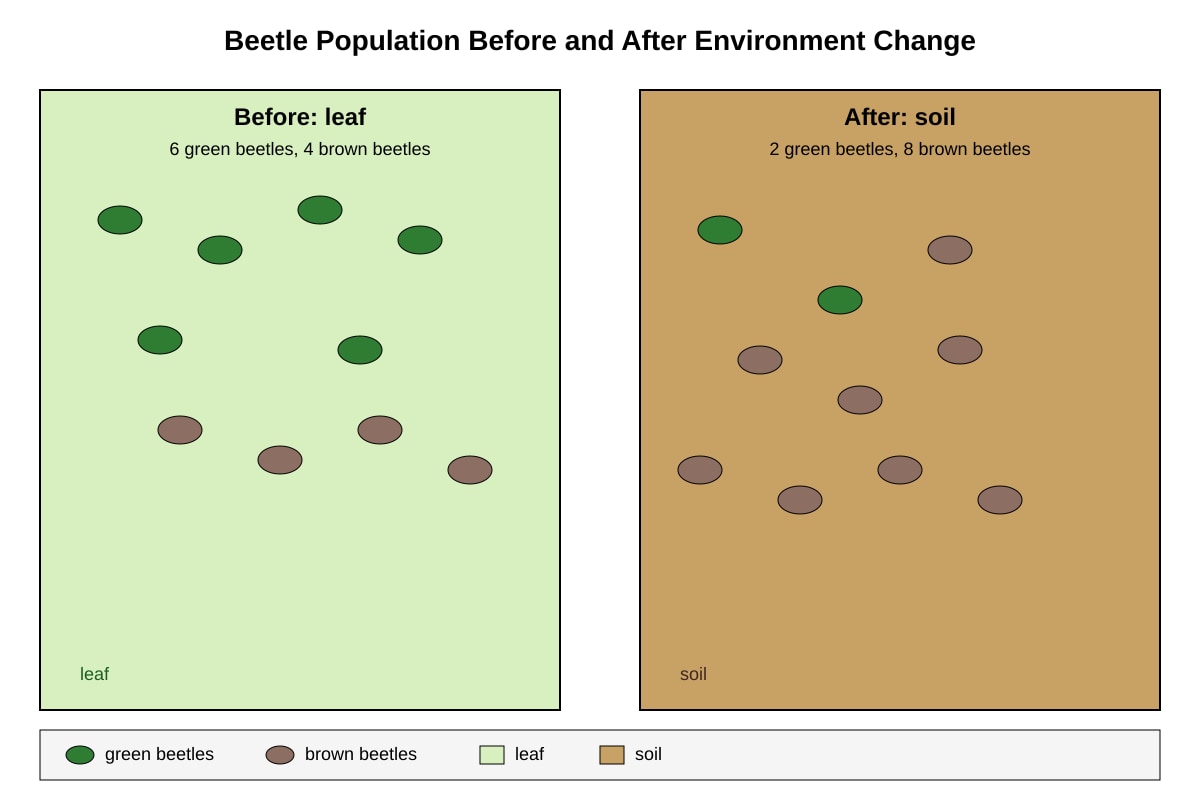
- Environment changed to brown soil, brown beetles camouflaged [1]
- Green beetles more visible to predators, eaten more [1]
- Brown beetles survived, reproduced, passing brown allele [1]
Based on Q8-fig1: before 6G/4B, after 2G/8B shows shift.
9. [4]
- Convergent: unrelated species develop similar traits due to similar environment [1+1 e.g. dolphin & shark shape]
- Divergent: related species become different due to different environments [1+1 e.g. finches' beaks]
Marking: definition + example each.
10. [4]
- Population split by physical barrier (river, mountain) [1]
- No gene flow between groups [1]
- Different selection pressures in each area [1]
- Accumulation of differences leads to reproductive isolation [1]
11. [2]
- Comparative anatomy (homologous structures) [1]
- Molecular evidence (DNA/protein similarity) [1]
Accept embryology, biogeography.
12. [3]
- Homologous structures have same basic bone layout [1]
- Suggest inherited from common ancestor [1]
- Modified for different functions in different species [1]
13. [3]
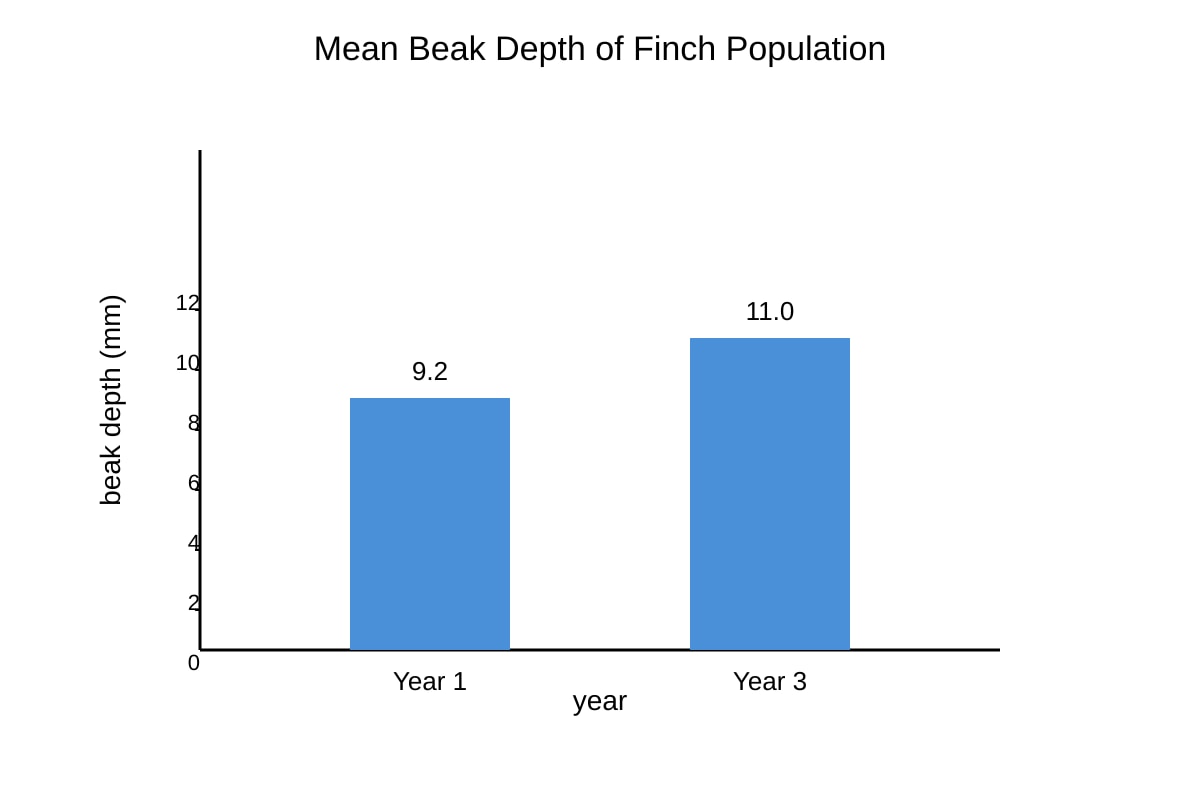
- Drought reduced small seeds, only large hard seeds left [1]
- Birds with deeper beaks could crack them, survived [1]
- Passed trait to offspring, mean depth increased (9.2→11.0 mm) [1]
From Q13-fig1 bar increase.
14. [2]
- Mutation [1]
- Sexual reproduction / recombination [1]
Accept gene flow.
15. [3]
- Low variation = fewer traits to adapt to change [1]
- Environmental change may kill most/all [1]
- Less chance of resistant individuals surviving [1]
16. [2]
- Species A and B most closely related [1]
- Fewest amino acid differences (3) [1]
Teaching: fewer differences = more recent common ancestor.
17. [1] Species D (18 differences from A).
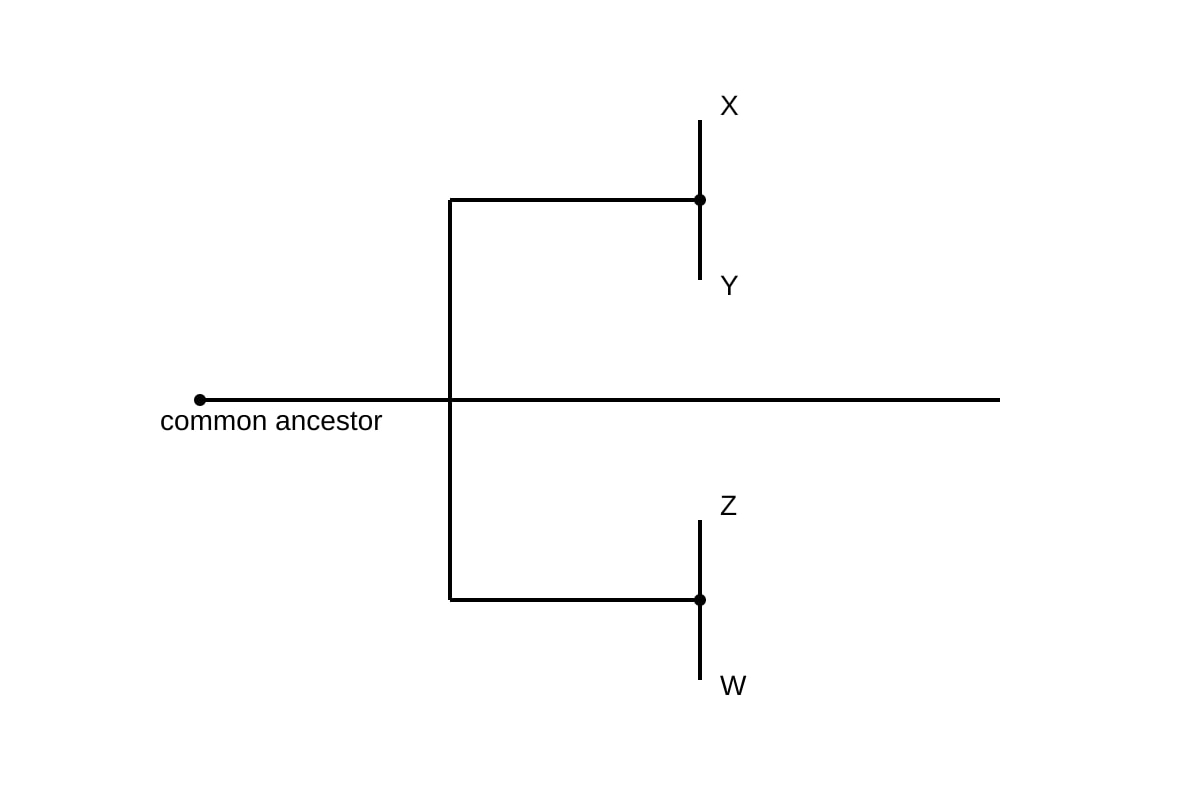
18. [1] X and Y (share most recent node in Q18-fig1).
19. [2]
- Shorter branch / recent node = closer relation [1]
- Tree shows divergence order from common ancestor [1]
20. [3]
- Insecticide is selection pressure [1]
- Resistant mosquitoes survived, bred [1]
- Frequency of resistance allele rose to 80% [1]
Common mistake: thinking insecticide created mutation, not selected it.