AI Generated Quiz
O Level Biology Cells Biomolecules Quiz
Free O Level Biology Cells Biomolecules quiz, DeepSeek AI version, with questions, answers, and O Level-style practice for Singapore students.
These static practice materials are generated from the site's syllabus and paper-generation workflow, with source and model context shown so students and parents can evaluate the material before use.
Questions
Free quiz and exam paper access
Enter your details to view this paper
Your access is remembered on this device.
Answers
O-Level Biology Quiz - Cells Biomolecules - ANSWER KEY
Total Marks: 50
Section A: Short Answer Questions (10 marks)
1. State the function of the Golgi body in a cell. [1]
- Answer: The Golgi body modifies, sorts, and packages proteins and lipids for secretion from the cell / for transport to other parts of the cell.
- Marking note: Accept "chemically modifies substances made by the ER and packages them into vesicles for secretion." Award [1] for any correct function.
2. Name the carbohydrate molecule that forms the cell wall of plant cells. [1]
- Answer: Cellulose.
- Marking note: Must be "cellulose" exactly. Do not accept "starch" or "glycogen."
3. State the chemical elements present in proteins that are NOT present in carbohydrates. [1]
- Answer: Nitrogen (and sometimes sulfur).
- Marking note: Award [1] for "nitrogen" or "nitrogen and sulfur." Do not accept carbon, hydrogen, or oxygen alone.
4. Name the reagent used to test for the presence of reducing sugars and state the colour change observed for a positive result. [2]
- Reagent: Benedict's solution. [1]
- Colour change: Blue to brick-red (or green/yellow/orange to brick-red precipitate). [1]
- Marking note: Accept "Benedict's reagent." For colour change, accept any description indicating formation of brick-red/orange-red precipitate.
5. Define the term enzyme specificity. [2]
- Answer: Enzyme specificity means that each enzyme can only catalyse one specific type of reaction / act on one specific substrate [1] because the shape of the enzyme's active site is complementary to the shape of its specific substrate molecule [1].
- Marking note: Award [1] for "acts on only one substrate" or "catalyses only one reaction" and [1] for linking to complementary shape of active site.
Section B: Structured Questions (15 marks)
6. State what is meant by the term activation energy. [1]
- Answer: Activation energy is the minimum amount of energy required for a chemical reaction to occur / to start a reaction.
- Marking note: Accept "energy needed to start a reaction" or "energy barrier that must be overcome for a reaction to proceed."
7. Name the type of bond that joins amino acids together to form a polypeptide chain. [1]
- Answer: Peptide bond.
- Marking note: Must be "peptide bond." Do not accept "hydrogen bond" or "ionic bond."
8. State one function of fats (lipids) in living organisms. [1]
- Answer: Any one of: long-term energy storage / insulation (thermal or electrical) / protection of vital organs / component of cell membranes (phospholipids) / source of metabolic water.
- Marking note: Award [1] for any one correct function.
9. Organelle identification and function.
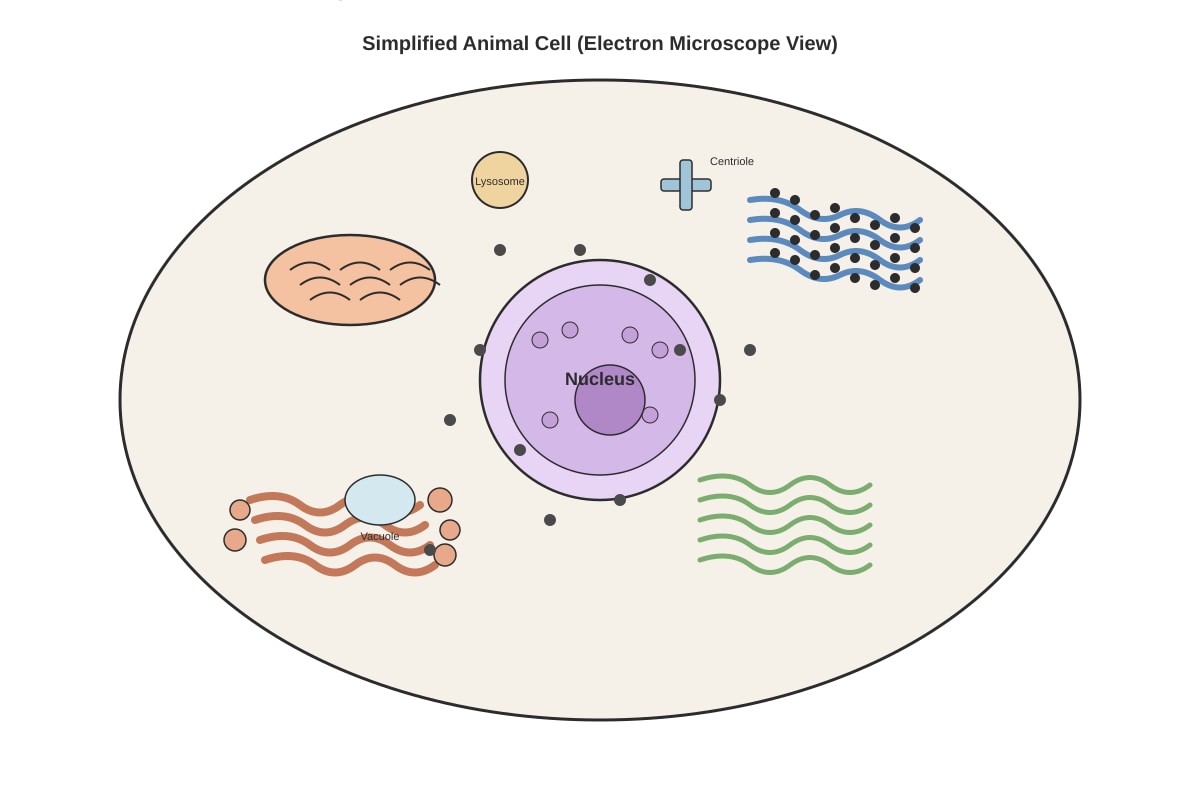
(a) Identify organelle A, which has a folded inner membrane. [1]
- Answer: Mitochondrion.
- Marking note: Accept "mitochondria" (plural). Do not accept "chloroplast."
(b) Identify organelle B, which has ribosomes attached to its surface. [1]
- Answer: Rough endoplasmic reticulum (RER).
- Marking note: Accept "rough ER" or "rough endoplasmic reticulum." Must specify "rough."
(c) Organelle C is the site of protein synthesis. Name organelle C. [1]
- Answer: Ribosome.
- Marking note: Accept "ribosomes."
(d) Explain how the structure of organelle A is adapted for its function. [2]
- Answer: The mitochondrion has a folded inner membrane (cristae) [1] which provides a large surface area for the attachment of respiratory enzymes and for ATP production during aerobic respiration [1].
- Marking note: Award [1] for identifying folded inner membrane/cristae and [1] for linking to increased surface area for respiration/ATP production.
10. Osmosis investigation with potato strips.
(a) Explain why the potato strip increased in length when placed in distilled water. [3]
- Answer: Distilled water has a higher water potential than the cell sap of the potato cells [1]. Water moves into the potato cells by osmosis, from a region of higher water potential to lower water potential, across the partially permeable cell membrane [1]. The cells become turgid, causing the potato strip to increase in length [1].
- Marking note: Award [1] for water potential comparison, [1] for osmosis explanation (direction, membrane), [1] for turgidity/increase in length.
(b) Explain why there was no change in length when the potato strip was placed in the 0.4 mol/dm³ sucrose solution. [2]
- Answer: The water potential of the 0.4 mol/dm³ sucrose solution is equal to the water potential of the cell sap in the potato cells [1]. There is no net movement of water into or out of the cells by osmosis [1].
- Marking note: Award [1] for equal water potential and [1] for no net water movement.
(c) Predict what would happen to the length of a potato strip placed in a 1.0 mol/dm³ sucrose solution. Explain your answer. [2]
- Answer: The potato strip would decrease in length / become shorter [1]. The 1.0 mol/dm³ sucrose solution has a lower water potential than the cell sap, so water moves out of the potato cells by osmosis, causing the cells to become flaccid/plasmolysed [1].
- Marking note: Award [1] for correct prediction and [1] for explanation linking water potential and water loss.
Section C: Structured Questions (15 marks)
11. Enzyme action.
(a) Describe the lock-and-key hypothesis of enzyme action. [3]
- Answer: The substrate molecule has a specific three-dimensional shape that is complementary to the shape of the enzyme's active site [1]. The substrate fits into the active site to form an enzyme-substrate complex [1]. The reaction occurs, products are formed, and the products leave the active site. The enzyme remains unchanged and can be reused [1].
- Marking note: Award [1] for complementary shape, [1] for enzyme-substrate complex formation, [1] for products released and enzyme unchanged/reused.
(b) Explain how a high temperature (above 60°C) affects the rate of an enzyme-catalysed reaction. [3]
- Answer: At high temperatures above the optimum, the enzyme is denatured [1]. The high temperature breaks the hydrogen bonds and other bonds that maintain the specific three-dimensional shape of the enzyme [1]. The active site loses its complementary shape, so the substrate can no longer fit into the active site, and the rate of reaction decreases to zero [1].
- Marking note: Award [1] for denaturation, [1] for bonds broken/shape changed, [1] for active site no longer complementary / substrate cannot bind.
(c) Amylase is an enzyme that digests starch. Explain why amylase cannot digest proteins. [2]
- Answer: Amylase has an active site with a specific shape that is complementary only to the starch molecule [1]. The protein molecule has a different shape that is not complementary to the active site of amylase, so it cannot bind and form an enzyme-substrate complex [1].
- Marking note: Award [1] for enzyme specificity / complementary shape concept and [1] for explaining that protein shape does not match amylase active site.
12. Food test results interpretation.
(a) Identify the main nutrient present in food sample P. [1]
- Answer: Starch.
- Marking note: Iodine test positive (blue-black) indicates starch.
(b) Identify the main nutrient present in food sample Q. [1]
- Answer: Reducing sugar.
- Marking note: Benedict's test positive (brick-red) indicates reducing sugar.
(c) A student claims that food sample R contains protein. Explain whether the results support this claim. [2]
- Answer: Yes, the results support the claim [1]. The Biuret test gave a purple colour, which is a positive result indicating the presence of protein [1].
- Marking note: Award [1] for "yes" and [1] for linking purple Biuret result to protein presence.
(d) Describe the procedure for carrying out the ethanol emulsion test for fats. [2]
- Answer: Add a small amount of the food sample to a test tube containing ethanol and shake thoroughly [1]. Pour the liquid into a test tube containing water and shake. A white (milky) emulsion indicates the presence of fats [1].
- Marking note: Award [1] for dissolving in ethanol and [1] for adding water and observing white emulsion.
13. Enzyme activity and pH.
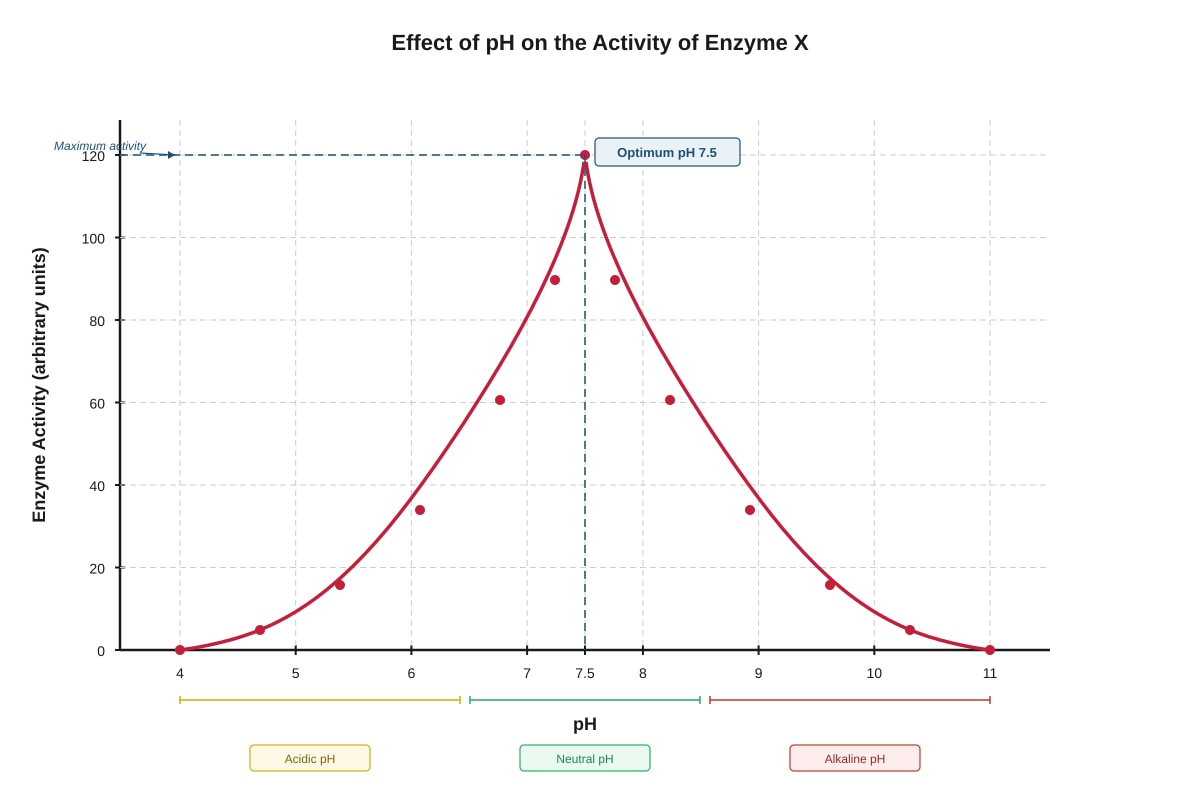
(a) State the optimum pH for enzyme X. [1]
- Answer: pH 7.5.
- Marking note: Accept "7.5" only.
(b) Describe the effect of pH on the activity of enzyme X between pH 4 and pH 7.5. [2]
- Answer: As the pH increases from 4 to 7.5, the activity of enzyme X increases [1] until it reaches its maximum activity at pH 7.5 [1].
- Marking note: Award [1] for increasing activity and [1] for maximum at pH 7.5.
(c) Explain why enzyme X shows very low activity at pH 4. [3]
- Answer: At pH 4, the pH is far from the optimum pH of enzyme X [1]. The high acidity (low pH) alters the charges on the amino acids in the enzyme, disrupting the ionic and hydrogen bonds that maintain the specific three-dimensional shape of the enzyme [1]. This causes the enzyme to denature, changing the shape of the active site so that the substrate can no longer bind effectively [1].
- Marking note: Award [1] for pH far from optimum, [1] for bonds disrupted/shape altered, [1] for active site no longer complementary / denaturation.
(d) Suggest where in the human body enzyme X might function. Give a reason for your answer. [2]
- Answer: Enzyme X might function in the small intestine / blood / cytoplasm of cells [1] because these locations have a pH close to neutral (around pH 7-8), which matches the optimum pH of enzyme X [1].
- Marking note: Award [1] for a suitable location with near-neutral pH and [1] for linking to optimum pH.
Section D: Data-Based and Extended Response Questions (10 marks)
14. Biological molecules.
(a) Name the smaller units (monomers) that make up each of the following large molecules: [3]
- (i) Starch: Glucose. [1]
- (ii) Proteins: Amino acids. [1]
- (iii) Lipids: Glycerol and fatty acids. [1]
- Marking note: Award [1] for each correct monomer. For lipids, both glycerol and fatty acids must be named for the mark.
(b) Describe the test for starch, including the reagent used and the expected result if starch is present. [2]
- Answer: Add a few drops of iodine solution (iodine in potassium iodide) to the food sample [1]. A blue-black colour indicates the presence of starch [1].
- Marking note: Award [1] for iodine solution and [1] for blue-black colour.
(c) Glycogen and starch are both storage carbohydrates. State where glycogen is stored in the human body and explain why it is a suitable storage molecule. [2]
- Answer: Glycogen is stored in the liver and muscles [1]. It is suitable because it is a large, insoluble molecule that does not affect the osmotic balance of cells, and it can be easily broken down into glucose when energy is needed [1].
- Marking note: Award [1] for liver/muscles and [1] for insolubility / no osmotic effect / easily mobilised.
15. Plant and animal cells.
(a) State one structure present in a plant cell that is not present in an animal cell. [1]
- Answer: Cell wall / chloroplast / large central vacuole.
- Marking note: Award [1] for any one correct structure.
(b) State one structure present in an animal cell that is not present in a plant cell. [1]
- Answer: Centrioles / lysosomes (accept other correct answers).
- Marking note: Award [1] for any one correct structure.
(c) Explain why plant cells have a cell wall while animal cells do not. [2]
- Answer: Plant cells have a cell wall made of cellulose that provides structural support and maintains the shape of the cell, which is important because plants do not have a skeleton [1]. Animal cells have a flexible cell membrane and rely on a skeleton or other support structures, so a rigid cell wall is not needed and would restrict movement [1].
- Marking note: Award [1] for support/rigidity in plants and [1] for animals not needing it / flexibility.
16. Diffusion experiment.
(a) Describe the relationship between temperature and the time taken for the dye to spread evenly. [1]
- Answer: As temperature increases, the time taken for the dye to spread evenly decreases.
- Marking note: Accept "inverse relationship" or "higher temperature, shorter time."
(b) Explain the effect of temperature on the rate of diffusion observed in this experiment. [2]
- Answer: At higher temperatures, the dye particles and water molecules have more kinetic energy [1]. They move faster, so the dye particles spread out more quickly through the water, increasing the rate of diffusion [1].
- Marking note: Award [1] for increased kinetic energy and [1] for faster movement / increased rate of diffusion.
17. State two differences between aerobic and anaerobic respiration in humans. [2]
- Answer: Any two of:
- Aerobic respiration requires oxygen; anaerobic respiration does not.
- Aerobic respiration produces a large amount of ATP (energy); anaerobic respiration produces a small amount of ATP.
- Aerobic respiration produces carbon dioxide and water; anaerobic respiration produces lactic acid (in humans).
- Aerobic respiration occurs in the mitochondria; anaerobic respiration occurs in the cytoplasm.
- Marking note: Award [1] for each correct difference, up to [2].
18. Name the process by which carbon dioxide enters a leaf and state one adaptation of a leaf for efficient gas exchange. [2]
- Answer: Diffusion [1]. Adaptation: thin/flat shape / large surface area / presence of stomata / air spaces in spongy mesophyll [1].
- Marking note: Award [1] for diffusion and [1] for any one correct adaptation.
19. Define the term osmosis. [2]
- Answer: Osmosis is the net movement of water molecules [1] from a region of higher water potential to a region of lower water potential, through a partially permeable membrane [1].
- Marking note: Award [1] for water movement and [1] for water potential gradient and partially permeable membrane.
20. Explain why a balanced diet must include proteins. [2]
- Answer: Proteins are needed for growth and repair of body tissues [1]. They are also used to make enzymes, hormones, and antibodies, which are essential for body functions [1].
- Marking note: Award [1] for growth/repair and [1] for enzymes/hormones/antibodies or other specific functions.