AI Generated Quiz

O Level Biology Cells Biomolecules Quiz

Free AI-Generated O Level Biology Cells Biomolecules quiz with questions and answers for Singapore students. This page is rendered as a direct URL so the questions and answers can be discovered without pressing in-page buttons.

These static practice materials are generated from the site's syllabus and paper-generation workflow, with source and model context shown so students and parents can evaluate the material before use.

O Level Biology AI Generated Generated by Claude Sonnet 4 Updated 2026-06-03

Questions

O-Level Biology Quiz - Cells Biomolecules

Name: _________________ Class: _______ Date: _________

Score: _____ / 50 Duration: 45 minutes

Instructions:

  • Answer all questions in the spaces provided
  • Show your working for calculation questions
  • Use appropriate biological terminology

Section A: Short Answer Questions [20 marks]

1. Name the process by which large molecules are built from smaller subunits in living organisms. [1]


2. State the chemical elements present in proteins that are not found in carbohydrates. [1]


3. Complete the word equation for aerobic respiration: [2]

Glucose + _________________ → _________________ + Water + Energy

4. Name the organelle where aerobic respiration takes place in plant and animal cells. [1]


5. State two functions of the cell membrane. [2]

(a) _________________________________

(b) _________________________________

6. Name the type of transport that moves substances against their concentration gradient. [1]


7. Complete the following sentence about enzyme specificity: [2]

Enzymes are specific because the shape of the _________________ is complementary to the shape of the _________________.

8. State the optimum pH for pepsin, the protein-digesting enzyme in the stomach. [1]


9. Name two end products of protein digestion. [2]

(a) _________________________________

(b) _________________________________

10. Give the food test that would produce a brick-red precipitate. [1]


11. State what happens to excess amino acids in the liver. [2]


12. Name the process by which water moves across a partially permeable membrane. [1]


13. State two differences between prokaryotic and eukaryotic cells. [2]

(a) _________________________________

(b) _________________________________

14. Name the carbohydrate stored in plant cells. [1]


Section B: Structured Questions [30 marks]

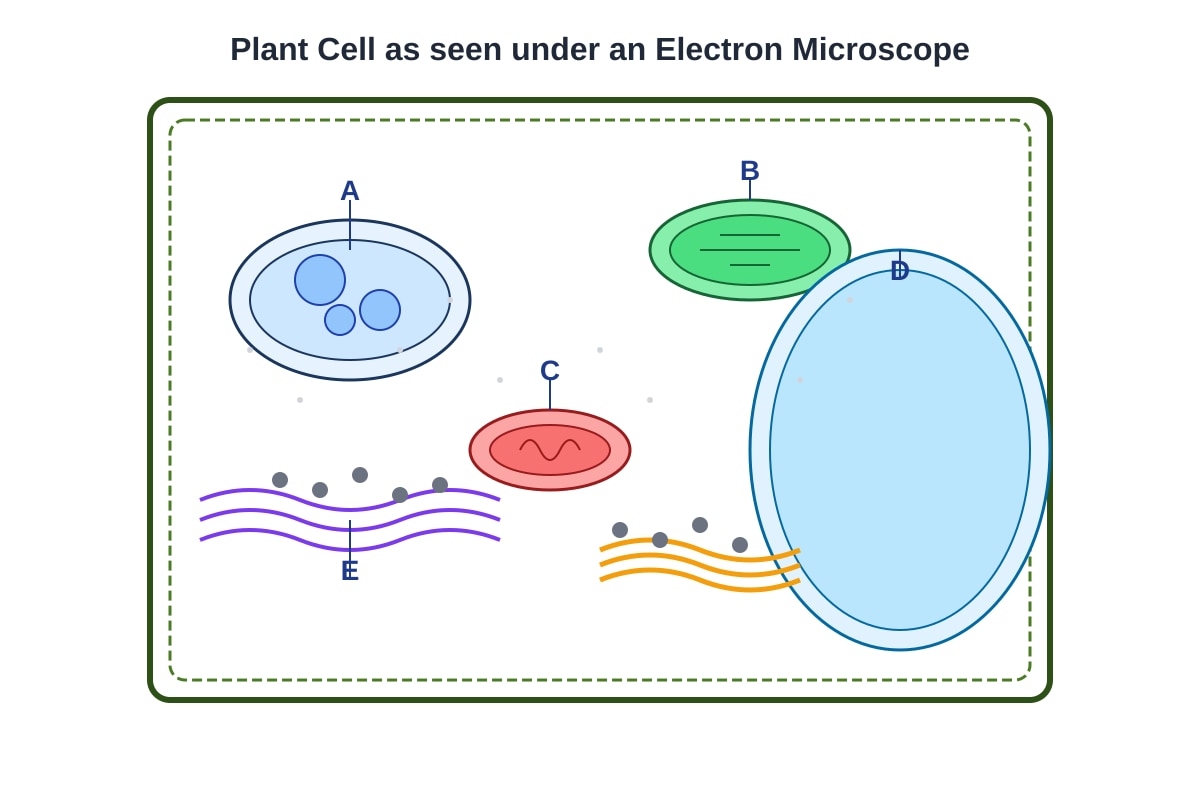
15. The diagram shows a plant cell as seen under an electron microscope.

[Diagram would show labeled plant cell with organelles A-E marked]

(a) Name organelles A and B. [2]

A: _________________________________

B: _________________________________

(b) Explain how organelle A is adapted for its function. [3]


(c) State one function of organelle B that does not occur in animal cells. [1]


16. An investigation was carried out to study the effect of temperature on enzyme activity. The results are shown in the table below.

Temperature (°C)Rate of reaction (arbitrary units)
1012
2025
3045
4060
5035
608

(a) Plot a graph of these results on the grid below. [3]

[Grid would be provided]

(b) State the optimum temperature for this enzyme. [1]


(c) Explain why the rate of reaction decreases above the optimum temperature. [2]


(d) Predict the rate of reaction at 0°C. Give a reason for your answer. [2]

Rate: _________________________________

Reason: _________________________________

17. Describe the process of active transport and explain why it is important for root hair cells. [6]


18. A student investigated osmosis using potato strips in different concentrations of sugar solution. The results are shown below.

Sugar concentration (%)Change in mass (%)
0+15
5+8
10+2
15-3
20-12

(a) Explain why the potato strips gained mass in 0% sugar solution. [3]


(b) Estimate the concentration of sugar solution that would cause no change in mass. Explain your answer. [2]

Concentration: _________________________________

Explanation: _________________________________

(c) Explain what would happen to plant cells if they were placed in a solution with a very high concentration of salt. [3]


Answers

O-Level Biology Quiz - Cells Biomolecules - Answer Key

Total Marks: 50


Section A: Short Answer Questions [20 marks]

1. Condensation / Anabolic reactions [1]

2. Nitrogen (and sulfur) [1]

3. Glucose + OxygenCarbon dioxide + Water + Energy [2]

  • 1 mark for oxygen
  • 1 mark for carbon dioxide

4. Mitochondrion / Mitochondria [1]

5. Any two from: [2]

  • Controls entry and exit of substances
  • Maintains cell shape
  • Allows communication between cells
  • Site of chemical reactions
  • Separates cell contents from environment

6. Active transport [1]

7. Enzymes are specific because the shape of the active site is complementary to the shape of the substrate. [2]

8. pH 1.5-2.0 (accept pH 1-3) [1]

9. Any two from: [2]

  • Amino acids
  • Peptides
  • Dipeptides

10. Benedict's test (for reducing sugars) [1]

11. Deamination occurs / Converted to urea [2]

  • 1 mark for deamination
  • 1 mark for urea formation

12. Osmosis [1]

13. Any two from: [2]

  • Prokaryotes have no nucleus / Eukaryotes have nucleus
  • Prokaryotes have no membrane-bound organelles / Eukaryotes have membrane-bound organelles
  • Prokaryotes have smaller ribosomes (70S) / Eukaryotes have larger ribosomes (80S)
  • Prokaryotes have plasmids / Eukaryotes do not have plasmids

14. Starch [1]


Section B: Structured Questions [30 marks]

15. (a) [2] A: Chloroplast B: Nucleus

(b) Any three from: [3]

  • Contains chlorophyll to absorb light
  • Has large surface area (thylakoids/grana) for light absorption
  • Has stroma containing enzymes for Calvin cycle
  • Double membrane controls entry/exit of substances

(c) Photosynthesis [1]

16. (a) Graph plotting: [3]

  • Correct axes labels with units (1 mark)
  • Correct scale and plotting of points (1 mark)
  • Smooth curve through points (1 mark)

(b) 40°C [1]

(c) [2]

  • High temperature denatures the enzyme (1 mark)
  • Active site changes shape so substrate cannot bind (1 mark)

(d) [2] Rate: Very low / close to 0 Reason: Low kinetic energy / few collisions between enzyme and substrate

17. [6 marks total] Mark scheme:

  • Active transport moves substances against concentration gradient (1)
  • Requires energy from ATP (1)
  • Uses carrier/transport proteins (1)
  • Important for root hair cells to absorb mineral ions (1)
  • Mineral ions needed for plant growth/metabolism (1)
  • Allows uptake even when soil concentration is lower than cell concentration (1)

18. (a) [3]

  • Water moves into potato cells by osmosis (1)
  • Water potential of potato cells lower than pure water (1)
  • Water moves down water potential gradient (1)

(b) [2] Concentration: Approximately 12-13% Explanation: This is the concentration where water potential of solution equals water potential of potato cells

(c) [3]

  • Water moves out of plant cells by osmosis (1)
  • Cell membrane pulls away from cell wall (1)
  • Cell becomes plasmolysed (1)