From Real Exams Quiz
O Level Biology Plant Biology Quiz
Free O Level Biology Plant Biology quiz, HY3 Exam version, with questions, answers, and O Level-style practice for Singapore students.
These static practice materials are generated from the site's syllabus and paper-generation workflow, with source and model context shown so students and parents can evaluate the material before use.
Questions
Free quiz and exam paper access
Enter your details to view this paper
Your access is remembered on this device.
Answers
O-Level Biology Quiz - Plant Biology: Answer Key
Total Marks: 40
Topic: Plant Biology (O-Level 6093, Theme III)
Section A: Short Answer
1. [1 mark]
Answer: Xylem
Teaching note: Xylem is the plant vascular tissue made of dead hollow cells that carries water and dissolved mineral ions upward from roots to leaves. Common mistake: confusing xylem with phloem (which carries sugars).
2. [1 mark]
Answer: Long and thin extension / large surface area / thin wall
Teaching note: A root hair cell is an epidermal cell with a hair-like projection. This increases surface area for absorption of water by osmosis and ions by active transport.
3. [1 mark]
Answer: Carbon dioxide + water → glucose + oxygen (light, chlorophyll)
Teaching note: Word equation for photosynthesis:
Marks for correct reactants and products.
4. [1 mark]
Answer: Cools the plant / transports minerals / maintains water column / pulls water up
Teaching note: Transpiration is loss of water vapour from leaves; it creates a suction (transpiration pull) that helps move water and minerals up the plant and cools leaves.
5. [1 mark]
Answer: Carbon dioxide
Teaching note: CO₂ enters via stomata for photosynthesis; O₂ is a product that exits.
Section B: Structured Response
6. [3 marks]
Answer:
- Soil water has higher water potential than root hair cell sap. [1]
- Water moves by osmosis across partially permeable membrane into cell. [1]
- Then moves into xylem via symplast/apoplast pathways. [1]
Teaching note: Osmosis = net movement of water from region of higher water potential to lower through partially permeable membrane. Mark for each clear step.
7. [4 marks]
Answer:
- Nitrate needed to make amino acids/proteins for growth. [1]
- Magnesium needed for chlorophyll synthesis. [1]
- Ions absorbed from soil by root hair cells. [1]
- Taken up by active transport (against gradient, uses ATP). [1]
Teaching note: Mineral deficiency: lack of nitrate → stunted growth; lack of Mg → chlorosis (yellow leaves). Active transport requires energy from respiration.
8. [3 marks]
Answer:
- Without O₂, root cells cannot respire aerobically. [1]
- Less ATP produced. [1]
- Active transport of mineral ions reduced, so uptake falls. [1]
Teaching note: Root hair active transport depends on mitochondrial ATP. Anaerobic conditions sharply cut ion uptake.
9. [3 marks]
Answer:
- Stomata open to let CO₂ in for photosynthesis. [1]
- Allow O₂ out. [1]
- Water vapour exits via stomata (transpiration). [1]
Teaching note: Guard cells control stomatal aperture. Common trap: saying stomata “breathe” – plants do not breathe like animals.
10. [4 marks]
Answer:
- Broad flat shape → large surface area to capture light. [1]
- Thin → short diffusion distance for gases. [1]
- Palisade layer has many chloroplasts → absorbs light. [1]
- Spongy mesophyll air spaces → gas exchange. [1]
Teaching note: Structure-function link is key in O-Level plant questions.
Section C: Data and Diagram Interpretation
11. [1 mark]
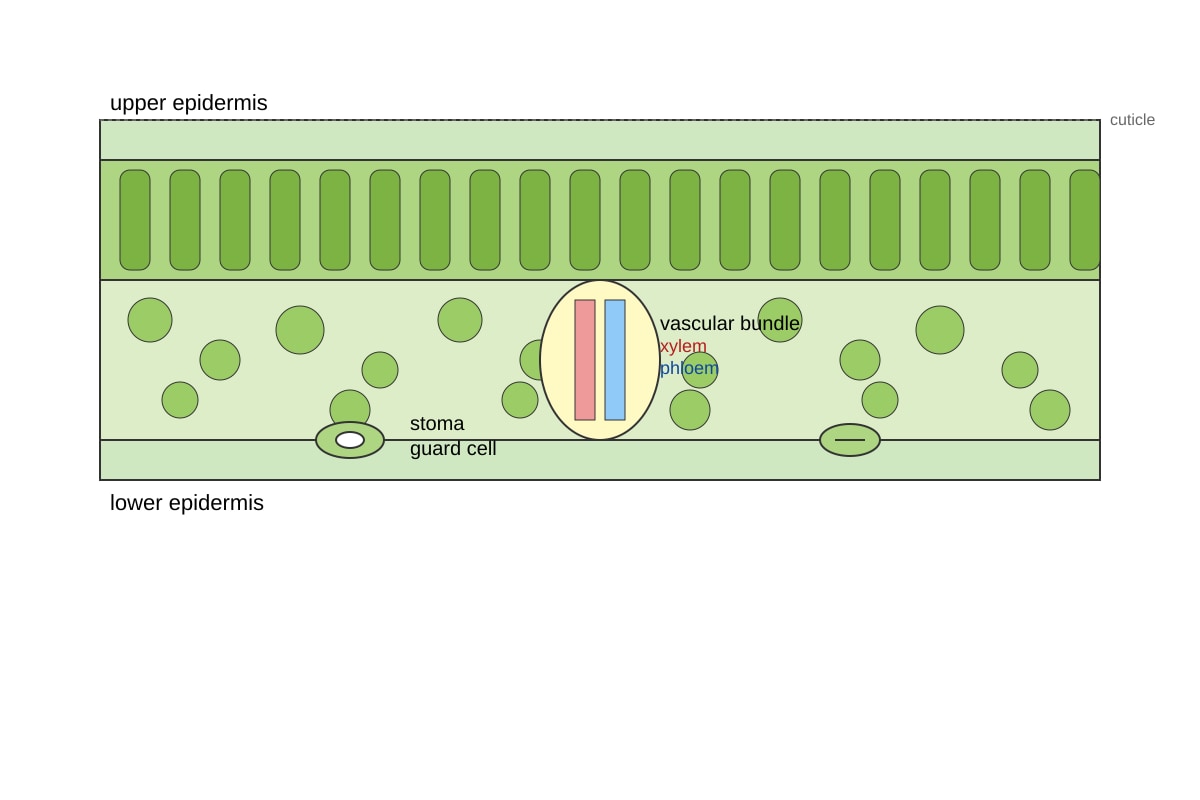
Answer: Palisade mesophyll / palisade layer
Teaching note: Palisade cells are packed with chloroplasts near upper surface to absorb most light.
12. [1 mark]
Answer: Air spaces between cells / loose arrangement
Teaching note: Air spaces increase surface area for CO₂ diffusion to cells.
13. [2 marks]
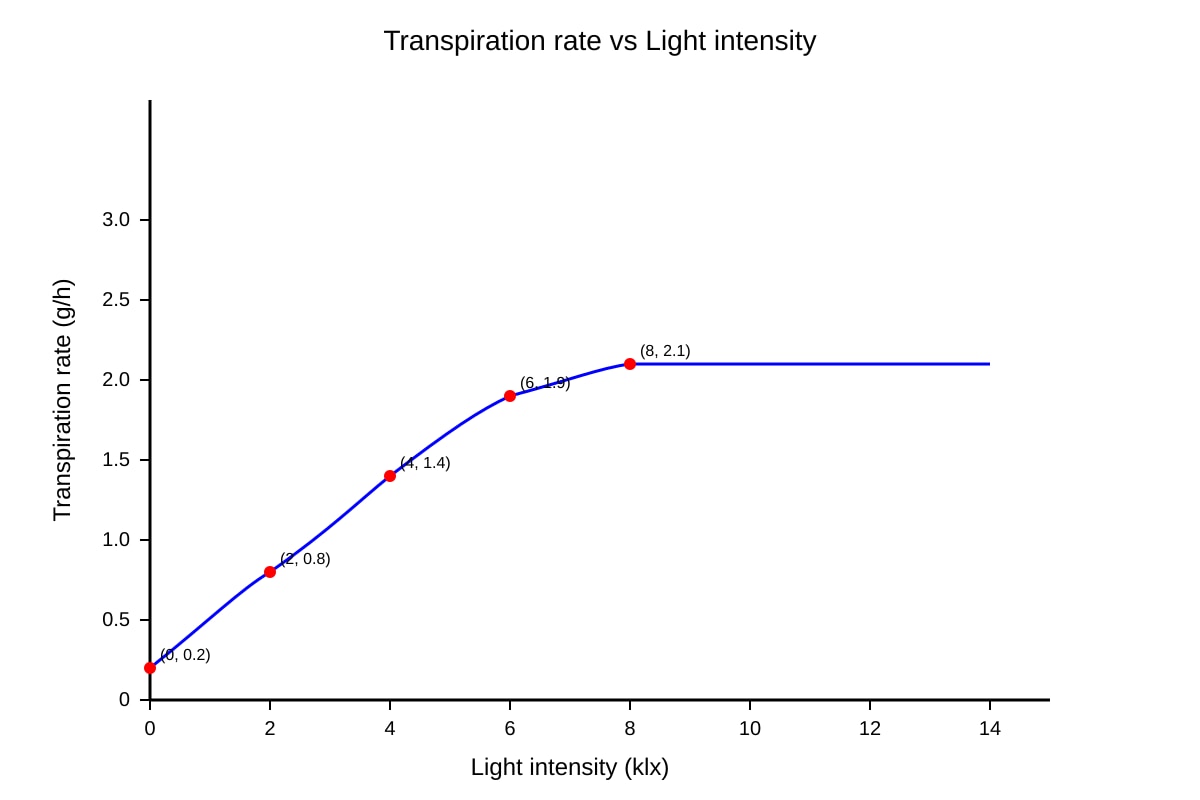
Answer: Transpiration rate increases with light intensity [1]; then levels off (plateau) after about 6 klx [1].
Teaching note: Describe both rising and plateau parts from graph.
14. [3 marks]
Answer:
- Higher light → stomata open wider → more evaporation. [1]
- More light → more photosynthesis → more water used. [1]
- Plateau because other factors limit (e.g. humidity, CO₂, max stomatal opening). [1]
15. [1 mark]
Answer: Fertiliser increased nitrate and magnesium content / plants absorbed more minerals.
Teaching note: Simple inference from table values.
16. [2 marks]
Working:
% increase =
= [2]
Answer: 192% (or 191.7%)
Teaching note: Show substitution. Common error: using wrong denominator.
17. [1 mark]
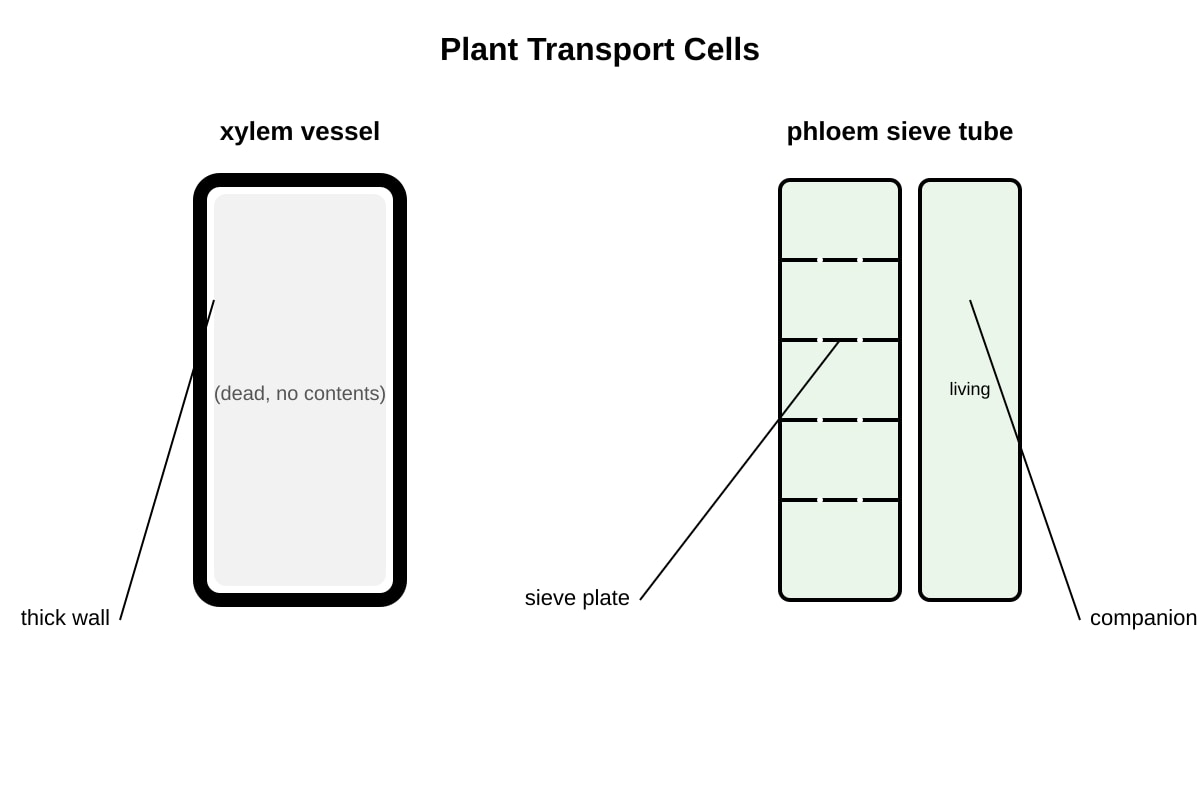
Answer: Xylem is dead with thick wall; phloem is living with sieve plates.
Teaching note: Any one valid structural difference from diagram.
18. [3 marks]
Answer:
- Transpiration loses water from leaves. [1]
- Creates tension pulling water up xylem. [1]
- Cohesion of water molecules transmits pull from top to roots. [1]
Teaching note: Cohesion-tension theory; water column is continuous.
19. [2 marks]
Working:
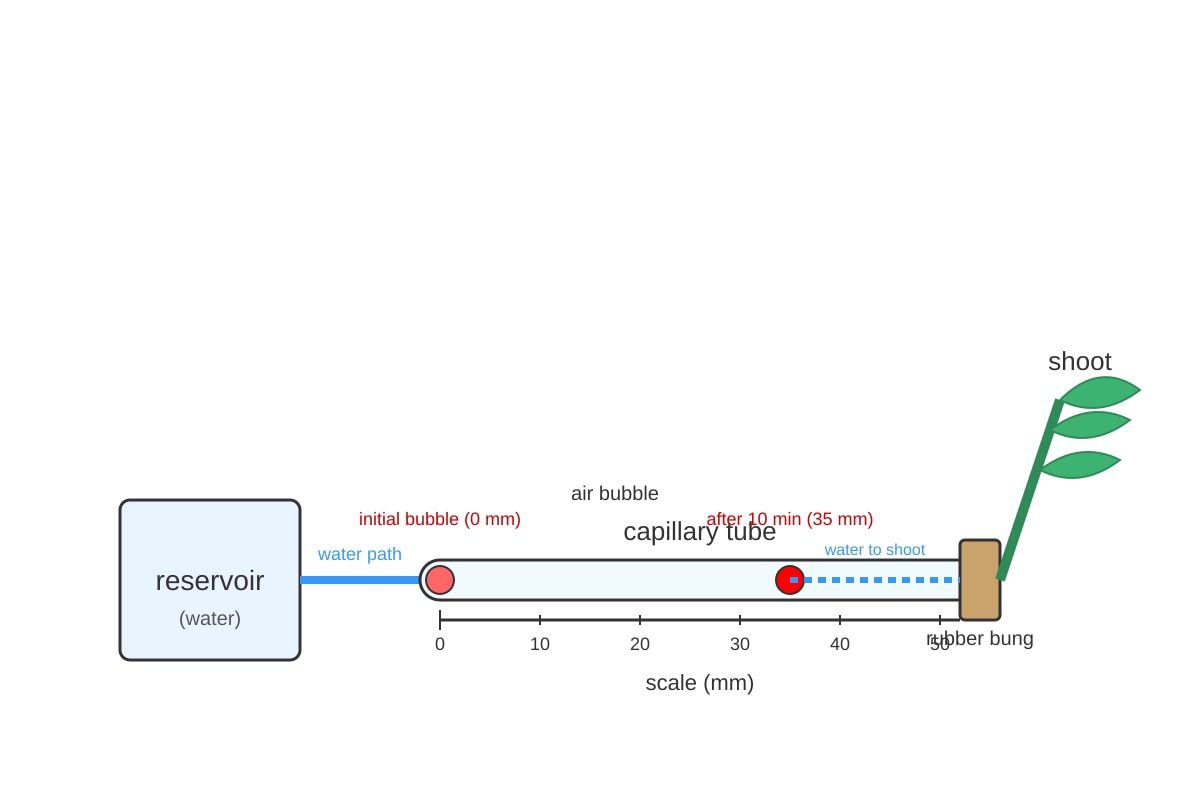
Distance = 35 mm − 0 mm = 35 mm
Rate = [2]
Answer: 3.5 mm/min
Teaching note: Potometer measures water uptake as proxy for transpiration. Units required.
20. [2 marks]
Answer: Any two:
- Closes stomata [1]
- Leaves wilt to reduce surface area [1]
- Thicker cuticle / hairs [1]
Teaching note: Two valid adaptations, 1 mark each.