From Real Exams Quiz
O Level Biology Genetics Inheritance Quiz
Free O Level Biology Genetics Inheritance quiz, HY3 Exam version, with questions, answers, and O Level-style practice for Singapore students.
These static practice materials are generated from the site's syllabus and paper-generation workflow, with source and model context shown so students and parents can evaluate the material before use.
Questions
O-Level Biology Quiz - Genetics Inheritance
Name: ___________________________
Class: ___________________________
Date: ___________________________
Score: _______ / 40
Duration: 50 minutes
Total Marks: 40
Instructions:
- Answer all 20 questions.
- Section A: Multiple-choice (1 mark each).
- Section B: Structured short answers (2 marks each).
- Section C: Extended response and genetics problems (3–4 marks each).
- Write your answers clearly in the spaces provided.
Section A: Multiple Choice (Questions 1–5)
1. In humans, the allele for free earlobes (F) is dominant over the allele for attached earlobes (f). A child with attached earlobes must have the genotype:
A. FF
B. Ff
C. ff
D. FF or Ff
____ (1)
2. Which process produces genetically identical daughter cells?
A. Meiosis
B. Mitosis
C. Fertilisation
D. Mutation
____ (1)
3. A pea plant with genotype Tt (tall) is crossed with tt (short). What is the probability of a short offspring?
A. 0%
B. 25%
C. 50%
D. 100%
____ (1)
4. Sex chromosomes in a human female are:
A. XY
B. XX
C. YY
D. XO
____ (1)
5. A mutation that changes a single base in DNA is best described as:
A. Chromosome deletion
B. Gene mutation
C. Crossing over
D. Polyploidy
____ (1)
Section B: Structured Short Answers (Questions 6–10)
6. State the term used to describe an organism that has two identical alleles for a trait.
________________________________________________________________ (2)
7. Give two differences between meiosis and mitosis.
(i) ________________________________________________________________
(ii) ________________________________________________________________ (2)
8. Explain why a gamete must contain only half the number of chromosomes of a body cell.
________________________________________________________________ (2)
9. Name the type of inheritance shown when both alleles are expressed in the heterozygote (e.g. AB blood group).
________________________________________________________________ (2)
10. State one way in which a gene mutation may affect a protein.
________________________________________________________________ (2)
Section C: Extended Response and Genetics Problems (Questions 11–20)
11. In pea plants, round seeds (R) are dominant to wrinkled seeds (r). A homozygous round plant is crossed with a wrinkled plant.
(a) State the genotypes of the parent plants. (1)
(b) Give the genotype and phenotype of the F1 offspring. (2)
______________________________________________________________ (3)
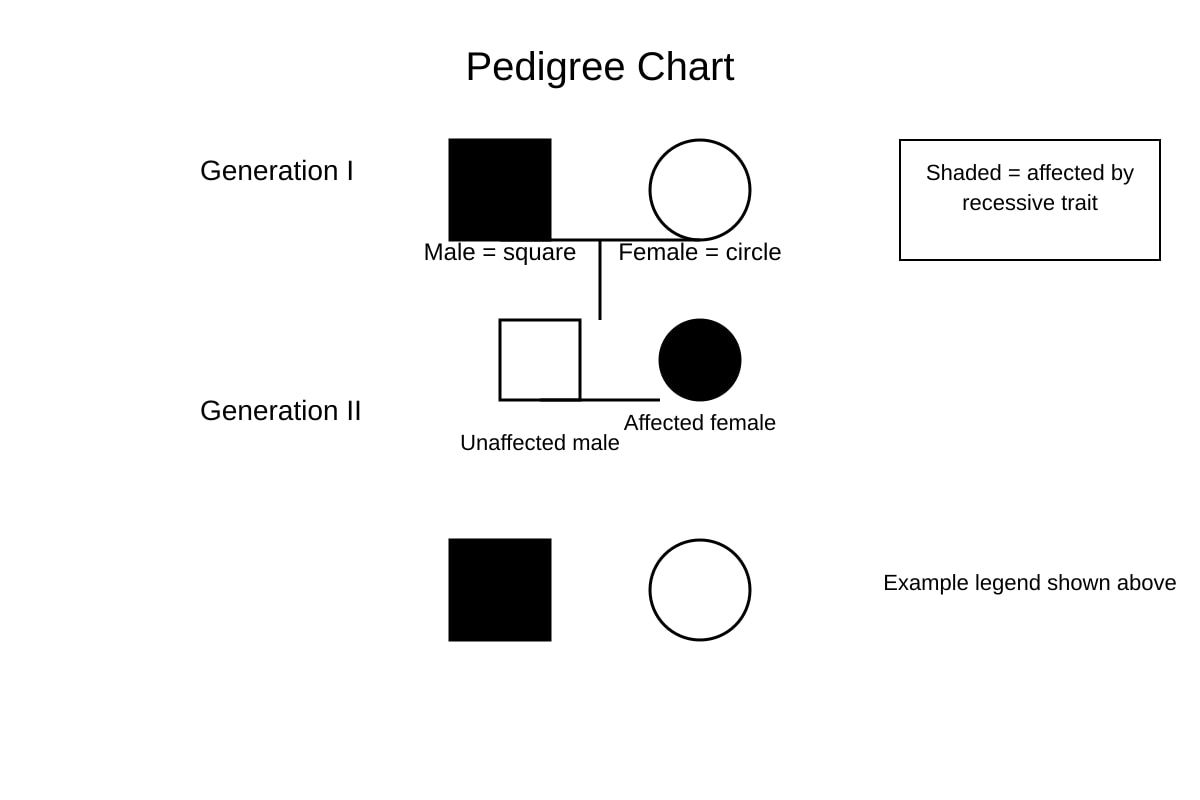
12. The diagram below shows a pedigree for a recessive trait in humans.
Image pending generation: diagram for Q12.
State the genotype of the shaded female in Generation II if the trait is caused by a recessive allele a. Explain your answer. (3)
______________________________________________________________ (3)
13. In a certain family, the father is blood group A (genotype I^A i) and the mother is blood group B (genotype I^B i). Show, using a genetic cross, the possible blood groups of their children. (4)
______________________________________________________________ (4)
14. Describe the stages of meiosis I that lead to genetic variation. (3)
______________________________________________________________ (3)
15. A farmer crosses a red-flowered plant (RR) with a white-flowered plant (rr). All F1 are pink. He then selfs the F1.
(a) State the inheritance pattern shown. (1)
(b) Give the phenotypic ratio of the F2 generation. (2)
______________________________________________________________ (3)
16. Explain how non-disjunction during meiosis can lead to Down syndrome. (3)
______________________________________________________________ (3)
17. The table shows the results of a cross between two heterozygous Drosophila (fruit flies) for wing shape.
| Phenotype | Number |
|---|---|
| Normal | 228 |
| Vestigial | 76 |
Use the data to determine the likely genotype of the parents and explain your reasoning. (4)
______________________________________________________________ (4)
18. Define the term "allele" and distinguish it from "gene". (2)
______________________________________________________________ (2)
19. A genetic condition is caused by a dominant allele (D). Affected male (Dd) marries unaffected female (dd).
(a) Draw a Punnett square for this cross. (2)
(b) State the probability their child is affected. (1)
______________________________________________________________ (3)
20. Suggest how genetic counselling may help a couple who are both carriers of a recessive allele for cystic fibrosis. (3)
______________________________________________________________ (3)
Answers
O-Level Biology Quiz - Genetics Inheritance: Answer Key
Total Marks: 40
Topic: Genetics Inheritance
Section A: Multiple Choice
1. C (ff) [1]
Teaching note: Attached earlobes is recessive, so the child must have two recessive alleles (ff). A or B would show free earlobes.
Common mistake: choosing Ff because they think one allele is enough; recessive needs both.
2. B (Mitosis) [1]
Teaching note: Mitosis produces two diploid, genetically identical cells for growth and repair. Meiosis produces non-identical gametes.
3. C (50%) [1]
Teaching note: Tt × tt → gametes T, t and t, t. Offspring: Tt (tall), tt (short) → 1:1 → 50% short.
4. B (XX) [1]
Teaching note: Human females have two X chromosomes; males XY.
5. B (Gene mutation) [1]
Teaching note: A single base change is a point/gene mutation. Chromosome deletion affects whole chunks.
Section B: Structured Short Answers
6. Homozygous (or pure-breeding) [2]
Marking: 1 for term, 1 for correct spelling/context.
Teaching note: Two identical alleles (AA or aa) = homozygous.
7. Two differences: [2]
- Mitosis: 2 diploid cells; Meiosis: 4 haploid cells.
- Mitosis: identical; Meiosis: genetically different.
- Mitosis: one division; Meiosis: two divisions.
(Any two clear differences, 1 mark each)
8. So that at fertilisation the zygote restores the full diploid number.** [2]
Marking: 1 for "half number in gamete", 1 for "fusion restores diploid".
Teaching note: Gametes are haploid (n); zygote becomes 2n.
9. Codominance (or incomplete dominance for ABO is codominance) [2]
Marking: 1 term, 1 example.
Teaching note: Both alleles expressed (A and B antigens).
10. Change amino acid sequence / non-functional protein / no protein [2]
Marking: 1 for "changes sequence", 1 for effect.
Teaching note: Base change → wrong codon → wrong amino acid.
Section C: Extended Response
11. [3]
(a) Parents: RR and rr [1]
(b) F1: all Rr, phenotype round [2: 1 genotype, 1 phenotype]
Teaching: Homozygous round = RR, wrinkled = rr. Cross → all Rr round.
12. [3]
Genotype: aa [1]
Explanation: Recessive trait means affected must be homozygous recessive. Both parents must carry a (father affected = aa gives a; mother unshaded but had affected child = carrier Aa). Daughter received a from each. [2]
Marking: 1 genotype, 2 reasoning.
13. [4]
Cross: I^A i × I^B i
Gametes: I^A, i and I^B, i
Offspring: I^A I^B (AB), I^A i (A), I^B i (B), ii (O) [2 for square, 2 for groups]
Ratio 1:1:1:1.
Teaching: Codominant alleles give four groups.
14. [3]
- Prophase I: crossing over exchanges segments. [1]
- Metaphase I: independent assortment of homologous pairs. [1]
- Anaphase I: separation of homologues. [1]
Teaching: These create new combinations.
15. [3]
(a) Incomplete dominance [1]
(b) F2: RR red, Rr pink, rr white → 1:2:1 [2]
Teaching: F1 Rr pink (blend); self → 1 red : 2 pink : 1 white.
16. [3]
Non-disjunction = failure of chromosome 21 to separate in meiosis I/II. [1] Gamete gets 2 copies. [1] Fertilisation → trisomy 21 (3 copies). [1]
Teaching: Leads to Down syndrome (47 chromosomes).
17. [4]
Ratio 228:76 ≈ 3:1 [1] → parents heterozygous (Vv × Vv) [1] Normal dominant (V), vestigial recessive (v) [1] Expected 3/4 normal, 1/4 vestigial matches data [1].
18. [2]
Allele: alternative form of a gene [1]. Gene: section of DNA coding for trait [1].
19. [3]
(a) Punnett:
| | D | d |
| d | Dd| dd|
| d | Dd| dd| [2]
(b) Probability affected = 50% [1]
Teaching: Dd affected, dd unaffected.
20. [3]
- Explain risk (25% if both carriers). [1]
- Discuss testing / prenatal diagnosis. [1]
- Support decision-making. [1]
Teaching: Carriers Cc × Cc → 1/4 cc affected.
Free quiz and exam paper access
Enter your details to view this paper
Your access is remembered on this device.