From Real Exams Quiz
O Level Biology Evolution Diversity Quiz
Free O Level Biology Evolution Diversity quiz, HY3 Exam version, with questions, answers, and O Level-style practice for Singapore students.
These static practice materials are generated from the site's syllabus and paper-generation workflow, with source and model context shown so students and parents can evaluate the material before use.
Questions
O-Level Biology Quiz - Evolution Diversity
Name: ___________________________
Class: ___________________________
Date: ___________________________
Score: ___________ / 40
Duration: 50 minutes
Total Marks: 40
Instructions: Answer all 20 questions. Section A is multiple-choice. Section B is short structured questions. Section C is data/interpretation questions. Write your answers in the spaces provided.
Section A: Multiple Choice (Questions 1–5, 1 mark each)
-
Which of the following best describes natural selection?
A. Organisms choose their preferred mates to produce stronger offspring
B. Individuals with advantageous traits survive and reproduce more successfully
C. Environmental changes cause organisms to develop new traits within their lifetime
D. All members of a species mutate at the same rate to match the environmentAnswer: ______
-
The forelimb of a bat and the forelimb of a human have similar bone structure but different functions. This is evidence of:
A. Convergent evolution
B. Analogous structures
C. Homologous structures
D. Artificial selectionAnswer: ______
-
Which of these is a characteristic of a species that is more likely to become extinct?
A. Wide geographic range and general diet
B. High reproductive rate and short generation time
C. Narrow habitat requirement and low population size
D. Ability to migrate to new environmentsAnswer: ______
-
In a population of beetles, red beetles are easily seen by birds while green beetles are camouflaged. Over many generations, the population becomes mostly green. This is an example of:
A. Genetic drift
B. Stabilising selection
C. Directional selection
D. Disruptive selectionAnswer: ______
-
Which statement about biodiversity is correct?
A. Biodiversity refers only to the number of animal species in a habitat
B. Higher biodiversity usually increases ecosystem stability
C. Monoculture plantations have higher biodiversity than rainforests
D. Biodiversity decreases as climate becomes warmerAnswer: ______
Section B: Short Structured Questions (Questions 6–15)
-
State one difference between continuous variation and discontinuous variation. [1]
-
Give two examples of discontinuous variation in humans. [2]
(a) ___________________________
(b) ___________________________ -
Describe two features of a bacterial cell that are different from an animal cell. [2]
(a) ____________________________________________________________________
(b) ____________________________________________________________________ -
Explain how antibiotic resistance can spread through a bacterial population. [3]
-
Define the term "evolution" in the context of biology. [2]
-
A population of moths has light and dark forms. After industrial pollution darkened tree bark, dark moths increased in number. Explain this change using the principle of natural selection. [4]
-
State two ways in which humans reduce biodiversity. [2]
(a) ___________________________
(b) ___________________________ -
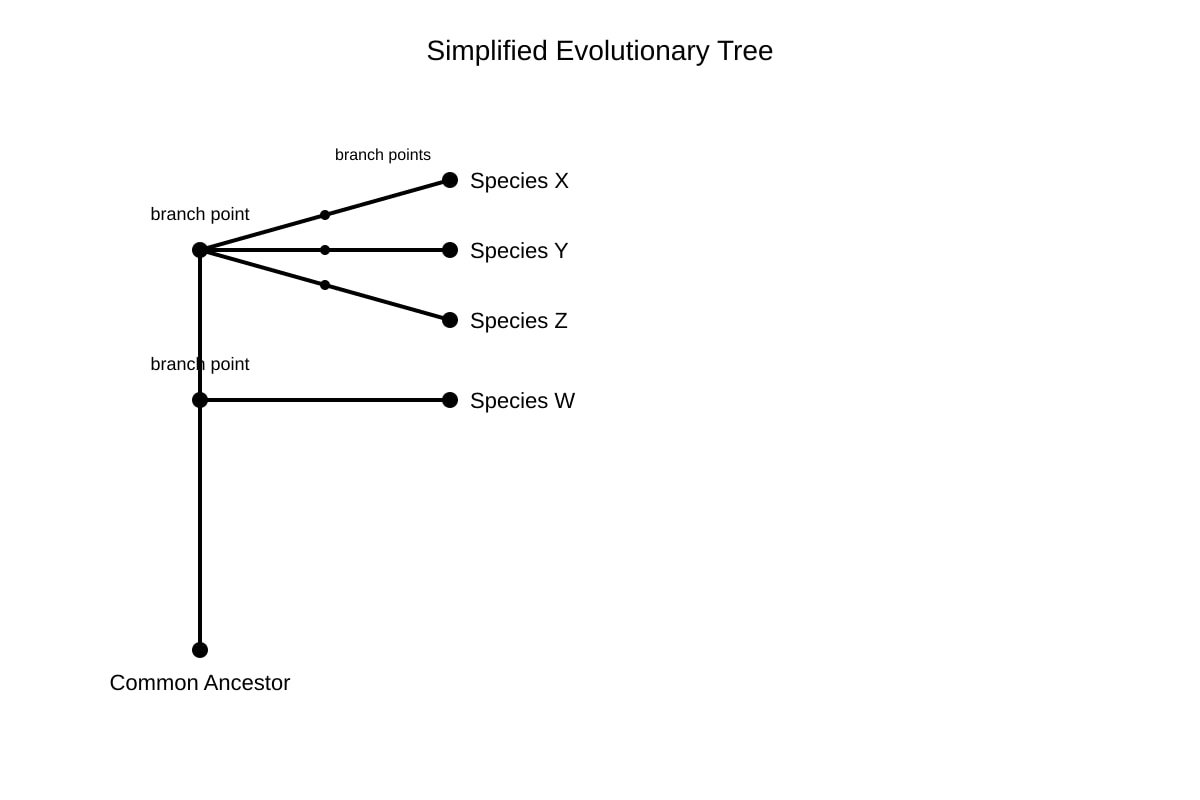
The diagram below shows a simplified evolutionary tree.
Image pending generation: diagram for Q13.
State which species is most closely related to Species X based on the tree. [1]
Answer: ______
-
Explain the difference between homologous and analogous structures. [2]
-
A farmer selects only the largest cows for breeding each generation. Name this process and state one possible disadvantage. [2]
Process: ___________________________
Disadvantage: ___________________________
Section C: Data and Interpretation (Questions 16–20)
- The table shows the number of bird species recorded in three habitats.
| Habitat | Number of bird species |
|---|---|
| Forest | 42 |
| Grassland | 18 |
| Urban park | 11 |
Calculate the percentage decrease in bird species from Forest to Urban park. [2]
Working: ______________________________________________________________
Answer: ______ %
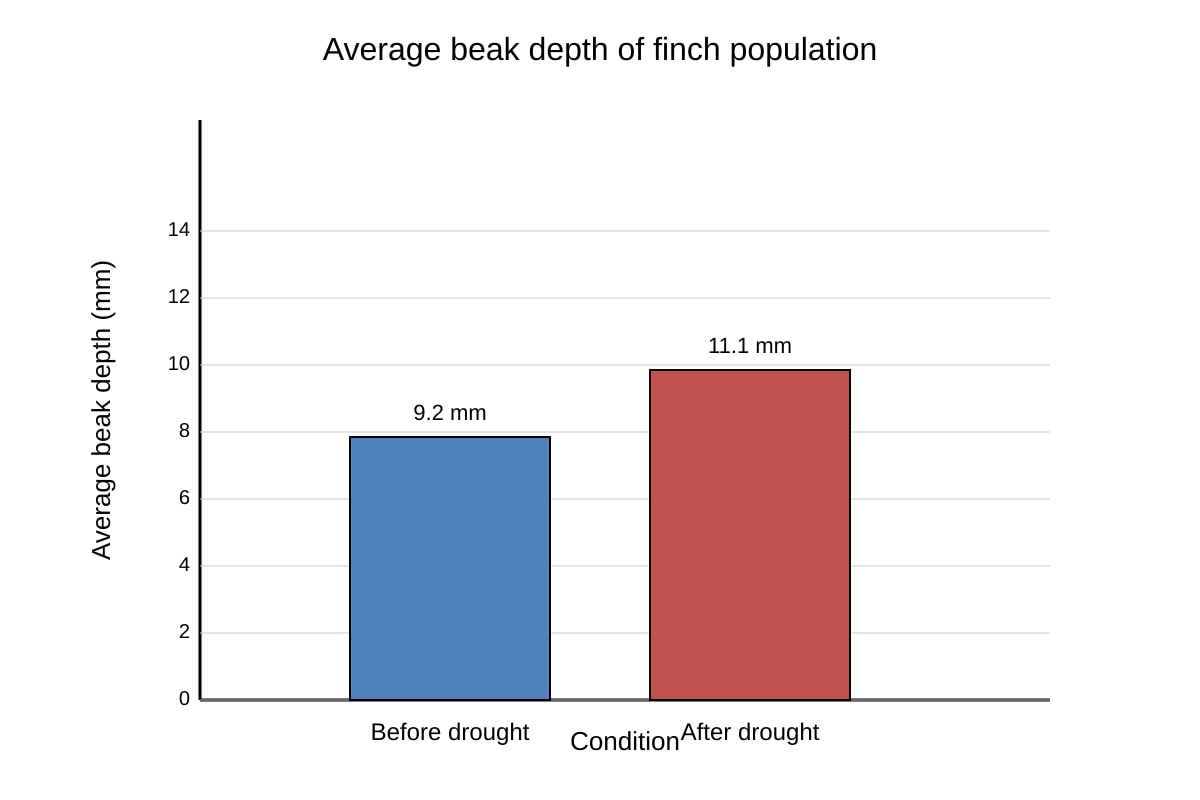
- The graph shows beak depth (mm) of a finch population before and after a drought.
Image pending generation: graph for Q17.
State the change in average beak depth and suggest a reason for this change. [3]
Change: ______________________________________________________________
Reason: ______________________________________________________________
-
A species of snail has shell colour controlled by one gene with two alleles: B (brown, dominant) and b (yellow, recessive). In a sample of 200 snails, 128 are brown and 72 are yellow. Use the Hardy–Weinberg equation to calculate the frequency of allele b. [3]
Working: ______________________________________________________________
Answer: ______ -
Explain how geographical isolation can lead to speciation. [4]
-
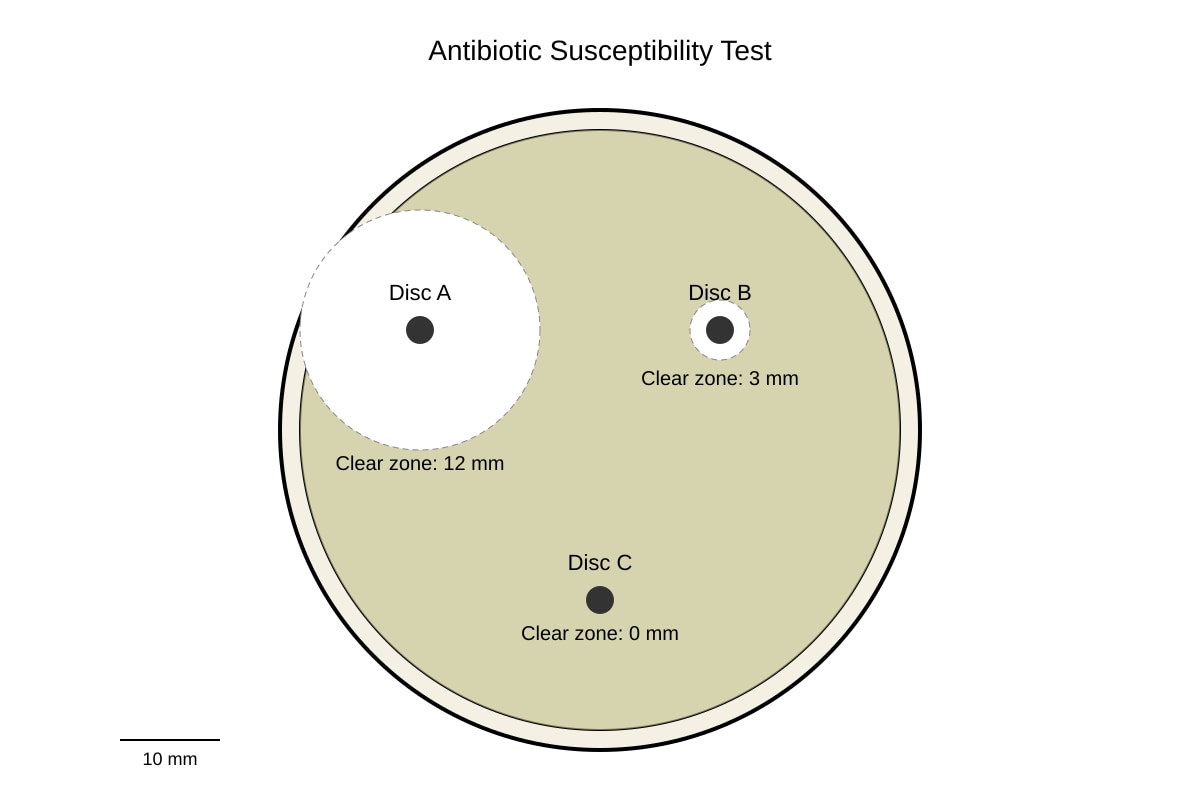
The diagram shows antibiotic susceptibility test results.
Image pending generation: experimental_setup for Q20.
State which antibiotic is most effective and explain your answer. [2]
Antibiotic: ______
Explanation: __________________________________________________________
Answers
O-Level Biology Quiz - Evolution Diversity (Answer Key)
Total Marks: 40
Topic: Evolution Diversity
Section A: Multiple Choice
-
B [1]
Teaching note: Natural selection is the process where individuals with traits better suited to the environment survive and reproduce more, passing on those traits. A is incorrect (mate choice is a mechanism but not the definition); C describes acquired characteristics (Lamarckian, incorrect); D is false as mutation is random. -
C [1]
Teaching note: Homologous structures share a common ancestral origin (similar bone layout) but may have different functions. Analogous (B) have same function but different origin; convergent (A) produces analogous traits. -
C [1]
Teaching note: Narrow habitat and small population make recovery from disturbance difficult, raising extinction risk. A and B describe resilient species. -
C [1]
Teaching note: Directional selection favours one extreme phenotype (green) shifting the population mean. Stabilising (B) favours middle; disruptive (D) favours both extremes; drift (A) is random. -
B [1]
Teaching note: Biodiversity includes variety of all life forms and higher diversity typically stabilises ecosystems. A is too narrow; C is false; D is not universally true.
Section B: Short Structured Questions
-
Continuous variation shows a range of intermediate phenotypes (e.g., height); discontinuous variation shows distinct categories with no intermediates (e.g., blood group). [1]
Marking: 1 mark for stating one valid difference. -
(a) Blood group (ABO) [1]
(b) Gender / eye colour (blue/brown) / attached earlobe [1]
Teaching note: Any two clear discontinuous traits accepted. -
(a) Bacterial cells have a cell wall made of peptidoglycan; animal cells have no cell wall (or cellulose in plants). [1]
(b) Bacterial cells have plasmids; animal cells do not. (Or: bacteria have nucleoid, not true nucleus.) [1]
From Template 4. -
[3]
- Some bacteria have random mutations giving resistance. [1]
- Antibiotics kill susceptible bacteria, leaving resistant ones. [1]
- Resistant bacteria reproduce, passing resistance genes (via plasmids/conjugation). [1]
Teaching note: Link to selection pressure and gene transfer.
-
Evolution is the change in inherited characteristics of a population over successive generations. [2]
- "Change in inherited characteristics" [1]
- "Over generations / time" [1]
-
[4]
- Before pollution, light moths camouflaged on light bark, dark moths eaten. [1]
- Pollution darkened bark, making light moths visible to predators. [1]
- Dark moths now camouflaged, more survive. [1]
- They reproduce, passing dark allele, shifting population to mostly dark. [1]
Teaching note: Classic industrial melanism example.
-
(a) Deforestation / habitat destruction [1]
(b) Pollution / overfishing / monoculture farming [1] -
Y or Z (either accepted, both equally close on tree) [1]
From image: Tree shows X, Y, Z share a more recent branch point than with W. -
Homologous: similar structure, common ancestor, different function (e.g., bat wing/human arm). [1]
Analogous: different structure, different ancestor, same function (e.g., insect wing/bird wing). [1] -
Process: Artificial selection (selective breeding). [1]
Disadvantage: Reduced genetic diversity / inbreeding defects. [1]
Section C: Data and Interpretation
-
[2]
Decrease = 42 – 11 = 31
Percentage = (31 / 42) × 100 = 73.8%
Answer: 73.8% (accept 74%) [2 for correct calc and answer, 1 if only answer without working]
Working shown required for mark. -
[3]
Change: Increase of 11.1 – 9.2 = 1.9 mm [1]
Reason: Birds with deeper beaks could crack harder seeds during drought; they survived and bred. [2]
Teaching note: Directional selection for larger beak. -
[3]
Yellow (bb) = 72/200 = 0.36 = q²
q = √0.36 = 0.6
Frequency of allele b = 0.6 [3 for full steps, 2 if q² and q, 1 if only answer]
Teaching note: Hardy–Weinberg: p² + 2pq + q² = 1. -
[4]
- Population split by physical barrier (river/mountain). [1]
- No gene flow between groups. [1]
- Different selection pressures / mutations accumulate. [1]
- Groups become reproductively isolated → new species. [1]
-
Antibiotic: A [1]
Explanation: Largest clear zone (12 mm) means most bacterial growth inhibited. [1]
Free quiz and exam paper access
Enter your details to view this paper
Your access is remembered on this device.