From Real Exams Quiz
O Level Biology Evolution Diversity Quiz
Free O Level Biology Evolution Diversity quiz, DeepSeek Exam version, with questions, answers, and O Level-style practice for Singapore students.
These static practice materials are generated from the site's syllabus and paper-generation workflow, with source and model context shown so students and parents can evaluate the material before use.
Questions
Free quiz and exam paper access
Enter your details to view this paper
Your access is remembered on this device.
Answers
O-Level Biology Quiz - Evolution Diversity — ANSWER KEY
Total Marks: 40
Section A: Short Answer Questions (10 marks)
1. Define the term natural selection. [2]
Answer:
- The process by which organisms that are better adapted to their environment / possess advantageous traits [1]
- tend to survive and reproduce more successfully, passing on these favourable traits to their offspring [1]
Marking notes: Award 1 mark for "better adapted/survival advantage" and 1 mark for "reproduce/pass on traits". Accept "differential survival and reproduction" for both marks.
2. State two sources of genetic variation within a population. [2]
Answer (any two, 1 mark each):
- Mutation (changes in DNA/gene sequence)
- Meiosis / independent assortment of chromosomes
- Crossing over during meiosis
- Random fertilisation / sexual reproduction
Marking notes: Accept any two valid sources. Do not accept "environmental factors" alone as this does not cause genetic variation.
3. Distinguish between continuous variation and discontinuous variation. Give one example of each. [4]
Answer:
- Continuous variation: Variation that shows a range of phenotypes / no distinct categories / influenced by many genes and environment [1]
- Example: height in humans, body mass, skin colour, leaf length [1]
- Discontinuous variation: Variation that falls into distinct categories / clear-cut groups / controlled by one or a few genes / little environmental influence [1]
- Example: ABO blood groups, tongue rolling ability, eye colour (basic), sex [1]
Marking notes: Award 1 mark for each correct description and 1 mark for each correct example. Accept any valid examples.
4. Name the scientist who, along with Charles Darwin, independently proposed the theory of evolution by natural selection. [1]
Answer:
- Alfred Russel Wallace
Marking notes: Accept "Wallace" only. Do not accept "Lamarck" or "Mendel".
5. What is meant by the term species? [1]
Answer:
- A group of organisms that can interbreed / reproduce with one another to produce fertile offspring
Marking notes: Accept "organisms that can breed together to produce fertile young". Must include concept of fertile offspring.
Section B: Structured Questions (10 marks)
6. The peppered moth (Biston betularia) exists in two forms: a light-coloured form and a dark (melanic) form.
(a) Explain why the dark form of the peppered moth became more common in industrial areas. [3]
Answer:
- In industrial areas, tree trunks became darkened by soot/pollution [1]
- Dark-coloured moths were better camouflaged against the darkened tree trunks [1]
- Dark moths were less likely to be seen and eaten by predators (birds), so they survived and reproduced more, passing on the dark-colour allele to offspring [1]
Marking notes: Award marks for: (1) environmental change (soot/pollution), (2) camouflage advantage, (3) differential survival and reproduction. Must link camouflage to predation.
(b) Suggest why the light form remained common in unpolluted rural areas. [2]
Answer:
- In unpolluted areas, tree trunks remained light-coloured / covered with lichens [1]
- Light-coloured moths were better camouflaged against the light tree trunks, so they were less likely to be preyed upon and continued to survive and reproduce [1]
Marking notes: Award 1 mark for environment description and 1 mark for selective advantage of light form.
7. Antibiotic resistance in bacteria is an example of evolution by natural selection.
(a) Explain how a population of bacteria can become resistant to an antibiotic over time. [4]
Answer:
- Within a bacterial population, there is genetic variation; some bacteria may already possess a mutation / gene that confers resistance to the antibiotic [1]
- When the antibiotic is applied, most non-resistant bacteria are killed [1]
- The resistant bacteria survive and reproduce [1]
- They pass on the resistance gene/allele to their offspring, so over many generations, the proportion of resistant bacteria in the population increases [1]
Marking notes: Award marks for: (1) pre-existing variation/mutation, (2) antibiotic kills susceptible bacteria, (3) resistant bacteria survive and reproduce, (4) resistance allele passed on / increases in frequency. Do not award marks if student implies bacteria "develop" resistance in response to the antibiotic.
(b) State one reason why antibiotic resistance is a concern for human health. [1]
Answer (any one, 1 mark):
- Infections caused by resistant bacteria are harder to treat
- Existing antibiotics become ineffective
- It may lead to untreatable infections / increased mortality
- Longer hospital stays / higher medical costs
Marking notes: Accept any valid concern related to human health.
Section C: Structured Questions (10 marks)
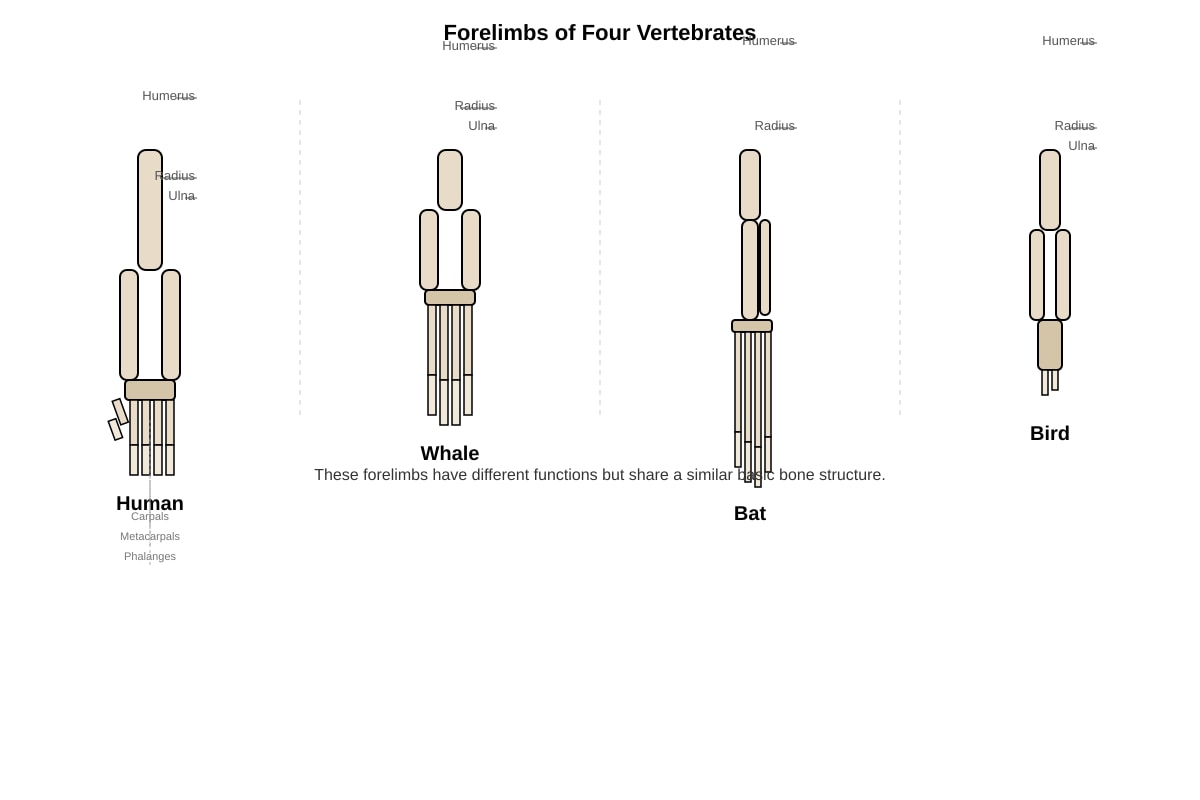
8. The diagram below shows the forelimbs of four different vertebrates: a human, a whale, a bat, and a bird.
Image pending generation for this question.
(a) What term is used to describe structures that have a similar basic plan but different functions? [1]
Answer:
- Homologous structures / homologous organs
Marking notes: Accept "homologous structures" or "homologous organs". Do not accept "analogous structures".
(b) Explain how such structures provide evidence for evolution. [3]
Answer:
- Homologous structures suggest that these organisms share a common ancestor [1]
- The basic skeletal structure/body plan was inherited from this common ancestor [1]
- Over time, the structures evolved / were modified for different functions in different environments (divergent evolution) [1]
Marking notes: Award marks for: (1) common ancestry, (2) inherited basic structure, (3) modification/adaptation for different functions. Must link structure to evolutionary relationship.
(c) State one other type of evidence for evolution, apart from comparative anatomy. [1]
Answer (any one, 1 mark):
- Fossil record
- DNA / molecular / genetic evidence
- Embryology / comparative embryology
- Biogeography / geographical distribution of species
- Vestigial structures/organs
Marking notes: Accept any valid type of evidence. Do not accept "comparative anatomy" as this is excluded in the question.
9. In a population of rabbits, some individuals have longer ears than others.
(a) Suggest a possible selective advantage of longer ears in a hot environment. [2]
Answer:
- Longer ears have a larger surface area [1]
- This allows more heat to be lost from the body / more effective thermoregulation / helps the rabbit stay cool [1]
Marking notes: Award 1 mark for surface area concept and 1 mark for heat loss/thermoregulation link. Accept other valid advantages such as better hearing to detect predators.
(b) Explain how natural selection could lead to an increase in average ear length over many generations. [3]
Answer:
- There is variation in ear length within the rabbit population; some rabbits have longer ears [1]
- Rabbits with longer ears have a selective advantage (e.g., better heat loss) and are more likely to survive in the hot environment [1]
- These rabbits reproduce and pass on the alleles/genes for longer ears to their offspring; over many generations, the frequency of the long-ear allele increases in the population [1]
Marking notes: Award marks for: (1) variation present, (2) selective advantage leading to differential survival, (3) reproduction and inheritance of trait. Must show progression over generations.
10. Explain why the fossil record is considered an important source of evidence for evolution. [2]
Answer:
- Fossils show that organisms have changed over time / show a sequence of evolutionary change [1]
- Fossils of extinct organisms show links between different groups / transitional forms / intermediate characteristics [1]
Marking notes: Award 1 mark for showing change over time and 1 mark for transitional forms/links between groups. Accept examples such as the horse fossil record or Archaeopteryx.
Section D: Data-Based Questions (10 marks)
11. Snail shell colour study.
(a) Describe the trend in the percentage of dark-coloured snails from Year 0 to Year 20. [2]
Answer:
- The percentage of dark-coloured snails increased steadily / continuously from 30% to 85% [1]
- The increase was more rapid between Year 5 and Year 15 (after the volcanic eruption) [1]
Marking notes: Award 1 mark for overall increase and 1 mark for noting the rate change. Accept answers that quote data points.
(b) Explain the change in the percentage of light-coloured and dark-coloured snails after the volcanic eruption in Year 5. [4]
Answer:
- The volcanic eruption covered the ground with dark ash, changing the environment / background colour [1]
- Dark-coloured snails were better camouflaged against the dark ash [1]
- Light-coloured snails were more visible to predators and were eaten in greater numbers [1]
- Dark-coloured snails survived and reproduced more, passing on the dark-shell allele; light-coloured snails decreased in frequency [1]
Marking notes: Award marks for: (1) environmental change, (2) camouflage advantage for dark snails, (3) predation pressure on light snails, (4) differential survival and reproduction. Must link cause and effect.
(c) Predict the percentage of dark-coloured snails in Year 25 if the dark ash remains on the ground. Explain your prediction. [2]
Answer:
- The percentage would be very high, likely above 90% / close to 100% [1]
- Because dark snails continue to have a selective advantage / light snails continue to be selected against, so the dark allele frequency continues to increase [1]
Marking notes: Award 1 mark for a reasonable prediction (above 90%) and 1 mark for explanation based on continued selection pressure. Accept "approximately 95%" or similar.
12. Horse evolution.
(a) Describe two trends in the evolution of the horse shown in Figure 1. [2]
Answer (any two, 1 mark each):
- Increase in overall body size / height at shoulder
- Reduction in the number of toes (from 4/3 to 1)
- Loss/size reduction of side toes
Marking notes: Accept any two clear trends. Must refer to data from the table.
(b) The ancestors of modern horses lived in forests, while modern horses live on open grasslands. Suggest how the changes in toe number and body size could be adaptations to life on open grasslands. [2]
Answer:
- Reduction to a single toe / hoof allows faster running / more efficient locomotion on hard, open ground [1]
- Larger body size helps in travelling long distances / seeing predators over tall grass / better thermoregulation [1]
Marking notes: Award 1 mark for each adaptation linked to grassland environment. Accept other valid suggestions.
(c) Explain why the fossil record of the horse provides good evidence for evolution. [2]
Answer:
- It shows a clear, gradual sequence of changes over time / transitional forms [1]
- The fossils can be dated and arranged in chronological order, showing the progression from small, multi-toed ancestors to large, single-toed modern horses [1]
Marking notes: Award 1 mark for sequence/transition and 1 mark for dating/chronological order. Accept reference to specific features changing over time.
13. Define the term adaptive radiation and give one example. [2]
Answer:
- Adaptive radiation is the process by which a single ancestral species evolves into several different forms / species, each adapted to a different ecological niche / environment [1]
- Example: Darwin's finches on the Galapagos Islands / mammalian radiation after dinosaur extinction / cichlid fishes in African lakes [1]
Marking notes: Award 1 mark for definition and 1 mark for a valid example.
14. Explain how geographical isolation can lead to the formation of a new species. [3]
Answer:
- A population is split / separated by a physical barrier (e.g., mountain, river, ocean) [1]
- The separated populations experience different environmental conditions / selection pressures [1]
- Over many generations, they accumulate different genetic changes / adaptations, so that eventually they can no longer interbreed to produce fertile offspring [1]
Marking notes: Award marks for: (1) physical barrier/separation, (2) different selection pressures, (3) reproductive isolation / cannot interbreed. Must show progression to new species.
15. State one reason why the theory of evolution by natural selection is considered a scientific theory rather than just a hypothesis. [1]
Answer (any one, 1 mark):
- It is supported by a large body of evidence from multiple fields (fossils, genetics, anatomy, etc.)
- It has been repeatedly tested and confirmed through observation and experimentation
- It makes testable predictions that have been verified
- It is widely accepted by the scientific community
Marking notes: Accept any valid reason that distinguishes a scientific theory from a hypothesis.
Section E: Application and Analysis Questions (10 marks)
16. Insect pesticide resistance.
(a) Explain how the frequency of the resistance allele could increase in the population over several generations if the pesticide is used repeatedly. [3]
Answer:
- Within the insect population, there is variation; some insects possess the resistance allele [1]
- When pesticide is applied, susceptible insects die, while resistant insects survive [1]
- Resistant insects reproduce and pass the resistance allele to their offspring; over generations, the frequency of the allele increases [1]
Marking notes: Award marks for: (1) pre-existing variation, (2) differential survival, (3) reproduction and inheritance. Similar to antibiotic resistance question.
(b) Suggest one reason why the resistance allele might not increase to 100% in the population, even with continued pesticide use. [2]
Answer (any one, 2 marks):
- There may be a fitness cost / disadvantage associated with the resistance allele in the absence of pesticide (e.g., resistant insects may reproduce more slowly or be less competitive) [2]
- New susceptible insects may migrate into the population [1]
- The resistance allele may be recessive, so heterozygous individuals may not express full resistance [1]
Marking notes: Award up to 2 marks for a well-explained reason. Accept any valid biological reason.
17. Galapagos finches.
(a) Explain how natural selection could lead to the evolution of different beak shapes from a common ancestral finch species. [4]
Answer:
- The ancestral finch population spread to different islands / environments with different food sources [1]
- There was variation in beak shape within the finch population [1]
- On each island, finches with beak shapes best suited to the available food survived and reproduced more successfully [1]
- Over many generations, the different selection pressures on different islands led to the accumulation of different beak shape adaptations, resulting in different species [1]
Marking notes: Award marks for: (1) different environments/food sources, (2) variation, (3) differential survival/reproduction based on beak shape, (4) divergence over time leading to different species. Must link beak shape to food source.
(b) State the term used to describe the process by which one species gives rise to multiple species, each adapted to a different ecological niche. [1]
Answer:
- Adaptive radiation
Marking notes: Accept "adaptive radiation" only.
18. Plant leaf thickness.
(a) Identify the selection pressure in this scenario. [1]
Answer:
- Dry environment / low water availability / drought
Marking notes: Accept any answer that identifies water scarcity as the pressure.
(b) Outline the steps of natural selection that would lead to an increase in average leaf thickness. [3]
Answer:
- There is variation in leaf thickness; some plants have thicker leaves [1]
- Plants with thicker leaves lose less water and are more likely to survive in the dry environment [1]
- These plants reproduce and pass on the alleles for thicker leaves to their offspring; over generations, the frequency of the thick-leaf allele increases [1]
Marking notes: Award marks for: (1) variation, (2) selective advantage/survival, (3) reproduction and inheritance. Must be in logical sequence.
19. Compare the processes of artificial selection and natural selection. Give one similarity and one difference. [2]
Answer:
- Similarity (1 mark): Both processes result in changes in the frequency of traits/alleles in a population over generations / both act on existing variation / both lead to evolution.
- Difference (1 mark): In artificial selection, humans select which organisms reproduce based on desired traits; in natural selection, the environment / nature determines which organisms survive and reproduce.
Marking notes: Award 1 mark for a valid similarity and 1 mark for a valid difference. Accept other correct comparisons.
20. DNA evidence.
(a) Based on the DNA evidence, which two species are most closely related? Explain your answer. [1]
Answer:
- Species A and B are most closely related [0.5]
- Because they have the highest percentage of DNA similarity (95%) [0.5]
Marking notes: Must state A and B and refer to the 95% similarity.
(b) Explain how DNA sequencing provides evidence for evolution. [2]
Answer:
- Species that are more closely related share a greater percentage of similar DNA sequences [1]
- This suggests they share a more recent common ancestor; differences in DNA accumulate over time as species diverge [1]
Marking notes: Award 1 mark for linking DNA similarity to relatedness and 1 mark for linking to common ancestry/divergence over time.
END OF ANSWER KEY