From Real Exams Quiz
O Level Biology Cells Biomolecules Quiz
Free O Level Biology Cells Biomolecules quiz, HY3 Exam version, with questions, answers, and O Level-style practice for Singapore students.
These static practice materials are generated from the site's syllabus and paper-generation workflow, with source and model context shown so students and parents can evaluate the material before use.
Questions

Free quiz and exam paper access
Enter your details to view this paper
Your access is remembered on this device.
Answers
O-Level Biology Quiz - Cells Biomolecules: Answer Key
Total Marks: 40
Topic: Cells Biomolecules
Section A: Short Answer
1. [1 mark] Chloroplast.
Teaching note: Chloroplasts are organelles in plant cells containing chlorophyll; they capture light energy for photosynthesis. Only plant cells (and some algae) have them among the basic O-Level cell types.
2. [1 mark] Carbon (C), Hydrogen (H), Oxygen (O), Nitrogen (N) — sometimes Sulphur (S).
Teaching note: Proteins are made of amino acids. Unlike carbs and fats (C,H,O only), proteins contain N in the amino group; some also contain S in cysteine.
3. [1 mark] Iodine solution.
Teaching note: Starch + iodine → blue-black colour. This is a standard food test for starch.
4. [1 mark] Any one: plasmids / peptidoglycan cell wall / nucleoid (no true nucleus) / 70S ribosomes / flagella.
Teaching note: Bacterial cells are prokaryotic; animal cells are eukaryotic. A clear difference is needed, e.g. bacteria have plasmids, animal cells do not.
5. [1 mark] Osmosis is the movement of water molecules from a region of high water potential to low water potential across a partially permeable membrane.
Teaching note: Must mention water, concentration gradient, and partially permeable membrane.
Section B: Structured Response
6. [2 marks]
(a) Bacterial cells have a cell wall made of peptidoglycan; animal cells have no cell wall. [1]
(b) Bacterial cells contain plasmids; animal cells do not. [1]
Alternative: Bacteria have a nucleoid (no membrane-bound nucleus); animal cells have a true nucleus.
Marking: 1 mark per clear named difference. Avoid "both have ribosomes" (similarity).
7. [3 marks]
- Increased protein intake → more amino acids deaminated in liver → more urea produced. [1]
- Urea enters blood, raising solute concentration of filtrate. [1]
- Kidney reabsorbs more water by osmosis to balance, producing more concentrated urine (or if diluted, explain ADH role). [1]
Teaching note: Link protein → urea → osmotic effect → kidney regulation. Common trap: confusing volume with concentration.
8. [4 marks]
- Enzymes are biological catalysts that speed up digestion without being used up. [1]
- Amylase breaks down starch into maltose in the mouth/small intestine. [1]
- Pepsin breaks down proteins into peptides in the stomach (acidic pH). [1]
- Lipase breaks down fats into glycerol and fatty acids in the small intestine. [1]
Marking: 1 for catalyst role, 3 for named enzyme + substrate + product/location.
9. [2 marks]
(a) Brick-red precipitate shows a reducing sugar is present. [1]
(b) Reducing sugar (e.g. glucose, maltose). [1]
Teaching note: Benedict's test: blue (negative) → green/ yellow/ orange/ brick-red (positive, more intense = more sugar).
10. [3 marks]
- Mineral ion uptake from low external to high internal concentration is against gradient. [1]
- Active transport is used, requiring energy (ATP). [1]
- ATP from aerobic respiration in root hair cell mitochondria powers the carrier proteins. [1]
Teaching note: Diffusion/osmosis cannot explain against-gradient movement; active transport needed.
11. [2 marks]
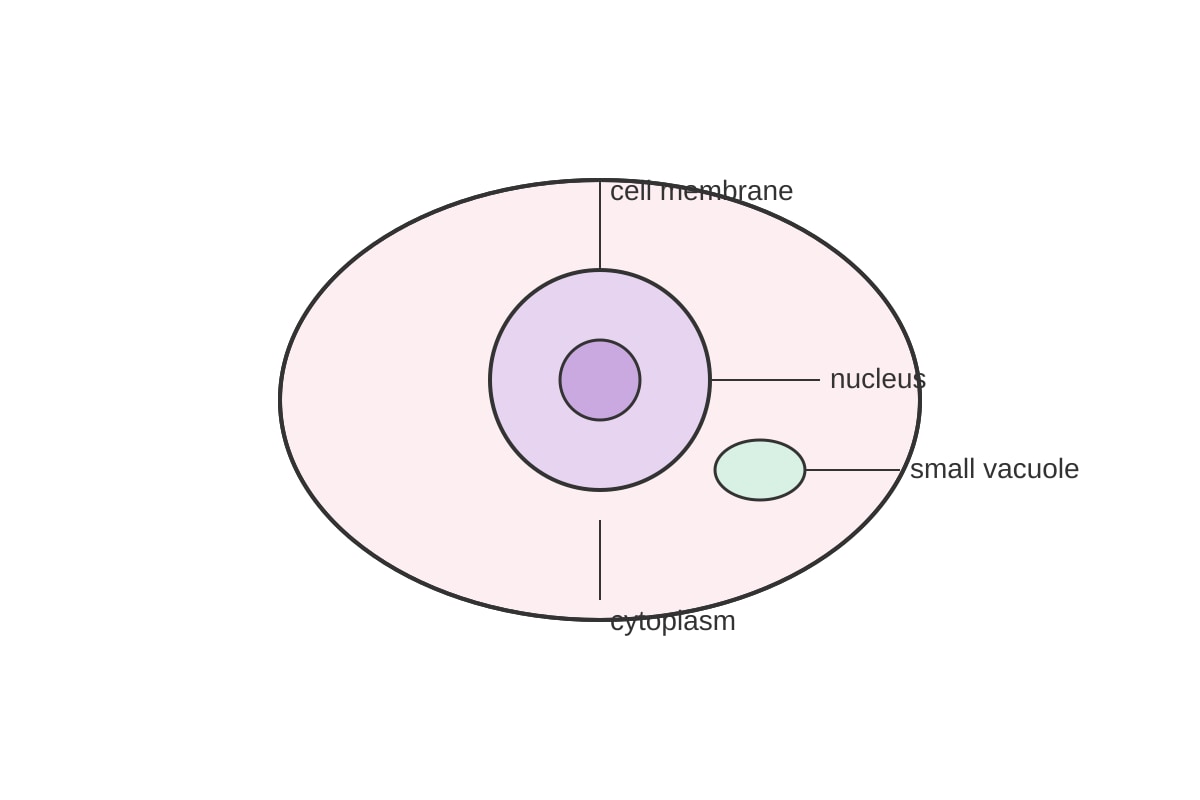
(a) Nucleus [1]
(b) Small vacuole (or any: cell membrane is present in both, but bacteria lack true nucleus) [1]
Note: Bacteria have no membrane-bound nucleus; animal cell diagram shows one. Also no true vacuole like animal's temporary one.
12. [3 marks]
- Glucose from: starch (or glycogen/cellulose) [1]
- Amino acids from: proteins (or polypeptides) [1]
- Glycerol from: lipids (or fats) [1]
Teaching note: Large molecules are polymers; digestion hydrolyses them to monomers.
13. [2 marks]
- Partially permeable membrane allows water molecules to pass but not large sucrose molecules. [1]
- Water moves by osmosis from dilute sucrose to concentrated sucrose side. [1]
14. [3 marks]
- Lock-and-key: enzyme has specific active site shape matching only its substrate. [1]
- Amylase active site fits starch (or glycogen) shape, not protein. [1]
- Protein shape does not complement amylase active site, so no enzyme-substrate complex forms. [1]
15. [2 marks]
- Water enters red blood cell by osmosis (outside is hypotonic). [1]
- Cell swells and may burst (lysis) as no cell wall supports it. [1]
Section C: Data and Diagram Interpretation
16. [3 marks]
(a) Sample A (iodine blue-black). [1]
(b) Sample B (Benedict's brick-red). [1]
(c) Sample C (Biuret purple). [1]
17. [3 marks total: 1+2]
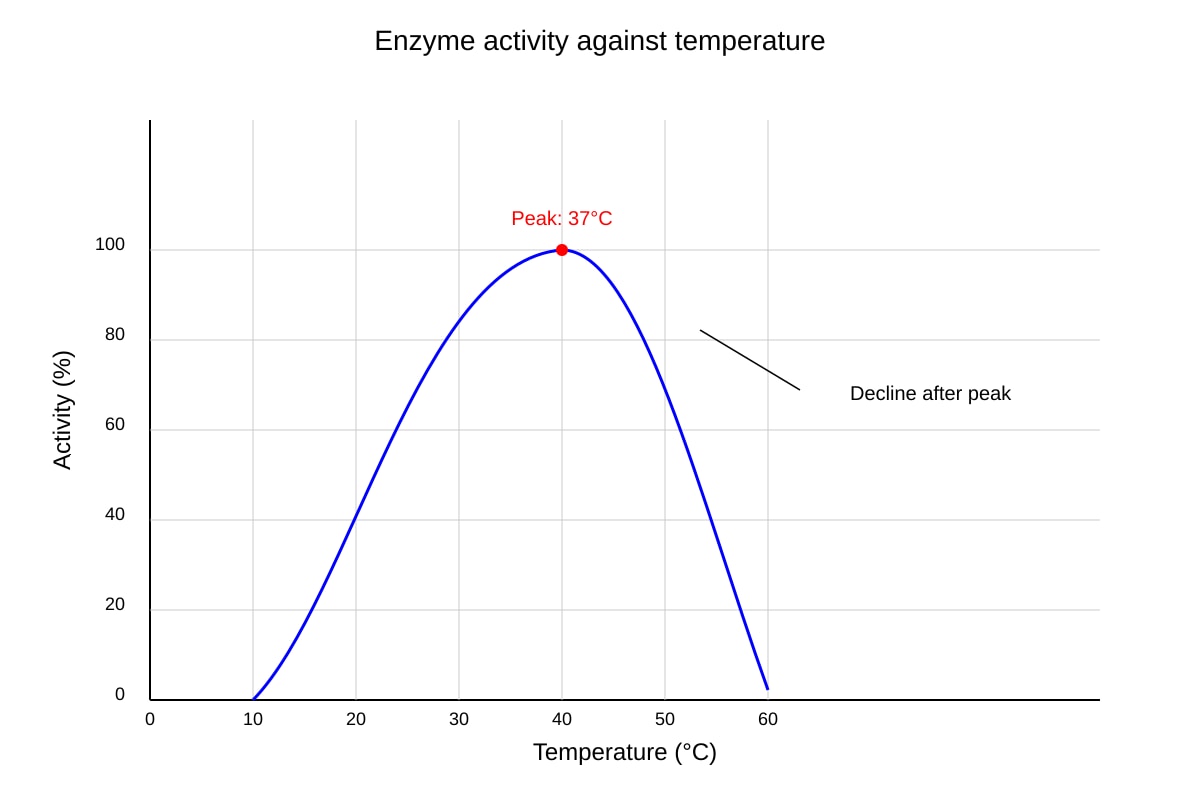
(a) 37°C. [1]
(b) Above 45°C enzyme denatures; tertiary structure/active site destroyed; no substrate binding. [2]
Teaching note: Peak at body temp; high temp breaks H-bonds in enzyme.
18. [2 marks total: 1+1]
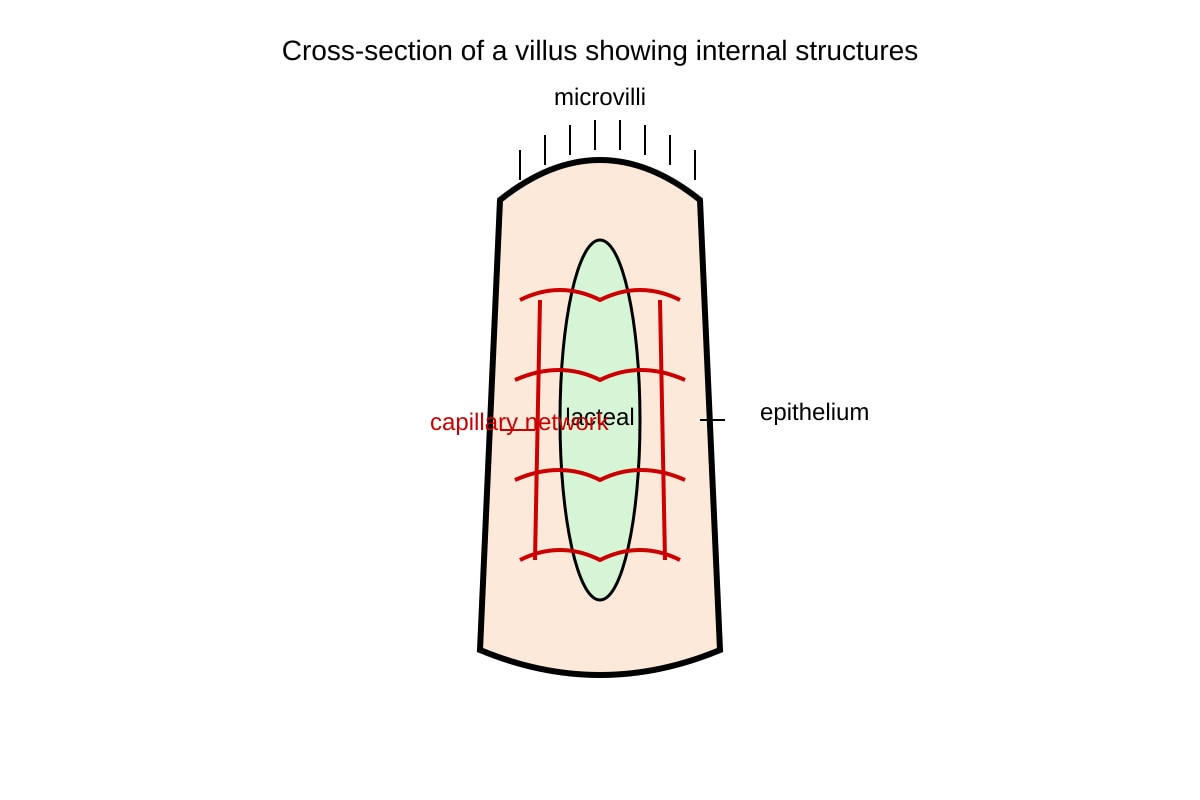
(a) Diffusion (or facilitated diffusion / active transport for some). [1]
(b) Microvilli / large surface area / thin wall / capillary network. [1]
19. [2 marks total: 1+1]
(a) Water moves out of the cell. [1]
(b) Cell shrinks (plasmolysis in plant cells). [1]
20. [2 marks total: 1+1]
(a) Site of aerobic respiration / ATP production. [1]
(b) Muscle contraction needs energy (ATP); many mitochondria supply it. [1]