From Real Exams Quiz
O Level Biology Cells Biomolecules Quiz
Free O Level Biology Cells Biomolecules quiz, Exam version, with questions, answers, and O Level-style practice for Singapore students.
These static practice materials are generated from the site's syllabus and paper-generation workflow, with source and model context shown so students and parents can evaluate the material before use.
Questions
Free quiz and exam paper access
Enter your details to view this paper
Your access is remembered on this device.
Answers
O-Level Biology Quiz - Cells Biomolecules - Answer Key
Total Marks: 25
Section A: Short Answer Questions [8 marks]
1. Name the process by which water moves across a partially permeable membrane. [1]
Answer: Osmosis [1]
2. State the chemical elements present in proteins. [1]
Answer: Carbon, Hydrogen, Oxygen, Nitrogen (sometimes Sulfur) [1] Note: Accept C, H, O, N or full names
3. Complete the word equation for aerobic respiration: [2]
Answer: Glucose + Oxygen → Carbon dioxide + Water + Energy [2] Award 1 mark for each correct term
4. Name two organelles that are visible under an electron microscope but not under a light microscope. [2]
Answer: Any two from:
- Endoplasmic reticulum [1]
- Golgi body/apparatus [1]
- Ribosomes [1]
- Mitochondria (inner structure) [1]
5. State the equation for anaerobic respiration in humans. [2]
Answer: Glucose → Lactate + Energy [2] Alternative: C₆H₁₂O₆ → 2C₃H₆O₃ + Energy Award 1 mark for glucose, 1 mark for lactate/lactic acid
Section B: Structured Response Questions [17 marks]
6. Organelle identification [2]
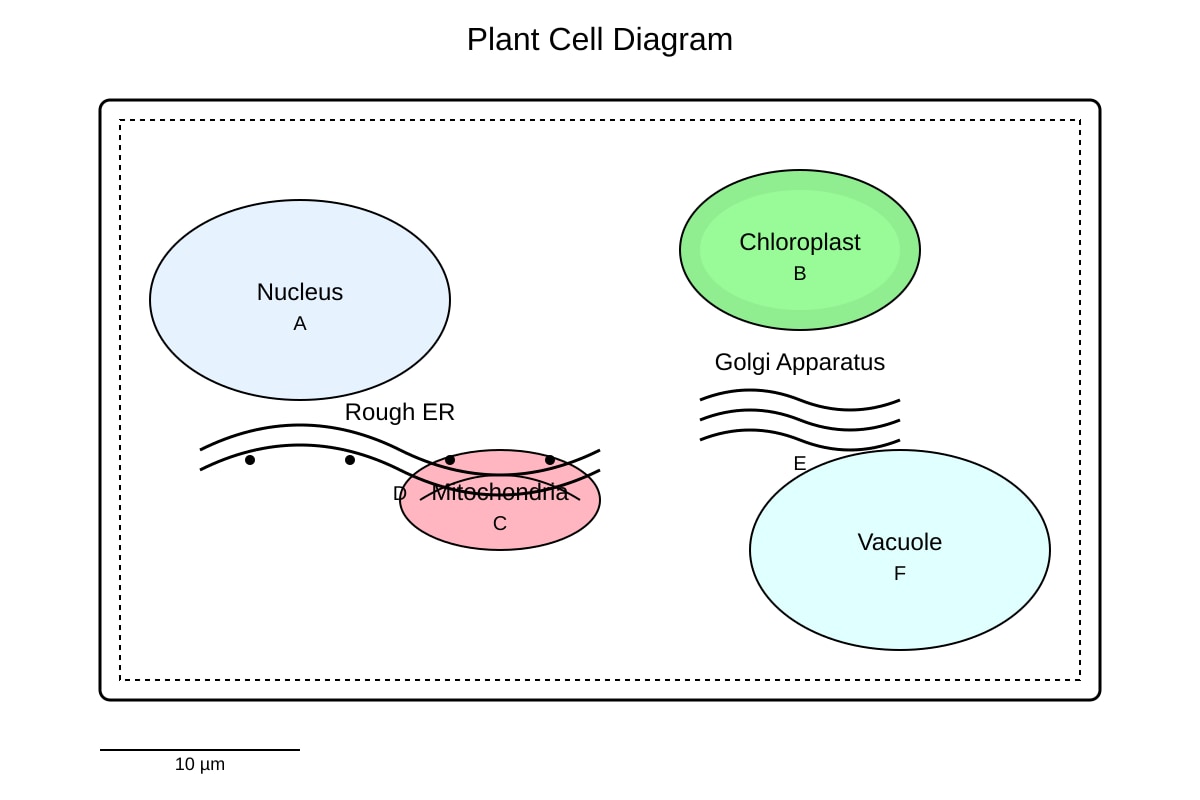
(a) Which organelle carries out photosynthesis? [1] Answer: Letter corresponding to chloroplast [1]
(b) Which organelle synthesises and transports proteins? [1] Answer: Letter corresponding to rough endoplasmic reticulum [1]
7. Describe two features of a bacterial cell that are different from an animal cell. [2]
Marking scheme:
- Cell wall made of peptidoglycan vs no cell wall [1]
- Plasmids present vs absent [1]
- Nucleoid vs membrane-bound nucleus [1]
- 70S ribosomes vs 80S ribosomes [1]
- Flagella present vs absent [1] Award any 2 correct differences
8. Explain how changes in a person's protein intake can affect the concentration of their urine. [3]
Marking scheme:
- Increased protein intake leads to increased amino acid deamination [1]
- This produces more urea in the blood [1]
- More urea increases solute concentration, so more water is reabsorbed by osmosis, making urine more concentrated [1]
9. Describe the roles of enzymes in human digestion. Give examples in your answers. [4]
Marking scheme:
- Enzymes act as biological catalysts to speed up digestion [1]
- Named enzyme + substrate (e.g., amylase acts on starch) [1]
- Product or location (e.g., producing maltose in mouth/small intestine) [1]
- Second example with enzyme + substrate/product [1]
Examples: amylase→starch→maltose; pepsin→proteins→polypeptides; lipase→fats→fatty acids and glycerol
10. Enzyme activity investigation [5]
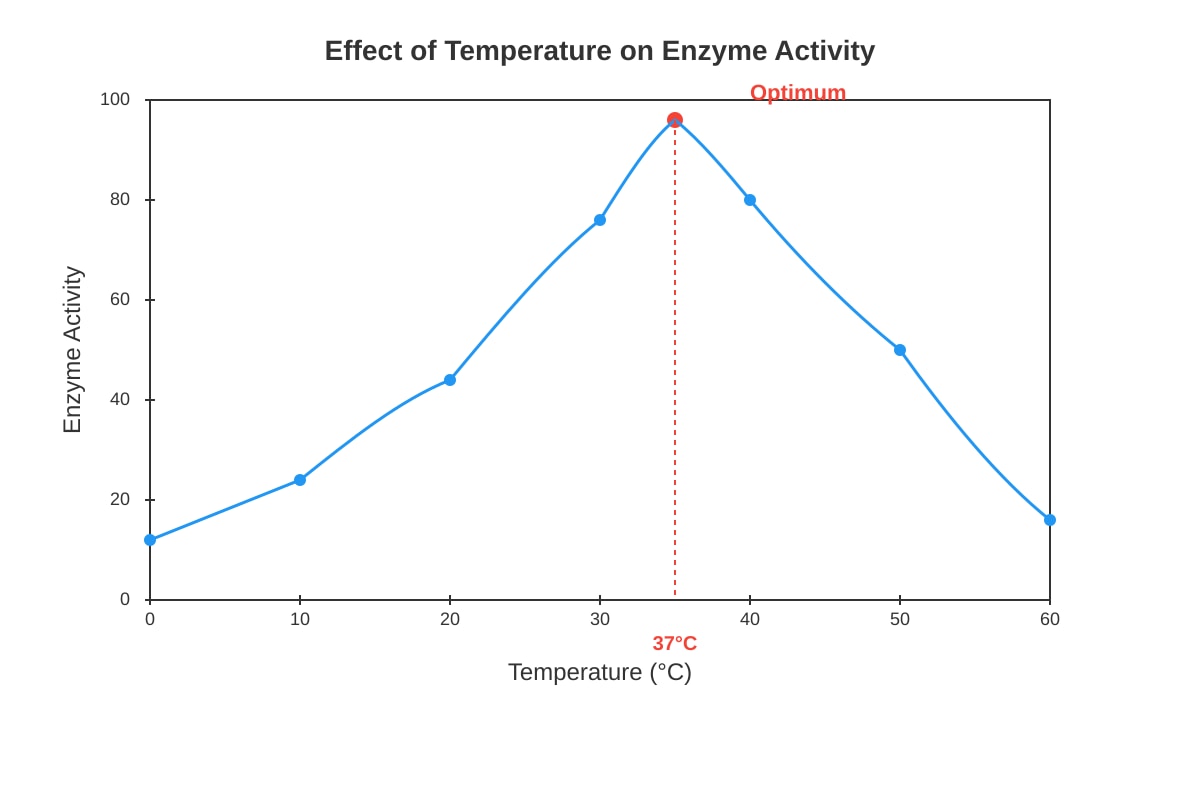
(a) State the optimum temperature for this enzyme. [1] Answer: 37°C [1]
(b) Explain why enzyme activity decreases above the optimum temperature. [2] Marking scheme:
- High temperature causes enzyme to denature [1]
- Active site changes shape, so enzyme-substrate complex cannot form [1]
(c) Suggest why this enzyme has an optimum temperature of 37°C. [2] Marking scheme:
- 37°C is human body temperature [1]
- Enzyme is adapted to work efficiently at normal body temperature [1]