AI Generated Exam Paper
O Level Biology Practice Paper 4
Free O Level Biology Practice Paper 4, DeepSeek AI version, with questions, answers, and O Level-style practice for Singapore students.
These static practice materials are generated from the site's syllabus and paper-generation workflow, with source and model context shown so students and parents can evaluate the material before use.
Questions
Free quiz and exam paper access
Enter your details to view this paper
Your access is remembered on this device.
Answers
TuitionGoWhere Practice Paper - Biology O-Level
Answer Key and Marking Scheme
Paper: Practice Paper 4 (Version 4 of 5)
Total Marks: 80
Section A: Structured Questions (45 marks)
Question 1: Cell Organelles (8 marks)
(a) Identify organelles P, Q, and R. [3]
| Label | Organelle | Mark |
|---|---|---|
| P | Mitochondrion / Mitochondria | [1] |
| Q | Rough endoplasmic reticulum / RER | [1] |
| R | Golgi body / Golgi apparatus | [1] |
Marking notes: Accept "rough ER" for Q. Accept "Golgi complex" for R. Spelling must be recognisable.
(b) Explain how the structure of organelle P (mitochondrion) is adapted for its function. [3]
Answer:
The mitochondrion is the site of aerobic respiration, where energy (ATP) is released for cellular activities. [1]
It has a folded inner membrane (cristae) which greatly increases the surface area for the attachment of respiratory enzymes and electron carriers involved in ATP production. [1]
The matrix contains enzymes for the Krebs cycle and the breakdown of respiratory substrates. [1]
Marking notes:
- Award [1] for stating function: site of aerobic respiration / releases ATP.
- Award [1] for describing folded inner membrane/cristae and linking to increased surface area.
- Award [1] for mentioning enzymes or matrix.
- Do not award marks for structure description without functional link.
(c) State the function of organelle Q (RER) and explain the significance of the attached ribosomes. [2]
Answer:
The rough endoplasmic reticulum synthesises and transports proteins within the cell. [1]
The ribosomes attached to its surface are the sites of protein synthesis; the proteins produced enter the RER for folding, modification, and transport to the Golgi body. [1]
Marking notes:
- Award [1] for stating function: protein synthesis and transport.
- Award [1] for explaining ribosome role: site of protein synthesis, proteins enter RER.
- Accept "transports proteins to Golgi body" as part of explanation.
Question 2: Osmosis Investigation (9 marks)
(a) State the initial length of each potato strip. [1]
Answer: 50 mm
Marking notes: Award [1] for correct value. Accept "50" with or without units.
(b) Explain why the potato strip in distilled water increased in length. [3]
Answer:
Distilled water has a higher water potential than the cell sap of the potato cells. [1]
Water molecules move from the distilled water (region of higher water potential) into the potato cells (region of lower water potential) by osmosis, across the partially permeable cell membrane. [1]
The entry of water causes the cells to become turgid, and the vacuole expands, pushing the cytoplasm against the cell wall, resulting in an increase in length of the potato strip. [1]
Marking notes:
- Award [1] for identifying water potential difference (distilled water > cell sap).
- Award [1] for describing osmosis: movement of water from higher to lower water potential across partially permeable membrane.
- Award [1] for explaining effect: cells become turgid, vacuole expands, strip lengthens.
- Do not award marks for "water moves from high concentration to low concentration" — must use "water potential".
(c) Explain what the zero change in length at 0.4 mol/dm³ indicates. [2]
Answer:
The water potential of the sucrose solution is equal to the water potential of the potato cell sap. [1]
There is no net movement of water into or out of the potato cells by osmosis, so the length remains unchanged. [1]
Marking notes:
- Award [1] for stating water potentials are equal.
- Award [1] for explaining no net water movement.
- Accept "isotonic" as alternative phrasing.
(d) Predict what would happen to a red blood cell placed in distilled water. Explain your answer. [3]
Answer:
The red blood cell would swell and eventually burst (undergo haemolysis). [1]
Distilled water has a much higher water potential than the cytoplasm of the red blood cell. [1]
Water enters the cell rapidly by osmosis, and because animal cells lack a cell wall, the cell membrane cannot withstand the pressure and ruptures. [1]
Marking notes:
- Award [1] for predicting swelling/bursting/haemolysis.
- Award [1] for water potential comparison.
- Award [1] for explaining absence of cell wall leads to bursting.
- Accept "lyse" or "burst" for haemolysis.
Question 3: Enzymes (9 marks)
(a) Define the term enzyme. [1]
Answer:
An enzyme is a biological catalyst that speeds up the rate of a chemical reaction without being chemically changed at the end of the reaction. [1]
Marking notes:
- Award [1] for "biological catalyst" (minimum). Accept "protein that speeds up reactions" or "catalyst produced by living organisms".
- Do not require "without being changed" for the mark, but it strengthens the answer.
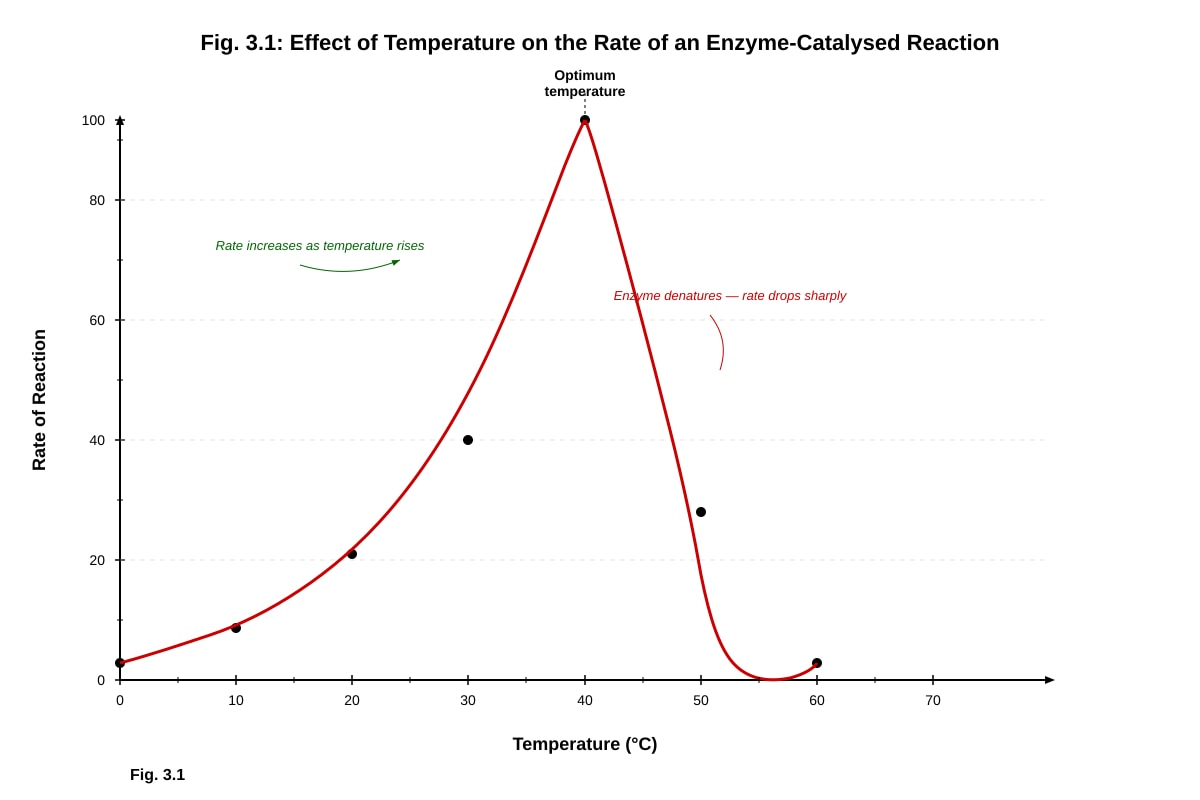
(b)(i) Explain why the rate of reaction increases as temperature rises from 10°C to 40°C. [2]
Answer:
As temperature increases, the kinetic energy of the enzyme and substrate molecules increases. [1]
This results in more frequent and more energetic collisions between enzyme and substrate molecules, increasing the rate of formation of enzyme-substrate complexes and thus the rate of reaction. [1]
Marking notes:
- Award [1] for increased kinetic energy.
- Award [1] for increased frequency of effective collisions / more enzyme-substrate complexes formed.
- Accept "molecules move faster" for kinetic energy.
(b)(ii) Explain why the rate of reaction decreases sharply above 50°C. [3]
Answer:
Above 50°C, the high temperature causes the enzyme to denature. [1]
The heat energy breaks the hydrogen bonds and other bonds that maintain the specific three-dimensional shape of the enzyme's active site. [1]
The active site loses its complementary shape to the substrate, so the substrate can no longer fit into the active site to form an enzyme-substrate complex, and the rate of reaction decreases. [1]
Marking notes:
- Award [1] for stating enzyme denatures.
- Award [1] for explaining bonds broken / active site shape changed.
- Award [1] for linking shape change to loss of function (substrate cannot bind).
- Do not award "enzyme dies" — enzymes are not alive.
(c) Using the lock-and-key hypothesis, explain why catalase can break down hydrogen peroxide but cannot break down starch. [3]
Answer:
According to the lock-and-key hypothesis, the active site of an enzyme has a specific three-dimensional shape that is complementary to the shape of its specific substrate. [1]
The active site of catalase is complementary in shape to hydrogen peroxide molecules, so hydrogen peroxide can fit into the active site to form an enzyme-substrate complex. [1]
Starch molecules have a different shape that is not complementary to the active site of catalase, so starch cannot bind to the active site and cannot be broken down by catalase. [1]
Marking notes:
- Award [1] for stating active site has specific complementary shape to substrate.
- Award [1] for explaining hydrogen peroxide fits catalase active site.
- Award [1] for explaining starch does not fit due to different shape.
- Must reference lock-and-key hypothesis explicitly or implicitly.
Question 4: Digestive System (9 marks)
(a) Name structures A, B, and C. [3]
| Label | Structure | Mark |
|---|---|---|
| A | Stomach | [1] |
| B | Pancreas | [1] |
| C | Liver | [1] |
Marking notes: Spelling must be recognisable. Accept "gall bladder" only if diagram clearly indicates gall bladder rather than liver.
(b) Describe the role of bile in the digestion of fats. [3]
Answer:
Bile is produced by the liver and stored in the gall bladder before being released into the duodenum. [1]
Bile emulsifies fats, breaking large fat globules into smaller fat droplets. [1]
This increases the total surface area of fats for lipase enzymes to act upon, increasing the rate of fat digestion. [1]
Marking notes:
- Award [1] for stating bile emulsifies/breaks up fats.
- Award [1] for describing increased surface area.
- Award [1] for linking increased surface area to faster enzyme action.
- Accept "bile salts" for bile.
(c) Explain how a reduced number of villi would affect absorption of digested food. [3]
Answer:
Villi are finger-like projections in the small intestine that greatly increase the surface area for absorption. [1]
A reduced number of villi would significantly decrease the total surface area available for absorption of digested food molecules such as glucose, amino acids, and fatty acids. [1]
This would result in less efficient absorption of nutrients, leading to malnutrition and weight loss despite adequate food intake. [1]
Marking notes:
- Award [1] for stating villi increase surface area.
- Award [1] for explaining reduced surface area decreases absorption.
- Award [1] for stating consequence (malnutrition / reduced nutrient uptake / weight loss).
- Accept reference to microvilli as additional surface area feature.
Question 5: Heart Structure and Function (10 marks)
(a) Name chambers X and Y. [2]
| Label | Chamber | Mark |
|---|---|---|
| X | Right ventricle | [1] |
| Y | Left ventricle | [1] |
Marking notes: Must specify "right" and "left" correctly. Accept "RV" and "LV" if defined.
(b) Explain why the wall of chamber Y (left ventricle) is thicker than the wall of chamber X (right ventricle). [2]
Answer:
The left ventricle pumps blood to the entire body (systemic circulation), which requires higher pressure to overcome the greater resistance of the longer circulatory pathway. [1]
The thicker muscular wall generates greater contractile force to produce this higher pressure. The right ventricle only pumps blood to the nearby lungs (pulmonary circulation), which requires lower pressure. [1]
Marking notes:
- Award [1] for stating left ventricle pumps to whole body / systemic circulation.
- Award [1] for linking thicker wall to need for higher pressure / greater force.
- Accept comparison of distances (body vs. lungs).
(c) Describe the events that occur during ventricular systole. [4]
Answer:
During ventricular systole, the ventricles contract. [1]
The pressure in the ventricles rises sharply, exceeding the pressure in the atria, causing the bicuspid (mitral) and tricuspid (atrioventricular) valves to close, preventing backflow of blood into the atria. [1]
When the ventricular pressure exceeds the pressure in the aorta and pulmonary artery, the semilunar valves are forced open. [1]
Blood is pumped out of the right ventricle into the pulmonary artery (to the lungs) and out of the left ventricle into the aorta (to the body). [1]
Marking notes:
- Award [1] for stating ventricles contract.
- Award [1] for describing AV valve closure due to pressure increase.
- Award [1] for describing semilunar valve opening.
- Award [1] for stating blood ejected to pulmonary artery and aorta.
- Accept "bicuspid and tricuspid valves" for AV valves.
(d) State the function of the valves in the heart. [2]
Answer:
The valves prevent the backflow of blood. [1]
They ensure that blood flows in one direction only through the heart — from atria to ventricles, and from ventricles to arteries. [1]
Marking notes:
- Award [1] for "prevent backflow".
- Award [1] for "ensure one-way flow" or specifying direction.
- Accept either point independently.
Section B: Free-Response Questions (20 marks)
Question 6: Aerobic Respiration (6 marks)
Answer:
Aerobic respiration is the process by which cells break down glucose in the presence of oxygen to release energy. [1]
Word equation:
Glucose + Oxygen → Carbon dioxide + Water + Energy (ATP) [1]
Site of reaction:
Aerobic respiration occurs in the mitochondria of cells. [1]
Importance of energy released:
The energy released in the form of ATP is used for:
- Muscle contraction for movement and locomotion. [1]
- Active transport of substances across cell membranes against concentration gradients. [1]
- Synthesis of large molecules such as proteins from amino acids, and cell division/growth. [1]
- Maintenance of body temperature in warm-blooded organisms.
(Any three uses for [3 marks])
Marking notes:
- Award [1] for definition including glucose breakdown with oxygen to release energy.
- Award [1] for correct word equation (accept chemical equation: C₆H₁₂O₆ + 6O₂ → 6CO₂ + 6H₂O + energy).
- Award [1] for stating mitochondria as site.
- Award up to [3] for three valid uses of energy, one mark each.
- Accept: muscle contraction, active transport, protein synthesis, cell division, growth, nerve impulse transmission, maintaining body temperature, bioluminescence.
Question 7: Root Hair Cell Adaptation (6 marks)
Answer:
A root hair cell is a specialised plant cell adapted for the absorption of water and mineral ions from the soil.
Adaptations:
-
The root hair cell has a long, narrow extension (the root hair) which greatly increases the surface area to volume ratio of the cell. [1] This allows for a faster rate of absorption of water by osmosis and mineral ions by active transport. [1]
-
The cell membrane of the root hair cell contains many carrier proteins. [1] These carrier proteins are specific for different mineral ions (e.g., nitrate ions, potassium ions) and actively transport them from the soil into the cell against the concentration gradient. [1]
-
The root hair cell contains many mitochondria in its cytoplasm. [1] The mitochondria carry out aerobic respiration to produce ATP, which provides the energy required for the active transport of mineral ions against the concentration gradient. [1]
-
The cell sap in the vacuole of the root hair cell contains dissolved sugars, amino acids, and mineral ions, giving it a lower water potential than the soil water. [1] This creates a water potential gradient that drives the entry of water by osmosis from the soil into the root hair cell. [1]
(Any three adaptations with explanations for [6 marks], 2 marks per adaptation)
Marking notes:
- Award [1] for identifying an adaptation and [1] for explaining how it aids function.
- Accept: large surface area, thin cell wall (short diffusion distance), many mitochondria, carrier proteins, concentrated cell sap.
- Must link structure to function explicitly.
- Maximum [6] marks.
Question 8: Double Circulation (8 marks)
Answer:
Double circulation refers to the circulatory system in humans where blood passes through the heart twice during one complete circuit of the body. It consists of the pulmonary circulation and the systemic circulation. [1]
Pulmonary circulation:
Deoxygenated blood from the body returns to the right atrium of the heart via the superior and inferior vena cavae. [1]
The right atrium contracts, pushing blood into the right ventricle. The right ventricle then contracts, pumping deoxygenated blood through the pulmonary artery to the lungs. [1]
In the lungs, gaseous exchange occurs: carbon dioxide diffuses out of the blood into the alveoli, and oxygen diffuses from the alveoli into the blood. The blood becomes oxygenated. [1]
Oxygenated blood returns from the lungs to the left atrium of the heart via the pulmonary veins. [1]
Systemic circulation:
The left atrium contracts, pushing oxygenated blood into the left ventricle. The left ventricle contracts powerfully, pumping oxygenated blood through the aorta to all parts of the body (except the lungs). [1]
In the body tissues, oxygen diffuses from the blood into the cells for aerobic respiration, and carbon dioxide (a waste product) diffuses from the cells into the blood. The blood becomes deoxygenated. [1]
Deoxygenated blood returns to the right atrium via the vena cavae, completing the circuit. [1]
Significance:
Double circulation ensures that oxygenated and deoxygenated blood are kept separate, allowing efficient delivery of oxygen to body tissues. The higher pressure in the systemic circuit (driven by the thicker left ventricle) ensures blood reaches all body tissues effectively. [1]
Marking notes:
- Award [1] for defining double circulation (blood passes through heart twice).
- Award [1] for naming right atrium and vena cavae in pulmonary circuit.
- Award [1] for describing right ventricle → pulmonary artery → lungs.
- Award [1] for describing gas exchange in lungs and return via pulmonary veins.
- Award [1] for naming left atrium and left ventricle in systemic circuit.
- Award [1] for describing left ventricle → aorta → body.
- Award [1] for describing gas exchange in tissues and return via vena cavae.
- Award [1] for significance (separation of blood / efficient oxygen delivery / pressure difference).
- Accept alternative valid points within the description.
Section C: Essay Question (15 marks)
Question 9: Starch Digestion and Villus Absorption (15 marks)
(a) Describe the digestion of starch from the mouth to the ileum. [9]
Answer:
Mouth:
Starch digestion begins in the mouth. The salivary glands secrete saliva, which contains the enzyme salivary amylase. [1]
Salivary amylase hydrolyses starch into maltose (a disaccharide). [1]
The food is chewed and mixed with saliva, increasing the surface area for enzyme action. The food bolus is then swallowed and passes down the oesophagus to the stomach. [1]
Stomach:
No starch digestion occurs in the stomach because the acidic conditions (hydrochloric acid) denature salivary amylase, stopping its action. [1]
Duodenum (small intestine):
The pancreas secretes pancreatic juice into the duodenum, which contains pancreatic amylase. [1]
Pancreatic amylase continues the digestion of any remaining starch into maltose. [1]
The alkaline conditions in the duodenum (due to bile and pancreatic juice) provide an optimal pH for pancreatic amylase activity. [1]
Ileum (small intestine):
The epithelial cells lining the ileum produce the enzyme maltase, which is present on the membranes of the microvilli. [1]
Maltase hydrolyses maltose into glucose (a monosaccharide). [1]
Glucose is the final product of starch digestion and is small enough to be absorbed across the intestinal epithelium into the bloodstream. [1]
Marking notes:
- Award marks as indicated for each stage.
- Must include: mouth (salivary amylase, starch → maltose), stomach (no digestion, acid denatures amylase), duodenum (pancreatic amylase, starch → maltose), ileum (maltase, maltose → glucose).
- Accept "pancreatic amylase" and "maltase" with correct substrates and products.
- Maximum [9] marks.
(b) Explain how the structure of a villus is adapted for the absorption of the products of digestion. [6]
Answer:
-
Finger-like projections: Villi are finger-like projections of the intestinal wall that greatly increase the total surface area for absorption of digested food molecules. [1] The epithelial cells of the villi also have microvilli on their surface, further increasing the surface area. [1]
-
One-cell thick epithelium: The wall of the villus is composed of a single layer of epithelial cells (one cell thick). [1] This provides a very short diffusion distance for absorbed nutrients (e.g., glucose, amino acids) to pass from the lumen of the ileum into the blood capillaries. [1]
-
Dense capillary network: Each villus contains a dense network of blood capillaries close to the epithelial surface. [1] This allows rapid transport of absorbed glucose and amino acids away from the villus, maintaining a steep concentration gradient for continued absorption. [1]
-
Lacteal: Each villus contains a lacteal (a lymphatic vessel) at its centre. [1] The lacteal absorbs fatty acids and glycerol (products of fat digestion), which are reassembled into fats and transported via the lymphatic system. [1]
-
Many mitochondria: The epithelial cells of the villi contain many mitochondria. [1] These provide ATP energy for the active transport of glucose and amino acids against their concentration gradients from the lumen into the blood. [1]
(Any three adaptations with explanations for [6 marks], 2 marks per adaptation)
Marking notes:
- Award [1] for identifying an adaptation and [1] for explaining how it aids absorption.
- Accept: large surface area (villi + microvilli), thin epithelium, capillary network, lacteal, mitochondria.
- Must link structure to function explicitly.
- Maximum [6] marks.
Question 10: Enzyme Function and Temperature Effects (15 marks)
(a) Explain how enzymes function as biological catalysts, using the lock-and-key hypothesis. [6]
Answer:
Enzymes are proteins that act as biological catalysts, speeding up the rate of chemical reactions in living organisms without being chemically changed or used up in the process. [1]
Lock-and-key hypothesis:
-
Each enzyme has a specific three-dimensional shape with a depression or cleft called the active site. [1] The active site has a specific shape that is complementary to the shape of its specific substrate molecule, like a lock and key. [1]
-
The substrate molecule fits precisely into the active site of the enzyme, forming an enzyme-substrate complex. [1] This binding brings the substrate molecule into the correct orientation for the reaction to occur.
-
The formation of the enzyme-substrate complex lowers the activation energy required for the chemical reaction to proceed. [1] This allows the reaction to occur more rapidly at body temperature than it would without the enzyme.
-
The reaction takes place, and the substrate is converted into product(s). The products no longer fit the active site and are released. [1] The enzyme remains unchanged and its active site is free to bind with another substrate molecule, allowing it to be reused repeatedly. [1]
Marking notes:
- Award [1] for definition of enzyme as biological catalyst.
- Award [1] for describing active site with specific complementary shape.
- Award [1] for lock-and-key analogy.
- Award [1] for enzyme-substrate complex formation.
- Award [1] for lowering activation energy.
- Award [1] for product release and enzyme reuse.
- Maximum [6] marks.
(b) With reference to a named enzyme, describe and explain the effect of temperature on the rate of an enzyme-catalysed reaction. [9]
Answer:
Named enzyme: Amylase (or any valid enzyme, e.g., catalase, pepsin). [1]
Effect of increasing temperature (0°C to optimum):
At low temperatures (e.g., 0°C), the enzyme and substrate molecules have low kinetic energy. [1] They move slowly, resulting in few collisions and a low rate of enzyme-substrate complex formation. The rate of reaction is low. [1]
As temperature increases, the kinetic energy of the enzyme and substrate molecules increases. [1] The molecules move faster, resulting in more frequent collisions between enzyme and substrate. More enzyme-substrate complexes are formed per unit time, so the rate of reaction increases. [1]
The rate of reaction approximately doubles for every 10°C rise in temperature until the optimum temperature is reached. For human enzymes like amylase, the optimum temperature is around 37°C (body temperature). [1] At the optimum temperature, the rate of reaction is at its maximum.
Effect of temperature above optimum:
Above the optimum temperature (e.g., above 40–50°C for amylase), the rate of reaction decreases sharply. [1]
The high temperature causes the enzyme to denature. The heat energy breaks the hydrogen bonds and other weak bonds (ionic bonds, hydrophobic interactions) that maintain the specific three-dimensional shape of the enzyme molecule. [1]
The active site loses its precise complementary shape, so the substrate can no longer fit into the active site to form an enzyme-substrate complex. [1] The enzyme is permanently inactivated, and the rate of reaction falls to zero. Denaturation is irreversible. [1]
Marking notes:
- Award [1] for naming a valid enzyme.
- Award [1] for low kinetic energy at low temperatures.
- Award [1] for increased kinetic energy and collision frequency as temperature rises.
- Award [1] for stating optimum temperature (around 37°C for human enzymes).
- Award [1] for stating rate decreases above optimum.
- Award [1] for explaining denaturation (bonds broken).
- Award [1] for explaining active site shape change.
- Award [1] for linking shape change to loss of function.
- Award [1] for stating denaturation is irreversible/permanent.
- Maximum [9] marks.
END OF ANSWER KEY
This answer key was generated by TuitionGoWhere AI. Mark allocations are indicative and based on typical O-Level Biology (6093) marking schemes. Teachers should exercise professional judgment when marking student responses.