AI Generated Exam Paper
O Level Biology Practice Paper 3
Free O Level Biology Practice Paper 3, HY3 AI version, with questions, answers, and O Level-style practice for Singapore students.
These static practice materials are generated from the site's syllabus and paper-generation workflow, with source and model context shown so students and parents can evaluate the material before use.
Questions
Free quiz and exam paper access
Enter your details to view this paper
Your access is remembered on this device.
Answers
TuitionGoWhere Practice Paper — Biology O-Level (Answer Key)
Version: 3 of 5
Total Marks: 60
Level: O-Level
Topic Focus: Cells & Biomolecules (syllabus-first, AI-inferred; not claimed as past-year derived)
Section A: Recall and Short Answer (16 marks)
Q1. [1] Chloroplast.
Teaching note: Photosynthesis occurs in chloroplasts because they contain chlorophyll to trap light energy. Plant cells only.
Q2. [1] Carbon (C), Hydrogen (H), Oxygen (O), Nitrogen (N); sometimes Sulphur (S).
Teaching note: Proteins are made of amino acids which contain these elements. Minimum accepted: C, H, O, N.
Q3. [1] Any one: maintains cell turgor / stores water and dissolved substances / supports cell.
Teaching note: Large vacuole presses cytoplasm against wall, keeping plant rigid.
Q4. [1] Reducing sugars.
Teaching note: Benedict’s solution turns brick-red with reducing sugars (e.g., glucose). Starch uses iodine.
Q5. [2] Diffusion is the net movement of particles from a region of higher concentration to a region of lower concentration.
Marking: 1 for movement high→low, 1 for “net” or passive nature.
Common mistake: Saying “anything moves” without concentration gradient.
Q6. [1] Active transport.
Teaching note: Requires energy (ATP) to move against gradient.
Q7. [1] Blue-black.
Teaching note: Iodine + starch → blue-black complex.
Q8. [1] Ribosome.
Teaching note: Too small for light microscope; seen via electron microscope.
Section B: Structured Response (28 marks)
Q9. [2]
(a) Bacterial cell has cell wall made of peptidoglycan; animal cell has no cell wall (or cellulose in plants). [1]
(b) Bacterial cell has plasmids / nucleoid (no true nucleus); animal cell has nucleus with nuclear envelope. [1]
Teaching note: Must state difference, not just presence.
Q10. [4]
- Amylase active site is complementary in shape to starch (lock-and-key) so only starch binds. [1]
- Factor 1: Temperature — rate rises to optimum (~37 °C) then falls as enzyme denatures. [1]
- Factor 2: pH — amylase works best near neutral; extreme pH changes active site shape. [1]
- (Extra: substrate concentration increases rate until saturation.) [1 if third factor]
Marking: 1 specificity + 2 factors (1 each) + 1 detail.
Common trap: Not explaining denaturation.
Q11. [2]
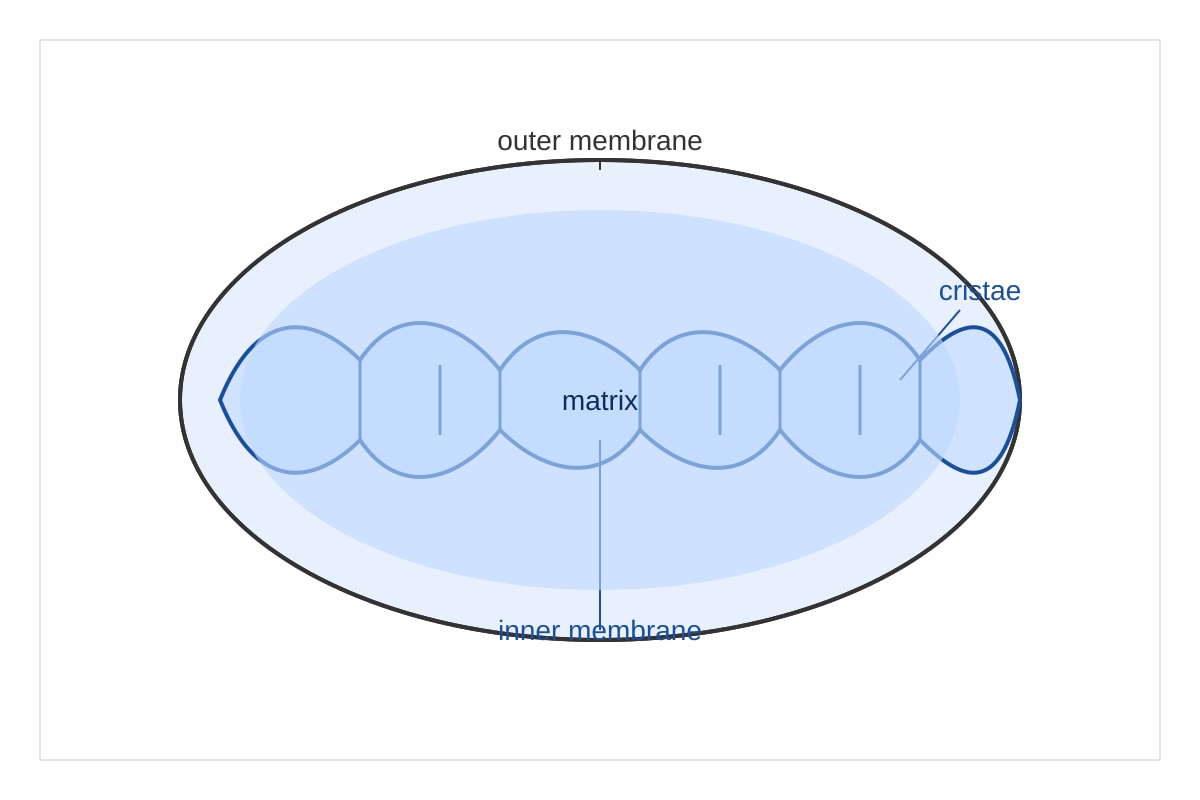
(a) Cristae (folded inner membrane) give large surface area for respiratory enzymes. [1]
(b) Matrix contains enzymes for Krebs cycle / double membrane separates compartments. [1]
Image requirement: Micrograph must show cristae and matrix clearly.
Q12. [6]
- Osmosis: water moves down its concentration gradient across partially permeable membrane. [1]
- Active transport: substances moved against gradient using ATP. [1]
- Osmosis needs no energy; active transport needs energy. [1]
- Osmosis involves water only; active transport involves ions/molecules via carrier proteins. [1]
- Plant example osmosis: water uptake by root hair cells. [1]
- Plant example active transport: mineral ion uptake by root hair cells. [1]
Marking descriptors: 6 clear points as above.
Q13. [4]
- 20→40 °C: rising temperature increases kinetic energy and collision rate, so more enzyme-substrate complexes form. [2]
- 50 °C still high but near denaturation; 60 °C: enzyme denatured, active site lost, activity drops sharply. [2]
Teaching note: Catalase is a protein; heat beyond optimum unfolds it.
Q14. [4]
- Enzymes are biological catalysts that speed up digestion. [1]
- Amylase: starch → maltose (in mouth/small intestine). [1]
- Pepsin: proteins → peptides (in stomach, acidic pH). [1]
- (Or lipase: fats → fatty acids + glycerol.) [1]
Marking: catalyst role + 2 enzymes with substrate/product.
Q15. [3]
- Air stone adds oxygen to solution. [1]
- Root cells use O₂ for aerobic respiration to produce ATP. [1]
- ATP powers active transport of mineral ions into roots. [1]
Teaching note: Without aeration, roots respire anaerobically, less ATP, poor uptake.
Section C: Application and Integration (16 marks)
Q16. [3]
- More protein → more deamination of amino acids in liver. [1]
- More urea produced → higher solute concentration in blood. [1]
- Kidney reabsorbs more water by osmosis → urine more concentrated (lower volume, darker). [1]
Common mistake: Confusing volume with concentration.
Q17. [2]
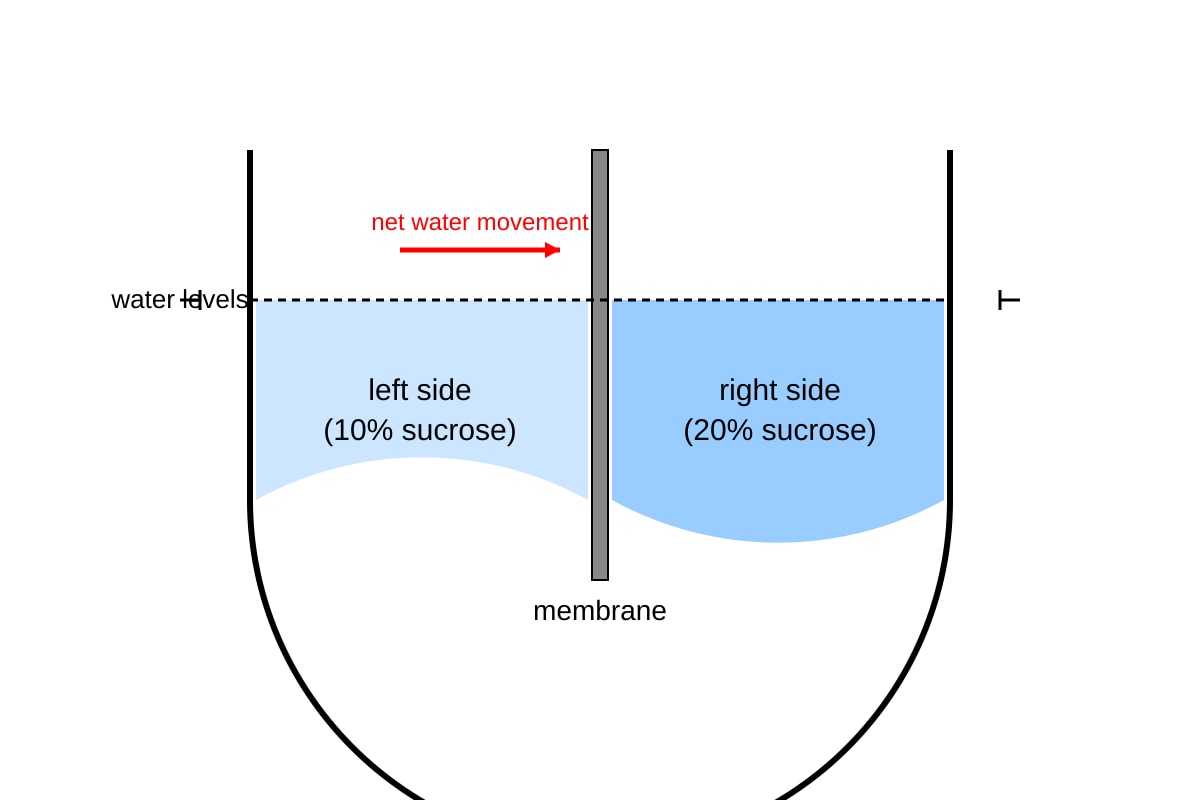
(a) Direction: from left (10%) to right (20%). [1]
(b) Term: osmosis. [1]
Image note: U-tube must show membrane; water moves to higher sucrose side.
Q18. [3]
- Enzyme has active site with specific shape. [1]
- Substrate fits like key into lock forming enzyme-substrate complex. [1]
- Reaction occurs; product released, enzyme unchanged. [1]
Q19. [3]
- Glycerol [1]
- Fatty acids [1]
- Function: long-term energy storage / insulation / cell membrane component. [1]
Q20. [5]
- Pure water has higher water potential than inside cell. [1]
- By osmosis, water enters red blood cell across membrane. [1]
- Cell has no wall, so it swells. [1]
- Continues until membrane bursts (haemolysis). [1]
- Because partially permeable membrane allows water but not solutes out. [1]
Marking: 5-point chain from potential to burst.
Total marks awarded = 60 (matches paper).