From Real Exams Exam Paper
O Level Biology Practice Paper 5
Free O Level Biology Practice Paper 5, HY3 Exam version, with questions, answers, and O Level-style practice for Singapore students.
These static practice materials are generated from the site's syllabus and paper-generation workflow, with source and model context shown so students and parents can evaluate the material before use.
Questions
Free quiz and exam paper access
Enter your details to view this paper
Your access is remembered on this device.
Answers
TuitionGoWhere Exam Practice (AI) - Biology O-Level Practice Paper (Version 5) Answer Key
Total Marks: 60
Section A: Cell Structure and Organisation
Q1 [1]
Answer: Cell wall (or chloroplast / large vacuole).
Teaching note: Under a light microscope, plant cells show a rigid cell wall, chloroplasts, and a large central vacuole; animal cells lack these. Award 1 mark for any one correct structure.
Q2 [2]
Answer:
- Bacterial cells have a cell wall made of peptidoglycan; animal cells have no cell wall (or have cellulose in plants, but animal none). [1]
- Bacterial cells have plasmids / nucleoid (free DNA); animal cells have a true nucleus with chromosomes. [1]
Teaching note: Mark for named feature + clear difference. Common trap: saying "both have ribosomes" (similar, not different).
Q3 [2]
Answer:
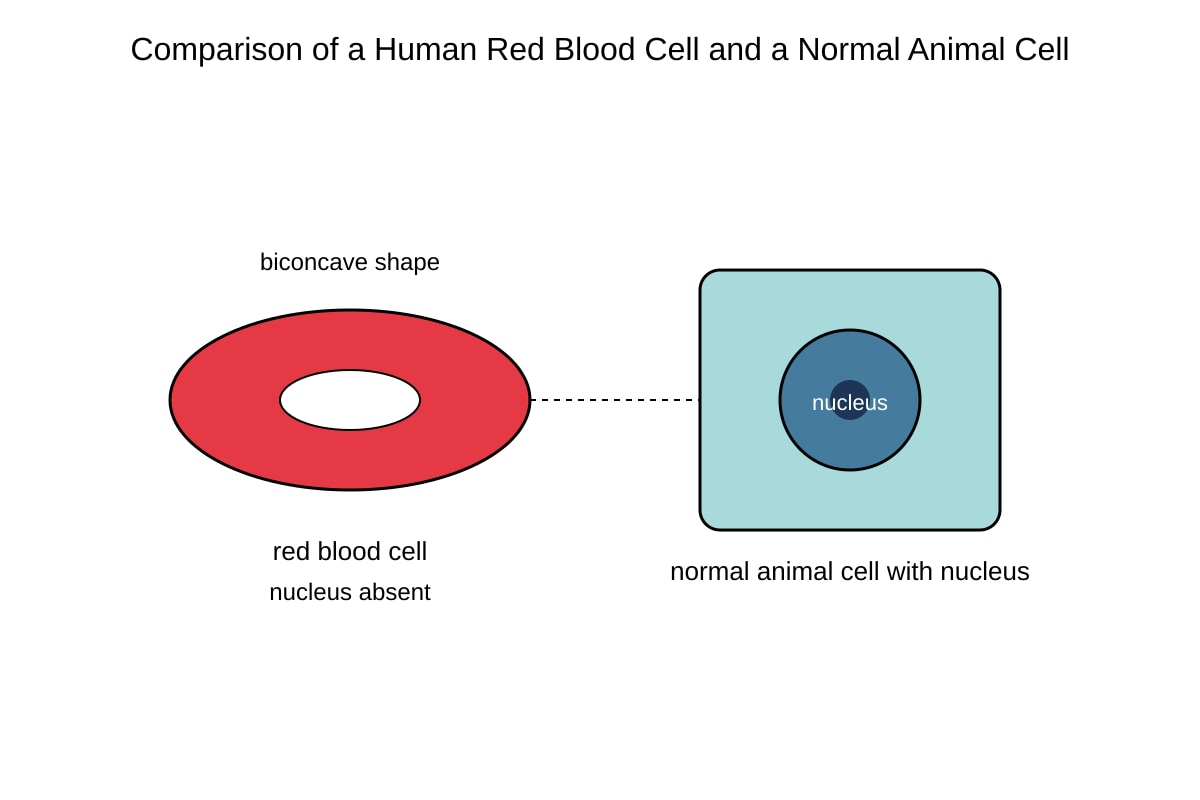
- No nucleus → more space for haemoglobin to carry oxygen. [1]
- Biconcave shape → increased surface area for gas exchange. [1]
Teaching note: Image shows red blood cell without nucleus and indented; adaptation links structure to function.
Q4 [2]
Answer: Ribosome [1]; bacterial ribosomes are smaller (70S) compared to eukaryotic 80S [1].
Teaching note: Ribosomes are the protein factory. Size difference is a prokaryotic vs eukaryotic distinction.
Q5 [2]
Answer: Muscle cells need energy for contraction [1]; mitochondria release energy (ATP) via respiration, so many mitochondria meet high demand [1].
Teaching note: Structure–function link; mitochondria = powerhouse.
Section B: Movement of Substances
Q6 [2]
Answer: Osmosis is the movement of water molecules [1] from a region of high water potential to low water potential across a partially permeable membrane [1].
Teaching note: Must include "water" and "partially permeable membrane".
Q7 [2]
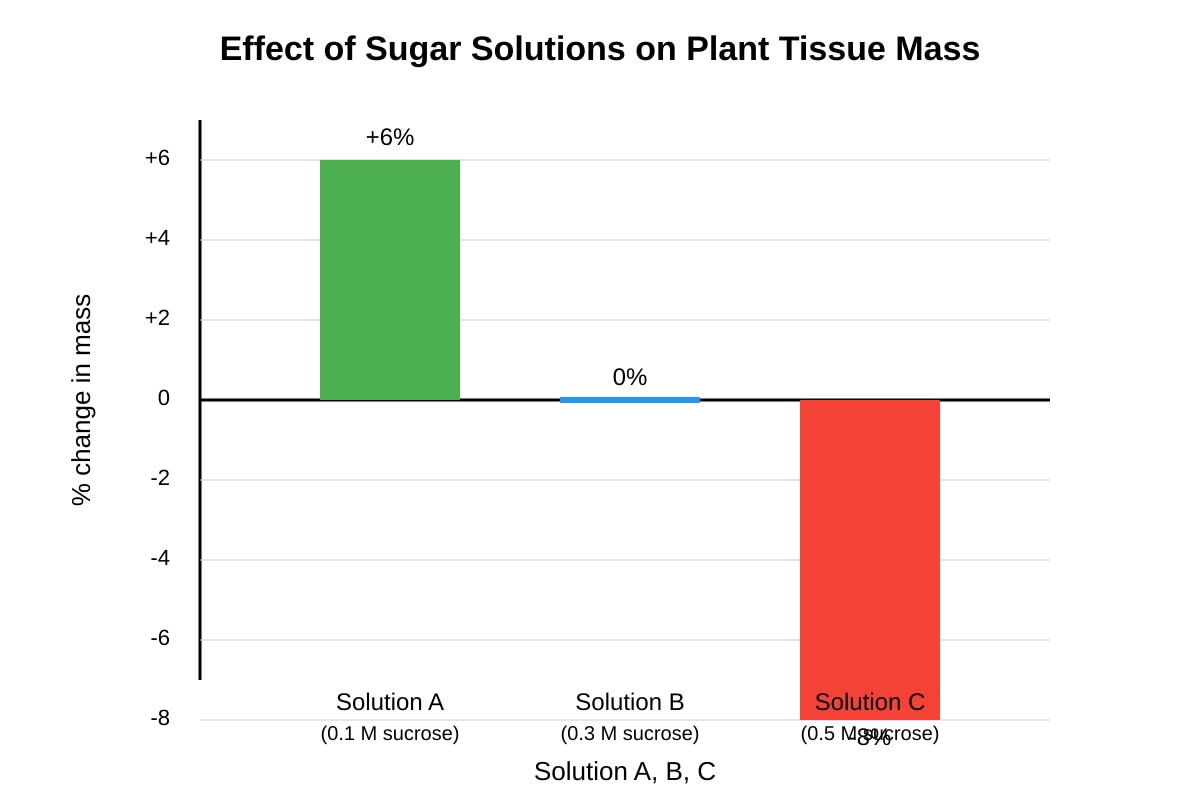
Answer: Solution B (0.3 M) [1]; mass change is 0% meaning no net water movement, so isotonic [1].
Teaching note: Isotonic = equal water potential; graph bars show B at 0%.
Q8 [3]
Answer:
- Diffusion is down concentration gradient, natural random motion, no energy needed [1].
- Active transport moves substances against gradient [1].
- Requires ATP from respiration to drive carrier proteins [1].
Teaching note: 1 mark each point.
Q9 [3]
Answer:
- Salt solution has lower water potential than potato cells [1].
- Water leaves potato cells by osmosis [1].
- Loss of turgor makes cells flaccid [1].
Teaching note: Link solution concentration to water movement.
Q10 [4]
Answer:
- Air stone adds oxygen to solution [1].
- Root cells use oxygen for aerobic respiration [1].
- Respiration produces ATP [1].
- ATP used for active transport of mineral ions into roots [1].
Teaching note: 1 mark per step; common trap is stopping at "plants need oxygen".
Section C: Biological Molecules and Enzymes
Q11 [3]
Answer:
- Starch → Blue-black [1]
- Reducing sugar → Benedict's solution [1]
- Protein → Biuret solution [1]
Teaching note: Standard food tests from syllabus.
Q12 [1]
Answer: Nitrogen (N) [and sometimes sulphur S].
Teaching note: Carbohydrates = C,H,O; proteins add N.
Q13 [4]
Answer:
- Enzymes are biological catalysts that speed up digestion [1].
- Amylase breaks down starch to maltose in mouth/small intestine [1].
- Pepsin breaks down protein to peptides in stomach [1].
- (Or protease/lipase example) [1].
Teaching note: 1 mark for catalyst role, 3 for examples with substrate/product.
Q14 [3]
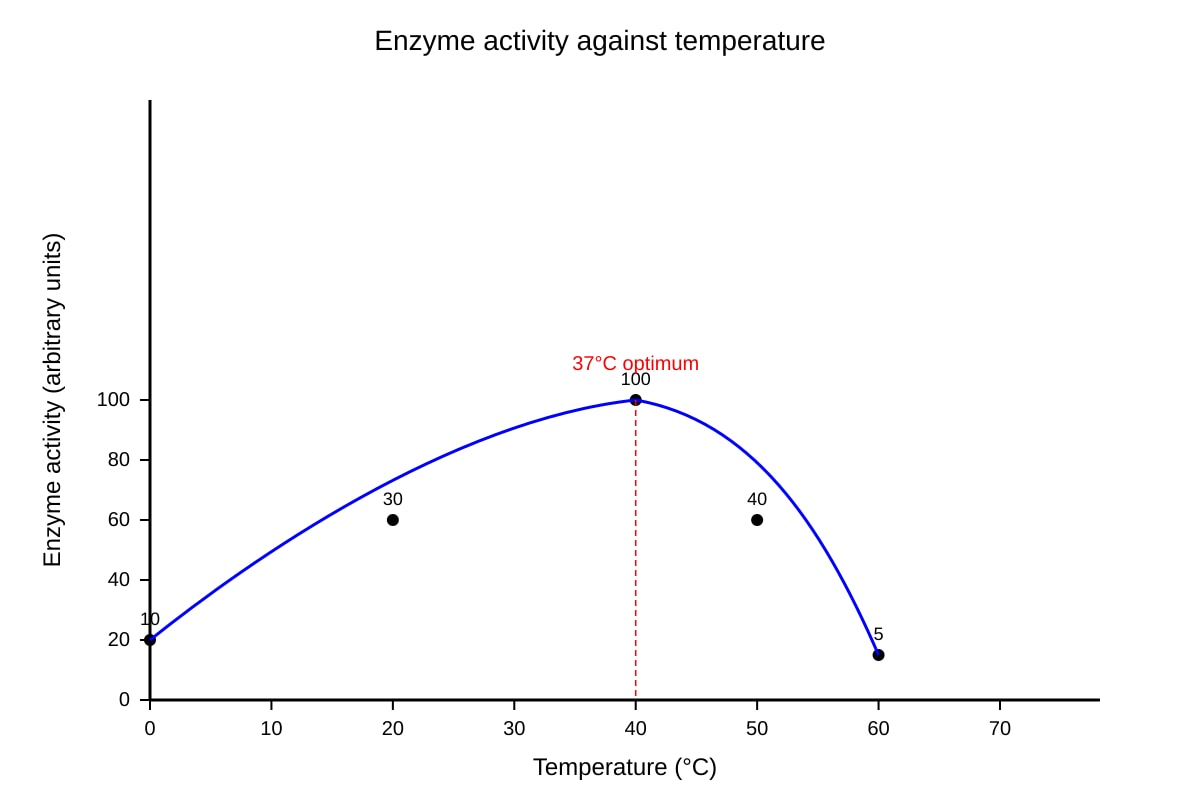
Answer: Optimum = 37°C [1]; above this, enzyme denatures, active site changes shape [1], substrate cannot bind, activity falls [1].
Teaching note: Graph peaks at 37; denaturation is permanent shape change.
Q15 [3]
Answer:
- Enzyme has specific active site complementary to substrate [1].
- Substrate fits like key into lock forming enzyme-substrate complex [1].
- Reaction occurs, product released, enzyme unchanged [1].
Teaching note: Lock-and-key shows specificity.
Section D: Integration and Data
Q16 [3]
Answer: Plant cell [1]; has chloroplasts [1] and cell wall (implied by ER+chloroplast combo, but chloroplast is key) [1].
Teaching note: Chloroplasts only in plant cells.
Q17 [3]
Answer: Protein in W and Z (biuret purple) [2]; only reducing sugar = X (Benedict only) [1].
Teaching note: Y negative for all = no test molecules.
Q18 [3]
Answer:
- More protein → more deamination in liver [1].
- More urea produced → higher solute in blood [1].
- Kidney reabsorbs water, urine more concentrated (or volume changes) [1].
Teaching note: Link protein metabolism to urea and osmotic effect.
Q19 [4]
Answer:
- Dye spreads from high to low concentration (diffusion) [1].
- Eventually evens out [1].
- Higher temperature increases rate [1] (or smaller droplet, stir).
- Because particles have more kinetic energy [1].
Teaching note: 1 mark each; diffusion is random net movement.
Q20 [7]
Answer:
- Zygote divides by mitosis to form embryo [1]
- Embryo moves down fallopian tube [1]
- Forms blastocyst, implants in uterus wall [1]
- Placenta develops for nutrient/O2 exchange [1]
- Umbilical cord connects fetus to placenta [1]
- Amniotic fluid cushions fetus [1]
- Tissues/organs form, pregnancy maintained [1]
Teaching note: 7 marks = 7 clear stages; avoid meiosis confusion.
End of Answer Key — Total 60 marks