From Real Exams Exam Paper
O Level Biology Practice Paper 5
Free Exam-Derived DeepSeek V4 Pro O Level Biology Practice Paper 5 practice paper with questions and answers for Singapore students. This page is rendered as a direct URL so the questions and answers can be discovered without pressing in-page buttons.
These static practice materials are generated from the site's syllabus and paper-generation workflow, with source and model context shown so students and parents can evaluate the material before use.
Questions
TuitionGoWhere Practice Paper - Biology O-Level
TuitionGoWhere Secondary School (AI)
Subject: Biology
Level: O-Level
Paper: PRACTICE - Cells & Biomolecules
Duration: 1 hour 15 minutes
Total Marks: 60
Version: 5 of 5
Name: ___________________________
Class: ___________________________
Date: ___________________________
Instructions to Candidates
- This paper consists of three sections: Section A, Section B, and Section C.
- Answer all questions.
- Write your answers in the spaces provided.
- The number of marks is given in brackets [ ] at the end of each question or part question.
- You are advised to spend about 20 minutes on Section A, 30 minutes on Section B, and 25 minutes on Section C.
Section A: Multiple Choice (10 marks)
Answer all questions. Circle the correct answer (A, B, C, or D).
1. Which of the following structures is found in both plant cells and animal cells?
A. Cell wall
B. Chloroplast
C. Nucleus
D. Large central vacuole
[1]
2. A student carries out a food test on an unknown solution. When iodine solution is added, the solution turns blue-black. What does this indicate?
A. Reducing sugar is present
B. Starch is present
C. Protein is present
D. Fat is present
[1]
3. The diagram below shows an enzyme-catalysed reaction.
Substrate → [Enzyme] → Products
Which statement best describes the role of the enzyme?
A. It provides energy for the reaction
B. It is used up during the reaction
C. It lowers the activation energy of the reaction
D. It changes the equilibrium of the reaction
[1]
4. Which organelle is responsible for the synthesis and transport of proteins within a cell?
A. Smooth endoplasmic reticulum
B. Rough endoplasmic reticulum
C. Golgi body
D. Mitochondrion
[1]
5. A red blood cell is placed in a concentrated salt solution. What will happen to the cell?
A. It will swell and burst
B. It will shrink and become crenated
C. It will remain unchanged
D. It will divide by mitosis
[1]
6. Which of the following correctly lists the elements found in proteins?
A. Carbon, hydrogen, oxygen only
B. Carbon, hydrogen, oxygen, nitrogen
C. Carbon, hydrogen, oxygen, phosphorus
D. Carbon, hydrogen, nitrogen, sulfur only
[1]
7. The lock-and-key hypothesis explains enzyme action. What does the "lock" represent?
A. The substrate molecule
B. The product molecule
C. The active site of the enzyme
D. The enzyme-substrate complex
[1]
8. Which process is responsible for the movement of oxygen from the alveoli into the blood capillaries?
A. Active transport
B. Osmosis
C. Diffusion
D. Phagocytosis
[1]
9. A student observes a cell under a light microscope and identifies the following structures: cell wall, cell membrane, cytoplasm, and nucleus. The cell does NOT contain chloroplasts. This cell is most likely from:
A. A leaf palisade cell
B. A root hair cell
C. A cheek cell
D. A guard cell
[1]
10. Which of the following is a function of the Golgi body?
A. Protein synthesis
B. Lipid synthesis
C. Modifying and packaging proteins for secretion
D. Producing ATP through respiration
[1]
Section B: Structured Questions (30 marks)
Answer all questions in the spaces provided.
11. The diagram below shows an animal cell and a plant cell as seen under a light microscope.
(a) Identify structure X (found only in the plant cell) and state its function. [2]
Structure X: ___________________________
Function: ___________________________________________________________________
(b) Structure Y is present in both cells and controls the movement of substances into and out of the cell. Name structure Y. [1]
(c) Explain why the plant cell has a more regular shape than the animal cell. [2]
12. A student investigated the effect of temperature on the activity of the enzyme amylase. Amylase breaks down starch into reducing sugars. The results are shown in the table below.
| Temperature (°C) | Time taken for starch to be completely broken down (minutes) |
|---|---|
| 10 | 18 |
| 20 | 12 |
| 30 | 6 |
| 40 | 3 |
| 50 | 8 |
| 60 | No breakdown after 30 minutes |
(a) Using the data, describe the effect of temperature on the activity of amylase. [3]
(b) Explain why the enzyme did not break down starch at 60°C. [2]
(c) Name the type of food test that could be used to confirm that reducing sugars were produced in this investigation. [1]
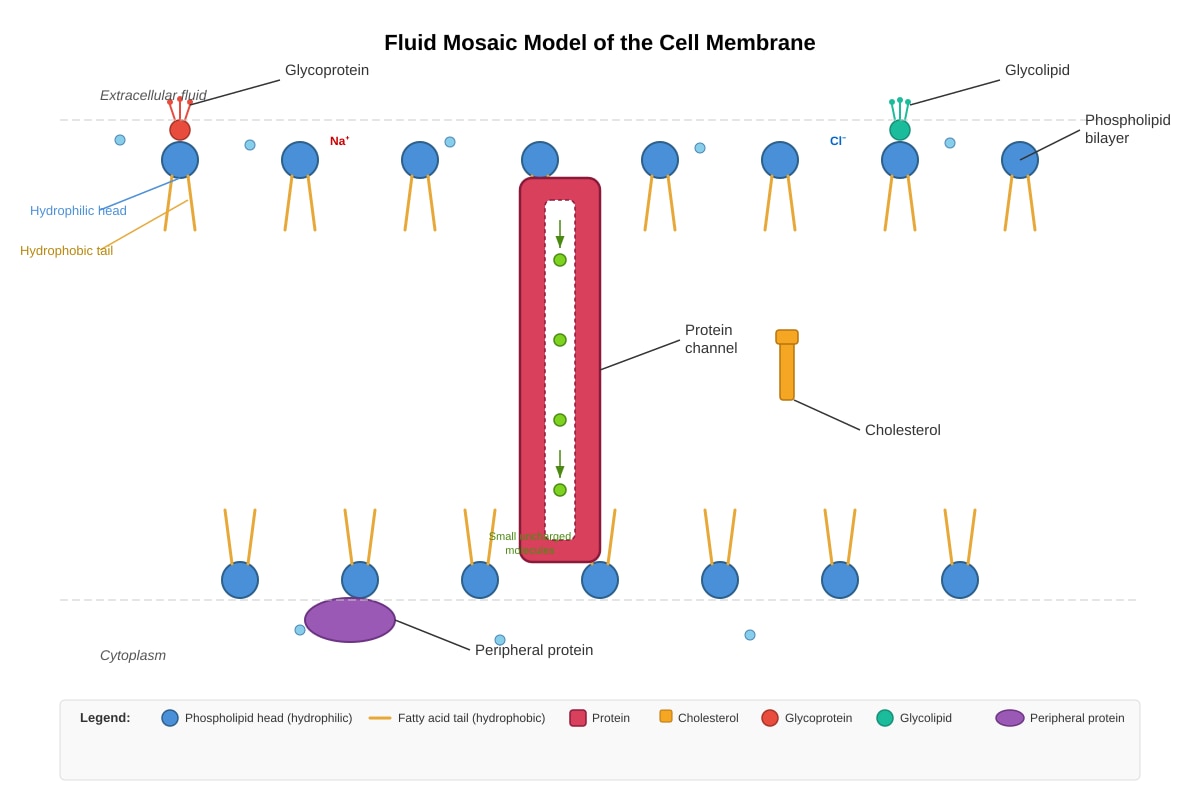
13. The diagram below represents the fluid mosaic model of the cell membrane.
(a) Label the following on the diagram: phospholipid bilayer, protein channel. [2]
[Diagram space provided]
(b) Explain how the structure of the cell membrane allows it to be partially permeable. [3]
(c) State one substance that moves across the cell membrane by:
(i) Diffusion: ___________________________ [1]
(ii) Active transport: ___________________________ [1]
14. A student carried out an investigation into osmosis using potato strips. Potato strips of equal mass were placed in sugar solutions of different concentrations for 30 minutes. The results are shown below.
| Concentration of sugar solution (mol/dm³) | Initial mass (g) | Final mass (g) | Change in mass (g) |
|---|---|---|---|
| 0.0 | 5.0 | 5.6 | +0.6 |
| 0.2 | 5.0 | 5.2 | +0.2 |
| 0.4 | 5.0 | 5.0 | 0.0 |
| 0.6 | 5.0 | 4.7 | -0.3 |
| 0.8 | 5.0 | 4.3 | -0.7 |
(a) Calculate the percentage change in mass for the potato strip placed in the 0.8 mol/dm³ sugar solution. Show your working. [2]
(b) Explain why the potato strip gained mass in the 0.0 mol/dm³ sugar solution. [3]
(c) At which concentration of sugar solution was the water potential of the potato cells equal to the water potential of the surrounding solution? Explain your answer. [2]
15. Compare the structure of a typical bacterial cell with that of a typical animal cell.
(a) State two features present in a bacterial cell that are not present in an animal cell. [2]
Feature 1: ___________________________________________________________________
Feature 2: ___________________________________________________________________
(b) State one feature present in an animal cell that is not present in a bacterial cell. [1]
Section C: Free Response Questions (20 marks)
Answer all questions in the spaces provided.
16. Enzymes are biological catalysts that play essential roles in living organisms.
(a) Explain the lock-and-key hypothesis of enzyme action. [4]
(b) Describe and explain the effect of pH on enzyme activity. [4]
17. Biological molecules are essential for the structure and function of living organisms.
(a) Describe the test for proteins, including the reagent used and the positive result observed. [2]
(b) Explain why proteins are important for living organisms. Give two reasons. [4]
Reason 1: ___________________________________________________________________
Reason 2: ___________________________________________________________________
(c) Large biological molecules are made from smaller subunits. Complete the table below. [3]
| Large molecule | Subunit(s) |
|---|---|
| Starch | |
| Protein | |
| Lipid |
18. A student investigated the effect of pH on the activity of catalase, an enzyme found in potato tissue. Catalase breaks down hydrogen peroxide into water and oxygen. The volume of oxygen produced in 2 minutes was measured at different pH values.
| pH | Volume of oxygen produced (cm³) |
|---|---|
| 3 | 2 |
| 5 | 8 |
| 7 | 15 |
| 9 | 6 |
| 11 | 1 |
(a) Plot a graph of the results on the grid provided. Label both axes. [3]
[Graph grid space provided]
END OF PAPER
Answers
TuitionGoWhere Practice Paper - Biology O-Level
ANSWER KEY AND MARKING SCHEME
Paper: PRACTICE - Cells & Biomolecules
Version: 5 of 5
Total Marks: 60
Section A: Multiple Choice (10 marks)
| Question | Answer | Mark |
|---|---|---|
| 1 | C | 1 |
| 2 | B | 1 |
| 3 | C | 1 |
| 4 | B | 1 |
| 5 | B | 1 |
| 6 | B | 1 |
| 7 | C | 1 |
| 8 | C | 1 |
| 9 | B | 1 |
| 10 | C | 1 |
Marking notes:
- Q1: Nucleus is present in both plant and animal cells. Cell wall, chloroplasts, and large central vacuole are plant-only features.
- Q4: Rough ER has ribosomes attached for protein synthesis and transport. Smooth ER is for lipid synthesis and detoxification.
- Q5: In concentrated salt solution (hypertonic), water leaves the red blood cell by osmosis, causing it to shrink (crenation).
- Q9: Root hair cells have cell walls but no chloroplasts (underground). Palisade and guard cells contain chloroplasts. Cheek cells lack cell walls.
Section B: Structured Questions (30 marks)
Question 11 (5 marks)
(a) Structure X: Chloroplast [1]
Function: Carries out photosynthesis / absorbs light energy to produce glucose/food for the plant [1]
(b) Structure Y: Cell membrane [1]
(c) The plant cell has a cell wall made of cellulose [1] which is rigid and provides structural support, giving the cell a fixed, regular shape [1]. Animal cells lack a cell wall and only have a flexible cell membrane, so they have an irregular shape.
Question 12 (6 marks)
(a) As temperature increases from 10°C to 40°C, the time taken for starch breakdown decreases, indicating that enzyme activity increases [1]. The fastest rate of reaction occurs at 40°C (only 3 minutes) [1]. Above 40°C, enzyme activity decreases sharply, and at 60°C, the enzyme is completely inactive (no breakdown after 30 minutes) [1].
(b) At 60°C, the high temperature causes the enzyme to denature [1]. The shape of the active site is permanently changed, so the substrate (starch) can no longer fit into the active site, and no enzyme-substrate complex can form [1].
(c) Benedict's test [1]
Question 13 (6 marks)
(a) Diagram labels:
- Phospholipid bilayer correctly indicated [1]
- Protein channel correctly indicated [1]
(b) The cell membrane is composed of a phospholipid bilayer [1]. The hydrophobic (water-repelling) tails face inwards, while the hydrophilic (water-attracting) heads face outwards [1]. This arrangement allows small, non-polar molecules (such as oxygen and carbon dioxide) to pass through freely by diffusion, while larger or charged molecules require protein channels or carriers, making the membrane partially permeable [1].
(c) Substances moving across the membrane:
(i) Diffusion: Oxygen / Carbon dioxide / Water (any one correct) [1]
(ii) Active transport: Mineral ions / Glucose / Amino acids (any one correct) [1]
Question 14 (7 marks)
(a) Percentage change in mass = (Final mass - Initial mass) / Initial mass × 100%
= (4.3 - 5.0) / 5.0 × 100% [1]
= -0.7 / 5.0 × 100%
= -14% [1]
(b) The 0.0 mol/dm³ solution is distilled water, which has a higher water potential than the potato cells [1]. Water moves from a region of higher water potential (the solution) to a region of lower water potential (the potato cells) by osmosis [1]. This causes water to enter the potato cells, increasing their mass [1].
(c) At 0.4 mol/dm³ [1]. At this concentration, there was no change in mass, indicating that there was no net movement of water into or out of the potato cells. This means the water potential of the potato cells was equal to the water potential of the surrounding solution [1].
Question 15 (3 marks)
(a) Two features present in a bacterial cell but not in an animal cell:
Feature 1: Cell wall (made of peptidoglycan) [1]
Feature 2: Plasmids / Circular DNA / Flagella / Capsule (any one correct) [1]
(b) One feature present in an animal cell but not in a bacterial cell:
Nucleus (membrane-bound) / Mitochondria / Membrane-bound organelles (any one correct) [1]
Section C: Free Response Questions (20 marks)
Question 16 (8 marks)
(a) The lock-and-key hypothesis states that the active site of an enzyme has a specific three-dimensional shape that is complementary to the shape of its specific substrate [1]. The substrate fits into the active site like a key fits into a lock [1]. When the substrate binds to the active site, an enzyme-substrate complex is formed [1]. This lowers the activation energy required for the reaction, allowing the reaction to proceed more quickly. The products are then released, and the enzyme remains unchanged and can be reused [1].
(b) Each enzyme has an optimum pH at which it works most efficiently [1]. At pH values above or below the optimum, enzyme activity decreases [1]. This is because changes in pH alter the ionic bonds and hydrogen bonds that maintain the specific three-dimensional shape of the enzyme's active site [1]. At extreme pH values, the enzyme becomes denatured — the shape of the active site is permanently changed, and the substrate can no longer bind, so the enzyme loses its catalytic function [1].
Question 17 (9 marks)
(a) Reagent: Biuret solution (sodium hydroxide followed by copper sulfate solution) [1]
Positive result: The solution changes from blue to purple/violet [1]
(b) Importance of proteins:
Reason 1: Growth and repair of body tissues — Proteins are used to build new cells and repair damaged tissues, as they are the main structural component of cells [2].
Reason 2: Enzymes are proteins — Enzymes are biological catalysts that speed up metabolic reactions in the body, and all enzymes are proteins [2].
(Also accept: Formation of hormones, antibodies for immunity, haemoglobin for oxygen transport, etc.)
(c) Table completion:
| Large molecule | Subunit(s) |
|---|---|
| Starch | Glucose [1] |
| Protein | Amino acids [1] |
| Lipid | Glycerol and fatty acids [1] |
Question 18 (3 marks)
(a) Graph requirements:
- Axes correctly labelled: x-axis = pH, y-axis = Volume of oxygen produced (cm³) [1]
- Appropriate scales used on both axes [1]
- All five points plotted accurately and connected with a smooth curve showing a peak at pH 7 [1]
Expected graph shape: The curve should rise from pH 3 to a maximum at pH 7, then decrease through pH 9 to pH 11, showing the optimum pH of catalase is around pH 7 (neutral).
Mark Allocation Summary
| Section | Questions | Marks |
|---|---|---|
| A: Multiple Choice | 1–10 | 10 |
| B: Structured Questions | 11–15 | 30 |
| C: Free Response | 16–18 | 20 |
| Total | 60 |
END OF ANSWER KEY