From Real Exams Exam Paper
O Level Biology Practice Paper 4
Free O Level Biology Practice Paper 4, HY3 Exam version, with questions, answers, and O Level-style practice for Singapore students.
These static practice materials are generated from the site's syllabus and paper-generation workflow, with source and model context shown so students and parents can evaluate the material before use.
Questions
Free quiz and exam paper access
Enter your details to view this paper
Your access is remembered on this device.
Answers
TuitionGoWhere Exam Practice (AI) - Biology O-Level Practice Paper (Version 4) Answer Key
Total Marks: 60
Section A Answers (16 marks)
1. [1] Cell wall (or chloroplast, or large permanent vacuole).
Teaching note: Under light microscope, plant cells show a rigid cell wall and chloroplasts; animal cells lack these. Accept any one correct plant-only feature.
2. [1] Mitochondrion (mitochondria).
Teaching note: Mitochondria are the sites of aerobic respiration where ATP is produced.
3. [1] Starch.
Teaching note: Iodine solution turns blue-black in presence of starch; this is a standard food test.
4. [1] Carbon (C), Hydrogen (H), Oxygen (O), Nitrogen (N) – sometimes Sulphur (S).
Teaching note: Proteins contain C, H, O, N; some also contain S in cysteine/disulphide bonds.
5. [1] Diffusion is the net movement of particles from a region of high concentration to a region of low concentration.
Teaching note: Must mention movement down concentration gradient without energy input.
6. [1] Bacterial cell wall is made of peptidoglycan; plant cell wall is made of cellulose.
Teaching note: This is a key prokaryotic vs eukaryotic difference. Other acceptable: bacterial has no true nucleus.
7. [1] Amylase (salivary amylase).
Teaching note: Salivary glands secrete amylase which begins starch breakdown in mouth.
8. [1] Maintains turgor pressure / stores water and dissolved substances.
Teaching note: Large vacuole provides support by pressing cytoplasm against wall.
Section B Answers (28 marks)
9. [2]
- Bacterial cells have a cell wall made of peptidoglycan; animal cells have no cell wall (or have cellulose-free membrane). [1]
- Bacterial cells have plasmids / nucleoid (no nucleus); animal cells have a true nucleus. [1]
Teaching note: Award 1 mark per clear named difference. Do not accept "both have ribosomes" (similarity).
10. [3]
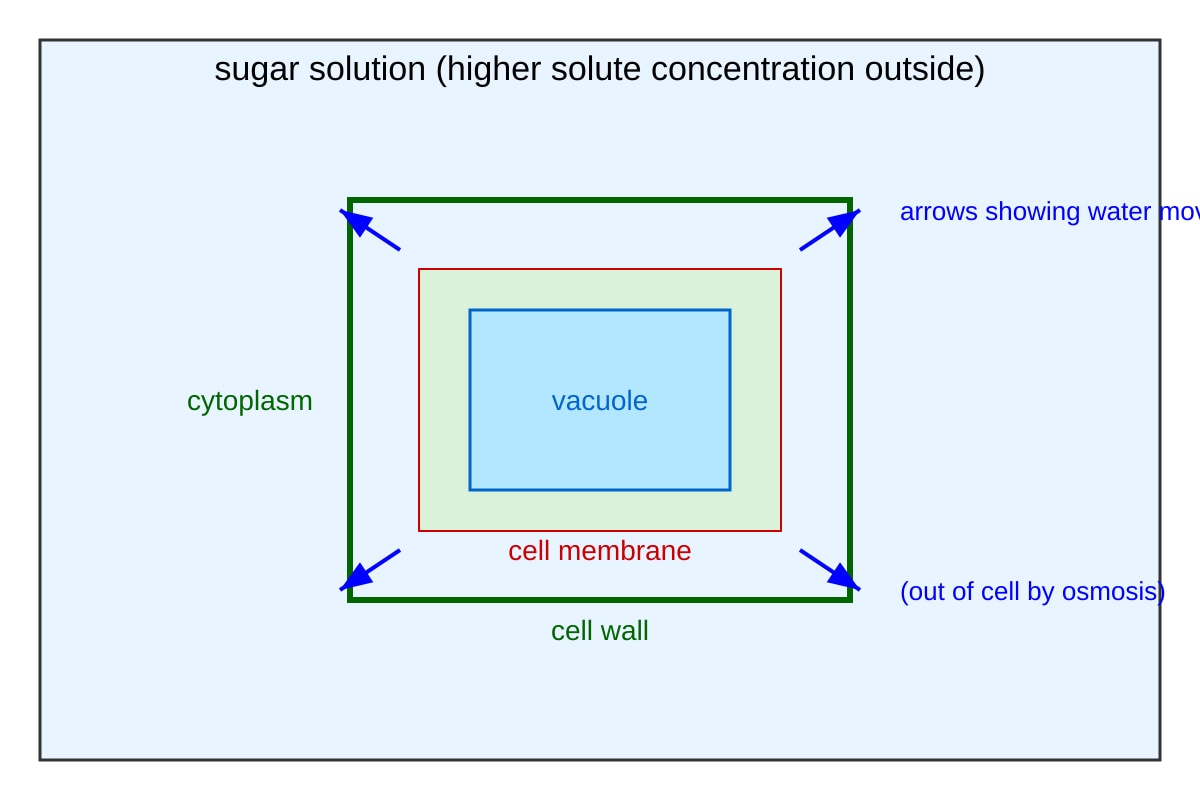
- The sugar solution outside has lower water potential than the cell cytoplasm. [1]
- Water moves out of the cell by osmosis across the partially permeable membrane. [1]
- Loss of water causes cytoplasm and membrane to shrink away from the rigid cell wall (plasmolysis). [1]
Teaching note: Must link osmosis to water potential gradient and name plasmolysis.
11. [4]
- Enzymes are biological catalysts that speed up digestion without being used up. [1]
- Amylase acts on starch → maltose (in mouth/duodenum). [1]
- Pepsin acts on proteins → peptides (in stomach). [1]
- (Or protease/lipase examples) Trypsin/protease on proteins; lipase on fats → fatty acids + glycerol. [1]
Teaching note: 1 mark for catalyst role, 1 each for two named enzymes with substrate + product.
12. [4]
(a) [1] Juice E (brick-red indicates most reducing sugar).
(b) [1] Juice B (no change = no reducing sugar).
(c) [2] Benedict's solution contains copper(II) ions; reducing sugars reduce Cu²⁺ to Cu₂O (copper(I) oxide) precipitate; colour indicates amount. [2]
Teaching note: Brick-red = highest, blue = none.
13. [3]
- Higher protein intake → more amino acids deaminated in liver. [1]
- Produces more urea → increases solute in blood. [1]
- Kidney reabsorbs less water / more water excreted to remove urea → urine more dilute (lower concentration) OR if dehydrated, ADH conserves water. [1]
Teaching note: Common trap: confusing volume with concentration. Link protein → urea → osmotic effect.
14. [3]
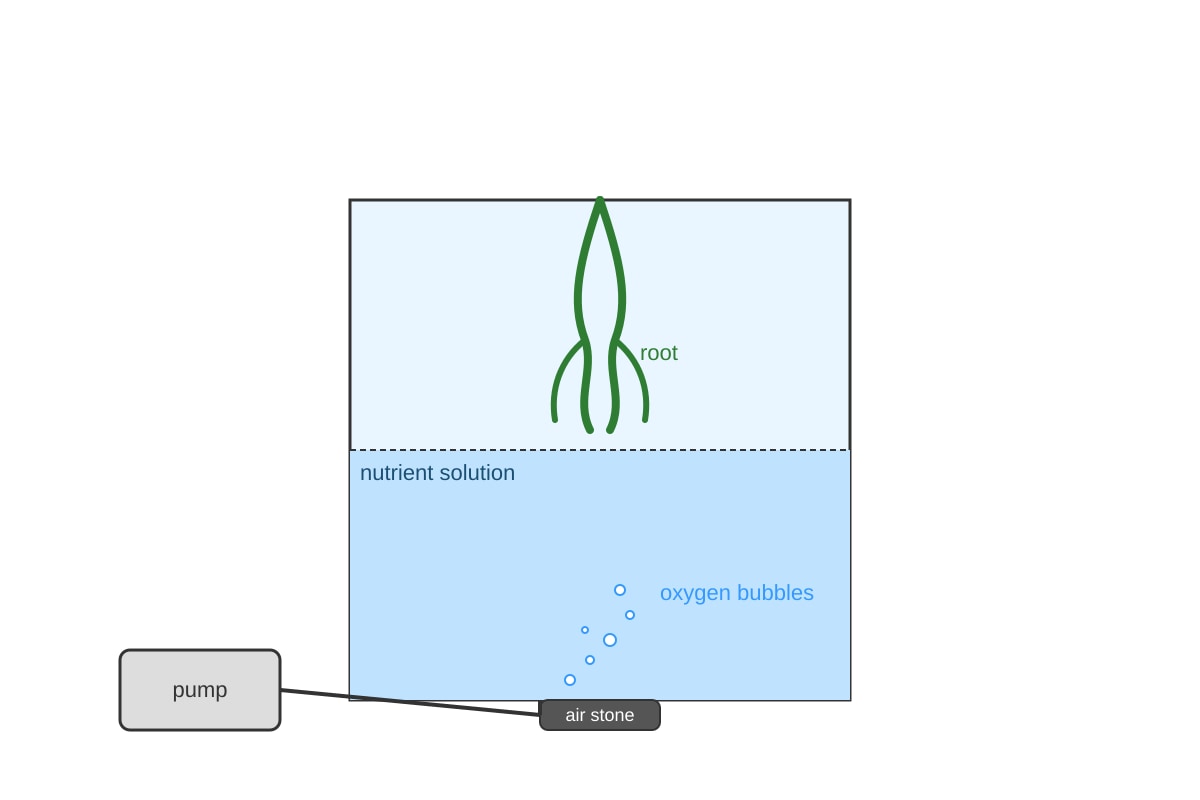
- Air stone adds oxygen to nutrient solution. [1]
- Root cells use O₂ for aerobic respiration to produce ATP. [1]
- ATP used for active transport of mineral ions into roots. [1]
Teaching note: Without aeration, anaerobic respiration reduces ion uptake.
15. [5]
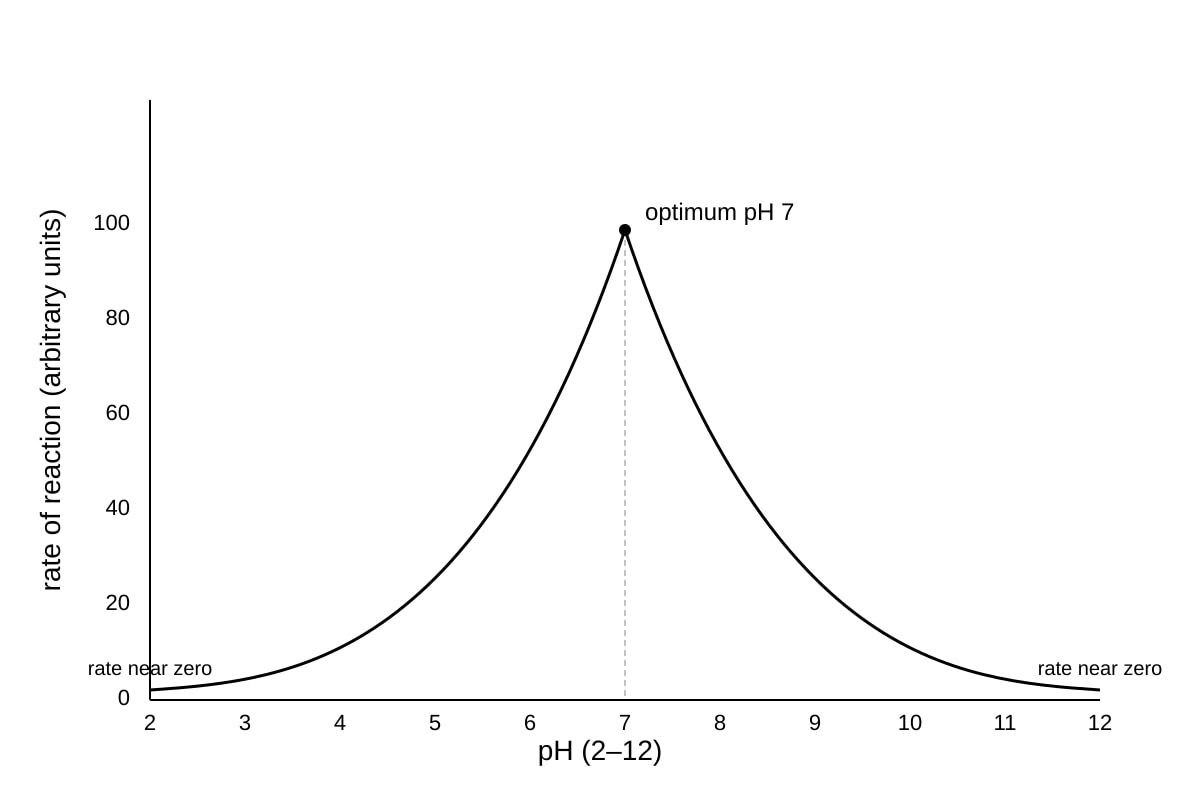
(a) [1] pH 7.
(b) [2] At pH 2, enzyme is denatured / H⁺ changes shape of active site; rate low. [2]
(c) [2] Substrate fits into specific active site like key in lock; enzyme-substrate complex forms; reaction occurs. [2]
Teaching note: Lock-and-key shows specificity.
Section C Answers (16 marks)
16. [4]
- Plant cell has cell wall, animal does not. [1]
- Plant has chloroplasts, animal does not. [1]
- Plant has large central vacuole, animal has small/no vacuole. [1]
- Both have membrane, nucleus, cytoplasm. [1] (or shape difference)
Teaching note: 1 mark per valid difference up to 3 + clarity.
17. [3]
- Add ethanol to sample, shake, add water. [1]
- White emulsion forms if fat present. [1]
- (Method: dissolve in ethanol, pour into water; emulsion = positive.) [1]
Teaching note: Ethanol dissolves fat, water makes it cloudy white.
18. [3]
- Active transport moves ions against gradient using carrier proteins. [1]
- Requires ATP from respiration. [1]
- Diffusion is passive, down gradient, no energy. [1]
Teaching note: Contrast clearly with diffusion.
19. [3]
- Water moves out by osmosis (high to low water potential). [1]
- Animal cell shrinks (crenation). [1]
- Because no wall to prevent shrinkage. [1]
Teaching note: Hypertonic solution causes crenation in animal cells.
20. [3]
- Zygote divides by mitosis to form embryo. [1]
- Moves to uterus, implants in wall. [1]
- Placenta provides nutrients/oxygen via umbilical cord. [1]
Teaching note: Mitosis (not meiosis); placenta key for survival.
End of Answer Key