From Real Exams Exam Paper
O Level Biology Practice Paper 3
Free O Level Biology Practice Paper 3, HY3 Exam version, with questions, answers, and O Level-style practice for Singapore students.
These static practice materials are generated from the site's syllabus and paper-generation workflow, with source and model context shown so students and parents can evaluate the material before use.
Questions
Free quiz and exam paper access
Enter your details to view this paper
Your access is remembered on this device.
Answers
TuitionGoWhere Exam Practice (AI) — Biology O-Level
Practice Paper: Cells & Biomolecules (Version 3 of 5) — Answer Key
Total Marks: 60
Section A: Recall and Short Answer (14 marks)
1. [1] Chloroplast.
Teaching note: Chloroplasts contain chlorophyll and are the site of photosynthesis in plant cells. Only plant cells (and some algae) have them.
2. [1] Carbon (C), Hydrogen (H), Oxygen (O), Nitrogen (N); sometimes Sulphur (S).
Teaching note: Proteins are made of amino acids which contain these elements. Carbohydrates and fats lack nitrogen.
3. [1] Any one: maintains cell turgor / stores water and dissolved substances / supports the cell.
Teaching note: The large central vacuole in plant cells is filled with cell sap and helps keep the cell rigid.
4. [1] Iodine solution.
Teaching note: Iodine turns blue-black in the presence of starch; this is a standard food test.
5. [2] Diffusion is the net movement of particles from a region of higher concentration to a region of lower concentration.
Marking: 1 mark for "high to low concentration"; 1 mark for "net movement of particles".
Common mistake: Writing only "movement" without direction or concentration reference.
6. [1] The active site is the region on the enzyme where the substrate binds.
Teaching note: It has a specific shape complementary to the substrate.
7. [1] Active transport.
Teaching note: Active transport uses energy (ATP) to move substances against a concentration gradient.
8. [1] Reducing sugar.
Teaching note: Benedict's solution gives brick-red with reducing sugars (e.g., glucose) after heating.
Section B: Structured Response and Interpretation (26 marks)
9. [2]
(a) Bacterial cells have a cell wall made of peptidoglycan; animal cells have no cell wall (or cellulose wall in plants, but absent in animals). [1]
(b) Bacterial cells contain plasmids; animal cells do not. [1]
Alternative acceptable: Bacteria have 70S ribosomes / nucleoid region without membrane-bound nucleus.
Teaching note: Bacteria are prokaryotes; animal cells are eukaryotes.
10. [3]
- Increased protein intake → more amino acids → deamination in liver → more urea produced. [1]
- More urea in blood increases solute concentration. [1]
- Kidney reabsorbs more water by osmosis to expel urea, but urine becomes more concentrated (or volume adjusts via ADH). [1]
Marking: Process link (1) + osmotic principle (1) + kidney regulation (1).
Common mistake: Confusing urine volume with concentration.
11. [4]
- Enzymes are biological catalysts that speed up digestion without being used up. [1]
- Amylase breaks down starch to maltose in the mouth/salivary gland. [1]
- Pepsin (stomach) breaks down proteins to peptides in acidic pH. [1]
- Lipase (pancreas/duodenum) breaks down fats to fatty acids and glycerol. [1]
Marking: Catalyst role (1) + two named enzyme–substrate–product pairs (2) + location (1).
Teaching note: Each enzyme is specific to its substrate.
12. [3]
- Air stone pumps oxygen into solution. [1]
- Root cells use O₂ for aerobic respiration to produce ATP. [1]
- ATP provides energy for active transport of mineral ions into roots. [1]
Common mistake: Stating "plants need air" without linking to ATP and ion uptake.
13. [2]
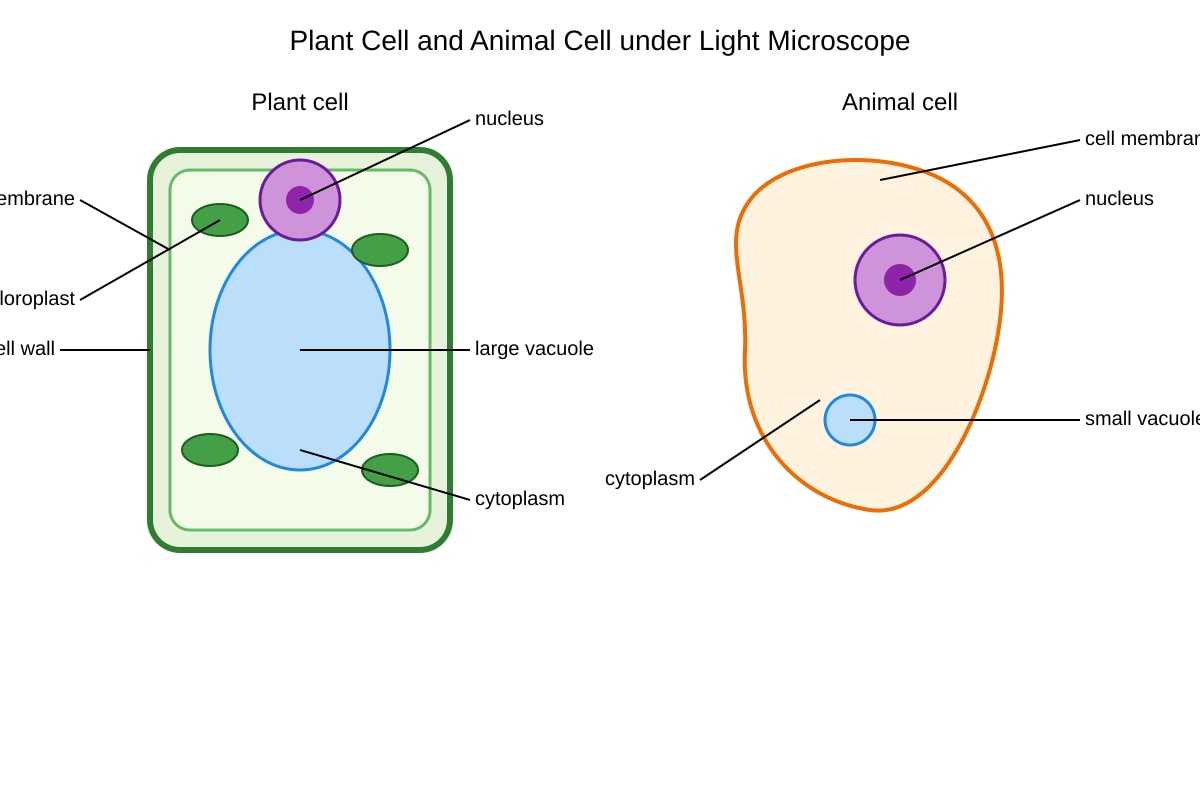
(a) Cell wall. [1]
(b) Chloroplast (or large vacuole). [1]
Based on image: Plant cell shows cell wall and chloroplasts; animal cell lacks both.
14. [3]
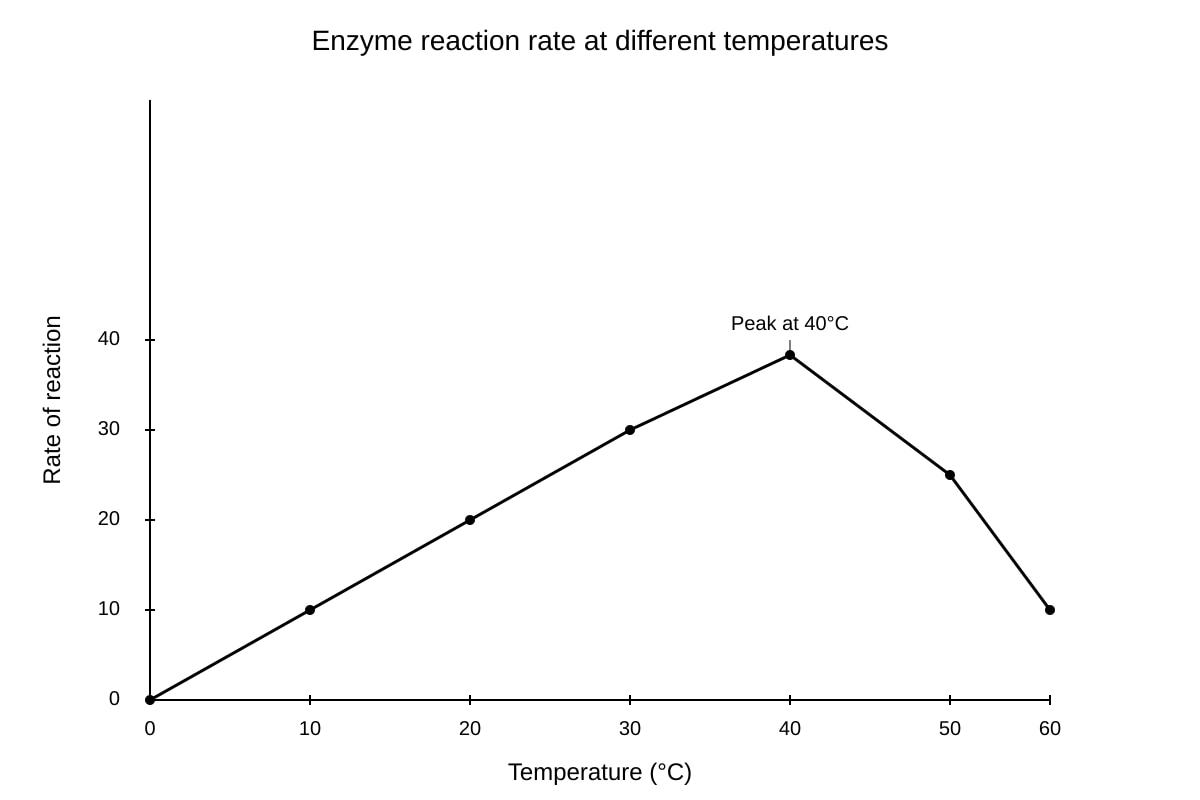
(a) [1] 40°C.
(b) [2] Above 40°C, enzyme denatures; tertiary structure breaks, active site loses shape, substrate cannot bind, rate falls. [2]
Marking: Denaturation (1) + loss of active site function (1).
15. [3]
- Both are polysaccharides of glucose. [1]
- Starch is branched/helical and used for energy storage. [1]
- Cellulose is straight-chain with β-glucose, forms cell wall for support. [1]
Teaching note: Different glycosidic bonds give different functions.
Section C: Extended Application (20 marks)
16. [6]
- Zygote divides by mitosis to form embryo. [1]
- Embryo travels down fallopian tube. [1]
- Blastocyst implants into uterine wall. [1]
- Placenta develops for nutrient/oxygen exchange. [1]
- Umbilical cord connects fetus to placenta. [1]
- Amniotic fluid protects fetus. [1]
Common mistake: Using meiosis instead of mitosis.
17. [4]
(a) [1] Osmosis.
(b) [3] Animal cell: swells and may burst (lysis). [1] Plant cell: becomes turgid, cell wall prevents bursting. [2]
Teaching note: Water potential higher outside → water enters by osmosis.
18. [4]
A: Starch [1]
B: Reducing sugar [1]
C: Protein [1]
D: Fat/Lipid [1]
Teaching note: Match test colours to biomolecules.
19. [4]
- Enzyme has active site with specific shape. [1]
- Substrate fits like key into lock. [1]
- Enzyme-substrate complex forms. [1]
- Reaction occurs, products released, enzyme unchanged. [1]
Teaching note: Explains enzyme specificity.
20. [3]
- Fats are not polymers of glucose like carbs. [1]
- Fats are made of glycerol + fatty acids, not monosaccharides. [1]
- Fats have different ratio/structure and function (long-term energy). [1]
Common mistake: Assuming same elements = same class.
End of Answer Key