From Real Exams Exam Paper
O Level Biology Practice Paper 3
Free O Level Biology Practice Paper 3, DeepSeek Exam version, with questions, answers, and O Level-style practice for Singapore students.
These static practice materials are generated from the site's syllabus and paper-generation workflow, with source and model context shown so students and parents can evaluate the material before use.
Questions
Free quiz and exam paper access
Enter your details to view this paper
Your access is remembered on this device.
Answers
TuitionGoWhere Practice Paper - Biology O-Level
Answer Key and Marking Scheme
Paper: PRACTICE (Version 3 of 5)
Total Marks: 60
Section A: Multiple Choice and Short Answer [20 marks]
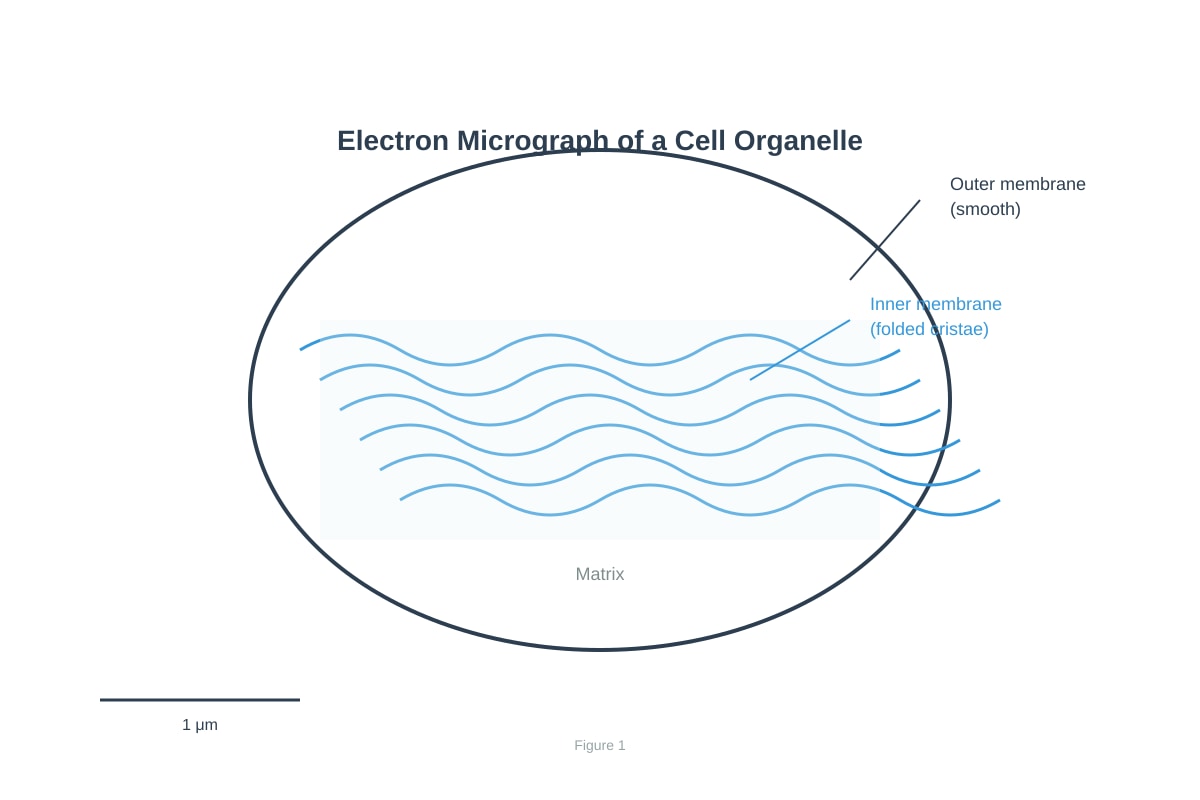
1. C – Chloroplast [1]
Marking note: Award 1 mark for correct letter. Chloroplasts are present in plant cells but absent in animal cells.
2. Organelle: Mitochondrion [1]
Function: Site of aerobic respiration / releases energy (ATP) for cellular activities [1]
Marking note: Accept "powerhouse of the cell" or "produces ATP/energy". Do not accept "produces energy" without reference to respiration or ATP.
3. (a) Protein [1]
(b) Growth and repair of tissues / synthesis of enzymes / synthesis of hormones / formation of antibodies (any one) [1]
Marking note: Accept any valid function of proteins. Do not accept "energy source" as primary function.
4. Any two from:
- Bacterial cells have a cell wall made of peptidoglycan; animal cells have no cell wall [1]
- Bacterial cells have plasmids; animal cells do not [1]
- Bacterial cells have circular DNA / no true nucleus; animal cells have a nucleus [1]
- Bacterial cells have 70S ribosomes; animal cells have 80S ribosomes [1]
- Bacterial cells may have flagella; animal cells do not (except sperm) [1]
Marking note: Award 1 mark for each correct structural difference. Must state the feature in both cell types for comparison. Accept "nucleoid" instead of "circular DNA".
5. (a) Graph plotting [2]:
- Correct axes labelled (pH on x-axis, rate of reaction on y-axis) [1]
- All points plotted accurately and connected with a smooth curve [1]
(b) pH 7 [1]
(c) At pH 12, the enzyme is denatured [1]. The high pH alters the shape of the active site, so the substrate can no longer bind / enzyme-substrate complex cannot form [1].
Marking note: Must mention denaturation and change in active site shape. Accept "extreme pH disrupts bonds maintaining tertiary structure".
6. (a) Osmosis [1]
(b) The red blood cell will shrink / become crenated [1]. Water moves out of the cell by osmosis from a region of higher water potential (inside the cell) to a region of lower water potential (concentrated salt solution) through the partially permeable cell membrane [1].
Marking note: Must state "shrink" or "crenated" and explain water movement by osmosis with reference to water potential gradient.
7. Carbon, hydrogen, oxygen, nitrogen [1]
Marking note: All four elements must be stated. Accept "C, H, O, N". Do not penalise if sulfur is also included.
8. (a) 40°C [1]. The iodine solution turned yellow-brown, indicating that starch had been completely digested / no starch remained [1].
(b) At 60°C, the enzyme (amylase) was denatured [1]. The high temperature altered the shape of the active site, so the substrate (starch) could no longer bind, and no digestion occurred. The iodine test remained blue-black, indicating starch was still present [1].
Marking note: Must mention denaturation and link to active site shape change. Accept "enzyme lost its catalytic function".
Section B: Structured Questions [20 marks]
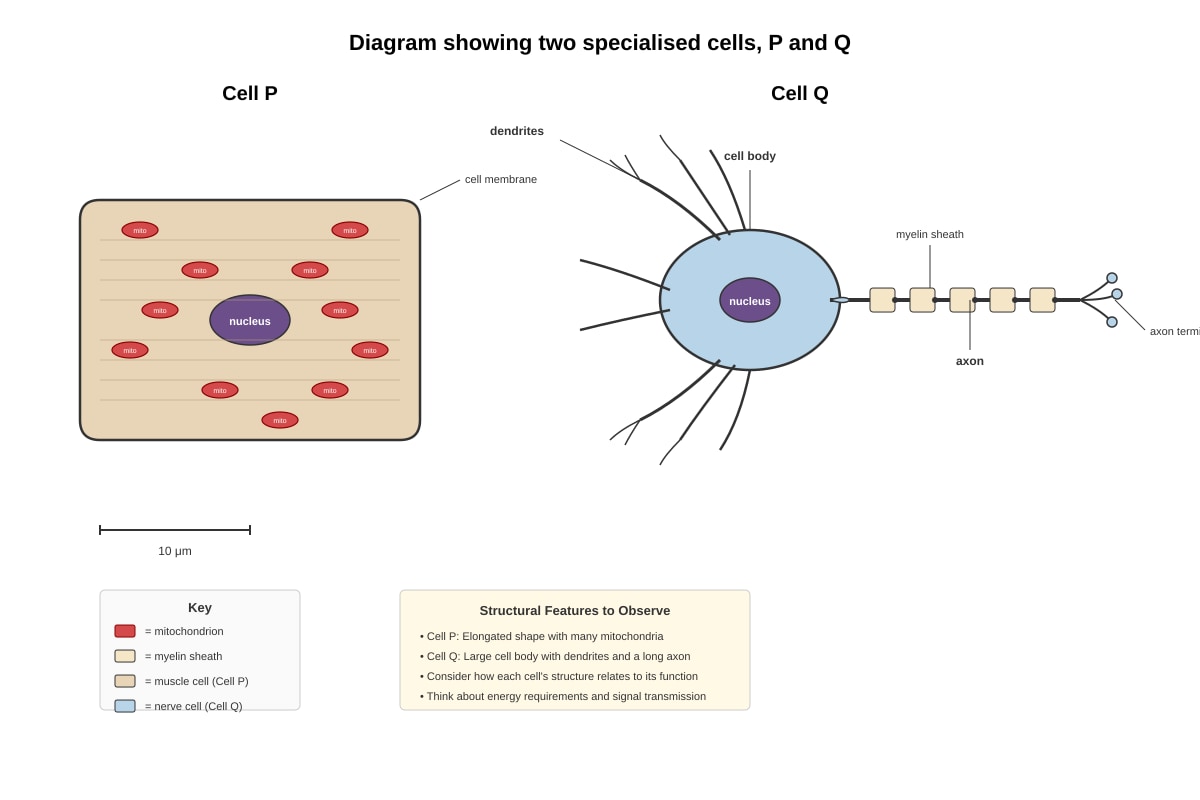
9. (a) Cell P: Muscle cell [1]
Cell Q: Root hair cell [1]
(b) Muscle cell has many mitochondria [1] to release energy (ATP) through aerobic respiration for muscle contraction [1].
(c) Root hair cell has a long, narrow extension [1] which increases the surface area to volume ratio for efficient absorption of water and mineral ions [1].
Marking note: Must link structure to function. Accept "elongated shape" for root hair cell. For muscle cell, accept "contains many mitochondria to provide energy for contraction".
10. (a) The 'lock and key' hypothesis states that the substrate molecule fits into the active site of the enzyme like a key fits into a lock [1]. The active site has a specific shape that is complementary to the shape of the substrate [1]. When the substrate binds to the active site, an enzyme-substrate complex is formed, and the reaction takes place [1].
(b) Each enzyme has an active site with a specific shape [1]. Only a substrate with a complementary shape can bind to the active site, so the enzyme can only catalyse one specific reaction [1].
Marking note: Must mention complementary shape and enzyme-substrate complex formation. Accept "induced fit" model as alternative if correctly explained.
11. (a) Solution A (distilled water) has a higher water potential than the potato cells [1]. Water entered the potato cells by osmosis from a region of higher water potential to a region of lower water potential through the partially permeable cell membrane, causing the mass to increase [1].
(b) Solution B (5% sucrose) has the same water potential as the potato cells [1]. There was no net movement of water by osmosis, so the mass remained unchanged [1].
(c) Solution C (20% sucrose) has a lower water potential than the potato cells [1]. Water left the potato cells by osmosis from a region of higher water potential (inside the cells) to a region of lower water potential (the solution), causing the mass to decrease [1].
(d) Any one from:
- Temperature [1]
- Size/surface area of potato strips [1]
- Time of immersion [1]
- Volume of solution [1]
- Type/variety of potato [1]
Marking note: Must state a valid controlled variable. Accept any reasonable answer.
12. Any two from:
- Controls the movement of substances into and out of the cell / partially permeable [1]
- Separates the cell contents from the external environment [1]
- Contains receptors for cell communication/signalling [1]
- Provides mechanical support / maintains cell shape [1]
Marking note: Award 1 mark for each correct function. Accept "selectively permeable".
Section C: Data-Based and Extended Response Questions [20 marks]
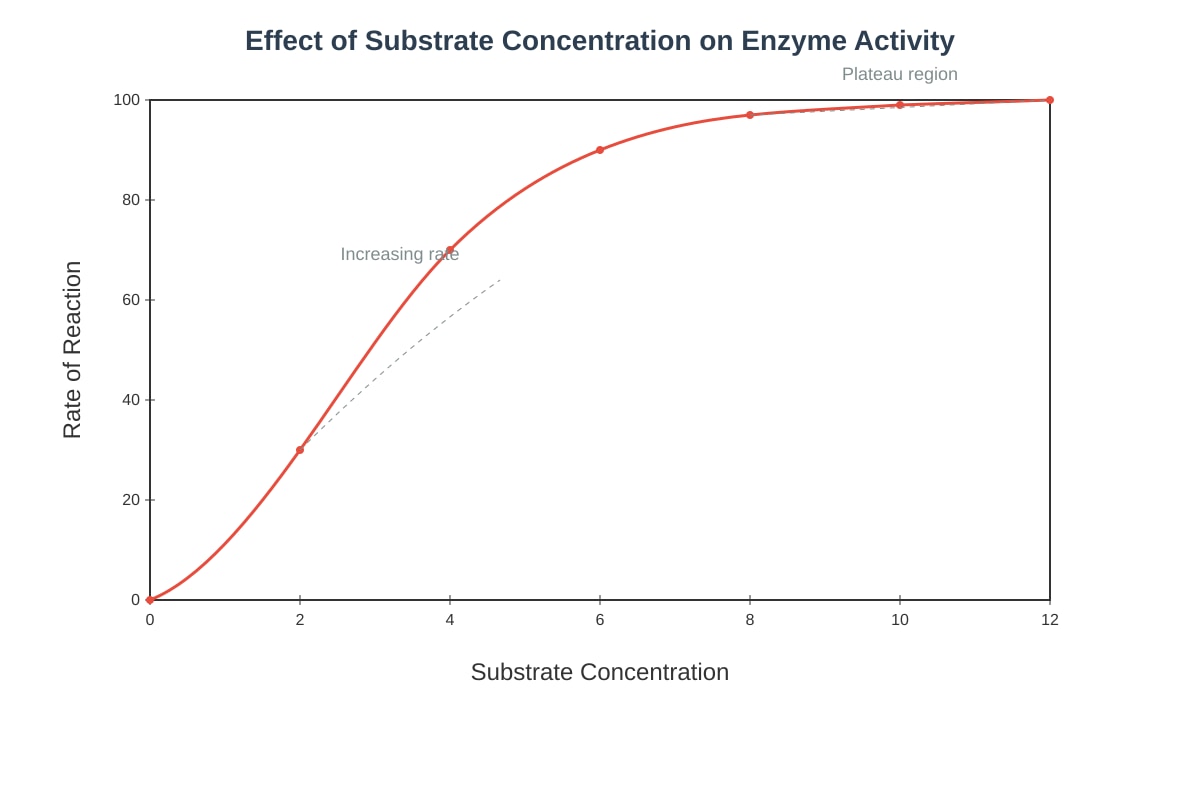
13. (a) As substrate concentration increases, the rate of reaction increases [1]. At low substrate concentrations, the rate increases rapidly; at higher concentrations, the rate increases more slowly until it reaches a maximum / plateau [1].
(b) At high substrate concentrations, all the active sites of the enzyme molecules are occupied by substrate molecules [1]. The enzyme is saturated / working at its maximum rate [1]. Increasing substrate concentration further has no effect because there are no free active sites available for additional substrate molecules to bind to [1].
Marking note: Must mention saturation of active sites and enzyme working at maximum rate (Vmax).
14. (a) Sample W: Starch [1]
Sample X: Reducing sugar / glucose [1]
Sample Y: Protein [1]
Sample Z: Fat / lipid [1]
(b) Benedict's test requires heating because the reaction between reducing sugars and Benedict's solution only occurs at high temperatures [1]. The water bath provides a constant, uniform temperature to ensure a fair test / reliable results [1].
Marking note: Accept "to provide activation energy for the reaction" or "to speed up the reaction".
15. Enzymes are biological catalysts that speed up the rate of digestion without being chemically changed at the end of the reaction [1].
Example 1: Amylase breaks down starch into maltose in the mouth and small intestine [1].
Example 2: Protease breaks down proteins into amino acids in the stomach and small intestine [1].
(Additional detail for full marks: Enzymes lower the activation energy required for the breakdown of large, insoluble food molecules into small, soluble molecules that can be absorbed into the bloodstream) [1].
Marking note: Must state the role of enzymes as catalysts and provide two named examples with substrate and product. Accept lipase (fats → fatty acids and glycerol) as an alternative example.
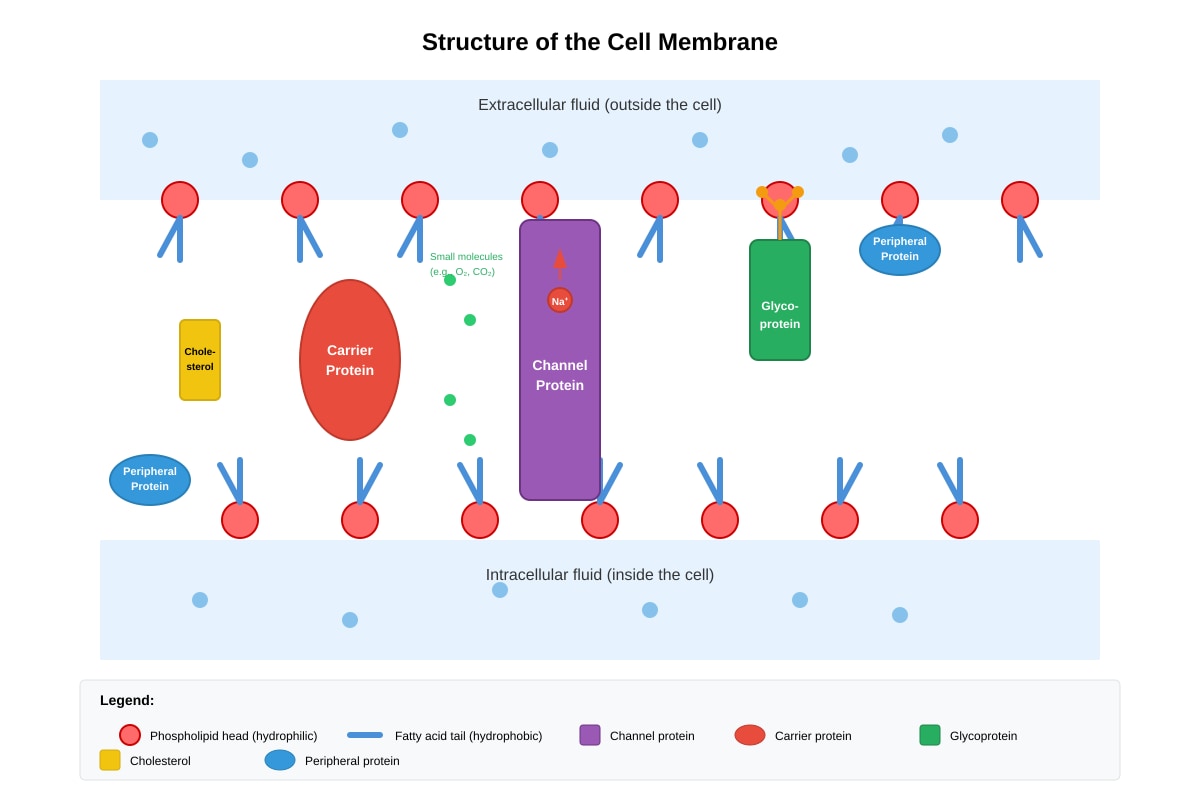
16. (a) Fluid mosaic model [1]
(b) The cell membrane is composed of a phospholipid bilayer [1]. The hydrophobic (fatty acid) tails face inwards, while the hydrophilic (phosphate) heads face outwards. This arrangement allows small, non-polar molecules to pass through but prevents large, polar molecules and ions from passing through freely, making the membrane partially permeable [1].
(c) Any one from:
- Transport of substances across the membrane (channel proteins / carrier proteins) [1]
- Acting as receptors for hormones / cell signalling [1]
- Enzymatic activity [1]
- Cell recognition / antigens [1]
Marking note: Accept any valid function of membrane proteins.
17. (a) As temperature increases, the time taken for even colour distribution decreases / the rate of diffusion increases [1].
(b) At higher temperatures, the water molecules and potassium permanganate particles have more kinetic energy [1]. The particles move faster and collide more frequently, so the potassium permanganate spreads through the water more quickly [1].
(c) Any one from:
- Volume of water [1]
- Mass / amount of potassium permanganate [1]
- Size of container / beaker [1]
- Starting concentration of potassium permanganate [1]
Marking note: Accept any reasonable controlled variable.
18. Starch is made of glucose molecules joined by alpha-1,4 glycosidic bonds, forming a coiled/helical structure; cellulose is made of glucose molecules joined by beta-1,4 glycosidic bonds, forming straight, unbranched chains [1].
Starch functions as an energy storage molecule in plants; cellulose functions as a structural component of plant cell walls [1].
Starch is insoluble and compact, making it suitable for storage; cellulose forms microfibrils that provide strength and rigidity to cell walls [1].
Marking note: Must compare both structure and function. Accept reference to starch being easily hydrolysed for energy release and cellulose being indigestible to most organisms.
19. In a concentrated salt solution, the external solution has a lower water potential than the plant cell cytoplasm [1]. Water leaves the cell by osmosis, causing the cytoplasm and vacuole to shrink, and the cell membrane pulls away from the cell wall (plasmolysis) [1]. The plant cell does not burst because it has a rigid cell wall made of cellulose that provides structural support and prevents the cell from taking in too much water / prevents over-expansion [1].
Marking note: Must mention water potential gradient, plasmolysis/flaccidity, and the protective role of the cell wall. Accept "cell becomes plasmolysed" instead of "flaccid".
20. The statement is incorrect because red blood cells in mammals do not contain a nucleus [1]. The nucleus is lost during the maturation of red blood cells to provide more space for haemoglobin to transport oxygen [1].
Marking note: Accept other valid examples such as sieve tube elements in plants. Must state the example and explain why the nucleus is absent.
END OF ANSWER KEY
Marking scheme aligned with O-Level Biology Paper 2 standards. Marks are awarded for correct biological terminology, clear explanations, and accurate use of scientific principles.