From Real Exams Exam Paper
O Level Biology Practice Paper 1
Free O Level Biology Practice Paper 1, HY3 Exam version, with questions, answers, and O Level-style practice for Singapore students.
These static practice materials are generated from the site's syllabus and paper-generation workflow, with source and model context shown so students and parents can evaluate the material before use.
Questions
Free quiz and exam paper access
Enter your details to view this paper
Your access is remembered on this device.
Answers
TuitionGoWhere Exam Practice (AI) — Biology O-Level Practice Paper Answer Key (Version 1)
Total Marks: 60
Section A: 14 marks | Section B: 14 marks | Section C: 16 marks | Section D: 16 marks
Section A: Cell Structure and Organisation
Q1 [1]
Answer: Cell wall (or chloroplast / large vacuole).
Teaching note: Plant cells have a rigid cell wall made of cellulose; animal cells lack this. Accept any one correct plant-only structure visible under light microscope.
Q2 [1]
Answer: Mitochondrion (mitochondria).
Teaching note: Mitochondria are the sites of aerobic respiration where glucose is broken down to release ATP.
Q3 [2]
Mark breakdown: 1 mark per correct different feature.
Answer:
- Bacterial cells have a cell wall made of peptidoglycan; animal cells have no cell wall. [1]
- Bacterial cells contain plasmids (small DNA rings); animal cells do not. [1]
(Also accept: bacteria have 70S ribosomes vs 80S in animals; nucleoid vs nucleus.)
Common mistake: stating "both have ribosomes" — this is a similarity, not a difference.
Q4 [2]
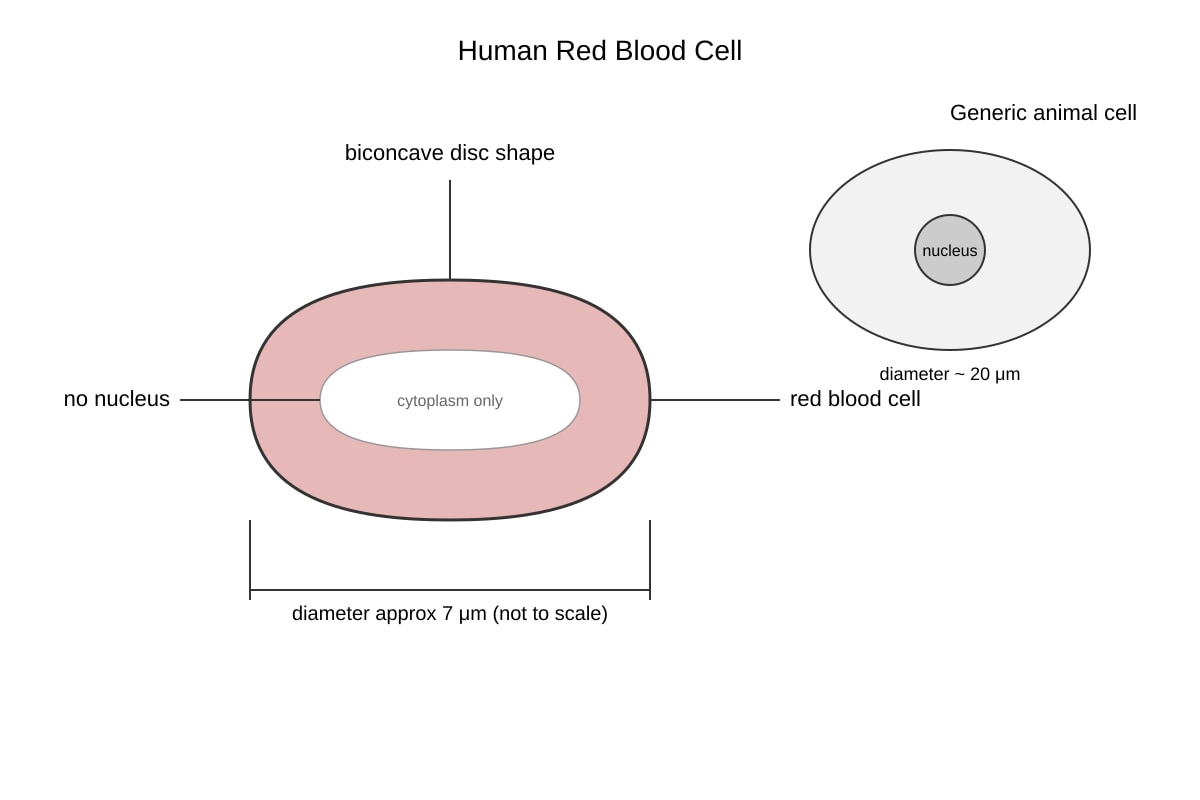
Expected visual: biconcave disc, no nucleus visible.
Mark breakdown: 1 mark per adaptation.
Answer:
- No nucleus → more space for haemoglobin to carry oxygen. [1]
- Biconcave shape → larger surface area for gas exchange. [1]
Teaching note: Red blood cells specialised for O₂ transport; structure matches function.
Q5 [2]
Answer: Either (plant or animal). [1] Both plant and animal cells (eukaryotes) contain ribosomes, mitochondria, ER and Golgi body under EM. [1]
Common mistake: assuming ER/Golgi only in animal cells.
Section B: Movement of Substances
Q6 [2]
Answer: Movement of particles (molecules) from a region of high concentration to a region of low concentration (down a concentration gradient). [2: 1 for direction, 1 for gradient]
Teaching note: Diffusion is passive; no energy needed.
Q7 [2]
Answer: Oxygen concentration is higher in alveoli than in blood. [1] Therefore O₂ diffuses down its concentration gradient into blood. [1]
Teaching note: Gas exchange in lungs relies on diffusion due to partial pressure difference.
Q8 [3]
Mark breakdown: 1 for statement, 2 for explanation.
Answer: Mass decreases. [1] The salt solution is hypertonic to potato cells. [1] Water leaves potato cells by osmosis (across partially permeable membrane) to the solution. [1]
Teaching note: Osmosis = water moves to higher solute concentration.
Q9 [3]
Mark breakdown: 1 each for O₂ → respiration → ATP → active transport.
Answer: Air provides oxygen for root cells. [1] Oxygen allows aerobic respiration to release ATP. [1] ATP provides energy for active transport of mineral ions into roots. [1]
Common mistake: saying "plants breathe" without linking to ion uptake.
Q10 [2]
Answer: (1) Energy / ATP; (2) Carrier protein in membrane. [1+1]
Teaching note: Active transport opposes gradient, unlike diffusion/osmosis.
Section C: Biological Molecules and Enzymes
Q11 [4]
Mark: 1 per correct column pair.
| Biomolecule | Food test | Positive result |
|---|---|---|
| Starch | Iodine solution | Blue-black colour |
| Reducing sugar | Benedict's solution | Brick-red precipitate |
| Protein | Biuret solution | Purple colour |
| Fat | Ethanol | White emulsion |
Q12 [1]
Answer: Carbon (C), Hydrogen (H), Oxygen (O), Nitrogen (N) — sometimes Sulphur (S).
Teaching note: Proteins contain N, unlike carbs/fats.
Q13 [4]
Mark breakdown: 1 catalyst role, +3 for two enzymes with substrate/product.
Answer: Enzymes are biological catalysts that speed up digestion. [1]
- Amylase breaks down starch to maltose in mouth/small intestine. [1.5]
- Pepsin breaks down proteins to peptides in stomach. [1.5]
(Other valid: lipase → fats to fatty acids+glycerol; maltase → maltose to glucose.)
Common trap: listing enzymes without substrate/product.
Q14 [3]
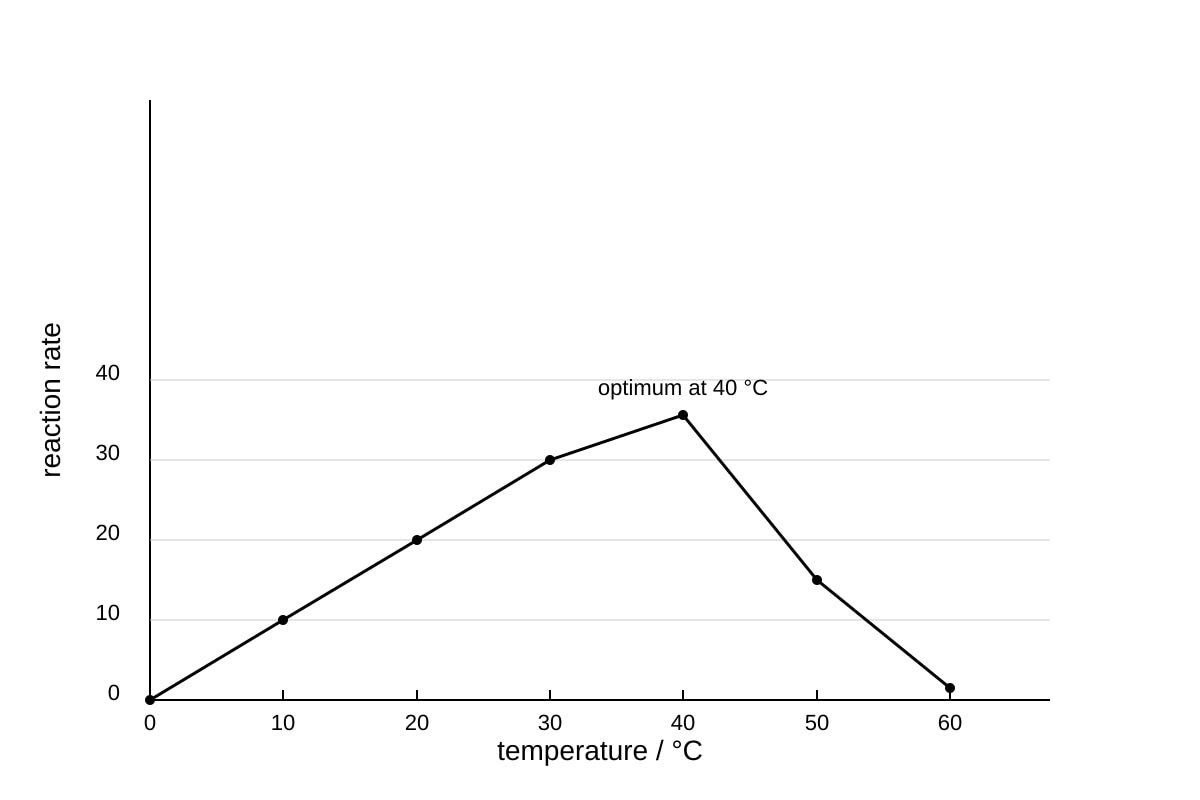
Expected graph: peak at 40°C, decline after.
(a) [1] 40 °C.
(b) [2] Above optimum, enzyme denatures; [1] active site changes shape, substrate no longer fits, rate falls. [1]
Teaching note: Denaturation is permanent structural change.
Q15 [2]
Answer: Enzyme has active site with specific shape. [1] Only substrate with complementary shape fits (like key in lock), so enzyme acts on one substrate type. [1]
Section D: Integrated Application
Q16 [3]
Mark breakdown: 1 protein→urea, 1 solute↑, 1 kidney response.
Answer: More protein → more deamination of amino acids → more urea in blood. [1] Urea raises blood solute concentration. [1] Kidney reabsorbs more water by osmosis, producing more concentrated (lower volume) urine. [1]
Common mistake: confusing volume with concentration.
Q17 [2]
Answer: Carbohydrate (polysaccharide). [1] Role: storage of energy in liver/muscles. [1]
Teaching note: Glycogen is animal starch from glucose monomers.
Q18 [2]
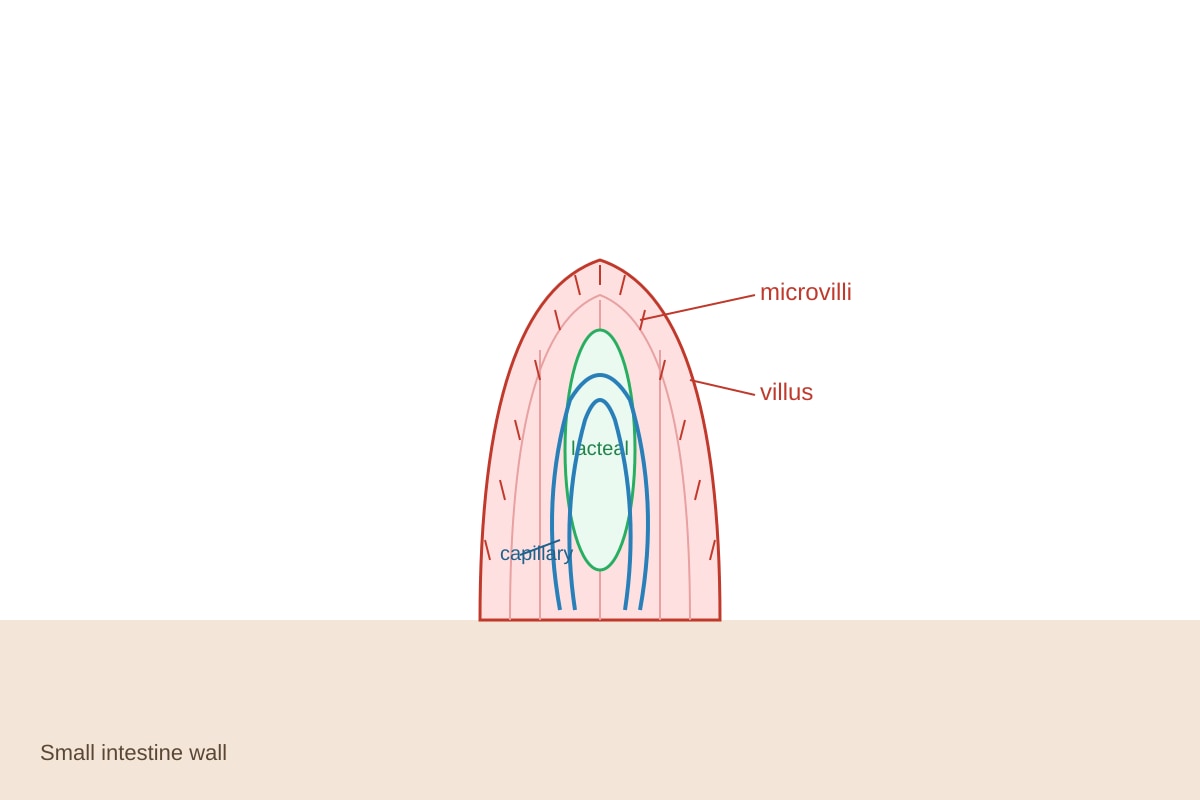
Expected visual: villus with microvilli, capillary, lacteal.
Answer:
- Microvilli increase surface area. [1]
- Thin wall / capillaries close to surface for short diffusion distance. [1]
(Also accept lacteal for fat transport.)
Q19 [2]
Answer: Condensation (polymerisation) reaction. [1] Peptide bond formed. [1]
Teaching note: Water released when monomers join.
Q20 [3]
Mark breakdown: 1 result, 2 reason.
Answer: Leaf extract contains reducing sugar. [1] Reason: e.g., photosynthesis produced glucose, or starch broken down to maltose. [2]
Teaching note: Benedict's brick-red = reducing sugar present.
End of Answer Key