From Real Exams Exam Paper
O Level Biology Practice Paper 1
Free O Level Biology Practice Paper 1, DeepSeek Exam version, with questions, answers, and O Level-style practice for Singapore students.
These static practice materials are generated from the site's syllabus and paper-generation workflow, with source and model context shown so students and parents can evaluate the material before use.
Questions
Free quiz and exam paper access
Enter your details to view this paper
Your access is remembered on this device.
Answers
TuitionGoWhere Practice Paper - Biology O-Level
ANSWER KEY AND MARKING SCHEME
Paper: PRACTICE - Version 1 of 5
Total Marks: 60
Section A: Multiple Choice (10 marks)
| Question | Answer | Mark |
|---|---|---|
| 1 | C | [1] |
| 2 | B | [1] |
| 3 | C | [1] |
| 4 | C | [1] |
| 5 | D | [1] |
| 6 | B | [1] |
| 7 | B | [1] |
| 8 | B | [1] |
| 9 | C | [1] |
| 10 | C | [1] |
Marking notes:
- Q1: Mitochondrion is found in both plant and animal cells. Cell wall, chloroplast, and large central vacuole are plant-only features.
- Q2: Lock-and-key hypothesis states the substrate has a complementary shape to the enzyme's active site.
- Q3: Biuret solution turns purple in the presence of protein.
- Q4: Active transport requires ATP; diffusion and osmosis are passive processes.
- Q5: Brick-red precipitate indicates the highest concentration of reducing sugar in Benedict's test.
- Q6: Golgi body packages and transports proteins. Ribosomes synthesise proteins, not lipids. SER is involved in lipid synthesis and detoxification. Mitochondria produce energy.
- Q7: In a concentrated salt solution (hypertonic), water leaves the red blood cell by osmosis, causing it to shrink (crenate).
- Q8: All proteins contain C, H, O, N. Some also contain S, but N is always present.
- Q9: Extreme pH causes denaturation of the enzyme, changing the shape of the active site irreversibly.
- Q10: Glycogen is a polysaccharide made of glucose subunits.
Section B: Structured Questions (30 marks)
Question 11 (5 marks)
(a)
A: Mitochondrion [1]
B: Rough endoplasmic reticulum (RER) [1]
Accept: "Endoplasmic reticulum" for B, but "Rough ER" is preferred given ribosomes visible.
(b)
Mitochondria are the site of aerobic respiration [1], where glucose is broken down to release energy in the form of ATP for cellular activities [1].
(c)
Any one of:
- Synthesis of proteins [1]
- Transport of proteins to the Golgi body [1]
Accept any valid function of RER.
Question 12 (6 marks)
(a)
As temperature increases from 10°C to 40°C, the time taken to digest starch decreases [1]. This is because the enzyme and substrate molecules have more kinetic energy, increasing the frequency of effective collisions / the rate of enzyme activity increases [1].
(b)
At 60°C, the enzyme amylase has been denatured [1]. The high temperature breaks the bonds maintaining the enzyme's three-dimensional shape, causing the active site to lose its complementary shape to the substrate, so the enzyme-substrate complex cannot form [1].
(c)
The time taken would decrease [1]. With twice the volume of enzyme, there are more active sites available, so more enzyme-substrate complexes can form per unit time, increasing the rate of reaction [1].
Question 13 (5 marks)
(a)
Phospholipids [1]
Accept: "Phospholipid bilayer"
(b)
A partially permeable membrane allows some substances to pass through but not others [1]. It permits the passage of small molecules (e.g., water, oxygen) but restricts the passage of large molecules (e.g., proteins, starch) [1].
(c)
Any two of:
- Transport proteins / channel proteins / carrier proteins for facilitated diffusion or active transport [1]
- Receptor proteins for cell signalling / hormone binding [1]
- Enzymes for catalysing reactions at the membrane surface [1]
Accept any two valid functions of membrane proteins.
Question 14 (6 marks)
(a)
W: Starch [1]
X: Reducing sugar [1]
Y: Protein [1]
Z: Fat / Lipid [1]
(b)
Fats dissolve in ethanol but are insoluble in water [1]. When water is added, the fat comes out of solution and forms a white emulsion, which is visible as a cloudy suspension [1].
Question 15 (8 marks)
(a)
Osmosis is the net movement of water molecules [1] from a region of higher water potential to a region of lower water potential through a partially permeable membrane [1].
(b)
Water enters the cell by osmosis because the external solution has a higher water potential than the cell contents [1]. The cell swells and becomes turgid [1]. The cell wall prevents the cell from bursting by exerting an opposing pressure [1].
(c)
Animal cells lack a cell wall [1]. In pure water, water enters the animal cell by osmosis, causing it to swell until the cell membrane bursts (lysis) [1]. Plant cells have a rigid cell wall that resists further expansion, preventing the cell from bursting [1].
Section C: Data-Based and Extended Response Questions (20 marks)
Question 16 (8 marks)
(a)
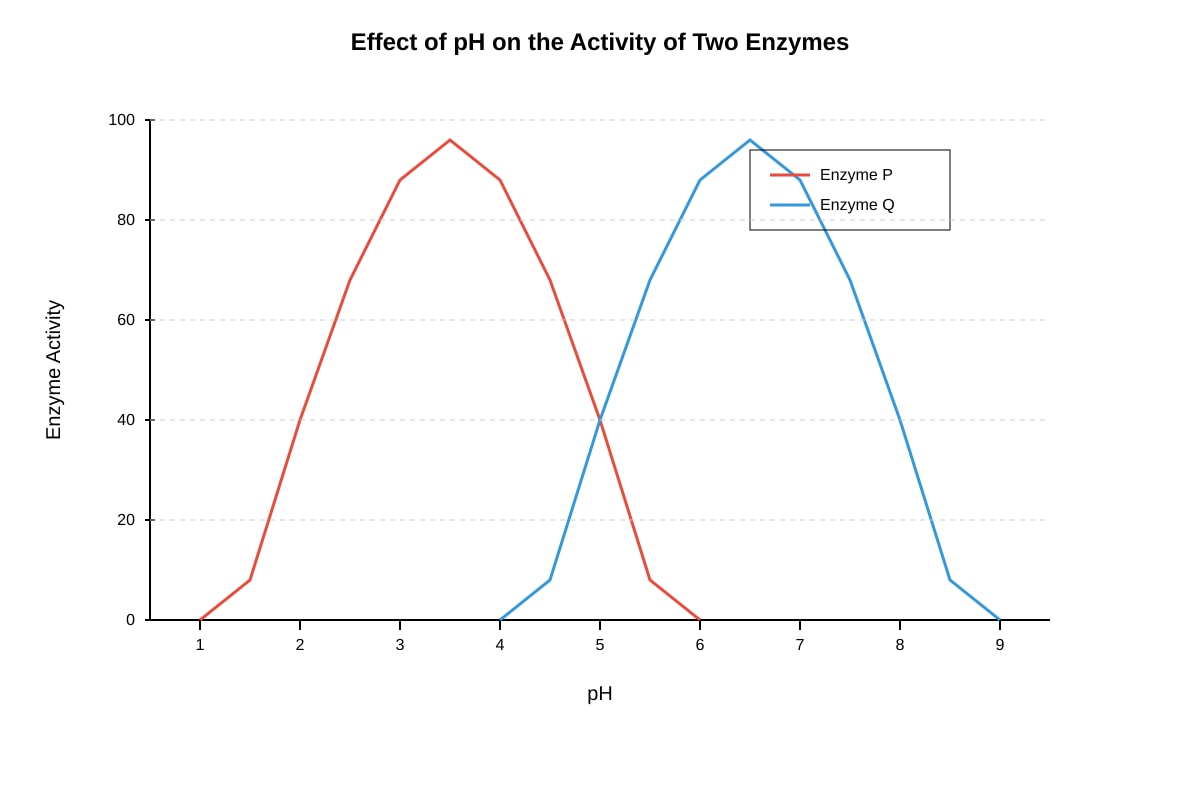
pH 2 [1]
(b)
Enzyme P is most likely found in the stomach [1]. The stomach contains hydrochloric acid, which creates an acidic environment with a pH around 2, providing the optimum pH for this enzyme [1].
(c)
Enzyme Q works in the small intestine, which has an alkaline environment (around pH 8) due to the secretion of bile and pancreatic juices [1]. Different enzymes have different optimum pH values because their active site shape is maintained by bonds that are stable at different pH levels [1].
(d)
At pH 12, the highly alkaline conditions cause denaturation of both enzymes [1]. The extreme pH disrupts the hydrogen and ionic bonds that maintain the enzyme's specific three-dimensional shape [1]. This changes the shape of the active site so that the substrate can no longer bind, and the enzyme-substrate complex cannot form [1].
Question 17 (7 marks)
(a)
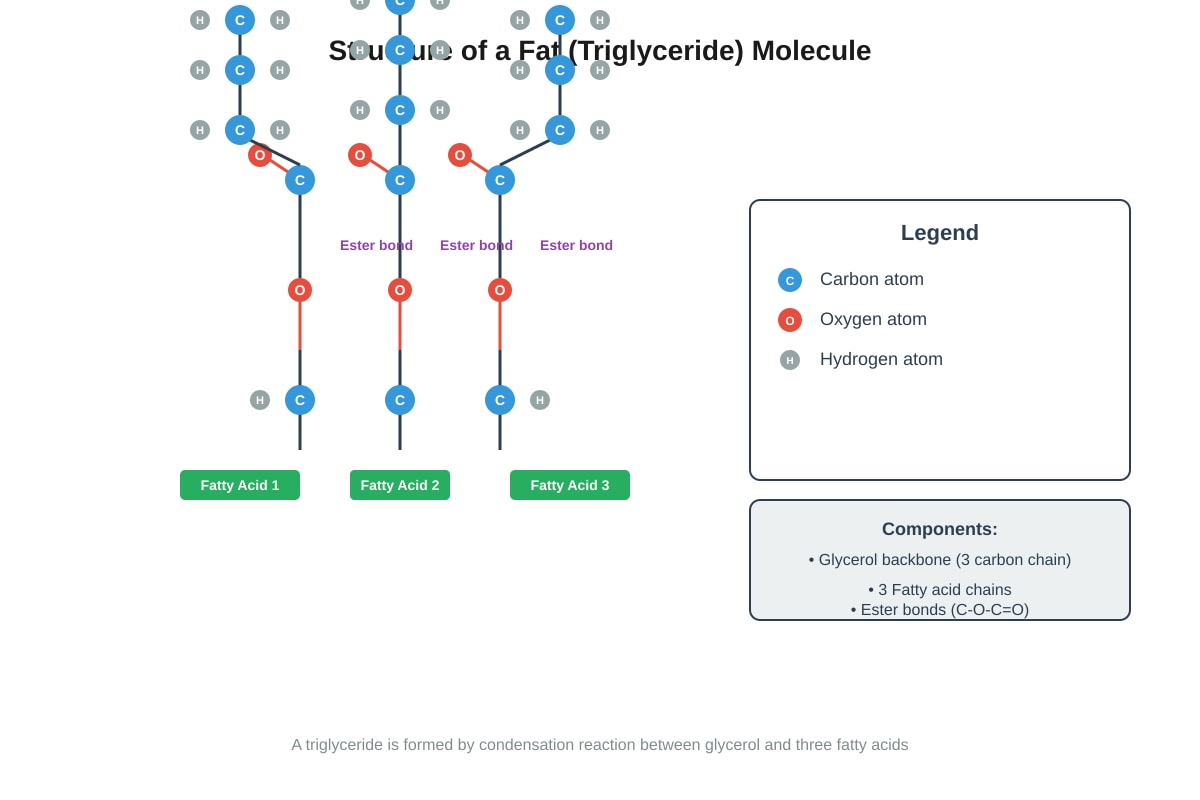
Glycerol [1] and fatty acids [1]
(b)
Any two of:
- Long-term energy storage [1]
- Insulation (thermal insulation to reduce heat loss) [1]
- Protection of vital organs (e.g., around kidneys) [1]
- Component of cell membranes (phospholipids) [1]
- Source of metabolic water when oxidised [1]
(c)
The statement is incorrect / partially incorrect [1]. While plants do not require insulation in the same way as animals, fats are still important for plants because:
- Fats are a compact form of energy storage in seeds (e.g., oils in sunflower seeds, peanuts) to support germination [1]
- Phospholipids are essential components of cell membranes in all plant cells [1]
- Fats provide waterproofing (e.g., waxy cuticle on leaves) to reduce water loss [1]
Award marks for any two valid points with explanation. Accept reasoned evaluation.
Question 18 (5 marks)
Enzymes are biological catalysts that speed up the rate of digestion without being used up in the reaction [1].
Examples (award 1 mark per correct enzyme-substrate-product set, up to 4 marks):
- Amylase (in saliva/pancreatic juice) breaks down starch into maltose [1]
- Protease (e.g., pepsin in stomach / trypsin in small intestine) breaks down proteins into polypeptides / amino acids [1]
- Lipase (in pancreatic juice) breaks down fats/lipids into glycerol and fatty acids [1]
- Maltase (in small intestine) breaks down maltose into glucose [1]
Marking notes:
- Award [1] for stating the general role of enzymes as biological catalysts.
- Award up to [4] for named enzymes with correct substrates and products.
- Accept any valid enzyme involved in human digestion.
- Do not award marks for enzymes not involved in digestion (e.g., catalase).
- The enzyme must be named; "protease" and "lipase" are acceptable as class names.
END OF ANSWER KEY
Total: 60 marks