From Real Exams Exam Paper
O Level Biology Practice Paper 1
Free O Level Biology Practice Paper 1, Exam version, with questions, answers, and O Level-style practice for Singapore students.
These static practice materials are generated from the site's syllabus and paper-generation workflow, with source and model context shown so students and parents can evaluate the material before use.
Questions
Free quiz and exam paper access
Enter your details to view this paper
Your access is remembered on this device.
Answers
TuitionGoWhere Practice Paper - Biology O-Level - Answer Key
Total Marks: 80
Section A [20 marks]
1. (a) Organelle identification [2]
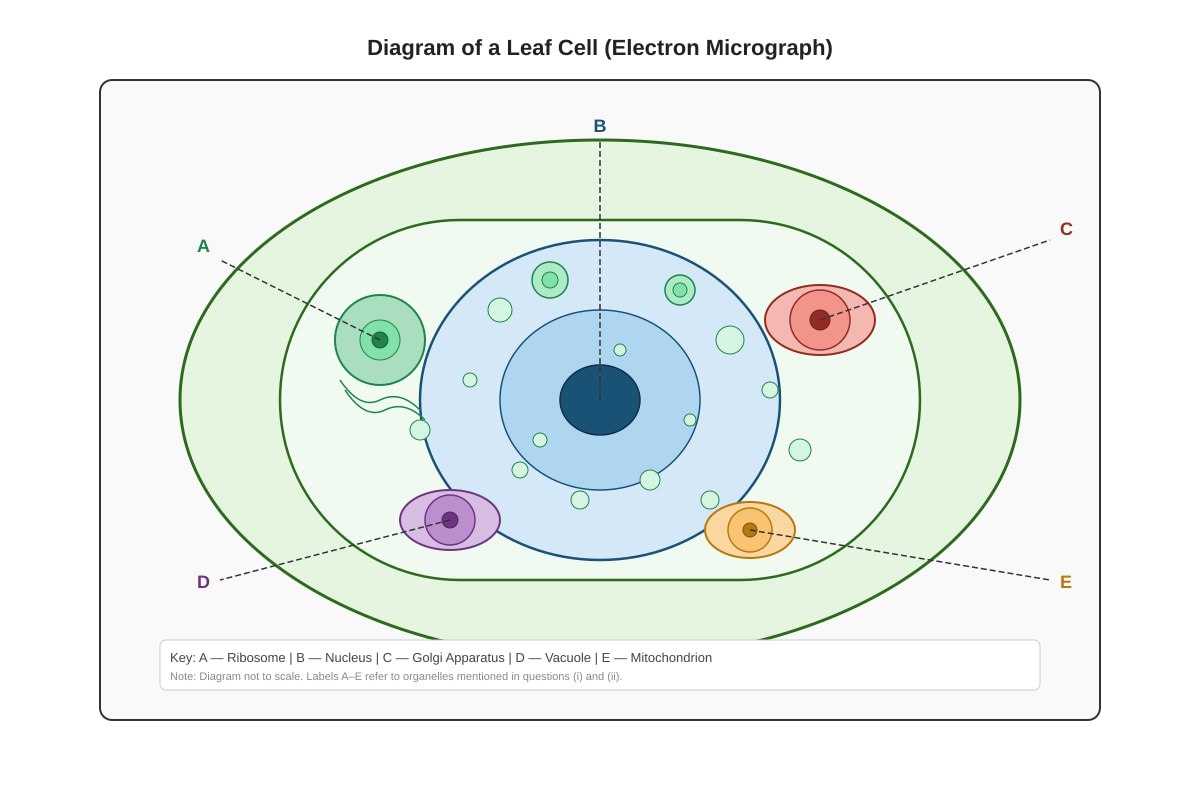
(i) Name the organelle labeled A that is responsible for protein synthesis. [1] Answer: Ribosome / Rough endoplasmic reticulum [1]
(ii) State the function of organelle B in the leaf cell. [1] Answer: Photosynthesis / To trap light energy for photosynthesis [1]
(b) Describe two structural differences between a bacterial cell and the plant cell shown above. [2] Marking scheme: Any two from:
- Bacterial cell has cell wall made of peptidoglycan; plant cell has cell wall made of cellulose [1]
- Bacterial cell has no membrane-bound nucleus; plant cell has membrane-bound nucleus [1]
- Bacterial cell has no chloroplasts; plant cell has chloroplasts [1]
- Bacterial cell has plasmids; plant cell has no plasmids [1]
2. (a) Complete the table [3]
| Biological Molecule | Chemical Elements Present |
|---|---|
| Carbohydrates | Carbon, Hydrogen, Oxygen [1] |
| Proteins | Carbon, Hydrogen, Oxygen, Nitrogen [1] |
| Fats | Carbon, Hydrogen, Oxygen [1] |
(b) Food test for starch [2] Answer: Test: Iodine solution [1] Positive result: Blue-black color [1]
3. Enzyme investigation [6]
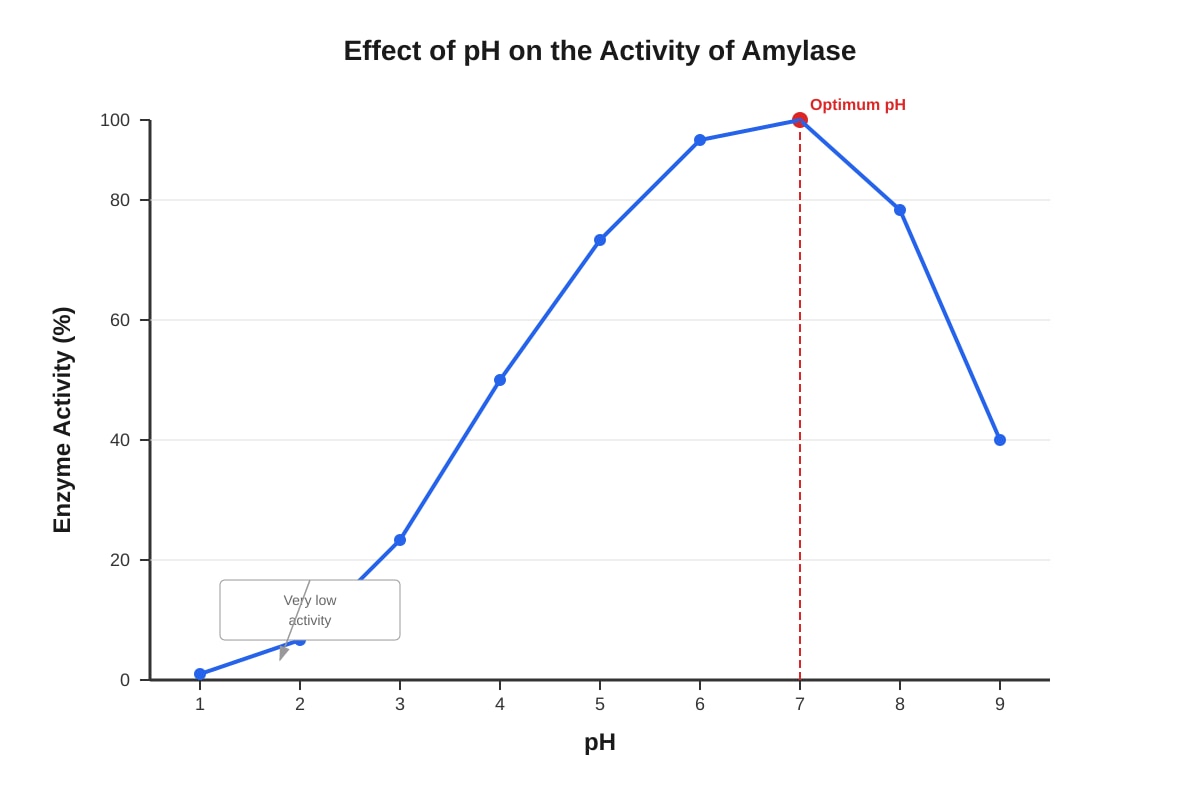
(a) State the optimum pH for amylase activity. [1] Answer: pH 7 [1]
(b) Explain why enzyme activity is very low at pH 2. [3] Marking scheme:
- Low pH denatures the enzyme [1]
- Active site changes shape [1]
- Enzyme-substrate complex cannot form / substrate cannot bind [1]
(c) Name the substrate and product of amylase. [2] Answer: Substrate: Starch [1] Product: Maltose [1]
4. Osmosis investigation [5]
(a) Define the term osmosis. [2] Answer: Movement of water molecules from a region of high water potential to a region of low water potential through a partially permeable membrane [2] Award 1 mark for water movement, 1 mark for through partially permeable membrane
(b) (i) State the concentration of the solution that is isotonic to the potato cells. [1] Answer: 10% [1]
(ii) Explain why the potato strip gained mass in the 0% solution. [2] Marking scheme:
- Water moved into potato cells by osmosis [1]
- Because water potential of 0% solution is higher than inside potato cells [1]
Section B [30 marks]
5. Human reproduction [10]
(a) Describe the sequence of events after fertilisation. [6] Marking scheme:
- Zygote divides by mitosis to form embryo [1]
- Embryo travels down fallopian tube/oviduct [1]
- Blastocyst forms and implants in uterine wall/endometrium [1]
- Placenta develops from embryonic and maternal tissues [1]
- Umbilical cord connects fetus to placenta [1]
- Amniotic fluid surrounds and protects developing fetus [1]
(b) Explain how the placenta is adapted for efficient exchange. [4] Marking scheme:
- Large surface area for exchange [1]
- Thin barrier between maternal and fetal blood [1]
- Rich blood supply on both sides [1]
- Allows passage of nutrients, oxygen, and waste products [1]
6. Plant root cells [8]
(a) Explain the advantage of pumping air through nutrient solution. [4] Marking scheme:
- Air provides oxygen [1]
- Oxygen used in aerobic respiration to produce ATP [1]
- ATP provides energy for active transport [1]
- Active transport needed to absorb mineral ions against concentration gradient [1]
(b) (i) Explain how root hair cell structure is adapted. [3] Marking scheme:
- Long projection increases surface area for absorption [1]
- Thin cell wall allows easy passage of water and ions [1]
- Many mitochondria provide ATP for active transport [1]
(ii) Name the process by which mineral ions are absorbed. [1] Answer: Active transport [1]
7. Nervous system and reflexes [8]
(a) Describe how named components produce a reflex action. [6] Marking scheme:
- Sensory receptor detects stimulus [1]
- Sensory neurone transmits impulse to spinal cord [1]
- Relay neurone in spinal cord connects sensory to motor neurone [1]
- Synapse: neurotransmitter released and crosses synaptic cleft [1]
- Motor neurone transmits impulse to effector [1]
- Effector (muscle/gland) responds [1]
(b) Explain why reflex actions are important for survival. [2] Marking scheme:
- Rapid response to danger/harmful stimuli [1]
- Automatic response does not require conscious thought [1]
8. Water regulation [6]
(a) Explain how water intake affects urine concentration. [4] Marking scheme:
- Increased water intake increases blood water potential [1]
- Less ADH released from pituitary gland [1]
- Less water reabsorbed in kidney tubules [1]
- More dilute urine produced [1]
(b) Name the hormone involved in water regulation. [1] Answer: ADH / Antidiuretic hormone [1]
(c) State where this hormone is produced. [1] Answer: Pituitary gland / Hypothalamus [1]
Section C [30 marks]
9. Leaf structure and photosynthesis [14]
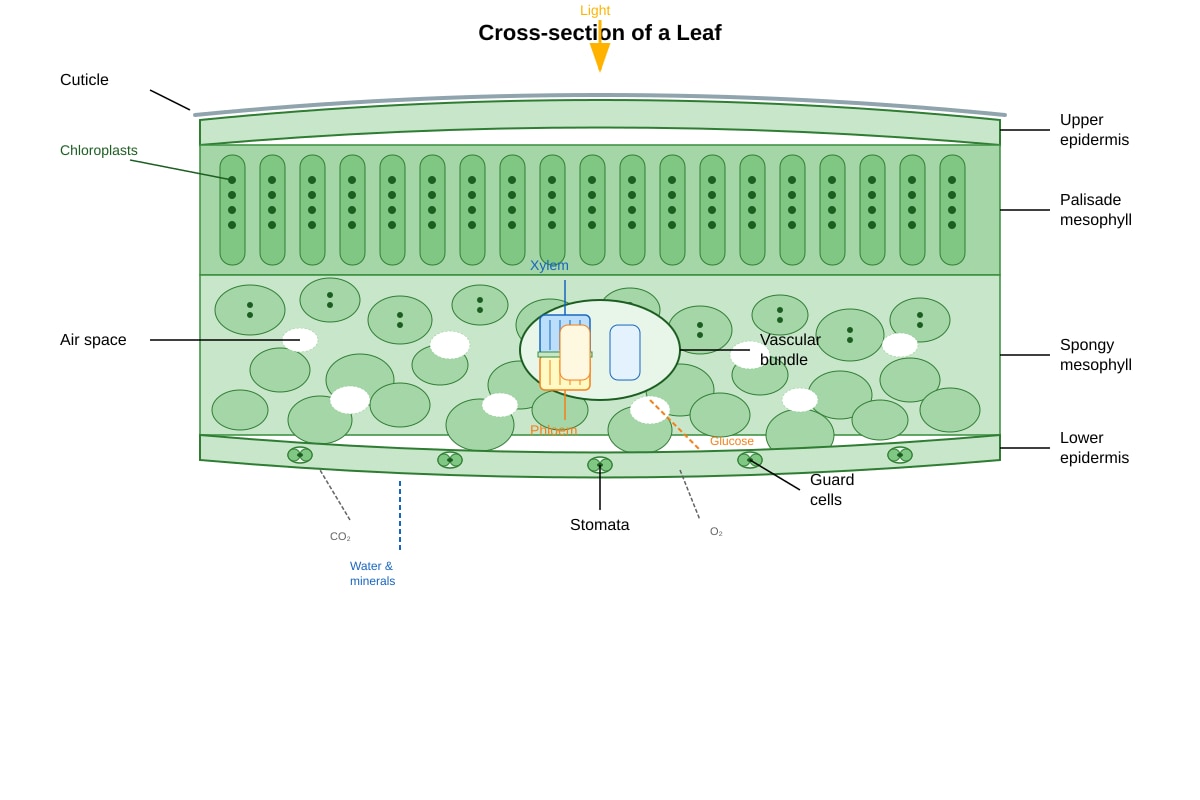
(a) (i) Name the process in palisade mesophyll cells. [1] Answer: Photosynthesis [1]
(ii) Write the word equation for this process. [2] Answer: Carbon dioxide + Water → Glucose + Oxygen [2] Award 1 mark for reactants, 1 mark for products
(b) Explain how leaf structure is adapted for gas exchange. [5] Marking scheme:
- Stomata allow gas exchange [1]
- Guard cells control opening and closing of stomata [1]
- Spongy mesophyll has air spaces for gas circulation [1]
- Thin leaf structure reduces diffusion distance [1]
- Large surface area of mesophyll cells for gas exchange [1]
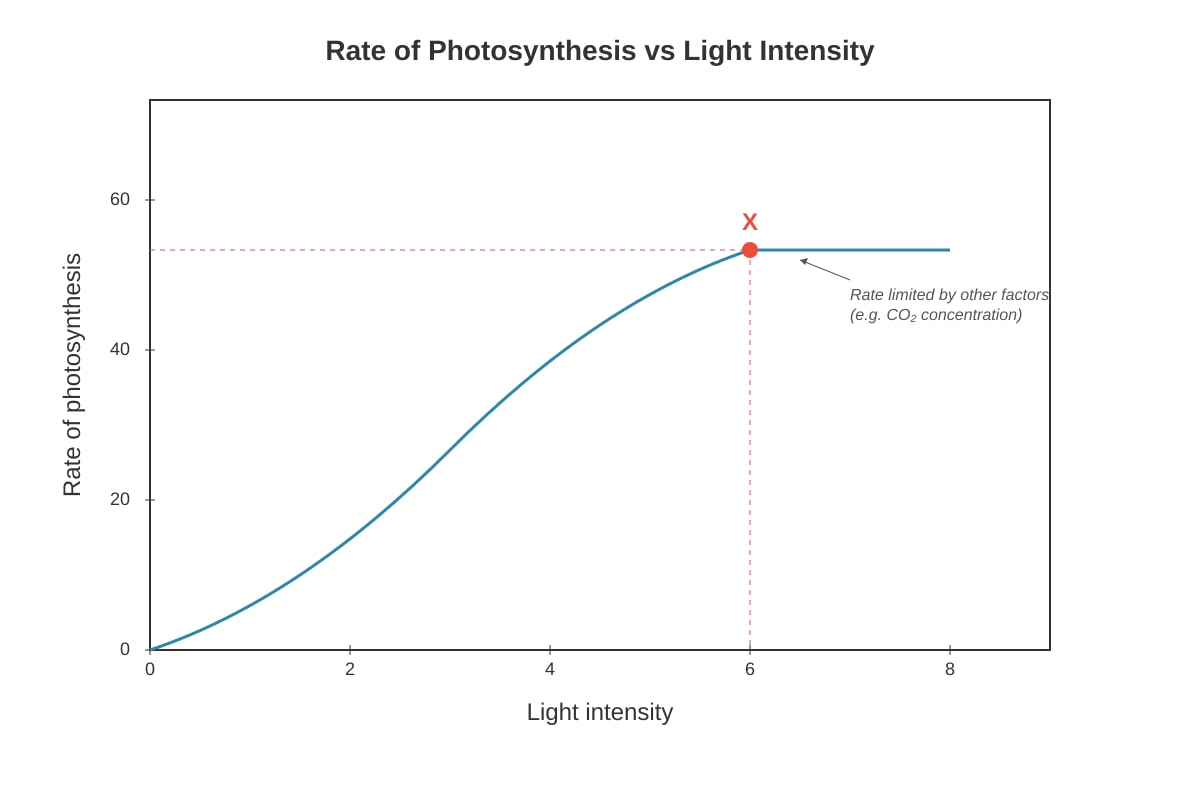
(c) (i) Explain why photosynthesis rate increases from 0 to X. [2] Marking scheme:
- Light is the limiting factor [1]
- More light energy available for photosynthesis [1]
(ii) Explain why rate doesn't increase beyond point X. [2] Marking scheme:
- Light is no longer limiting [1]
- Another factor becomes limiting (temperature/CO₂ concentration) [1]
(iii) State two other limiting factors. [2] Answer: Any two from:
- Temperature [1]
- Carbon dioxide concentration [1]
- Chlorophyll concentration [1]
10. Human digestion [14]
(a) Describe roles of enzymes in digestion with examples. [6] Marking scheme:
- Enzymes act as biological catalysts to speed up digestion [1]
- Amylase breaks down starch to maltose in mouth/small intestine [1]
- Pepsin breaks down proteins to polypeptides in stomach [1]
- Lipase breaks down fats to fatty acids and glycerol in small intestine [1]
- Maltase breaks down maltose to glucose in small intestine [1]
- Trypsin breaks down proteins in small intestine [1] Award maximum 6 marks for enzyme function and specific examples
(b) Explain why stomach produces hydrochloric acid. [3] Marking scheme:
- Provides optimum pH for pepsin activity [1]
- Kills bacteria in food [1]
- Denatures proteins to make them easier to digest [1]
(c) Describe how small intestine is adapted for absorption. [5] Marking scheme:
- Villi increase surface area [1]
- Microvilli further increase surface area [1]
- Thin wall reduces diffusion distance [1]
- Rich blood supply maintains concentration gradient [1]
- Lacteal for fat absorption [1]
11. Active transport [8]
(a) Explain what is meant by active transport. [2] Answer: Movement of substances against concentration gradient using energy from ATP [2] Award 1 mark for against concentration gradient, 1 mark for energy/ATP
(b) Give two examples of active transport. [2] Answer: Any two from:
- Uptake of mineral ions by root hair cells [1]
- Glucose absorption in small intestine [1]
- Sodium-potassium pump in nerve cells [1]
(c) Explain why active transport is important for mineral ion uptake. [4] Marking scheme:
- Mineral ions are often in low concentration in soil [1]
- Plant needs higher concentration inside cells [1]
- Movement against concentration gradient requires energy [1]
- Ensures plant gets essential minerals for growth and metabolism [1]