From Real Exams Exam Paper
O Level Additional Mathematics Practice Paper 3
Free O Level A Maths Practice Paper 3, DeepSeek Exam version, with questions, answers, and O Level-style practice for Singapore students.
These static practice materials are generated from the site's syllabus and paper-generation workflow, with source and model context shown so students and parents can evaluate the material before use.
Questions
Free quiz and exam paper access
Enter your details to view this paper
Your access is remembered on this device.
Answers
TuitionGoWhere Practice Paper – Answer Key and Marking Scheme
Additional Mathematics O-Level – Graphs & Coordinate Geometry (Version 3)
Section A: Straight Lines and Basic Coordinate Geometry
Question 1
(a) AB = √[(8 − 2)² + (−3 − 5)²] [M1] = √[6² + (−8)²] = √(36 + 64) = √100 = 10 units [A1]
(b) Midpoint = ((2+8)/2, (5+(−3))/2) = (5, 1) [A1]
Question 2
Gradient of y = 2x + 5 is 2. [B1] Gradient of perpendicular line = −1/2. [M1] Equation: y − (−1) = −1/2(x − 3) y + 1 = −1/2x + 3/2 2y + 2 = −x + 3 x + 2y − 1 = 0 [A1]
Question 3
Gradient of PQ = (2 − 4)/(3 − (−1)) = −2/4 = −1/2 [M1] Since P, Q, R are collinear, gradient of QR = gradient of PQ. (k − 2)/(5 − 3) = −1/2 (k − 2)/2 = −1/2 k − 2 = −1 k = 1 [A1]
Question 4
Area = 1/2 |1(6 − 2) + 4(2 − 2) + 7(2 − 6)| [M1] = 1/2 |1(4) + 4(0) + 7(−4)| = 1/2 |4 + 0 − 28| = 1/2 |−24| = 12 square units [A1]
Question 5
3x − 2 = x² + x − 4 [M1] x² − 2x − 2 = 0 x = [2 ± √(4 + 8)]/2 = [2 ± √12]/2 = [2 ± 2√3]/2 = 1 ± √3 When x = 1 + √3, y = 3(1 + √3) − 2 = 1 + 3√3 When x = 1 − √3, y = 3(1 − √3) − 2 = 1 − 3√3 A(1 + √3, 1 + 3√3), B(1 − √3, 1 − 3√3) [A1]
Section B: Circles
Question 6
(a) x² − 6x + y² + 4y = 12 (x − 3)² − 9 + (y + 2)² − 4 = 12 [M1] (x − 3)² + (y + 2)² = 25 [M1] Centre = (3, −2), radius = 5 units [A1]
(b) Distance from (5, −5) to centre (3, −2): √[(5 − 3)² + (−5 − (−2))²] = √[4 + 9] = √13 ≈ 3.61 [M1] Since √13 < 5, the point lies inside the circle. [A1]
Question 7
(a) Radius = distance from (−2, 3) to (1, 7) = √[(1 − (−2))² + (7 − 3)²] = √[3² + 4²] = √25 = 5 units [M1, A1]
(b) (x + 2)² + (y − 3)² = 25 [A1]
(c) (x + 2)² + (y − 3)² = 25 x² + 4x + 4 + y² − 6y + 9 = 25 [M1] x² + y² + 4x − 6y − 12 = 0 [A1]
Question 8
(a) Centre = midpoint of AB = ((1+7)/2, (2+10)/2) = (4, 6) [A1]
(b) Radius = half the length of AB AB = √[(7 − 1)² + (10 − 2)²] = √[36 + 64] = √100 = 10 [M1] Radius = 5 units [A1]
(c) (x − 4)² + (y − 6)² = 25 [A1]
Question 9
(a) Distance from centre (4, −1) to line x = 1 is |4 − 1| = 3 units. Radius = 3 units. [A1]
(b) (x − 4)² + (y + 1)² = 9 [A1]
Question 10
Substitute y = 2x + c into x² + y² = 5: x² + (2x + c)² = 5 [M1] x² + 4x² + 4cx + c² = 5 5x² + 4cx + (c² − 5) = 0 [M1] For tangency, discriminant = 0: (4c)² − 4(5)(c² − 5) = 0 [M1] 16c² − 20c² + 100 = 0 −4c² + 100 = 0 c² = 25 c = ±5 [A1]
Question 11
Let the circle be x² + y² + 2gx + 2fy + c = 0. At (0, 0): 0 + 0 + 0 + 0 + c = 0 ⇒ c = 0 [M1] At (4, 0): 16 + 0 + 8g + 0 + 0 = 0 ⇒ 8g = −16 ⇒ g = −2 [M1] At (0, 6): 0 + 36 + 0 + 12f + 0 = 0 ⇒ 12f = −36 ⇒ f = −3 [M1] Equation: x² + y² − 4x − 6y = 0 [A1]
Section C: Linear Law and Applications
Question 12
(a) Take lg of both sides: lg y = lg(axⁿ) = lg a + n lg x [M1] This is of the form Y = nX + lg a, where Y = lg y and X = lg x. Plotting lg y against lg x gives a straight line with gradient n and vertical intercept lg a. [A1]
(b) lg 4.2 = 0.62 (2 d.p.) [A1] Completed table:
| X = lg x | 0.18 | 0.30 | 0.48 | 0.60 | 0.70 |
|---|---|---|---|---|---|
| Y = lg y | 0.62 | 0.90 | 1.30 | 1.58 | 1.80 |
(c)
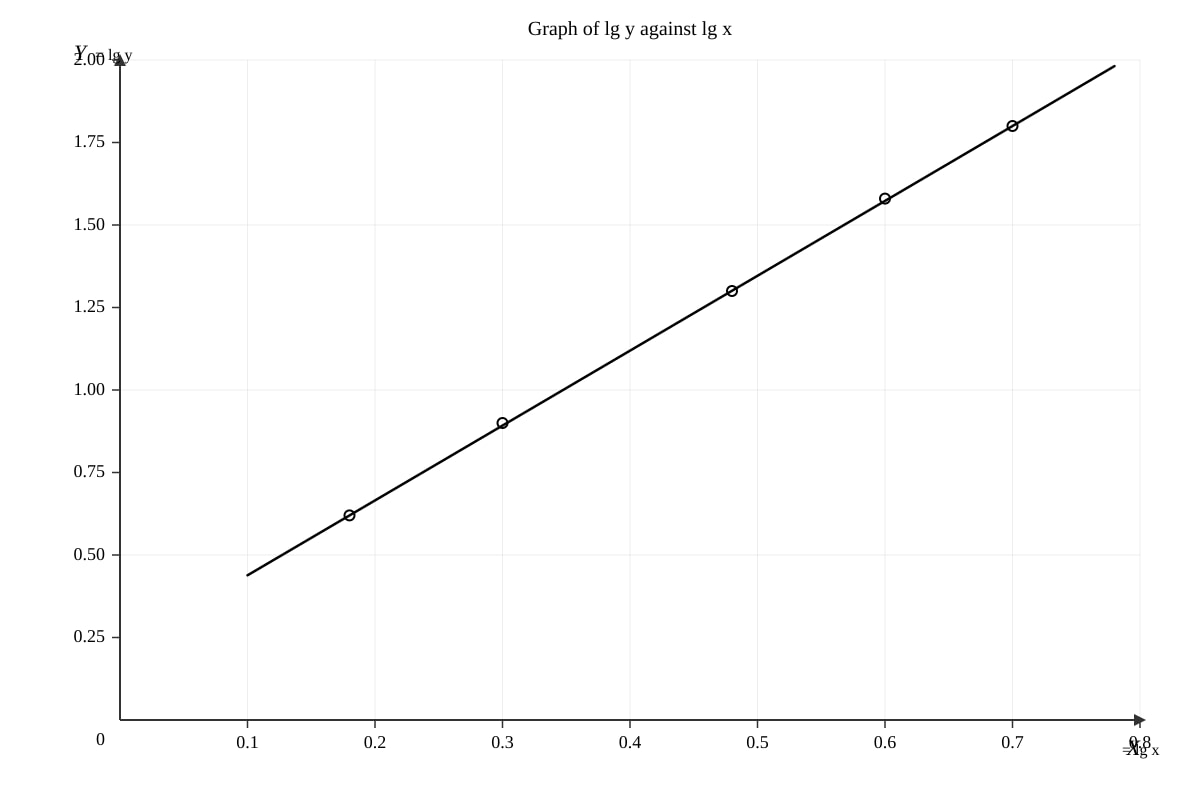
Generated graph for this question.
(d) Gradient n ≈ (1.80 − 0.62)/(0.70 − 0.18) = 1.18/0.52 ≈ 2.27 [M1, A1] Intercept = lg a ≈ 0.22 (from graph) [M1] a = 10^0.22 ≈ 1.66 [A1] (Accept values consistent with candidate's graph)
Question 13
(a) y = kbˣ lg y = lg k + x lg b [M1] Plot lg y (vertical axis) against x (horizontal axis). [A1] Gradient = lg b, vertical intercept = lg k.
(b) lg b = 0.255 ⇒ b = 10^0.255 ≈ 1.80 [M1, A1] lg k = 0.699 ⇒ k = 10^0.699 ≈ 5.00 [M1, A1]
Question 14
(a) x² − 4x + 3 = x − 1 [M1] x² − 5x + 4 = 0 (x − 1)(x − 4) = 0 x = 1 or x = 4 [M1] When x = 1, y = 0; when x = 4, y = 3 A(1, 0), B(4, 3) [A1]
(b) AB = √[(4 − 1)² + (3 − 0)²] = √[9 + 9] = √18 = 3√2 units [M1, A1]
(c) Midpoint = ((1+4)/2, (0+3)/2) = (2.5, 1.5) [A1]
Question 15
(a) Gradient of PQ = (5 − 1)/(6 − 2) = 4/4 = 1 [M1] Gradient of QR = (3 − 5)/(8 − 6) = −2/2 = −1 [M1] Product of gradients = 1 × (−1) = −1, so PQ ⟂ QR. [A1]
(b) Since ∠PQR = 90°, area = 1/2 × PQ × QR PQ = √[(6 − 2)² + (5 − 1)²] = √(16 + 16) = √32 = 4√2 [M1] QR = √[(8 − 6)² + (3 − 5)²] = √(4 + 4) = √8 = 2√2 Area = 1/2 × 4√2 × 2√2 = 1/2 × 8 × 2 = 8 square units [A1]
Question 16
(a) 2x + 3y = 12 ⇒ 3y = −2x + 12 ⇒ y = −2/3x + 4 Gradient = −2/3 [A1]
(b) L₂ has gradient −2/3 and passes through (4, −1). y − (−1) = −2/3(x − 4) [M1] y + 1 = −2/3x + 8/3 y = −2/3x + 5/3 [A1]
(c) At x-axis, y = 0: 0 = −2/3x + 5/3 [M1] 2/3x = 5/3 ⇒ x = 2.5 Point is (2.5, 0) [A1]
Question 17
(a) dy/dx = 3x² − 6x [M1] At stationary points, dy/dx = 0: 3x² − 6x = 0 ⇒ 3x(x − 2) = 0 ⇒ x = 0 or x = 2 [M1] When x = 0, y = 2; when x = 2, y = 8 − 12 + 2 = −2 Stationary points: (0, 2) and (2, −2) [A1]
(b) d²y/dx² = 6x − 6 [M1] At x = 0: d²y/dx² = −6 < 0 ⇒ maximum point (0, 2) At x = 2: d²y/dx² = 6 > 0 ⇒ minimum point (2, −2) [A1]
Question 18
(a) Centre = (3, −2), radius = 5 units [A1]
(b) Substitute y = x + 1 into (x − 3)² + (y + 2)² = 25: (x − 3)² + (x + 1 + 2)² = 25 [M1] (x − 3)² + (x + 3)² = 25 x² − 6x + 9 + x² + 6x + 9 = 25 [M1] 2x² + 18 = 25 2x² = 7 x² = 3.5 x = ±√3.5 [M1] When x = √3.5, y = √3.5 + 1 When x = −√3.5, y = −√3.5 + 1 P(√3.5, √3.5 + 1), Q(−√3.5, −√3.5 + 1) [A1] (Or approximately P(1.87, 2.87), Q(−1.87, −0.87))
Question 19
(a) When x = 1, y = 5: p(1)² + q(1) = 5 ⇒ p + q = 5 [A1] When x = 2, y = 18: p(4) + q(2) = 18 ⇒ 4p + 2q = 18 [A1]
(b) From p + q = 5 ⇒ q = 5 − p Substitute: 4p + 2(5 − p) = 18 [M1] 4p + 10 − 2p = 18 2p = 8 ⇒ p = 4 q = 5 − 4 = 1 [A1]
(c) y = 4x² + x When x = 3: y = 4(9) + 3 = 36 + 3 = 39 [A1]
Question 20
(a) OA = √[(−3 − 0)² + (4 − 0)²] = √(9 + 16) = √25 = 5 units [A1]
(b) Gradient of OA = (4 − 0)/(−3 − 0) = −4/3 [M1] Radius is perpendicular to tangent, so gradient of tangent = 3/4 [M1, A1]
(c) Tangent passes through A(−3, 4) with gradient 3/4: y − 4 = 3/4(x + 3) [M1] 4y − 16 = 3x + 9 3x − 4y + 25 = 0 [A1]
Marking Summary
| Section | Questions | Marks |
|---|---|---|
| A: Straight Lines | 1–5 | 12 |
| B: Circles | 6–11 | 24 |
| C: Linear Law & Applications | 12–20 | 24 |
| Total | 1–20 | 60 |
End of Answer Key
TuitionGoWhere Practice Paper – Version 3 – Marking Scheme