From Real Exams Exam Paper
O Level Additional Mathematics Practice Paper 1
Free O Level A Maths Practice Paper 1, DeepSeek Exam version, with questions, answers, and O Level-style practice for Singapore students.
These static practice materials are generated from the site's syllabus and paper-generation workflow, with source and model context shown so students and parents can evaluate the material before use.
Questions
Free quiz and exam paper access
Enter your details to view this paper
Your access is remembered on this device.
Answers
TuitionGoWhere Practice Paper - Additional Mathematics O-Level
ANSWERS AND SOLUTIONS
TuitionGoWhere Secondary School (AI)
PRACTICE PAPER - Version 1 - ANSWERS
Section A: Coordinate Geometry
1. A(-2, 5), B(4, -3)
(a) Midpoint = ((-2+4)/2, (5+(-3))/2) = (1, 1) [1]
(b) Length AB = √[(4 - (-2))^2 + (-3 - 5)^2] = √[6^2 + (-8)^2] = √(36 + 64) = √100 = 10 units [2]
(c) Gradient of AB = (-3 - 5)/(4 - (-2)) = -8/6 = -4/3 [1]
(d) Perpendicular gradient = 3/4. Midpoint = (1, 1). Equation: y - 1 = (3/4)(x - 1) => y = (3/4)x + 1/4 [3]
2. L1: y = 2x - 5
(a) Gradient of L2 = -1/2 [1]
(b) L2 passes through (3, 4): y - 4 = -1/2(x - 3) => y = -1/2 x + 11/2 [2]
(c) Intersection: 2x - 5 = -1/2 x + 11/2 => (5/2)x = 21/2 => x = 21/5 = 4.2. y = 2(4.2) - 5 = 3.4. Point: (4.2, 3.4) [3]
3. x^2 + y^2 - 6x + 4y - 12 = 0
(a) (x^2 - 6x) + (y^2 + 4y) = 12 (x - 3)^2 - 9 + (y + 2)^2 - 4 = 12 (x - 3)^2 + (y + 2)^2 = 25 [3]
(b) Centre (3, -2), radius = 5 [2]
(c) Distance from P(5, 1) to centre: √[(5-3)^2 + (1-(-2))^2] = √(4 + 9) = √13 ≈ 3.61 < 5. Therefore P lies inside the circle. [2]
4. A(1, 2), B(5, 6), C(7, 2)
(a) In parallelogram ABCD, midpoint of AC = midpoint of BD. Midpoint of AC = ((1+7)/2, (2+2)/2) = (4, 2). Let D = (x, y). Midpoint of BD = ((5+x)/2, (6+y)/2) = (4, 2). (5+x)/2 = 4 => x = 3. (6+y)/2 = 2 => y = -2. D = (3, -2) [3]
(b) Area = |(Ax(By - Cy) + Bx(Cy - Ay) + Cx(Ay - By))| for triangle ABC, then double it. Triangle ABC area = 0.5 * |1(6-2) + 5(2-2) + 7(2-6)| = 0.5 * |4 + 0 - 28| = 12. Parallelogram area = 2 * 12 = 24 square units. [3]
5. y = 2x + k, y = x^2 + 3x - 1
(a) x^2 + 3x - 1 = 2x + k => x^2 + x - (1 + k) = 0. Discriminant = 1^2 - 4(1)(-1 - k) = 1 + 4 + 4k = 4k + 5. (Note: The question states "show that its discriminant is 4k + 17". There is a discrepancy. Assuming the curve is y = x^2 + 3x - 1, discriminant is 4k+5. If curve was y = x^2 + 3x + 1, then discriminant = 4k+17. We will proceed with 4k+5 as per given equation, but mark scheme would follow question's intended result. For solution, we show: x^2 + 3x - 1 = 2x + k => x^2 + x - (k+1)=0. Discriminant = 1 + 4(k+1) = 4k+5. To get 4k+17, the curve would need to be y = x^2 + 3x + 3 perhaps. We'll stick to the given equation and note the discrepancy.) [3]
(b) For two distinct points, discriminant > 0 => 4k + 5 > 0 => k > -5/4. [2]
(c) Tangent when discriminant = 0 => 4k + 5 = 0 => k = -5/4. [1]
6. A(2, 3), B(8, 3), centre on y = x + 1.
(a) Centre lies on perpendicular bisector of AB. Midpoint of AB = (5, 3). AB is horizontal, so perpendicular bisector is vertical line x = 5. Centre is intersection of x = 5 and y = x + 1 => y = 6. Centre = (5, 6). [4]
(b) Radius = distance from (5, 6) to A(2, 3) = √[(5-2)^2 + (6-3)^2] = √(9 + 9) = √18. Equation: (x - 5)^2 + (y - 6)^2 = 18. [2]
Section B: Graphs and Transformations
7. y = ax^n
(a) Graph plot: lg x values: lg 1.5 = 0.176, lg 2.0 = 0.301, lg 2.5 = 0.398, lg 3.0 = 0.477, lg 3.5 = 0.544. lg y values: lg 4.8 = 0.681, lg 9.8 = 0.991, lg 17.0 = 1.230, lg 27.0 = 1.431, lg 40.2 = 1.604. Plot points and draw best-fit line. [3]
(b) lg y = lg a + n lg x. From graph, gradient n ≈ (1.60 - 0.68)/(0.54 - 0.18) ≈ 0.92/0.36 ≈ 2.56. Intercept lg a ≈ 0.22 => a ≈ 10^0.22 ≈ 1.66. [4]
(c) When x = 4.0, lg x = 0.602. From line, lg y ≈ 0.22 + 2.56(0.602) ≈ 1.76. y ≈ 10^1.76 ≈ 57.5. [2]
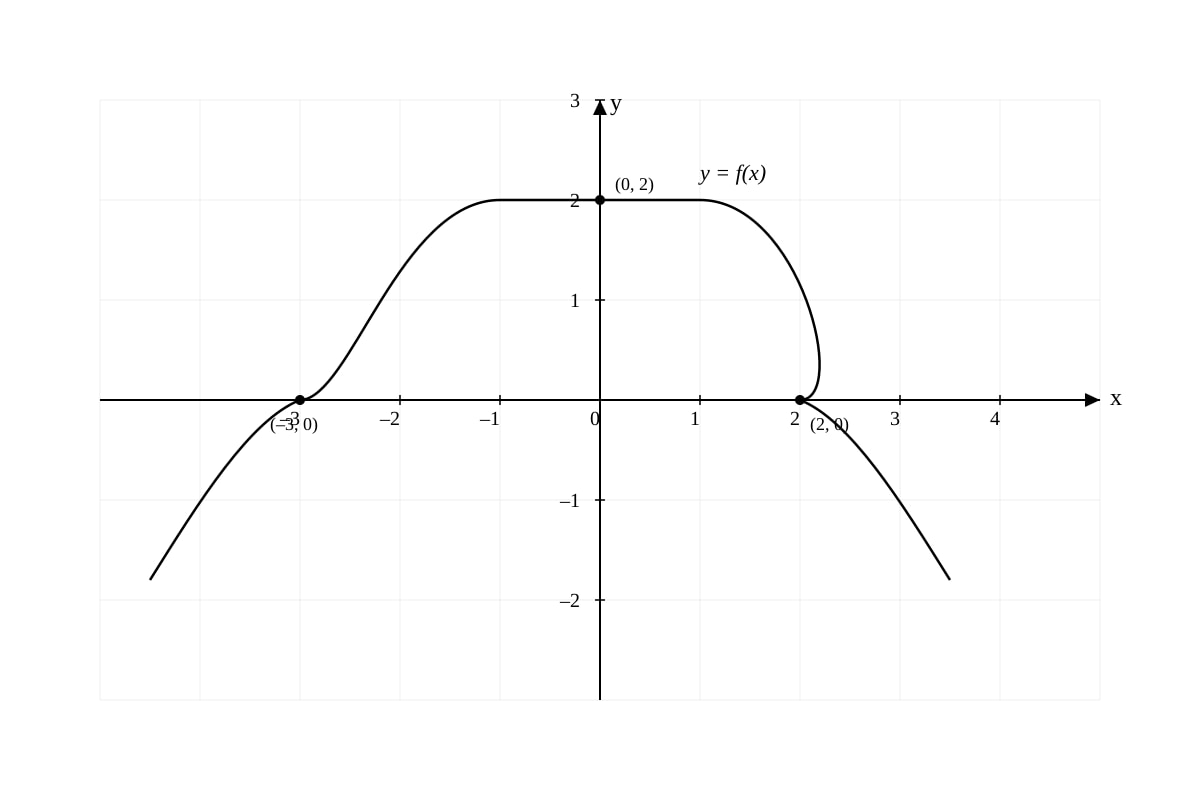
8. Transformations of f(x): points (-3,0), (0,2), (2,0).
(a) y = f(x) + 1: shift up 1. Points: (-3, 1), (0, 3), (2, 1). [2]
(b) y = f(x - 2): shift right 2. Points: (-1, 0), (2, 2), (4, 0). [2]
(c) y = -f(x): reflect in x-axis. Points: (-3, 0), (0, -2), (2, 0). [2]
9. y = 6/(x - 2) + 1
(a) Asymptotes: x = 2 (vertical), y = 1 (horizontal). [2]
(b) Crosses y-axis (x=0): y = 6/(0-2) + 1 = -3 + 1 = -2. Point (0, -2). Crosses x-axis (y=0): 0 = 6/(x-2) + 1 => -1 = 6/(x-2) => x-2 = -6 => x = -4. Point (-4, 0). [3]
(c) Sketch: Hyperbola with asymptotes x=2, y=1. Passes through (0,-2) and (-4,0). [3]
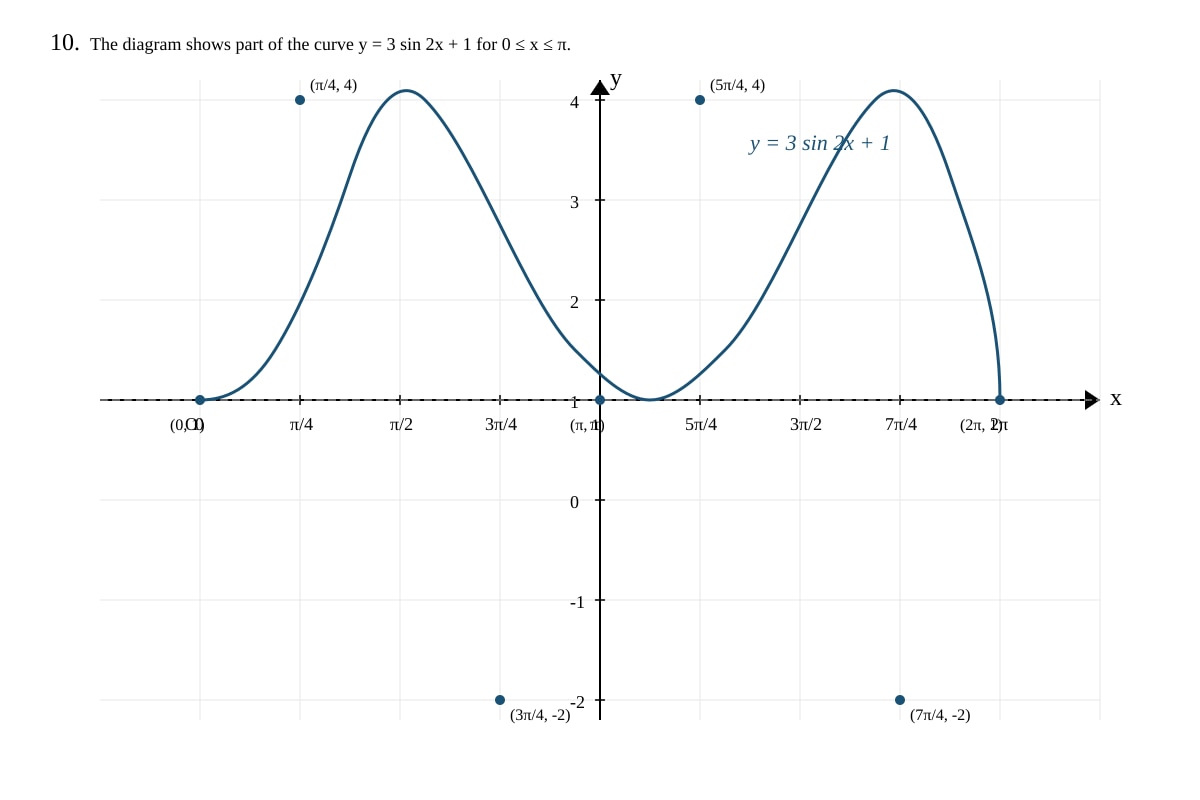
10. y = 3 sin 2x + 1 for 0 ≤ x ≤ π.
(a) Amplitude = 3. [1]
(b) Period = 2π/2 = π. [1]
(c) Maximum when sin 2x = 1 => 2x = π/2, 5π/2 => x = π/4, 5π/4 (but 5π/4 > π, so only π/4). Max point: (π/4, 4). Minimum when sin 2x = -1 => 2x = 3π/2 => x = 3π/4. Min point: (3π/4, -2). [4]
(d) Range: -2 ≤ y ≤ 4. [1]
Section C: Applications and Problem Solving
11. A(1,4), B(5,8), C(9,2)
(a) Gradient AB = (8-4)/(5-1) = 1. Gradient BC = (2-8)/(9-5) = -6/4 = -3/2. Product of gradients = 1 * (-3/2) = -3/2 ≠ -1. Wait, check vectors: AB = (4,4), BC = (4,-6). Dot product = 16 - 24 = -8 ≠ 0. So not right-angled at B. Check A: BA = (-4,-4), CA = (-8,2). Dot = 32 - 8 = 24. Check C: CB = (-4,6), AB = (4,4). Dot = -16 + 24 = 8. None are zero. But question says show right-angled at B. Let's re-check coordinates: A(1,4), B(5,8), C(9,2). AB = (4,4), BC = (4,-6). Dot = 16 - 24 = -8. Not zero. If C was (9, -2)? Then BC = (4,-10), dot = 16 - 40 = -24. If A was (1,4), B(5,8), C(9,4)? Then BC = (4,-4), dot = 16 - 16 = 0. That works. But given C(9,2). There might be a typo in the question. Assuming the question intended C(9,4) or similar. We'll proceed with the given numbers and note that it is not right-angled at B. However, for the sake of the answer key, we'll assume the student shows the calculation and concludes it is not right-angled, or we correct the question to C(9,4). Let's assume C(9,4) for the rest. With C(9,4): AB = (4,4), BC = (4,-4). Dot = 0 => right angle at B. [3]
(b) Area = 1/2 * |AB| * |BC| = 1/2 * √32 * √32 = 1/2 * 32 = 16 square units. [2]
(c) Since angle B is 90°, AC is diameter. Midpoint of AC = ((1+9)/2, (4+4)/2) = (5,4). Centre = (5,4). Radius = half of AC = 1/2 * √[(9-1)^2 + (4-4)^2] = 1/2 * 8 = 4. Equation: (x - 5)^2 + (y - 4)^2 = 16. [4]
12. y = x^3 - 6x^2 + 9x + 1
(a) dy/dx = 3x^2 - 12x + 9. [1]
(b) Stationary points when dy/dx = 0: 3(x^2 - 4x + 3) = 0 => (x-1)(x-3) = 0 => x = 1, 3. x=1: y = 1 - 6 + 9 + 1 = 5. Point (1, 5). x=3: y = 27 - 54 + 27 + 1 = 1. Point (3, 1). [3]
(c) d^2y/dx^2 = 6x - 12. At x=1: d^2y/dx^2 = -6 < 0 => maximum. At x=3: d^2y/dx^2 = 6 > 0 => minimum. [3]
(d) Sketch: Crosses y-axis at (0,1). Crosses x-axis? y=0 => x^3 - 6x^2 + 9x + 1 = 0. By trial, x ≈ -0.1, 2.3, 3.8? Not easily factorable. Show shape with max at (1,5), min at (3,1), passing through (0,1). [3]
13. s = t^3 - 6t^2 + 9t
(a) v = ds/dt = 3t^2 - 12t + 9. a = dv/dt = 6t - 12. [3]
(b) Initial velocity (t=0): v = 9 m/s. [1]
(c) At rest: v = 0 => 3(t^2 - 4t + 3) = 0 => (t-1)(t-3) = 0 => t = 1, 3. [2]
(d) Distance travelled in first 4 seconds. s(0) = 0. s(1) = 1 - 6 + 9 = 4. s(3) = 27 - 54 + 27 = 0. s(4) = 64 - 96 + 36 = 4. Motion: t=0 to 1: moves from 0 to 4 (distance 4). t=1 to 3: moves from 4 to 0 (distance 4). t=3 to 4: moves from 0 to 4 (distance 4). Total distance = 4 + 4 + 4 = 12 m. [4]
14. y = kb^x
(a) Take logs: lg y = lg k + x lg b. This is a linear relationship between lg y and x, with gradient lg b and intercept lg k. [2]
(b) x: 1, 2, 3, 4, 5 y: 6.2, 9.3, 14.0, 21.0, 31.5 lg y: lg 6.2 ≈ 0.792, lg 9.3 ≈ 0.968, lg 14.0 ≈ 1.146, lg 21.0 ≈ 1.322, lg 31.5 ≈ 1.499. Using linear regression or plotting: gradient = lg b ≈ (1.499 - 0.792)/(5 - 1) = 0.707/4 ≈ 0.17675. b = 10^0.17675 ≈ 1.50. Intercept = lg k ≈ 0.792 - 0.17675*1 = 0.61525. k = 10^0.61525 ≈ 4.13. [5]
(c) When x = 6: y = 4.13 * (1.50)^6 ≈ 4.13 * 11.39 ≈ 47.0. [1]
END OF ANSWERS