AI Generated Quiz
O Level Principles of Accounts Inventory Costing Quiz
Free O Level POA Inventory Costing quiz, HY3 AI version, with questions, answers, and O Level-style practice for Singapore students.
These static practice materials are generated from the site's syllabus and paper-generation workflow, with source and model context shown so students and parents can evaluate the material before use.
Questions
Free quiz and exam paper access
Enter your details to view this paper
Your access is remembered on this device.
Answers
O-Level Principles of Accounts Quiz - Inventory Costing (Answer Key)
Total Marks: 40
Topic: Inventory Costing
Level: O-Level
Section A: Basic Concepts and Cost of Sales
Q1. [1 mark]
Formula:
Cost of Sales = Opening Inventory + Purchases − Closing Inventory
Teaching note: Under periodic system, we do not record each sale's cost; we compute total cost of sales at period end using this formula.
Common mistake: Writing "Sales − Profit" instead of inventory formula.
Q2. [2 marks]
Opening inventory: 12,000
Closing inventory: 3,000 + 4,000 = $11,000
Mark breakdown: 1 mark for correct formula/substitution, 1 mark for correct answer.
Q3. [2 marks]
Inventory is valued at the lower of cost and net realizable value (LCNRV). This applies the prudence concept — assets should not be overstated, and anticipated losses should be recognized early.
Teaching note: Cost = purchase price + bringing to location/condition. NRV = expected selling price − costs to sell. Choose the lower.
Marking: 1 mark for stating LCNRV, 1 mark for linking to prudence/concept.
Q4. [2 marks] Any two of:
- To avoid tying up excess cash in stock
- To reduce storage/holding costs
- To minimise risk of obsolescence/spoilage
- To meet customer demand promptly (avoid stockouts)
1 mark each.
Q5. [1 mark]
Yes, include $800. Under FOB shipping point, goods belong to buyer once shipped.
Common mistake: Thinking goods in transit are excluded automatically.
Section B: FIFO and AVCO Methods
Q6. [3 marks] FIFO: closing inventory = 150 units (400 total − 250 sold).
- From 25 Apr purchase: 100 units × 700
- From 10 Apr purchase: 50 units × 300
Total = $1,000
Marking: 1 for units remaining, 2 for correct valuation.
Q7. [3 marks]
AVCO:
Total cost = (100×6)+(100×500+700 = 2,400 ÷ 400 = 6 = $900
Marking: 1 for total cost/units, 1 for avg, 1 for closing value.
Q8. [2 marks]
FIFO (900). FIFO uses older lower costs for issues, leaving recent higher costs in inventory during rising prices.
1 mark conclusion, 1 mark reason.
Q9. [2 marks]
COGS FIFO = Total cost − Closing inv = 1,000 = 5 + 150×500+1,400)
1 mark method, 1 mark answer.
Q10. [3 marks]
Units available = 50 + 100 = 150
Total cost = (50×12) = 1,200 = 1,700 ÷ 150 = 11.33 = 340.00)
Marking: 1 avg cost, 1 units remaining, 1 value.
Q11. [1 mark] Advantage: FIFO matches physical flow of goods (oldest sold first); easier to understand; ending inventory close to current cost.
Section C: Inventory Turnover and Analysis
Q12. [1 mark] Inventory turnover ratio = Cost of Sales ÷ Average Inventory. Measures how many times stock is sold and replaced in a period.
Q13. [2 marks]
2023: 50,000 = 6.0 times
2024: 60,000 = 6.0 times
1 mark per year.
Q14. [2 marks]
Turnover 2024 = 6.0
Days = 365 ÷ 6.0 = 60.83 days
1 mark formula, 1 mark answer to 2 dp.
Q15. [3 marks]
Trend: unchanged at 6.0 times (stable).
Action e.g., review slow-moving lines or use JIT to reduce average inventory and free cash.
Marking: 1 trend, 2 for sensible recommendation.
Q16. [2 marks]
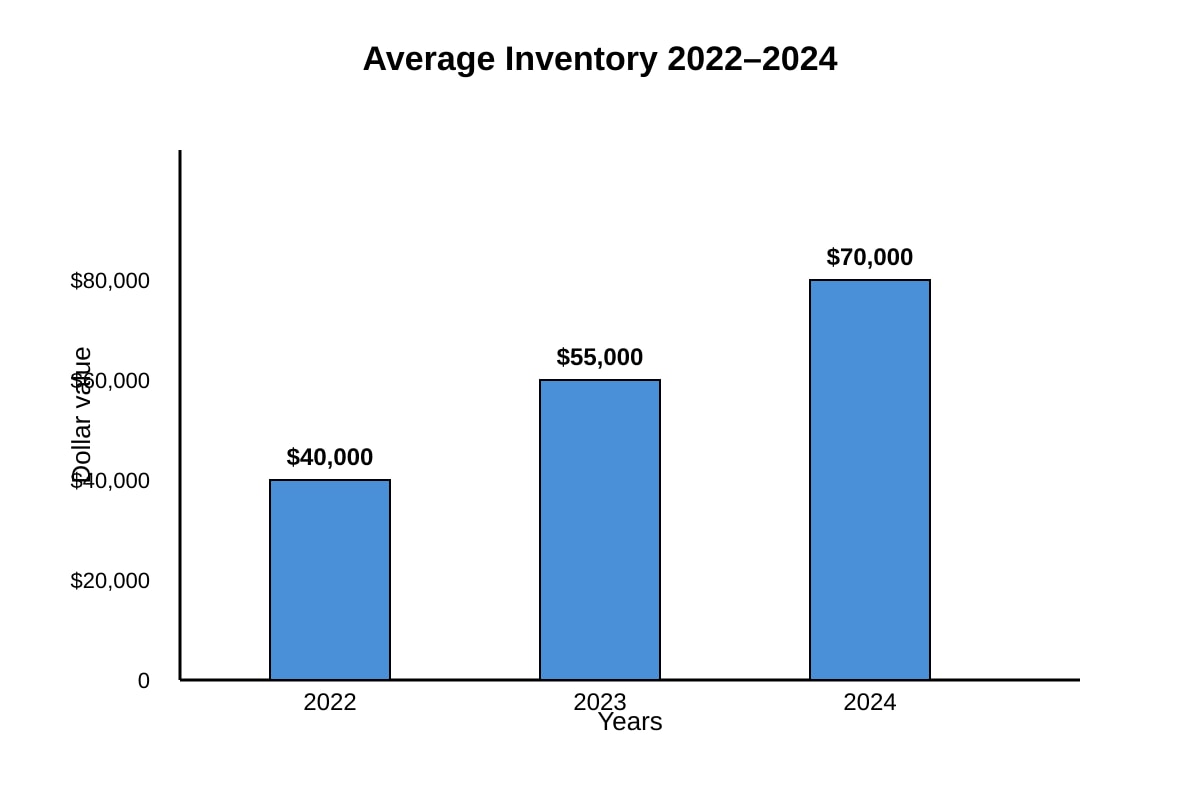
2022: 70,000
Increase = (40,000) ÷ $40,000 × 100% = 75%
1 mark calculation, 1 answer.
Section D: Adjustments and Extended Application
Q17. [2 marks]
1,000 = $8,000 (obsolete goods not realizable at cost).
1 mark adjustment, 1 answer.
Q18. [3 marks]
Inventory Account
Dr | Cr
Opening b/d: 3,000
Purchases: 500
Total: 3,500
Balance b/d next: $500
Marking: 1 format, 1 entries, 1 balancing.
Q19. [3 marks]
During rising prices: FIFO gives lower COGS → higher reported profit; AVCO smooths costs → moderate profit. FIFO inventory higher.
1 mark FIFO effect, 1 AVCO, 1 comparison.
Q20. [4 marks]
(a) 240,000 ÷ 30,000 = 8.0 times [1]
(b) 365 ÷ 8 = 45.625 days [1]
(c) Lower days generally better: stock converts to cash faster, less cash tied up [2]
Marking as shown.