AI Generated Exam Paper
O Level Principles of Accounts Practice Paper 2
Free O Level POA Practice Paper 2, HY3 AI version, with questions, answers, and O Level-style practice for Singapore students.
These static practice materials are generated from the site's syllabus and paper-generation workflow, with source and model context shown so students and parents can evaluate the material before use.
Questions
TuitionGoWhere Practice Paper - Principles of Accounts O-Level
TuitionGoWhere Practice Paper (AI) — Version 2 of 5
Subject: Principles of Accounts
Level: O-Level
Paper: Practice Paper (AI-Inferred)
Duration: 1 hour 15 minutes
Total Marks: 40
Name: ___________________________
Class: ___________________________
Date: ___________________________
Instructions:
- Answer all questions in the spaces provided.
- Show all workings clearly. Marks are awarded for method and accuracy.
- Use the periodic inventory system unless stated otherwise.
- Write your answers in ink and cancel any rough work neatly.
This practice paper is generated from LLM-inferred syllabus templates. It is not derived from official past-year exam papers and should be used for topical revision only.
Section A: Inventory Costing Fundamentals (Questions 1–6) — 10 marks
1. State the formula for cost of sales under the periodic inventory system. [1]
2. On 1 May 2024, Bright Store had opening inventory of 50 units at 8each.DuringMay,itpurchased120unitsat10 each and sold 100 units. Calculate the cost of sales for May 2024. [2]
3. Explain, with reference to an accounting concept, how closing inventory should be valued. [2]
4. Calculate the value of closing inventory at 31 May 2024 for Bright Store (from Q2) using the FIFO method. [2]
5. A business uses AVCO. Opening inventory: 80 units at 5.Purchases:40unitsat6. Sales: 90 units. Calculate the average cost per unit after purchases. [1]
6. Identify one reason why a business might prefer FIFO over AVCO during a period of rising prices. [2]
Section B: FIFO and AVCO Applications (Questions 7–13) — 16 marks
7. Cool Supplies uses the periodic system. Transactions for June 2024:
- 1 Jun: Opening 100 units at $12
- 8 Jun: Bought 150 units at $14
- 15 Jun: Sold 180 units
- 22 Jun: Bought 100 units at $16
- 28 Jun: Sold 70 units
Calculate closing inventory using FIFO. [3]
8. Using the same data in Q7, calculate closing inventory using AVCO (weighted average, recalculated only at period end). [3]
9. State the cost of sales for June 2024 under FIFO (from Q7 data). [1]
10. A student calculated AVCO closing inventory as 100 units × 14=1,400. Explain the error. [2]
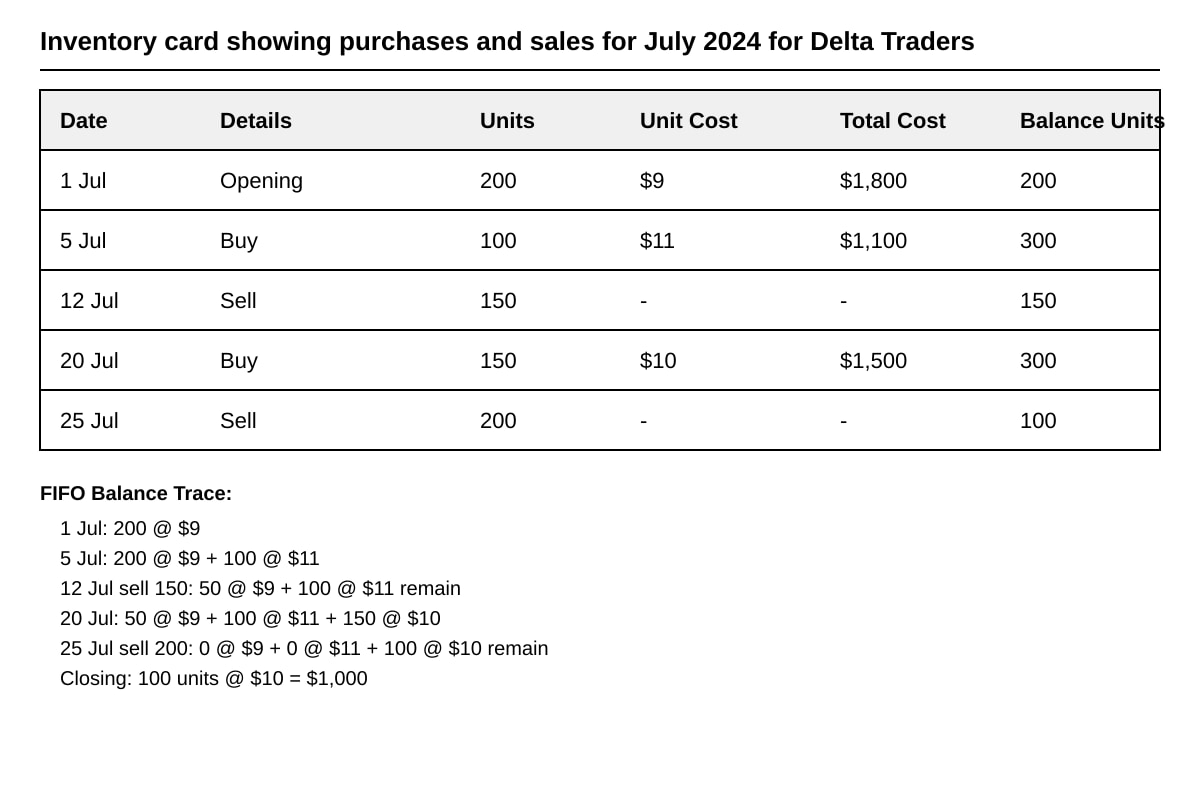
11.
Image pending generation: table for Q11.
Using the inventory card above, calculate closing inventory using FIFO. [3]
12. Explain why FIFO and AVCO give different closing inventory values when prices change. [2]
13. Under which method (FIFO or AVCO) would net profit be higher during rising prices? Give a reason. [2]
Section C: Analysis and Interpretation (Questions 14–20) — 14 marks
14. Eco Mart: 2023 Cost of sales 300,000,Averageinventory60,000. Calculate inventory turnover ratio. [1]
15. Using the result in Q14, calculate days sales in inventory for 2023 (use 365 days). [2]
16. 2024 figures for Eco Mart: Cost of sales 330,000,Averageinventory75,000. Calculate days sales in inventory for 2024. [2]
17. Comment on the change in inventory efficiency from 2023 to 2024. [2]
18. Recommend two actions Eco Mart could take to improve inventory turnover. [2]
19. A business has closing inventory overstated by $2,000. State the effect on gross profit and on net profit. [2]
20. Explain how the lower of cost and net realizable value rule protects users of accounts. [3]
End of Practice Paper
Answers
TuitionGoWhere Practice Paper — Principles of Accounts O-Level (Version 2) Answer Key
Subject: Principles of Accounts
Level: O-Level
Paper: Practice Paper (AI-Inferred)
Total Marks: 40
Teaching notes are provided for each question. This is syllabus-first generated content, not official exam-derived.
Section A: Inventory Costing Fundamentals (10 marks)
1. [1 mark]
Formula: Opening Inventory + Purchases − Closing Inventory = Cost of Sales.
Teaching note: Under periodic system we do not record each sale at cost; we find cost of sales by deducting closing stock from goods available.*
2. [2 marks]
Goods available = (50 × 8)+(120×10) = 400+1,200 = 1,600.Closinginventory(FIFO,70unitsleftfrom10 batch) = 70 × 10=700.
Cost of sales = 1,600−700 = $900.
Mark breakdown: 1 for goods available, 1 for COS.
3. [2 marks]
Closing inventory is valued at the lower of cost and net realizable value (NRV). This applies the prudence concept — do not overstate assets or profit.
Mark: 1 for rule, 1 for concept.
4. [2 marks]
From Q2: 70 units remaining from 120 bought at 10.FIFOusesoldestcostfirstforissues,soleftoverisnewest=10. 70 × 10=700.
5. [1 mark]
Total cost = (80 × 5)+(40×6) = 400+240 = 640.Totalunits=120.AVCO=640 ÷ 120 = $5.33 per unit.
6. [2 marks]
FIFO matches actual physical flow (oldest goods sold first) and during rising prices gives lower cost of sales, hence higher reported profit (acceptable to some owners). Or: FIFO closing inventory closer to current replacement cost.
Any one valid reason with explanation = 2 marks.
Section B: FIFO and AVCO Applications (16 marks)
7. [3 marks]
Units available: 100+150+100 = 350. Sold: 180+70 = 250. Closing = 100 units.
FIFO: last bought 100 @ 16=1,600.
Mark: 1 units, 2 value.
8. [3 marks]
Total cost = (100×12)+(150×14)+(100×16)=1,200+2,100+1,600 = 4,900.Totalunits=350.AVCO=4,900 ÷ 350 = 14.00.Closing=100×14 = $1,400.
Mark: 1 avg, 2 closing.
9. [1 mark]
Cost of sales = 250 units × 14(AVCO)=3,500. (Under FIFO: 180 from 12/14 + 70 from 14=2,140+980=3,120; but Q9 asks AVCO) = $3,500.
10. [2 marks]
Error: used only one purchase price (14)ignoringopening12 and later 16batches;AVCOmustweightallunitsatcost.Also100unitsiswrongclosingqty?(Actuallyclosingis100,butcostmustbe14.00 weighted, not selected $14 by chance). Main error = did not compute weighted average of all pools.
11. [3 marks]
FIFO:
1 Jul 200@9;5Jul+100@11 (300); 12 Jul sell 150 → from 9:150left(50@9, 100@11);20Jul+150@10 (50@9,100@11,150@10=300);25Julsell200→50@9, 100@11,50@10 sold; left = 100@10+50@11? Wait: after 25 Jun sell 200 from oldest: 50@9+100@11 +50@10removed,remaining=100@10 + 50@11=150units.Value=(100×10)+(50×11)=1,000+550=1,550.
Mark: 1 trace, 2 value.
12. [2 marks]
FIFO assumes oldest costs issued first so closing inventory reflects recent prices; AVCO spreads all costs evenly. When prices rise, FIFO closing > AVCO closing.
13. [2 marks]
FIFO gives higher net profit in rising prices because cost of sales uses cheaper old costs, leaving higher closing inventory and lower expense.
Section C: Analysis and Interpretation (14 marks)
14. [1 mark]
300,000÷60,000 = 5.0 times.
15. [2 marks]
365 ÷ 5.0 = 73.00 days.
16. [2 marks]
Turnover = 330,000÷75,000 = 4.4 times. Days = 365 ÷ 4.4 = 82.95 days.
17. [2 marks]
Days increased from 73 to 83, so inventory is slower-moving; less efficient, more cash tied up.
18. [2 marks]
- Reduce slow-moving stock via promotions. 2) Use just-in-time ordering. (Any two valid)
19. [2 marks]
Overstated closing inventory → cost of sales understated → gross profit overstated → net profit overstated by $2,000.
20. [3 marks]
Rule prevents overstatement of inventory asset and profit if NRV < cost (prudence). Users (owners, creditors) get reliable view; avoids misleading decisions.
Mark: 1 rule, 2 user protection.
Free quiz and exam paper access
Enter your details to view this paper
Your access is remembered on this device.