AI Generated Exam Paper
O Level Principles of Accounts Practice Paper 1
Free O Level POA Practice Paper 1, HY3 AI version, with questions, answers, and O Level-style practice for Singapore students.
These static practice materials are generated from the site's syllabus and paper-generation workflow, with source and model context shown so students and parents can evaluate the material before use.
Questions
TuitionGoWhere Practice Paper - Principles of Accounts O-Level
TuitionGoWhere Practice Paper (AI) — Version 1
Subject: Principles of Accounts
Level: O-Level
Paper: Practice Paper (AI-Generated, Topic: Inventory Costing)
Duration: 1 hour
Total Marks: 40
Name: ________________________
Class: ________________________
Date: ________________________
Instructions:
- This practice paper contains 20 questions on Inventory Costing.
- Answer all questions in the spaces provided.
- Show all workings clearly. Marks are awarded for correct method and final answer.
- Use the periodic inventory system unless stated otherwise.
Section A: Basic Concepts and Calculations (Questions 1–7) [14 marks]
1. State the accounting concept used to value inventory at the lower of cost and net realisable value. [1]
2. Given opening inventory of 3,000,purchasesof12,000, and closing inventory of $4,000, calculate the cost of sales. [1]
3. A business has opening inventory of 50 units, purchases 150 units, and closing inventory of 30 units. Calculate the number of units sold. [1]
4. Explain, with an accounting concept, how inventory is valued. [2]
5. Calculate the ending inventory at 31 May 2024 from the following: physical count 200 units at 8each,plus20damagedunits(worth0), exclude 15 units on consignment. [1]
6. Define FIFO and AVCO in your own words. [2]
7. Given opening inventory 5,000,purchases20,000, sales 30,000(sellingprice),closinginventory6,000. Calculate cost of sales using cost figures only (assume purchases are at cost). [1]
Section B: Inventory Account and Costing Methods (Questions 8–14) [14 marks]
8. Prepare the inventory T-account for April 2024: opening 100 units at 10,purchased200unitsat12, sold 250 units. Show balance c/d. [3]
9. ABC Trading uses periodic inventory. Transactions for March 2024:
- 1 Mar: Opening 100 units at $10
- 10 Mar: Bought 200 units at $12
- 20 Mar: Sold 150 units
- 25 Mar: Bought 100 units at $14
- 30 Mar: Sold 100 units
Calculate closing inventory using (a) FIFO [3] and (b) AVCO [3].
10. Using the data in Q9, calculate cost of goods sold under FIFO. [2]
11. State ONE difference between FIFO and AVCO in their effect on reported profit during rising prices. [1]
12. A shop has opening inventory 80 units at 5,purchase120unitsat6, sale 150 units, purchase 50 units at $7. Calculate closing inventory value under AVCO (periodic). [2]
13. Compute days sales in inventory for 2023: cost of sales 73,000,openinginventory7,000, closing $8,000. Use 365 days, 2 dp. [2]
14. From Q13, if 2024 has cost of sales 80,000,opening8,000, closing $10,000, calculate inventory turnover ratio for both years. [2]
Section C: Analysis and Recommendation (Questions 15–20) [12 marks]
15. XYZ Electronics: 2023 COS 480,000,avginv80,000; 2024 COS 540,000,avginv108,000. Calculate inventory turnover for both years. [2]
16. Based on Q15, comment on the trend. [2]
17. Recommend TWO actions to improve inventory management for XYZ Electronics. [2]
18. A business reports closing inventory 9,000underFIFOand8,400 under AVCO. Explain which method gives higher profit in rising price period and why. [2]
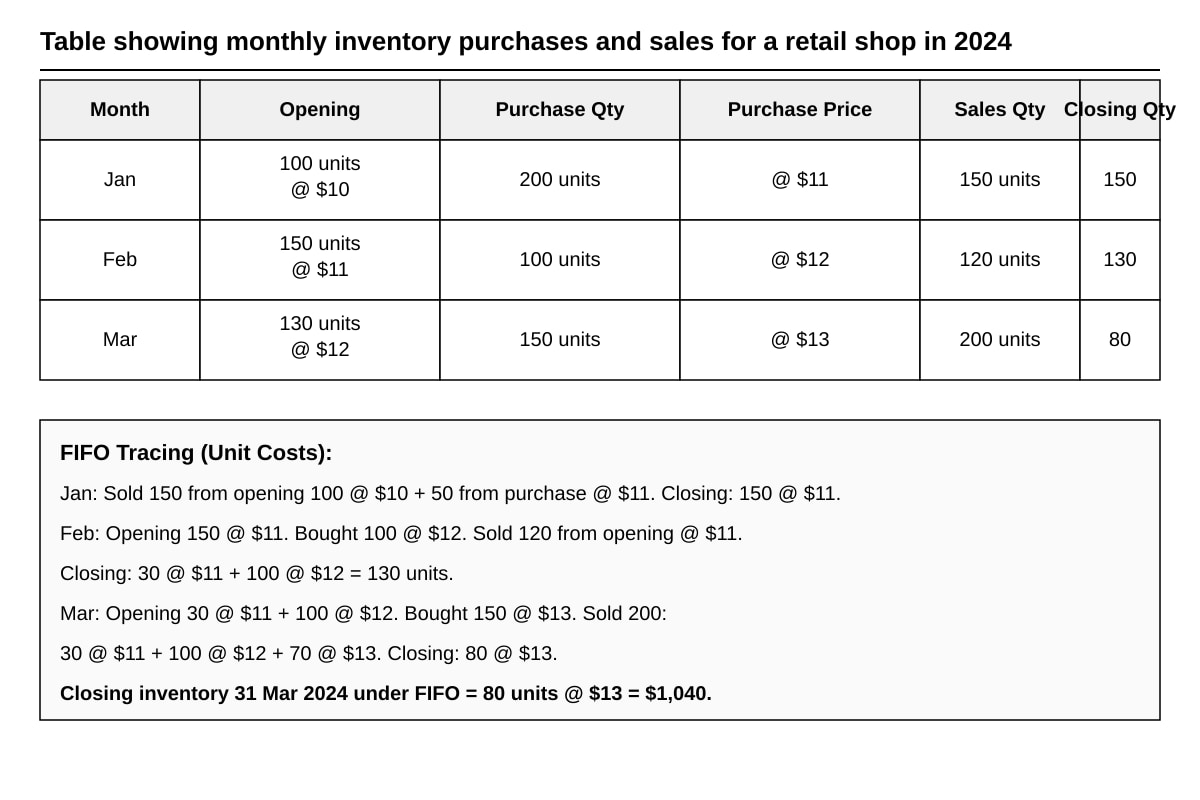
19.
Image pending generation: table for 19.
Using the table above, calculate closing inventory value at 31 March 2024 under FIFO. [2]
20. Explain why a business might prefer AVCO over FIFO for inventory costing. [2]
Answers
TuitionGoWhere Practice Paper — Answers (Version 1)
Subject: Principles of Accounts | Level: O-Level | Topic: Inventory Costing | Total Marks: 40
Section A Answers
1. [1 mark]
Answer: Prudence concept (or lower of cost and net realisable value rule).
Teaching note: Inventory must not be overstated. Prudence means recognizing losses early; we value stock at lower of cost or NRV.
2. [1 mark]
Cost of sales = Opening + Purchases − Closing = 3,000+12,000 − 4,000=∗∗11,000**.
Working: 15000 − 4000 = 11000.
3. [1 mark]
Units sold = 50 + 150 − 30 = 170 units.
Concept: Units available (200) less closing (30) = sold.
4. [2 marks]
Answer: Inventory is valued at lower of cost and net realisable value (NRV) per prudence concept. [1] This prevents overstatement of assets and profit if market value falls below cost. [1]
Marking: 1 for concept, 1 for explanation.
5. [1 mark]
Ending inventory = 200 × 8=∗∗1,600** (damaged $0, consignment excluded).
Note: Consignment goods owned by others are not ours.
6. [2 marks]
FIFO: First-in-first-out; oldest costs issued first. [1]
AVCO: Weighted average cost recalculated after each purchase. [1]
7. [1 mark]
Cost of sales = 5,000+20,000 − 6,000=∗∗19,000**. Sales price irrelevant.
Section B Answers
8. [3 marks]
Inventory Account (T):
Dr Inventory Cr
Apr 1 Balance b/d 100 @ $10 = $1,000
Apr Purchases 200 @ $12 = $2,400
Cost of sales $3,300
Apr 30 Balance c/d $100 (10 units)
Closing = 300 − 250 = 50 units; 50 × 10?Actuallyavgnotusedperiodic:FIFOremainingfromlatest:50×12 = 600.ButT−accounttotalcost:3400−3300=100?Correction:units100+200=300;sold250;left50.Cost:ifFIFO,50from12 = 600.ShowBalancec/d600. [3 for correct layout, balances, c/d]
9. [6 marks total]
(a) FIFO [3]: Closing 150 units = 100@14+50@12 = 1,400+600 = **2,000∗∗.(b)AVCO[3]:Totalcost=100×10+200×12+100×14=5800;units400;avg=14.50; closing 150×14.50 = $2,175.
Marks: 3 each method with workings.
10. [2 marks]
COGS FIFO = (100×10)+(200×12)+(50×14) issued 250? Sold: 150+100=250 from oldest: 100@10=1000, 150@12=1800, total $2,800. [2]
11. [1 mark]
FIFO gives higher profit in rising prices because older lower costs matched to sales. [1]
12. [2 marks]
Units: 80+120−150+50=100 left. Total cost = 400+720+350=1470? Wait 50@7=350; prior 80@5=400, 120@6=720, total 1520; avg=1520/250=6.08; closing 100×6.08=$608. [2]
13. [2 marks]
Avg inv = (7000+8000)/2 = 7500. Turnover = 73000/7500 = 9.7333. Days = 365/9.7333 = 37.50 days. [2]
14. [2 marks]
2023: 73000/7500 = 9.73 times. 2024: avg=(8000+10000)/2=9000; 80000/9000 = 8.89 times. [1+1]
Section C Answers
15. [2 marks]
2023: 480000/80000 = 6.0 times; 2024: 540000/108000 = 5.0 times. [1+1]
16. [2 marks]
Turnover fell from 6.0 to 5.0, meaning slower sales, more holding, possible overstock. [2]
17. [2 marks]
- Just-in-time ordering to cut excess. 2) Clear slow movers via discounts. [1 each]
18. [2 marks]
FIFO gives higher profit (9,000>8,400) in rising prices because cheaper old costs in COGS. [2]
19. [2 marks]
From table: Mar closing 80 units (130+150−200). FIFO: 80 from Mar buy @13=∗∗1,040**. [2]
20. [2 marks]
AVCO smooths price fluctuations, easier matching, less tax volatility. [2]
Free quiz and exam paper access
Enter your details to view this paper
Your access is remembered on this device.