AI Generated Quiz
A Level H2 Physics Waves Sound Light Quiz
Free A Level H2 Physics Waves Sound Light quiz, LongCat AI version, with questions, answers, and A Level-style practice for Singapore students.
These static practice materials are generated from the site's syllabus and paper-generation workflow, with source and model context shown so students and parents can evaluate the material before use.
Questions
Free quiz and exam paper access
Enter your details to view this paper
Your access is remembered on this device.
Answers
A-Level Physics H2 Quiz - Waves Sound Light
Answer Key and Marking Scheme
Section A: Multiple Choice [10 marks]
1. A [1]
Explanation: In a transverse wave, the particles oscillate perpendicular to the direction of energy transfer. This is the defining characteristic of a transverse wave. Sound waves in air are longitudinal (particles oscillate parallel to energy transfer), but the question refers to a wave on a string, which is transverse.
2. B [1]
Explanation: The general wave equation is . Comparing with , we have rad s. Since , we get Hz.
Common mistake: Students may confuse with and select 8 Hz.
3. B [1]
Explanation: Destructive interference occurs when the path difference is a half-integer multiple of the wavelength: where . Here, , so , which gives a dark fringe.
4. A [1]
Explanation: Grating spacing mm m. Using for :
5. B [1]
Explanation: For a stable (stationary) interference pattern, the two sources must be coherent — they must have the same frequency and maintain a constant phase difference. Equal amplitude is not strictly necessary (it only affects the contrast of the pattern), and the waves do not need to travel in opposite directions.
6. B [1]
Explanation: For a pipe open at both ends, the fundamental has .
, so m m.
Common mistake: Using (which applies to a closed pipe) gives 0.33 m (option A).
7. C [1]
Explanation: , so m nm. This is in the visible spectrum (orange-red light).
8. C [1]
Explanation: In a standing wave, the distance between two adjacent nodes is . Given this distance is 0.40 m:
m, so m.
9. C [1]
Explanation: When a wave crosses a boundary between two media, the frequency is determined by the source and remains unchanged. The speed and wavelength both change (since ). Amplitude may also change due to partial reflection/transmission.
10. C [1]
Explanation: Polarisation occurs when the oscillation of a wave is restricted to a single plane. This is only possible for transverse waves, where the oscillation direction can be selected. Longitudinal waves oscillate along the direction of propagation and cannot be polarised.
Section B: Structured Questions [30 marks]
11. (a) Displacement of a wave is the distance and direction of a particle from its equilibrium (mean) position at a given instant. [1]
Note: Direction must be mentioned for full credit.
(b) Amplitude of a wave is the maximum displacement of a particle from its equilibrium position. [1]
Note: "Maximum displacement" is the key phrase.
(c) [1]
Note: Accept equivalent forms such as wave speed = frequency × wavelength.
(d) Using : [2]
m s
[1] for correct formula, [1] for correct answer with unit.
12. (a) The principle of superposition states that when two or more waves meet at a point, the resultant displacement at that point is the vector sum of the individual displacements due to each wave. [2]
Marking: [1] for "when two/more waves overlap/meet", [1] for "resultant displacement is the sum of individual displacements".
(b) The path difference is . [1]
Since the path difference is a half-integer multiple of , destructive interference occurs. [1]
Note: The waves arrive out of phase (phase difference = radians), so they cancel.
13. (a) Using the double-slit formula : [3]
m mm
[1] for correct formula, [1] for correct substitution, [1] for correct answer with unit.
(b) The fringe spacing increases. [1]
Since and , the fringe spacing is proportional to wavelength, so it increases when red light is used. [1]
Note: Red light has a longer wavelength than green light.
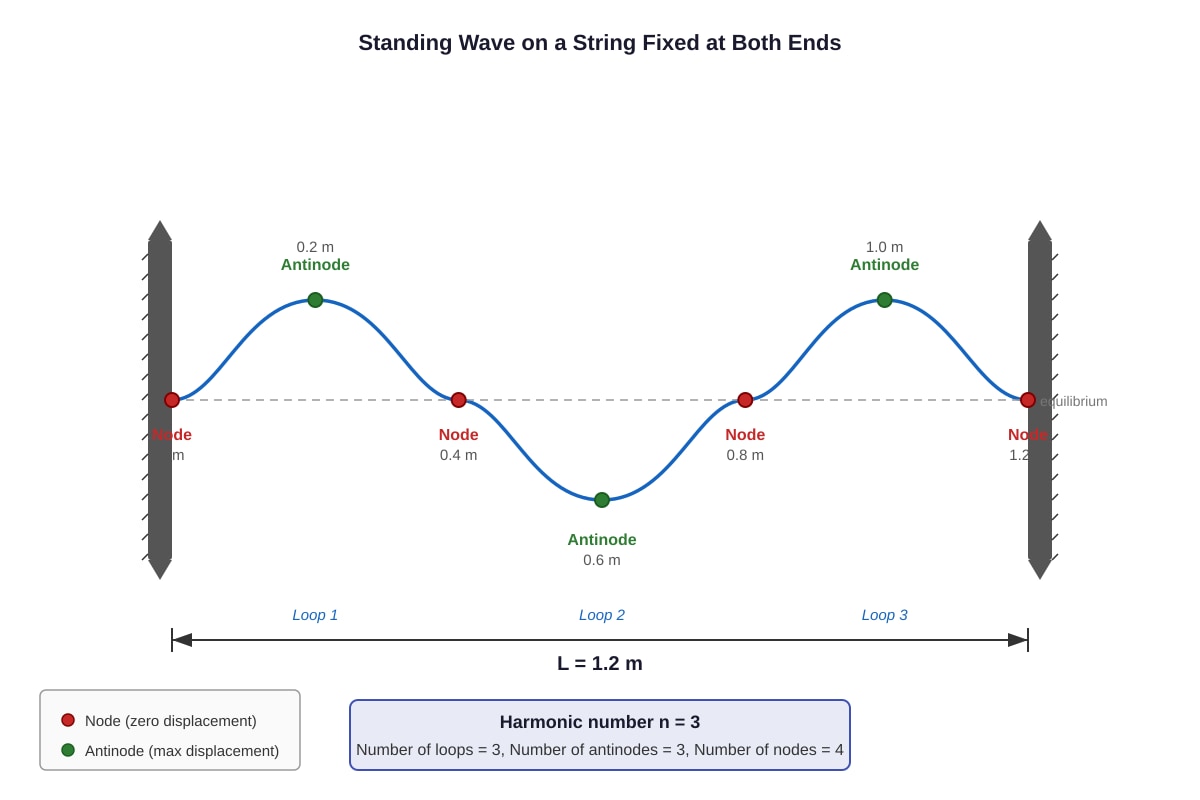
14. (a) The diagram shows 3 loops, which corresponds to the third harmonic (). [1]
(b) For a string fixed at both ends, where : [2]
m
[1] for correct relationship, [1] for correct answer.
(c) Using : [2]
m s
[1] for correct formula/substitution, [1] for correct answer with unit.
15. (a) Diffraction is the spreading out of waves when they pass through a gap or around an obstacle. [1]
The effect is most noticeable when the size of the gap or obstacle is comparable to the wavelength of the wave. [1]
Note: Both the definition and the condition for significant diffraction are required.
(b) (i) For the first minimum in single-slit diffraction: [2]
[1] for correct formula and substitution, [1] for correct answer.
(ii) Linear distance: (small angle) [2]
m mm
[1] for correct method, [1] for correct answer with unit.
16. (a) Any two of the following: [2]
- In a transverse wave, particles oscillate perpendicular to the direction of wave travel; in a longitudinal wave, particles oscillate parallel to the direction of wave travel. [1]
- Transverse waves can be polarised; longitudinal waves cannot. [1]
- Transverse waves have crests and troughs; longitudinal waves have compressions and rarefactions. [1]
[1] each, any two valid differences.
(b) Polarisation occurs when the oscillations of a wave are restricted to a single plane. [1]
This phenomenon is only possible for transverse waves, because only transverse waves have oscillation directions that can be selected or filtered. [1]
Since light can be polarised (e.g. using a Polaroid filter), this demonstrates that light is a transverse wave. [1]
Note: Longitudinal waves cannot be polarised because their oscillation is always along the direction of propagation.
17. (a) Using : [2]
m
[1] for correct formula/substitution, [1] for correct answer with unit.
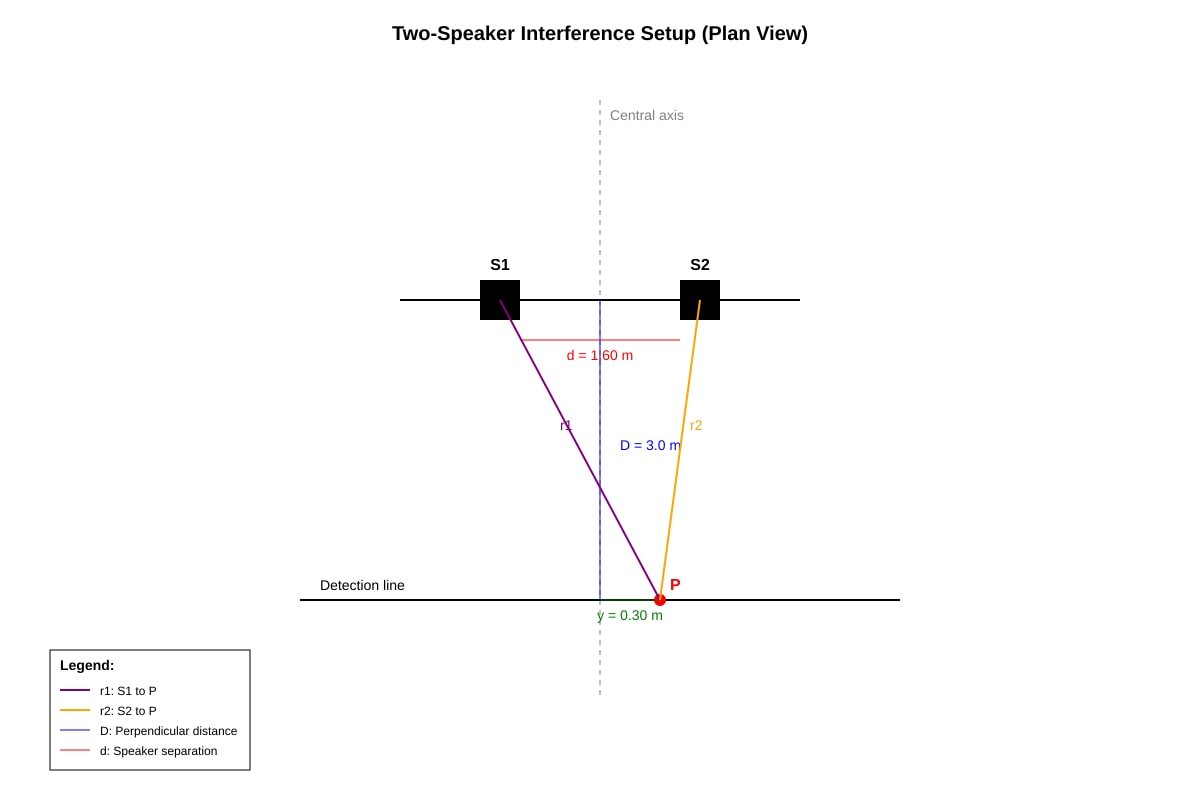
(b) (i) Using Pythagoras' theorem: [3]
m
m
Path difference m m
[1] for correct calculation of , [1] for correct calculation of , [1] for correct path difference.
Note: The distances from each speaker to point P are calculated using the geometry of the setup. S1 is 0.50 m from the central axis on one side, S2 is 1.10 m from the central axis on the other side (since speakers are 1.60 m apart, the midpoint is at 0.80 m from each speaker, so S1 is at 0.80 − 0.30 = 0.50 m and S2 is at 0.80 + 0.30 = 1.10 m from point P's perpendicular).
(ii) Order
Since this is not an integer, this is not a maximum of exact constructive interference. However, the question states the first loud sound is detected, so we interpret this as the first maximum near the centre. The path difference of 0.15 m corresponds to approximately , which is closest to the zeroth order (central maximum at 0 path difference). Given the context of "first loud sound" away from centre, the order is (central maximum) or the question may intend the nearest integer order.
Re-evaluation: If the first loud sound away from centre is detected, and path difference = 0.15 m = 0.375λ, this does not correspond to a perfect integer order. The question likely expects: order = path difference / λ = 0.15/0.40 ≈ 0.4, which rounds to order 0 (the central maximum is the zeroth order).
Answer: [1]
Note: If the path difference were exactly (0.40 m), it would be first order. The value 0.15 m suggests this is a point near the central maximum.
Section C: Data and Application Questions [20 marks]
18. (a) In a pipe closed at one end: [3]
- The closed end must be a node (zero displacement, as the air cannot move at the closed end). [1]
- The open end must be an antinode (maximum displacement, as the air is free to move). [1]
- The simplest standing wave pattern has a node at the closed end and an antinode at the open end, giving . The next possible pattern adds half a wavelength, giving , then , etc. Only odd multiples of fit, so only odd harmonics () are present. [1]
(b) For the fundamental (first harmonic) of a closed pipe: [2]
m
m m
[1] for correct formula, [1] for correct answer with unit.
(c) For a closed pipe, resonant lengths are where [3]
First resonance: m (for )
Next resonance: m m (for )
This is consistent with the theory, as the next resonant length should be the first resonant length.
[1] for stating the relationship, [1] for correct calculation, [1] for confirming consistency with 0.50 m.
19. (a) , or where is a constant of proportionality. [1]
Note: The intensity of a wave is directly proportional to the square of its amplitude.
(b) If amplitude is doubled: [2]
W m
[1] for correct relationship, [1] for correct answer with unit.
(c) When two waves of the same frequency and amplitude but with a phase difference of radians (180°) are superimposed: [3]
- The waves are exactly out of phase at every point.
- By the principle of superposition, the resultant displacement at every point is the sum of the two individual displacements, which are equal in magnitude but opposite in direction.
- Therefore, destructive interference occurs everywhere, and the resultant wave has zero amplitude.
[1] for stating the waves are out of phase, [1] for applying superposition, [1] for resultant amplitude = 0.
20. (a) Using where m s: [2]
m cm
[1] for correct formula/substitution, [1] for correct answer with unit.
(b) Using the diffraction grating equation for : [3]
[1] for correct formula, [1] for correct substitution, [1] for correct answer.
Note: The first-order maximum occurs at 90°, meaning the diffracted wave travels parallel to the grating surface.
(c) If is reduced to 1.0 cm: [3]
Since cannot exceed 1, no diffraction maximum is possible for any order.
The student's claim is correct. Reducing the slit separation below the wavelength means the condition cannot be satisfied for any real angle (since ).
[1] for calculating , [1] for noting that is impossible, [1] for concluding the claim is correct.
Total: 60 marks