AI Generated Quiz
A Level H2 Physics Waves Sound Light Quiz
Free A Level H2 Physics Waves Sound Light quiz, HY3 AI version, with questions, answers, and A Level-style practice for Singapore students.
These static practice materials are generated from the site's syllabus and paper-generation workflow, with source and model context shown so students and parents can evaluate the material before use.
Questions
A-Level Physics H2 Quiz - Waves Sound Light
Name: ___________________________
Class: ___________________________
Date: ___________________________
Score: _______ / 40
Duration: 50 minutes
Total Marks: 40
Instructions:
- Answer all 20 questions.
- Section A: Short structured questions (1–8). Section B: Calculation and application (9–15). Section C: Data interpretation and extended response (16–20).
- Show all working clearly. Use SI units.
- Marks for each question are shown in brackets.
Section A: Short Structured Questions (1–8)
1. State what is meant by the term wavelength of a progressive wave. [1]
2. A sound wave of frequency 512 Hz travels in air at 340 m s−1. Calculate its wavelength. [2]
3. Explain why polarisation is evidence that light is a transverse wave. [2]
4. State the principle of superposition of waves. [1]
5. The intensity of a sound wave from a point source is I at distance r. Write the relationship between intensity and distance. [1]
6. A standing wave is formed on a string. State the meaning of a node. [1]
7. In double-slit interference, what condition must be satisfied for a bright fringe to be observed at a point? [2]
8. A diffraction grating has 500 lines per mm. State the grating spacing d in metres. [2]
Section B: Calculation and Application (9–15)
9. A wave on a string has amplitude 0.040 m and frequency 25 Hz. The wave speed is 10 m s−1. (a) Calculate the wavelength. [2] (b) Calculate the period. [1]
10. Two identical loudspeakers are placed 0.80 m apart and emit sound of frequency 680 Hz in phase. A listener is 3.0 m directly in front of one speaker. Speed of sound =340 m s−1. (a) Calculate the wavelength of the sound. [1] (b) Determine the path difference to the listener. [2] (c) State whether constructive or destructive interference occurs. [1]
11. Light of wavelength 600 nm passes through double slits separated by 0.30 mm. The screen is 2.0 m away. (a) Calculate the fringe separation Δy. [3] (b) State what happens to Δy if the screen distance is doubled. [1]
12. A diffraction grating with 1.0×10⁵ lines per metre is used to observe light of wavelength 500 nm. (a) Calculate the grating spacing d. [1] (b) Find the angle θ for the first-order maximum (n=1). [3]
13. Unpolarised light of intensity I0 passes through a polariser then an analyser at 60∘ to the polariser. (a) State the intensity after the polariser. [1] (b) Calculate the intensity after the analyser using Malus' law. [2]
14. A string fixed at both ends is 1.2 m long and vibrates in its fundamental mode. (a) State the wavelength of the standing wave. [1] (b) If the wave speed is 48 m s−1, calculate the fundamental frequency. [2]
15. A sound source emits 0.20 W uniformly. Calculate the intensity at 4.0 m from the source. [3]
Section C: Data Interpretation and Extended Response (16–20)
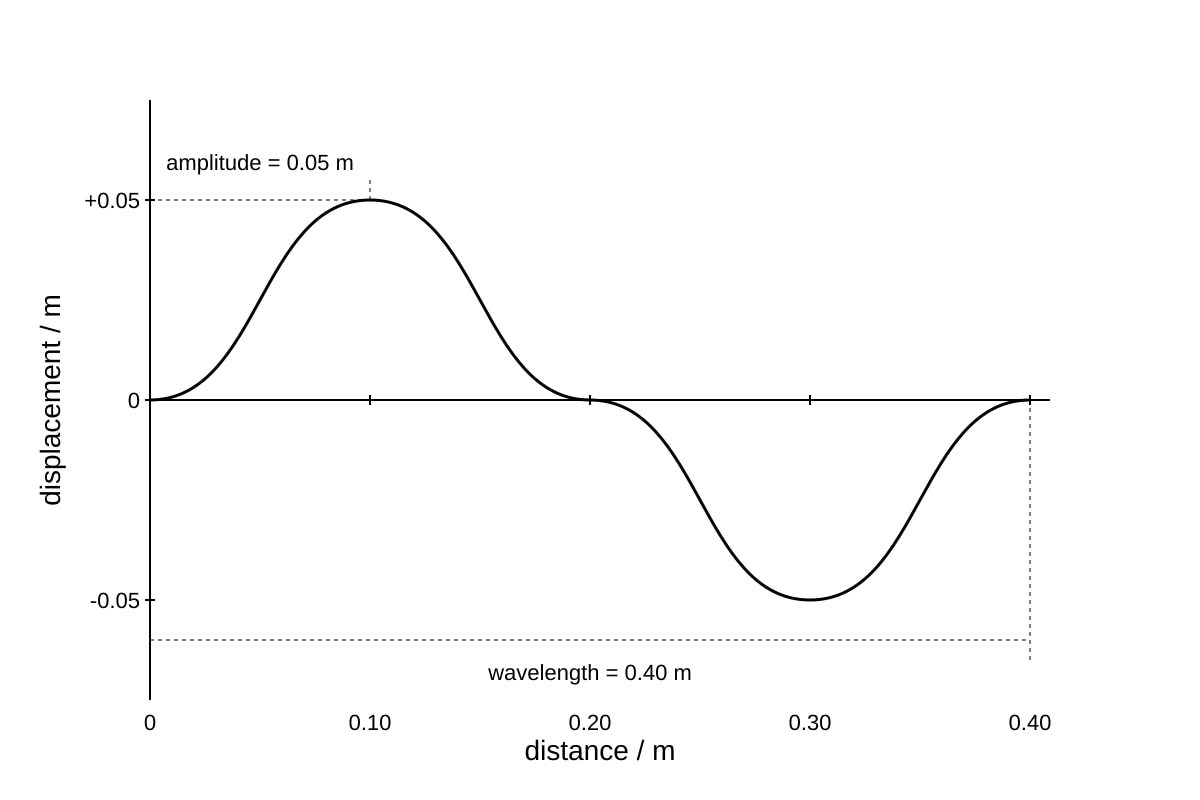
16. The diagram shows a displacement–distance graph of a transverse wave at time t=0.
Image pending generation: graph for Q16.
(a) Determine the amplitude. [1] (b) Determine the wavelength. [1] (c) If the frequency is 5.0 Hz, calculate the wave speed. [2]
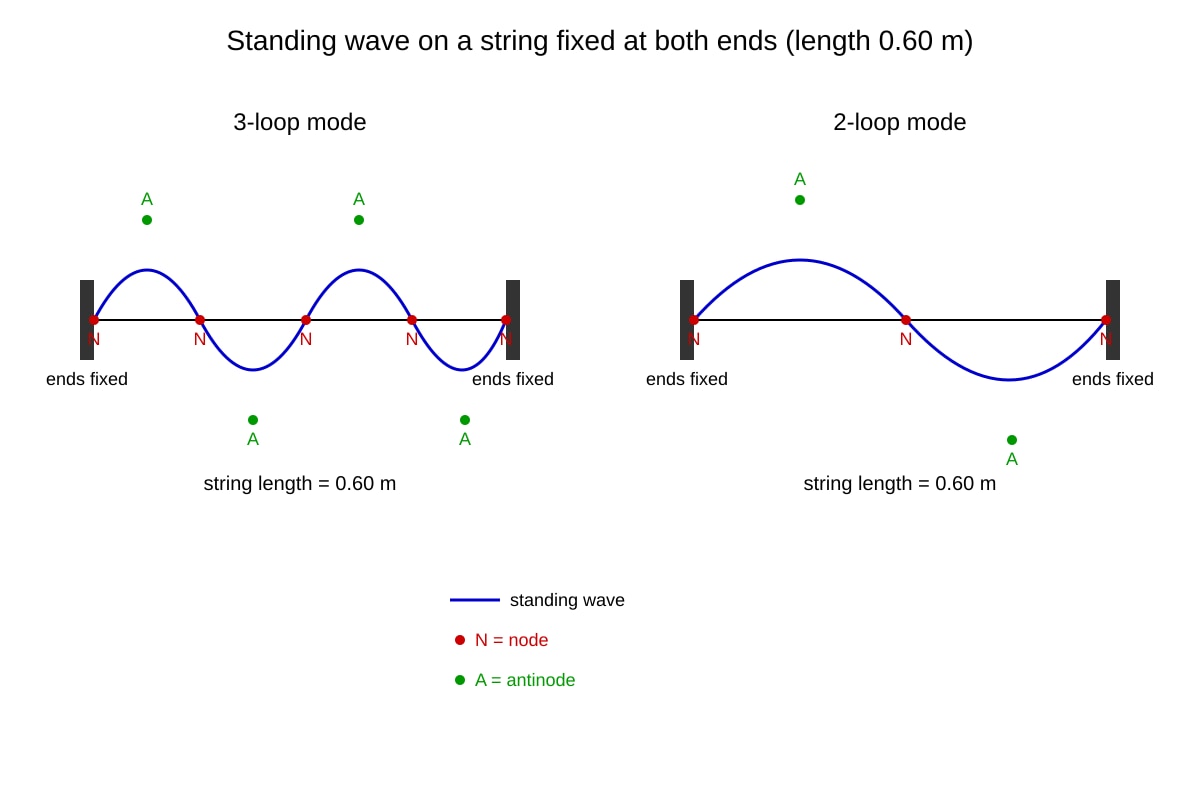
17. The figure shows a standing wave on a string at two instants.
Image pending generation: diagram for Q17.
(a) For the 3-loop mode, state the number of nodes. [1] (b) Calculate the wavelength of the 3-loop mode. [2] (c) Explain how the frequency changes when the string goes from 3-loop to 2-loop mode. [2]
18. A student places two speakers 1.0 m apart and plays a 440 Hz tone. She walks parallel to the line joining speakers at 2.0 m distance and hears maxima and minima. (a) Explain the formation of maxima using superposition. [3] (b) Calculate the fringe separation if the observation line is 2.0 m from the midpoint. [3]
19. Describe an experiment to determine the wavelength of laser light using a diffraction grating. Include procedure, measurements, and how the wavelength is found. [5]
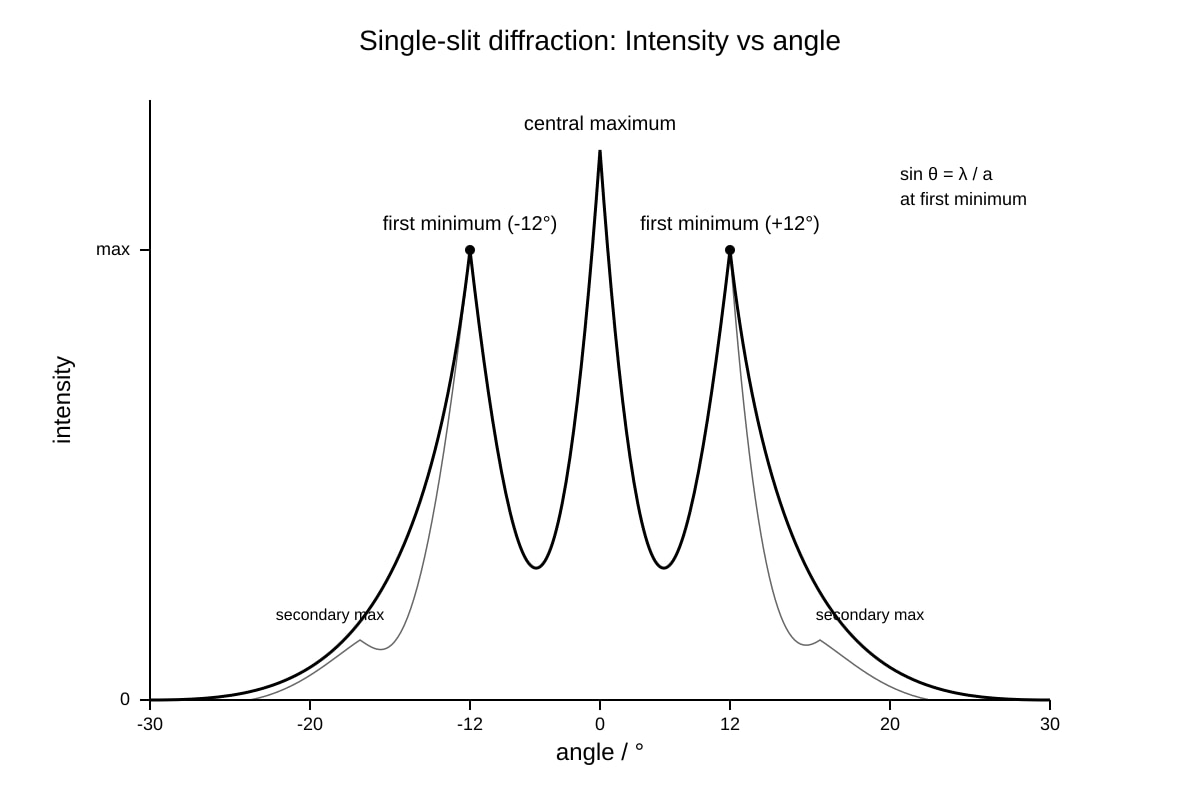
20. The graph shows intensity against diffraction angle for single-slit diffraction.
Image pending generation: graph for Q20.
(a) State the condition for the first minimum. [1] (b) If slit width is 0.050 mm and first minimum at 12∘, calculate λ. [3] (c) Explain how the pattern would change if the slit width is halved. [2]
Answers
A-Level Physics H2 Quiz - Waves Sound Light (Answer Key)
Total Marks: 40
Topic: Waves, Sound & Light (syllabus-first, AI-generated from Stage 4 templates; not claimed as past-year derived)
Section A
1. [1 mark]
Wavelength is the distance between two consecutive points in phase (e.g. two adjacent crests or compressions).
Teaching note: "In phase" means oscillating together; for a sine wave, crest-to-crest distance = one λ.
2. [2 marks]
v=fλ⇒λ=fv=512340=0.664 m (allow 0.66 m).
Marks: formula 1, substitution + answer 1.
3. [2 marks]
Polarisation is the restriction of vibration to one plane. Only transverse waves can be polarised because their oscillations are perpendicular to direction of travel; longitudinal waves vibrate along the direction of travel and cannot be plane-polarised.
Marks: transverse nature 1, explanation of why longitudinal cannot 1.
4. [1 mark]
When two or more waves meet, the resultant displacement is the vector sum of the individual displacements.
5. [1 mark]
I∝r21 (intensity inverse-square law for point source).
6. [1 mark]
A node is a point on a standing wave where displacement is always zero (no oscillation).
7. [2 marks]
Path difference =nλ (where n=0,1,2,…).
Marks: path difference condition 1, integer multiple of λ 1.
8. [2 marks]
500 lines per mm = 500×103 lines per m = 5.0×10⁵ m−1.
d=5.0×1051=2.0×10⁻⁶ m.
Marks: conversion 1, answer 1.
Section B
9. [3 marks]
(a) λ=fv=2510=0.40 m [2]
(b) T=f1=251=0.040 s [1]
10. [4 marks]
(a) λ=680340=0.50 m [1]
(b) Path to far speaker =3.02+0.802=9.64=3.104 m.
Path difference =3.104−3.0=0.104 m [2]
(c) 0.104/0.50=0.208≈ not half-integer → constructive (nearer to nλ than (n+½)λ) [1]
11. [4 marks]
(a) Δy=aλD=0.30×10−3600×10−9×2.0=4.0×10⁻³ m=4.0 mm [3]
(b) Δy doubles [1]
12. [4 marks]
(a) d=1.0×1051=1.0×10⁻⁵ m [1]
(b) dsinθ=nλ⇒sinθ=1.0×10−5500×10−9=0.0500
θ=sin−1(0.0500)=2.87∘ [3]
13. [3 marks]
(a) After polariser: I0/2 [1]
(b) I=(I0/2)cos260∘=(I0/2)(0.25)=0.125I0 [2]
14. [3 marks]
(a) Fundamental: L=λ/2⇒λ=2L=2.4 m [1]
(b) f=λv=2.448=20 Hz [2]
15. [3 marks]
I=4πr2P=4π(4.0)20.20=201.10.20=9.95×10⁻⁴ W m−2 [3]
Section C
16. [4 marks]
(a) Amplitude = 0.05 m [1]
(b) Wavelength = 0.40 m [1]
(c) v=fλ=5.0×0.40=2.0 m s−1 [2]
17. [5 marks]
(a) 3-loop mode: nodes at both ends + 2 internal = 4 nodes [1]
(b) 3 loops → L=3(λ/2)⇒λ=2L/3=1.2/3=0.40 m [2]
(c) Frequency f=v/λ; λ increases from 0.40 m (3-loop) to 0.60 m (2-loop) so frequency decreases [2]
18. [6 marks]
(a) Maxima occur where waves from two speakers arrive in phase (path difference = nλ); superposition gives larger amplitude [3]
(b) λ=340/440=0.773 m; fringe sep y≈sλD=1.00.773×2.0=1.55 m [3]
19. [5 marks]
Procedure: shine laser at grating, measure distance D to screen, mark maxima.
Measure x for order n. Use dsinθ=nλ, tanθ=x/D.
Marks: apparatus 1, measurement 1, formula 1, calculation 1, safety/accuracy 1.
20. [6 marks]
(a) asinθ=λ [1]
(b) λ=asinθ=(0.050×10⁻³)sin12∘=1.04×10⁻⁵ m=10.4 μm (accept 10 μm) [3]
(c) Halving a → θ doubles (first minimum farther out); central maximum wider [2]
Free quiz and exam paper access
Enter your details to view this paper
Your access is remembered on this device.