AI Generated Quiz
A Level H2 Physics Thermal Physics Quiz
Free A Level H2 Physics Thermal Physics quiz, LongCat AI version, with questions, answers, and A Level-style practice for Singapore students.
These static practice materials are generated from the site's syllabus and paper-generation workflow, with source and model context shown so students and parents can evaluate the material before use.
Questions
Free quiz and exam paper access
Enter your details to view this paper
Your access is remembered on this device.
Answers
A-Level Physics H2 Quiz — Thermal Physics
Answer Key and Teaching Notes
Question 1 [2 marks]
Answer: The thermodynamic (Kelvin) scale of temperature is an absolute temperature scale that is independent of the properties of any particular substance. It is defined such that the triple point of water is exactly 273.16 K, and absolute zero (0 K) is the temperature at which a system has minimum internal energy.
Teaching notes:
- The key ideas are: (1) absolute scale — no dependence on material properties, and (2) defined using a fixed reference point (triple point of water).
- Students often confuse the thermodynamic scale with the Celsius scale. Emphasise that the thermodynamic scale is absolute — it does not depend on the expansion of mercury or any thermometric property.
- Award 1 mark for stating it is independent of substance properties, and 1 mark for referencing absolute zero or the triple point definition.
Question 2 [3 marks]
Answer: Heat and temperature are not the same. Temperature is a measure of the average kinetic energy of the molecules in a substance — it determines the direction of heat flow. Heat is the transfer of thermal energy from a body at higher temperature to one at lower temperature. The internal energy of a system is the total energy (kinetic + potential) of all its molecules. A body can have high internal energy (e.g., a large volume of warm water) but low temperature, showing that heat (energy in transit) and temperature (a state property) are distinct concepts.
Teaching notes:
- Award 1 mark for clearly defining temperature, 1 mark for clearly defining heat as energy transfer, and 1 mark for linking to internal energy to show the distinction.
- A common mistake is to say "heat is the total kinetic energy" — this is wrong. Internal energy includes both kinetic and potential energy of molecules.
- Students should understand that temperature is an intensive property (independent of amount), while heat/internal energy are extensive (depend on amount).
Question 3 [4 marks]
(a) [1 mark] Answer: The principle of conservation of energy (or equivalently: heat lost by the hot object = heat gained by the cold object, since the container is perfectly insulated).
(b) [3 marks] Answer: Let the final equilibrium temperature be °C.
Heat lost by aluminium = heat gained by water
Teaching notes:
- Award 1 mark for correct equation setup (heat lost = heat gained), 1 mark for correct substitution, and 1 mark for the correct final answer.
- Common error: forgetting that the temperature change for aluminium is and for water is , not the other way round.
- Another common error: not converting units consistently (though here everything is already in SI).
Question 4 [4 marks]
Answer:
-
Specific heat capacity () is the amount of energy required to raise the temperature of 1 kg of a substance by 1 °C (or 1 K). At the molecular level, this energy increases the kinetic energy of the molecules (translational, rotational, vibrational modes), which is observed as a temperature rise. Units: J kg⁻¹ °C⁻¹ (or J kg⁻¹ K⁻¹).
-
Specific latent heat of fusion () is the amount of energy required to change 1 kg of a substance from solid to liquid at constant temperature. At the molecular level, this energy is used to break the intermolecular bonds holding the molecules in a fixed lattice arrangement, increasing the potential energy of the molecules. The kinetic energy (and hence temperature) does not change during the phase transition. Units: J kg⁻¹.
Teaching notes:
- Award 1 mark for correct definition of specific heat capacity, 1 mark for correct molecular-level explanation (kinetic energy increases), 1 mark for correct definition of specific latent heat of fusion, 1 mark for correct molecular-level explanation (potential energy increases, bonds broken, temperature constant).
- Students frequently confuse the two. Emphasise: specific heat capacity → temperature changes; latent heat → phase changes at constant temperature.
- A common error is to say latent heat "breaks chemical bonds" — it breaks intermolecular forces, not intramolecular chemical bonds.
Question 5 [5 marks]
(a) [4 marks] Answer: The process involves three stages:
Stage 1: Heating ice from −10.0 °C to 0 °C:
Stage 2: Melting ice at 0 °C:
Stage 3: Heating water from 0 °C to 30.0 °C:
Total energy:
(b) [1 mark] Answer:
Teaching notes:
- Award 1 mark for each stage (Q₁, Q₂, Q₃) correctly calculated, and 1 mark for the correct total.
- Common error: forgetting one of the three stages (most commonly forgetting to warm the ice from −10 °C to 0 °C, or forgetting the melting stage).
- For part (b), award 1 mark for correct use of with the correct total energy.
Question 6 [2 marks]
Answer: Any two of the following:
- The molecules of an ideal gas are point particles with negligible volume.
- There are no intermolecular forces between the molecules (except during collisions).
- All collisions between molecules and with the walls are perfectly elastic.
- The molecules are in continuous random motion.
- The time of collision is negligible compared to the time between collisions.
Teaching notes:
- Award 1 mark for each correct assumption, up to a maximum of 2.
- Students should know at least 3–4 assumptions. The most commonly tested are: negligible volume, no intermolecular forces, elastic collisions, random motion.
- A common error is to state "molecules don't collide" — they do collide, but collisions are elastic and instantaneous.
Question 7 [4 marks]
(a) [1 mark] Answer: Isobaric process (constant pressure).
(b) [3 marks] Answer: Using Charles's law (or the ideal gas law at constant pressure):
Teaching notes:
- Award 1 mark for correct formula, 1 mark for correct substitution (including converting to Kelvin), and 1 mark for the correct final answer in °C.
- Critical common error: using temperatures in °C instead of Kelvin. The gas laws require absolute temperature. This is one of the most frequent mistakes at A-Level.
- Another error: not converting the final answer back to °C when the question asks for it.
Question 8 [4 marks]
(a) [2 marks] Answer: Using the ideal gas equation :
(b) [2 marks] Answer: At constant volume:
Teaching notes:
- Award 1 mark for correct formula and 1 mark for correct answer in each part.
- Remind students to use J mol⁻¹ K⁻¹ (the molar gas constant) when using with in moles.
- For part (b), students could also recalculate from scratch using with the new temperature — this is equally valid.
Question 9 [3 marks]**
Answer: Since , we see that .
If the absolute temperature is doubled ():
Therefore, increases by a factor of .
Teaching notes:
- Award 1 mark for stating the proportionality , 1 mark for the correct mathematical derivation, and 1 mark for the final factor of .
- Students often mistakenly think doubling doubles . Emphasise the square-root relationship.
- This question tests understanding of the formula, not just recall.
Question 10 [4 marks]
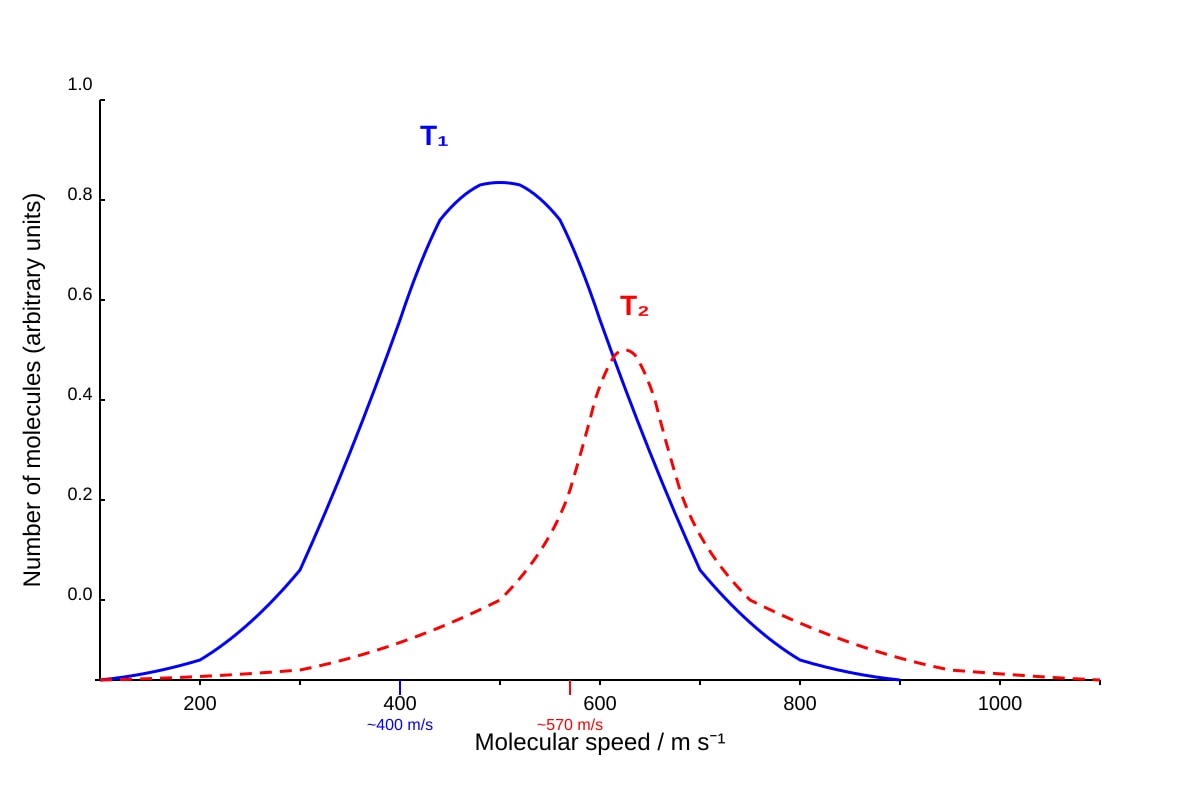
(a) [2 marks] Answer: is the higher temperature. As temperature increases, the average kinetic energy of the molecules increases, so the most probable speed increases and the peak of the distribution shifts to the right. The curve also becomes broader and flatter because the spread of speeds increases. Since the curve has its peak at a higher speed and is broader/lower, .
(b) [1 mark] Answer: The area under each curve represents the total number of molecules in the sample, which is the same for both temperatures (the gas sample is the same).
(c) [1 mark] Answer: The curve has a finite width (it is not a single vertical line), which shows that molecules have a range of speeds rather than all having the same speed.
Teaching notes:
- For (a), award 1 mark for correctly identifying as higher, and 1 mark for a correct explanation linking temperature to molecular kinetic energy and peak shift.
- Students sometimes think the taller peak corresponds to higher temperature. Emphasise: higher temperature → peak shifts right AND peak becomes lower (because the same total area is spread over a wider range).
- For (c), accept any valid observation: the curve is spread out / has a range of speeds / is not a delta function.
Question 11 [2 marks]
Answer: The first law of thermodynamics states that the increase in internal energy () of a system is equal to the heat supplied to the system () minus the work done by the system ():
Alternatively: Energy cannot be created or destroyed; it can only be transferred or converted from one form to another. In thermodynamic terms, the net energy entering a system as heat equals the increase in internal energy plus the work done by the system.
Teaching notes:
- Award 1 mark for the equation (or equivalent form), and 1 mark for a clear verbal statement.
- Students must be careful with sign conventions. In the convention used here: is heat supplied to the system, is work done by the system. Some textbooks use where is work done on the system. Both are valid if the sign convention is clearly stated.
- Award the mark for the verbal statement if the student clearly conveys conservation of energy applied to thermodynamics.
Question 12 [4 marks]
(a) [2 marks] Answer: . An adiabatic process is defined as one in which no heat is transferred into or out of the system. The compression is adiabatic, so by definition.
(b) [2 marks] Answer: Using the first law:
Here, and work is done on the gas, so J (work done by the gas is negative):
The internal energy increases by 450 J.
Teaching notes:
- For (a), award 1 mark for stating and 1 mark for explaining that this is the definition of an adiabatic process.
- For (b), award 1 mark for correct application of the first law and 1 mark for the correct numerical answer with the correct sign (increase).
- Common error: sign convention confusion. If using where is work done by the gas, then when work is done on the gas, is negative. So J.
- Another common error: saying internal energy decreases because the gas is compressed. Compression increases internal energy because work is done on the gas.
Question 13 [5 marks]
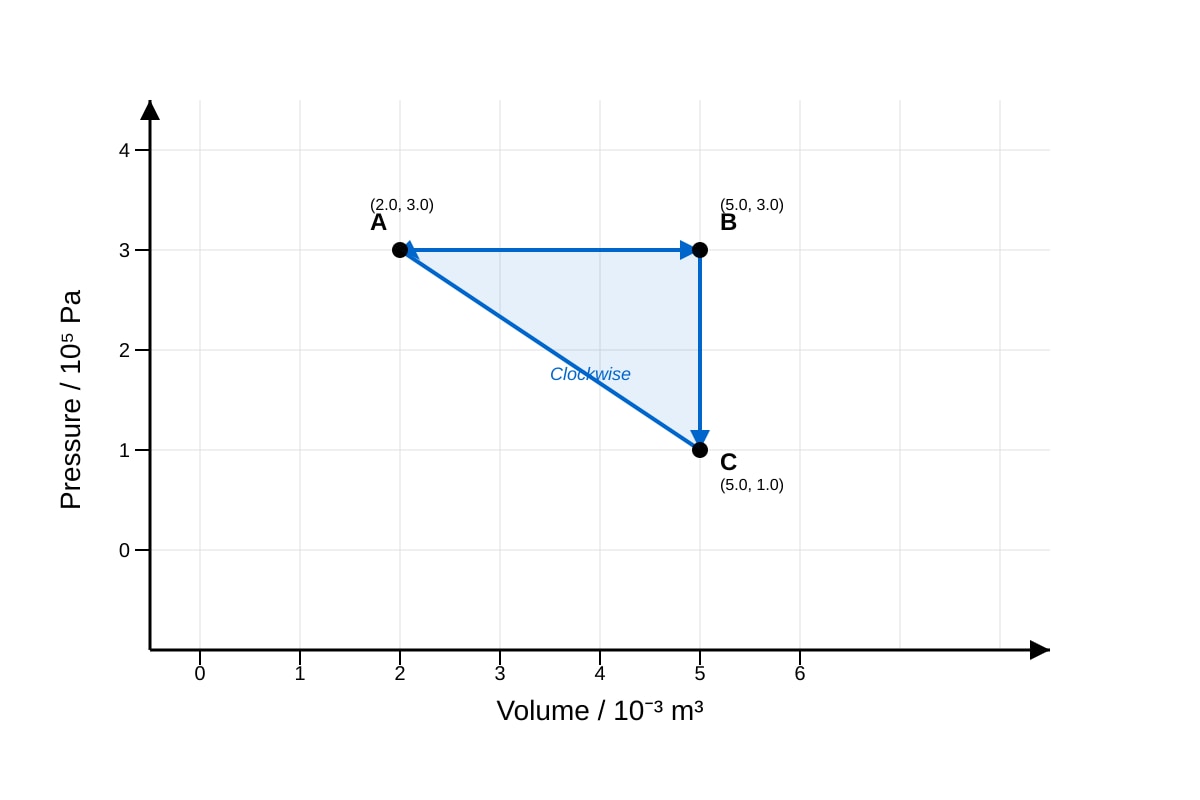
(a) [2 marks] Answer: Work done by the gas during A → B (isobaric expansion):
(b) [1 mark] Answer: The work done by the gas during B → C is zero, because the volume is constant (isochoric process). Work done = since .
(c) [2 marks] Answer: The net change in internal energy over the complete cycle is zero. Internal energy is a state function — it depends only on the state of the gas, not on the path taken. Since the gas returns to its initial state A, the net change in internal energy over the cycle is zero.
Teaching notes:
- For (a), award 1 mark for correct formula and 1 mark for correct answer.
- For (b), award 1 mark for stating zero with a valid reason (constant volume).
- For (c), award 1 mark for stating zero change and 1 mark for explaining that internal energy is a state function / the gas returns to its initial state.
- Common error in (a): using the wrong pressure or volume change. Students should read values carefully from the diagram.
- Common error in (c): thinking that because work is done, internal energy must change. Over a complete cycle, the gas returns to its initial state, so .
Question 14 [4 marks]
(a) [2 marks] Answer: At constant volume, no work is done ( since ).
From the first law:
Therefore, J (the internal energy increases by 600 J).
(b) [2 marks] Answer: Since the volume is constant, the gas does no work (). All of the thermal energy supplied (600 J) goes directly into increasing the internal energy of the gas. From the first law , with , we have J. For a monatomic ideal gas, this increase in internal energy corresponds entirely to an increase in the translational kinetic energy of the molecules, which means the temperature rises.
Teaching notes:
- For (a), award 1 mark for stating and 1 mark for J.
- For (b), award 1 mark for explaining that no work is done at constant volume, and 1 mark for linking this to the first law and explaining the physical meaning (increase in molecular kinetic energy / temperature).
- This question reinforces the key concept that at constant volume, all heat supplied goes to internal energy.
Question 15 [5 marks]
(a) [2 marks] Answer: The - diagram should show a smooth curve (a rectangular hyperbola) decreasing from left to right, representing the isothermal (constant temperature) expansion. The curve should start at and end at .
Expected sketch features:
- Axes labelled with "Volume / 10⁻³ m³" (x-axis) and "Pressure / 10⁵ Pa" (y-axis)
- A smooth decreasing curve (isotherm) from m³ to m³
- The curve should be convex, not a straight line
(b) [3 marks] Answer: For an isothermal expansion of an ideal gas, the work done by the gas is:
First, find from the initial state: J
Teaching notes:
- For (a), award 1 mark for a smooth decreasing curve and 1 mark for correct general shape (hyperbolic, not linear).
- For (b), award 1 mark for the correct formula, 1 mark for finding J, and 1 mark for the correct final answer.
- Common error: using for an isothermal process. This is wrong because pressure is not constant. The correct formula involves the natural logarithm.
- Another common error: using the average pressure. The isothermal work formula must be used.
Question 16 [4 marks]
(a) [2 marks] Answer: Energy supplied by heater: J
This energy is used to vaporise 0.042 kg of water:
(b) [1 mark] Answer: Some heat from the heater is lost to the surroundings (through the beaker walls, by convection, radiation, etc.), so not all of the electrical energy goes into vaporising the water. This means the calculated is higher than expected...
Correction: Actually, since some heat is lost to the surroundings, less energy goes into vaporising the water than the total electrical energy supplied. The student would use the total electrical energy (which is more than the energy actually used for vaporisation) in the numerator, giving a value that is higher than the accepted value.
Wait — let me reconsider. The question states the experimental value is less than the accepted value. This would happen if the mass of water evaporated is overestimated (e.g., water was already evaporating before timing started, or the beaker lost water by other means), or if the heater's actual power output is less than its rated power.
Revised answer for (b): The heater may not be operating at exactly 250 W (the actual power output may be less than the rated value), so the actual energy supplied is less than . Alternatively, some water may have evaporated before the timing started, leading to an overestimate of the mass evaporated in the measured time.
(c) [1 mark] Answer: Insulate the beaker to reduce heat losses to the surroundings. (Or: use a lid to reduce evaporative losses before timing begins. Or: measure the actual power output of the heater using a voltmeter and ammeter.)
Teaching notes:
- For (a), award 1 mark for correct energy calculation and 1 mark for correct .
- For (b), accept any valid reason that would lead to the experimental value being less than the accepted value. The key physics understanding is identifying systematic errors.
- For (c), accept any practical improvement that addresses a valid source of error.
Question 17 [5 marks]
(a) [3 marks] Answer: For a monatomic ideal gas, the internal energy is:
(b) [2 marks] Answer: Since :
Teaching notes:
- For (a), award 1 mark for the correct formula ( for monatomic gas), 1 mark for correct substitution, and 1 mark for the correct answer.
- Common error: using (this is for diatomic gases at moderate temperatures where rotational modes are active). Helium is monatomic, so only 3 translational degrees of freedom contribute.
- For (b), award 1 mark for the correct proportionality and 1 mark for the correct numerical ratio.
Question 18 [5 marks]
(a) [3 marks] Answer: More work is done on the gas in the adiabatic compression (Process Y).
On a - diagram, both processes start at the same initial state and end at the same final (smaller) volume. For an isothermal compression, , so the pressure increases gradually. For an adiabatic compression, where , so the pressure rises more steeply — the adiabatic curve lies above the isothermal curve.
The work done on the gas equals the area under the curve on the - diagram. Since the adiabatic curve is above the isothermal curve, the area under it (between the curve and the volume axis) is greater. Therefore, more work is done on the gas in the adiabatic process.
(b) [2 marks] Answer: The temperature increases in the adiabatic process (Process Y). In an adiabatic compression, no heat is exchanged (), so all the work done on the gas goes into increasing its internal energy, which means the temperature rises. In the isothermal process (Process X), the temperature remains constant by definition — any work done on the gas is balanced by heat flowing out of the gas to the surroundings.
Teaching notes:
- For (a), award 1 mark for correctly identifying Process Y (adiabatic), 1 mark for explaining that the adiabatic curve lies above the isothermal on a - diagram, and 1 mark for linking the greater area to more work done on the gas.
- For (b), award 1 mark for identifying the adiabatic process and 1 mark for a correct explanation using the first law.
- This is a challenging conceptual question. Students should practise sketching isothermal and adiabatic curves on the same - diagram.
Question 19 [4 marks]
(a) [2 marks] Answer: Carnot efficiency:
(b) [2 marks] Answer: In practice, the efficiency is less than the Carnot efficiency because:
- Real engines involve irreversible processes (friction, turbulence, rapid compression/expansion) that generate entropy.
- Heat is lost to the surroundings through conduction, convection, and radiation.
- The working substance does not behave as an ideal gas.
- The Carnot cycle assumes all processes are reversible (quasi-static), which is an idealisation that cannot be achieved in practice.
Teaching notes:
- For (a), award 1 mark for the correct formula and 1 mark for the correct answer (40% or 0.40).
- For (b), award 1 mark for each valid reason, up to 2 marks.
- Critical: temperatures must be in Kelvin. Using °C would give , which is wrong.
- Students should understand that the Carnot efficiency represents a theoretical upper limit that no real engine can exceed (Kelvin-Planck statement of the second law).
Question 20 [4 marks]
Answer: The student's claim is not always true. The statement ignores the role of heat transfer.
From the first law of thermodynamics: . When a gas expands, it does positive work (), which by itself would tend to decrease internal energy. However, if heat is simultaneously supplied to the gas (), the internal energy could remain constant or even increase, depending on the relative magnitudes of and .
Counterexample 1 — Isothermal expansion: In an isothermal expansion of an ideal gas, the temperature (and hence internal energy) remains constant (). The gas does positive work (), but exactly the same amount of heat flows into the gas from the surroundings (). So the gas expands and does work, yet its internal energy does not decrease.
Counterexample 2 — Isobaric expansion with heating: If a gas expands at constant pressure while being heated, (since and , and ), so . The internal energy actually increases despite the gas doing work.
The only case where the statement is true is in an adiabatic expansion (), where , so the internal energy does decrease.
Teaching notes:
- Award 1 mark for stating the claim is not always true, 1 mark for referencing the first law (), 1 mark for a valid counterexample (isothermal expansion), and 1 mark for explaining why the counterexample works.
- This is a high-level evaluation question. Students must demonstrate critical thinking, not just recall.
- Accept any valid counterexample. The isothermal case is the most straightforward.
End of Answer Key
Mark allocation summary: Q1(2) + Q2(3) + Q3(4) + Q4(4) + Q5(5) + Q6(2) + Q7(4) + Q8(4) + Q9(3) + Q10(4) + Q11(2) + Q12(4) + Q13(5) + Q14(4) + Q15(5) + Q16(4) + Q17(5) + Q18(5) + Q19(4) + Q20(4) = 60 marks ✓