AI Generated Quiz
A Level H2 Physics Thermal Physics Quiz
Free A Level H2 Physics Thermal Physics quiz, HY3 AI version, with questions, answers, and A Level-style practice for Singapore students.
These static practice materials are generated from the site's syllabus and paper-generation workflow, with source and model context shown so students and parents can evaluate the material before use.
Questions
A-Level Physics H2 Quiz - Thermal Physics
Name: ___________________________
Class: ___________________________
Date: ___________________________
Score: _______ / 40
Duration: 60 minutes
Total Marks: 40
Instructions: Answer all 20 questions. Show your working clearly where calculations are required. Use the data booklet values where needed: k=1.38×10⁻²³ J K−1, NA=6.02×10²³ mol−1, R=8.31 J mol−1K−1.
Section A: Temperature and Ideal Gases (Questions 1–7)
1. The thermodynamic temperature of a sample is 300 K. Convert this temperature to the Celsius scale. [1]
2. State the equation of state for an ideal gas in terms of the number of molecules N, using the Boltzmann constant k. [1]
3. A sealed container holds 2.0×10²³ molecules of an ideal gas at a pressure of 1.5×10⁵ Pa and temperature 320 K. Calculate the volume of the container. [3]
4. State two basic assumptions of the kinetic theory of gases. [2]
5. Derive the expression for the pressure p exerted by an ideal gas in terms of the mean square speed ⟨c2⟩, number density n, and mass of one molecule m. [3]
6. The mean translational kinetic energy of a gas molecule is given by 21m⟨c2⟩=23kT. Calculate the mean translational kinetic energy of a molecule at 400 K. [2]
7. A gas cylinder contains 0.50 mol of helium at 290 K. Using pV=nRT, calculate the volume if the pressure is 2.0×10⁵ Pa. [2]
Section B: Thermodynamic Systems (Questions 8–14)
8. State the zeroth law of thermodynamics. [1]
9. Define internal energy of a thermodynamic system. [2]
10. State the first law of thermodynamics using the sign convention where W is work done on the gas. [1]
11. A gas is compressed so that 120 J of work is done on it, and it loses 40 J of heat to the surroundings. Calculate the change in internal energy ΔU. [2]
12. For an ideal gas expanding at constant pressure p, the work done on the gas is W=−pΔV. A gas expands from 0.020 m3 to 0.050 m3 at 1.0×10⁵ Pa. Calculate the work done by the gas. [2]
13. Define specific heat capacity. [2]
14. A 1.2 kg block of copper (specific heat capacity 390 J kg−1K−1) is heated from 20∘C to 45∘C. Calculate the heat energy required. [2]
Section C: Data Interpretation and Synthesis (Questions 15–20)
15. The specific latent heat of vaporisation of water is 2.26×10⁶ J kg−1. Calculate the energy needed to vaporise 0.020 kg of water at 100∘C. [2]
16. A student measures the pressure and volume of a fixed mass of gas at constant temperature. The data are shown below.
| p / 105 Pa | V / 10−3 m3 |
|---|---|
| 1.0 | 4.0 |
| 2.0 | 2.0 |
| 4.0 | 1.0 |
State the relationship between p and V demonstrated, and calculate pV in Pa m3. [3]
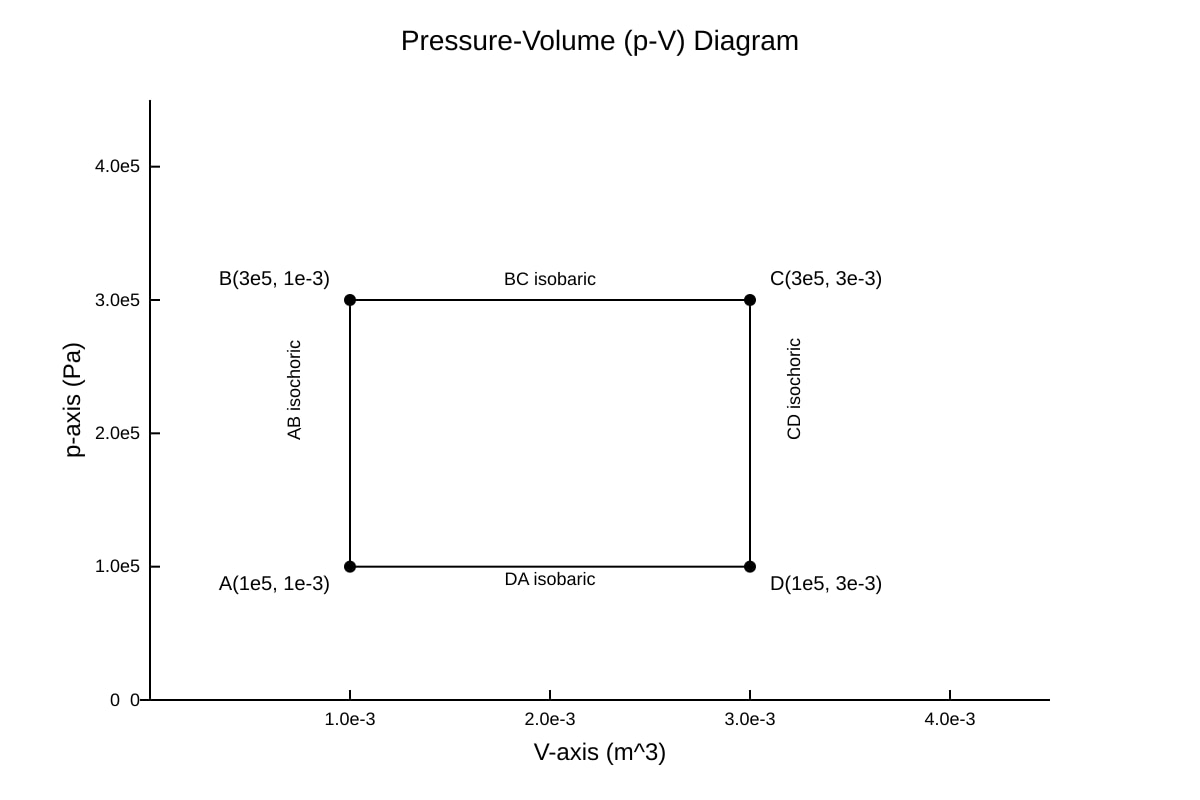
17.
Image pending generation: graph for Q17.
Using the diagram, calculate the work done on the gas during process B → C. [2]
18. Explain why the internal energy of an ideal gas depends only on its temperature. [2]
19. A refrigerator transfers 80 J of heat from its cold interior to the warmer room while 30 J of work is done on the refrigerant. Using ΔU=Q+W, calculate ΔU of the refrigerant. [2]
20. A steel component (mass 0.80 kg, specific heat capacity 460 J kg−1K−1) cools from 150∘C to 30∘C. Calculate the heat lost. [2]
Answers
A-Level Physics H2 Quiz - Thermal Physics (Answer Key)
Total Marks: 40
Topic: Thermal Physics (Syllabus 9478, Topics 12–13)
Section A: Temperature and Ideal Gases
1. [1 mark]
TC=TK−273=300−273=27∘C.
Teaching note: Thermodynamic (Kelvin) and Celsius scales differ by 273.15; at this level 273 is acceptable.
Common mistake: Adding 273 instead of subtracting.
2. [1 mark]
pV=NkT
Teaching note: N = number of molecules, k = Boltzmann constant. This is the microscopic form of the ideal gas law.
3. [3 marks]
pV=NkT⇒V=pNkT
V=1.5×10⁵(2.0×10²³)(1.38×10⁻²³)(320)
=1.5×105883.2=5.89×10⁻³ m3
Mark breakdown: 1 for rearranging, 1 for substitution, 1 for answer with unit.
Common mistake: Wrong power of ten from k.
4. [2 marks]
Any two of:
- Molecules are in continuous random motion.
- Volume of molecules negligible compared to container.
- No intermolecular forces except during elastic collisions.
- Collisions with walls and each other are perfectly elastic.
(1 mark each)
5. [3 marks]
Pressure from molecular motion: consider N molecules in volume V, number density n=N/V.
For one molecule mass m, momentum change per collision with wall = 2mcx.
Rate of collisions ∝cx/(2L); force from all molecules gives p=31nm⟨c2⟩.
Mark breakdown: 1 for momentum change, 1 for averaging/rate, 1 for final expression.
6. [2 marks]
23kT=23(1.38×10⁻²³)(400)=8.28×10⁻²¹ J.
Teaching note: Mean translational KE depends only on T.
7. [2 marks]
V=pnRT=2.0×10⁵(0.50)(8.31)(290)=6.02×10⁻³ m3.
Common mistake: Using k instead of R with moles.
Section B: Thermodynamic Systems
8. [1 mark]
If two systems are each in thermal equilibrium with a third, they are in thermal equilibrium with each other.
9. [2 marks]
Internal energy is the sum of the microscopic kinetic and potential energies of all particles in the system. (1 for kinetic, 1 for potential)
10. [1 mark]
ΔU=Q+W (where W = work done on gas).
11. [2 marks]
ΔU=Q+W=(−40)+(120)=+80 J.
Negative Q because heat lost.
12. [2 marks]
Work done by gas = pΔV=(1.0×10⁵)(0.050−0.020)=3.0×10³ J.
(Work done on gas would be −3.0×10³ J.)
13. [2 marks]
Specific heat capacity is the heat energy required to raise the temperature of 1 kg of a substance by 1 K (or 1∘C). 1 for mass ref, 1 for temp ref.
14. [2 marks]
Q=mcΔT=(1.2)(390)(45−20)=1.2×390×25=11700 J.
Section C: Data Interpretation and Synthesis
15. [2 marks]
Q=ml=(0.020)(2.26×10⁶)=4.52×10⁴ J.
16. [3 marks]
Relationship: p is inversely proportional to V at constant T (Boyle’s law).
pV values: 1.0×105×4.0×10−3=400 Pa m3; similarly all give 400 Pa m3.
Mark breakdown: 1 relation, 2 for calculation/constant.
17. [2 marks]
B→C is isobaric at p=3.0×10⁵ Pa, ΔV=3.0×10⁻³−1.0×10−3=2.0×10⁻³ m3.
Work done on gas W=−pΔV=−(3.0×10⁵)(2.0×10⁻³)=−600 J.
(Magnitude 600 J done by gas.)
18. [2 marks]
For ideal gas, intermolecular forces are negligible so potential energy is zero; internal energy is only random kinetic energy, which depends on T via 23NkT.
19. [2 marks]
Q=−80 J (heat removed from refrigerant), W=+30 J.
ΔU=−80+30=−50 J.
20. [2 marks]
Q=mcΔT=(0.80)(460)(150−30)=0.80×460×120=44160 J lost.
Free quiz and exam paper access
Enter your details to view this paper
Your access is remembered on this device.