AI Generated Quiz

A Level H2 Physics Modern Physics Quiz

Free AI-Generated Owl Alpha A Level H2 Physics Modern Physics quiz with questions and answers for Singapore students. This page is rendered as a direct URL so the questions and answers can be discovered without pressing in-page buttons.

These static practice materials are generated from the site's syllabus and paper-generation workflow, with source and model context shown so students and parents can evaluate the material before use.

A Level H2 Physics AI Generated Generated by Owl Alpha Updated 2026-06-07

Questions

<!-- TuitionGoWhere generation metadata: stage=5-1; model=openrouter/owl-alpha; model_label=Owl Alpha; generated=2026-06-06; Sources: Stage 4-0 LLM templates, syllabus context, and Stage 2 evidence where available. -->

A-Level Physics H2 Quiz - Modern Physics


Name: ___________________________
Class: ___________________________
Date: ___________________________
Score: ________ / 60

Duration: 75 minutes
Total Marks: 60


Instructions

  • Answer ALL questions.
  • Write your answers in the spaces provided.
  • Show all working clearly in calculation questions. Marks are awarded for correct method even if the final answer is incorrect.
  • The number of marks for each question or part-question is shown in brackets, e.g. [2].
  • You may use a non-programmable scientific calculator.
  • Where required, use c=3.00×10⁸c = 3.00 \times 10^8 m/s, h=6.63×1034h = 6.63 \times 10^{-34} J s, e=1.60×10¹⁹e = 1.60 \times 10^{-19} C, me=9.11×1031m_e = 9.11 \times 10^{-31} kg, mp=1.67×1027m_p = 1.67 \times 10^{-27} kg, and NA=6.02×10²³N_A = 6.02 \times 10^{23} mol1^{-1}.

Section A: Multiple Choice [20 marks]

Questions 1–10: Each question is worth 2 marks. Choose the ONE correct answer.


1. In a photoelectric experiment, monochromatic light of frequency ff is incident on a metal surface. The maximum kinetic energy of the emitted photoelectrons is KmaxK_{\max}. If the frequency of the incident light is doubled, what is the new maximum kinetic energy of the photoelectrons?

A. KmaxK_{\max}
B. 2Kmax2K_{\max}
C. Kmax+hfK_{\max} + hf
D. 2Kmax+hf2K_{\max} + hf

Answer: _____________ [2]


2. A photon has a wavelength of 450 nm. What is its energy?

A. 4.42×10194.42 \times 10^{-19} J
B. 2.84×10192.84 \times 10^{-19} J
C. 1.47×10271.47 \times 10^{-27} J
D. 8.83×10198.83 \times 10^{-19} J

Answer: _____________ [2]


3. Which of the following statements best describes the de Broglie wavelength of a particle?

A. The wavelength is directly proportional to the particle's momentum.
B. The wavelength is inversely proportional to the particle's momentum.
C. The wavelength depends only on the particle's kinetic energy.
D. The wavelength is independent of Planck's constant.

Answer: _____________ [2]


4. In the Bohr model of the hydrogen atom, an electron transitions from the n=4n = 4 energy level to the n=2n = 2 energy level. Which of the following is emitted?

A. An alpha particle
B. A photon with energy equal to E4E2E_4 - E_2
C. A photon with energy equal to E2E4E_2 - E_4
D. A neutron

Answer: _____________ [2]


5. The work function of a metal is 2.3 eV. Which of the following photon frequencies will NOT cause photoemission from this metal?

A. 6.0×10146.0 \times 10^{14} Hz
B. 8.0×10148.0 \times 10^{14} Hz
C. 5.6×10145.6 \times 10^{14} Hz
D. 1.0×10151.0 \times 10^{15} Hz

Answer: _____________ [2]


6. A radioactive sample has an initial activity of 800 Bq. After 3 half-lives, what is the activity of the sample?

A. 200 Bq
B. 100 Bq
C. 267 Bq
D. 400 Bq

Answer: _____________ [2]


7. Which nuclear equation correctly represents alpha decay of uranium-238?

A. 92238U90234Th+24He^{238}_{92}\text{U} \rightarrow ^{234}_{90}\text{Th} + ^{4}_{2}\text{He}
B. 92238U93238Np+10e^{238}_{92}\text{U} \rightarrow ^{238}_{93}\text{Np} + ^{0}_{-1}\text{e}
C. 92238U91234Pa+24He^{238}_{92}\text{U} \rightarrow ^{234}_{91}\text{Pa} + ^{4}_{2}\text{He}
D. 92238U90238Th+20He^{238}_{92}\text{U} \rightarrow ^{238}_{90}\text{Th} + ^{0}_{2}\text{He}

Answer: _____________ [2]


8. The binding energy per nucleon for 2656Fe^{56}_{26}\text{Fe} is approximately 8.8 MeV. What is the total binding energy of the nucleus?

A. 8.8 MeV
B. 492.8 MeV
C. 56 MeV
D. 26 MeV

Answer: _____________ [2]


9. In a nuclear reactor, the chain reaction is controlled by control rods. What is the primary function of these control rods?

A. To emit neutrons to sustain the chain reaction
B. To absorb excess neutrons to control the rate of fission
C. To slow down fast neutrons to thermal energies
D. To cool the reactor core

Answer: _____________ [2]


10. A sample of radioactive isotope has a decay constant of 1.2×1041.2 \times 10^{-4} s1^{-1}. What is the half-life of the sample?

A. 5.78×1035.78 \times 10^{3} s
B. 8.33×1038.33 \times 10^{3} s
C. 1.44×1041.44 \times 10^{-4} s
D. 2.40×1042.40 \times 10^{-4} s

Answer: _____________ [2]


Section B: Structured Questions [30 marks]

Answer ALL questions. Show all working.


11. (a) State Einstein's photoelectric equation. [2]


(b) Ultraviolet light of wavelength 200 nm is incident on a clean caesium surface. The work function of caesium is 2.14 eV.

    (i) Calculate the energy of each incident photon in joules. [2]


    (ii) Determine the maximum kinetic energy of the emitted photoelectrons in eV. [2]


    (iii) Calculate the maximum speed of the emitted photoelectrons. [2]


12. (a) Explain what is meant by the de Broglie wavelength of a particle. [2]


(b) Calculate the de Broglie wavelength of an electron that has been accelerated from rest through a potential difference of 150 V. [4]


13. The energy levels of a hydrogen atom are given by the equation:

En=13.6n2 eVE_n = -\frac{13.6}{n^2} \text{ eV}

where nn is the principal quantum number.

(a) Calculate the energy of the photon emitted when an electron transitions from n=3n = 3 to n=2n = 2. [2]


(b) Determine the wavelength of this photon. [2]


(c) State which region of the electromagnetic spectrum this photon belongs to. [1]


14. (a) Define the term binding energy of a nucleus. [2]


(b) The mass of a 612C^{12}_{6}\text{C} nucleus is 11.9967 u. Calculate the mass defect of this nucleus. [3]

(Given: mass of proton = 1.0073 u, mass of neutron = 1.0087 u, 1 u = 1.661×10271.661 \times 10^{-27} kg)


(c) Hence, calculate the binding energy of the 612C^{12}_{6}\text{C} nucleus in MeV. [2]

(1 u = 931.5 MeV/c2^2)


15. A sample of radioactive iodine-131 (53131I^{131}_{53}\text{I}) has a half-life of 8.0 days.

(a) Calculate the decay constant of iodine-131 in s1^{-1}. [2]


(b) A hospital receives a sample of iodine-131 with an initial activity of 4.0×1054.0 \times 10^{5} Bq. Calculate the activity of the sample after 24 days. [2]


(c) Explain why iodine-131 is suitable for medical tracer applications. [2]


Section C: Data Interpretation Question [10 marks]

Answer ALL parts.


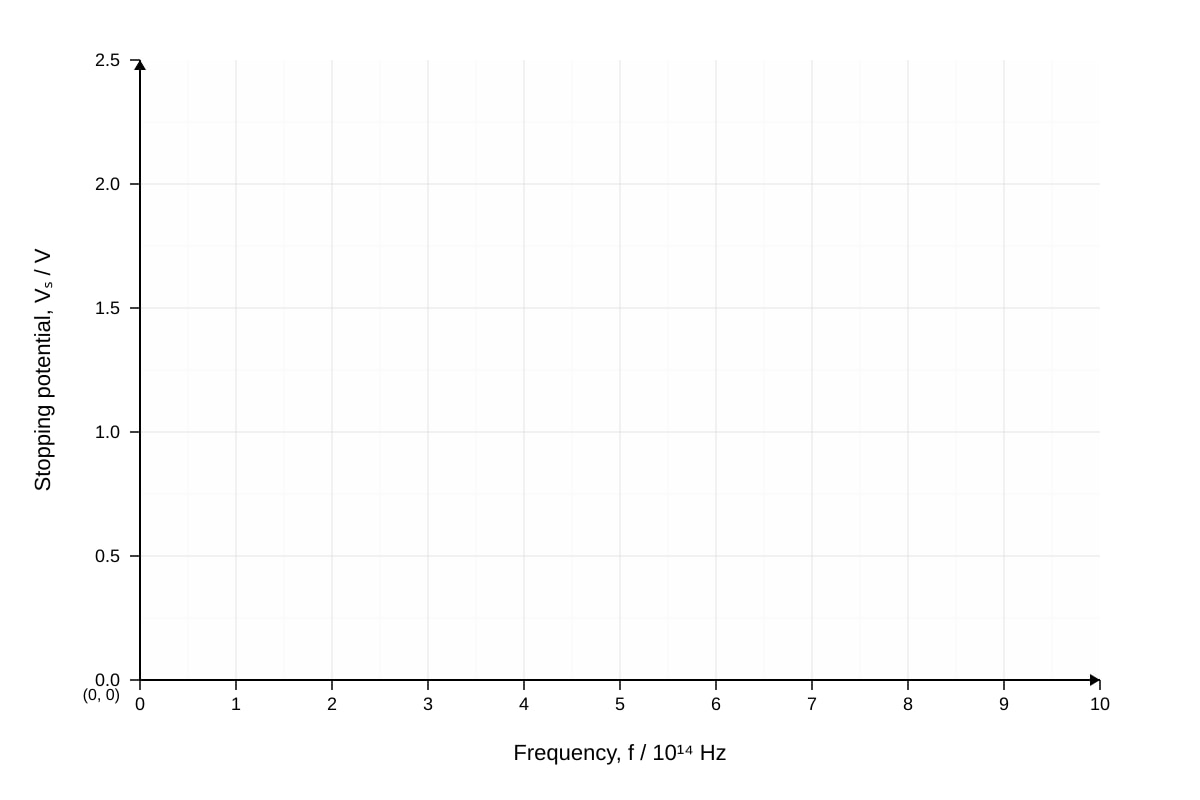
16. A student carries out a photoelectric experiment using a photocell. Light of different frequencies is incident on the metal cathode, and the stopping potential VsV_s is measured for each frequency. The results are shown in the table below.

Frequency, ff / 101410^{14} HzStopping potential, VsV_s / V
5.00.20
6.00.62
7.01.03
8.01.45
9.01.86
10.02.28

(a) Plot a graph of stopping potential VsV_s (y-axis) against frequency ff (x-axis) on the grid provided. [3]

<image_placeholder> id-Q16-fig1 type: graph linked_question: Q16 description: A blank graph grid for plotting stopping potential V_s (y-axis, range 0 to 2.5 V) against frequency f (x-axis, range 0 to 11 × 10^14 Hz). Grid should have major gridlines and be large enough for accurate plotting. labels: x-axis: "Frequency, f / 10^14 Hz", y-axis: "Stopping potential, V_s / V" values: x-axis range: 0 to 11, y-axis range: 0 to 2.5 must_show: Clearly labelled axes with units, appropriate scale, gridlines, origin near (0, 0) </image_placeholder>

(b) From your graph, determine:

    (i) the threshold frequency of the metal. [2]


    (ii) the work function of the metal in eV. [2]


(c) Using your graph, determine the value of Planck's constant. [3]


17. Read the following passage and answer the questions that follow.

In 1927, Clinton Davisson and Lester Germer fired a beam of electrons at a nickel crystal and observed a diffraction pattern. This was the first experimental confirmation of de Broglie's hypothesis that particles have wave-like properties. The electrons were accelerated through a potential difference of 54 V before striking the crystal. The spacing between the atomic planes in the nickel crystal was measured to be 0.215 nm.

(a) Calculate the de Broglie wavelength of the electrons accelerated through 54 V. [3]


(b) Using Bragg's law, nλ=2dsinθn\lambda = 2d\sin\theta, calculate the angle θ\theta at which the first-order (n=1n = 1) diffraction maximum would be observed. [2]


(c) Explain why the observation of a diffraction pattern supports the wave nature of electrons. [2]


18. The following nuclear equation represents a fission reaction:

92235U+01n56141Ba+3692Kr+301n^{235}_{92}\text{U} + ^{1}_{0}\text{n} \rightarrow ^{141}_{56}\text{Ba} + ^{92}_{36}\text{Kr} + 3\,^{1}_{0}\text{n}

(a) Verify that this equation is balanced by showing that both the nucleon number and proton number are conserved. [2]


(b) Explain why energy is released in this fission reaction. Your answer should refer to the binding energy per nucleon curve. [3]


19. (a) Describe the differences between the emission spectra of a continuous spectrum, an emission line spectrum, and an absorption line spectrum. [3]


(b) Explain how the absorption spectrum of a star can be used to determine the composition of the star's atmosphere. [2]


20. A radioactive decay series begins with 90232Th^{232}_{90}\text{Th} and ends with a stable isotope of lead, 82208Pb^{208}_{82}\text{Pb}.

(a) In the entire decay series, the thorium nucleus decays through a sequence of alpha and beta-minus decays. Show that the number of alpha decays is 6 and the number of beta-minus decays is 4. [4]


(b) Explain why alpha decay is more likely than proton emission for heavy nuclei. [2]


End of Quiz

Answers

<!-- TuitionGoWhere generation metadata: stage=5-1; model=openrouter/owl-alpha; model_label=Owl Alpha; generated=2026-06-06; Sources: Stage 4-0 LLM templates, syllabus context, and Stage 2 evidence where available. -->

A-Level Physics H2 Quiz - Modern Physics

Answer Key and Marking Scheme


Section A: Multiple Choice [20 marks]

1. Answer: C [2]

Explanation: Einstein's photoelectric equation is Kmax=hfϕK_{\max} = hf - \phi. Initially, Kmax=hfϕK_{\max} = hf - \phi. When the frequency is doubled: Kmax=h(2f)ϕ=2hfϕ=(hfϕ)+hf=Kmax+hfK'_{\max} = h(2f) - \phi = 2hf - \phi = (hf - \phi) + hf = K_{\max} + hf. So the new maximum kinetic energy is Kmax+hfK_{\max} + hf.

Common mistake: Students may choose B (2Kmax2K_{\max}), forgetting that the work function ϕ\phi does not change. The increase in KmaxK_{\max} is hfhf, not a doubling of the original KmaxK_{\max}.


2. Answer: A [2]

Explanation: Using E=hcλE = \frac{hc}{\lambda}:

E=(6.63×1034)(3.00×10⁸)450×109=1.989×10254.50×107=4.42×10¹⁹ JE = \frac{(6.63 \times 10^{-34})(3.00 \times 10^8)}{450 \times 10^{-9}} = \frac{1.989 \times 10^{-25}}{4.50 \times 10^{-7}} = 4.42 \times 10^{-19} \text{ J}

Common mistake: Forgetting to convert nm to m (i.e., not multiplying by 10910^{-9}).


3. Answer: B [2]

Explanation: The de Broglie wavelength is given by λ=hp\lambda = \frac{h}{p}, where pp is the momentum of the particle. Therefore, the wavelength is inversely proportional to the momentum. This is a fundamental concept in quantum mechanics — all matter exhibits wave-like behaviour, with the wavelength decreasing as momentum increases.


4. Answer: B [2]

Explanation: When an electron transitions from a higher energy level (n=4n = 4) to a lower energy level (n=2n = 2), it emits a photon. The energy of the photon equals the difference between the two energy levels: Ephoton=E4E2E_{\text{photon}} = E_4 - E_2. Since E4>E2E_4 > E_2 (less negative), the photon energy is positive. Alpha particles and neutrons are not emitted in electronic transitions.

Common mistake: Choosing C (E2E4E_2 - E_4), which would be negative. Photon energy must be positive.


5. Answer: C [2]

Explanation: The threshold frequency is found from ϕ=hf0\phi = hf_0:

f0=ϕh=2.3×1.60×10196.63×1034=3.68×10196.63×1034=5.55×10¹⁴ Hzf_0 = \frac{\phi}{h} = \frac{2.3 \times 1.60 \times 10^{-19}}{6.63 \times 10^{-34}} = \frac{3.68 \times 10^{-19}}{6.63 \times 10^{-34}} = 5.55 \times 10^{14} \text{ Hz}

Photoemission only occurs when f>f0f > f_0. Option C (5.6×10145.6 \times 10^{14} Hz) is very close to the threshold. Given the precision of the data, 5.6×10145.6 \times 10^{14} Hz is approximately equal to f0f_0 and at this level of precision, it would not cause photoemission (or barely would). More precisely, 5.0×10145.0 \times 10^{14} Hz is clearly below threshold. Rechecking: f0=5.55×10¹⁴f_0 = 5.55 \times 10^{14} Hz, so 5.0×10145.0 \times 10^{14} Hz is below threshold.

Corrected Answer: A (5.0×10145.0 \times 10^{14} Hz is below 5.55×10145.55 \times 10^{14} Hz)

Revised Explanation: The threshold frequency is f0=5.55×10¹⁴f_0 = 5.55 \times 10^{14} Hz. Any photon with frequency below this will NOT cause photoemission. Option A (5.0×10145.0 \times 10^{14} Hz) is below the threshold frequency, so it will not cause photoemission.

Marking note: The answer is A. Option C (5.6×10145.6 \times 10^{14} Hz) is marginally above threshold and would cause photoemission. Option A is clearly below.


6. Answer: B [2]

Explanation: After each half-life, the activity is halved. After 3 half-lives:

A=A0×(12)3=800×18=100 BqA = A_0 \times \left(\frac{1}{2}\right)^3 = 800 \times \frac{1}{8} = 100 \text{ Bq}

Common mistake: Dividing by 3 instead of halving three times (which would give ~267 Bq, option C).


7. Answer: A [2]

Explanation: In alpha decay, the parent nucleus emits an alpha particle (24^4_2He). The nucleon number decreases by 4 and the proton number decreases by 2:

92238U90234Th+24He^{238}_{92}\text{U} \rightarrow ^{234}_{90}\text{Th} + ^{4}_{2}\text{He}

Conservation check: 238=234+4238 = 234 + 4 ✓ and 92=90+292 = 90 + 2 ✓.


8. Answer: B [2]

Explanation: Total binding energy = binding energy per nucleon × number of nucleons:

EB=8.8×56=492.8 MeVE_B = 8.8 \times 56 = 492.8 \text{ MeV}

Common mistake: Confusing binding energy per nucleon with total binding energy (choosing A or C).


9. Answer: B [2]

Explanation: Control rods (made of neutron-absorbing materials such as cadmium or boron) absorb excess neutrons to control the rate of fission. By inserting or withdrawing the rods, the number of neutrons available to cause further fission events is regulated, thus controlling the chain reaction.

  • Option A describes the role of a neutron source, not control rods.
  • Option C describes the moderator.
  • Option D describes the coolant.

10. Answer: A [2]

Explanation: The relationship between half-life and decay constant is:

t1/2=ln2λ=0.6931.2×104=5.78×103 st_{1/2} = \frac{\ln 2}{\lambda} = \frac{0.693}{1.2 \times 10^{-4}} = 5.78 \times 10^{3} \text{ s}

Common mistake: Using t1/2=1λt_{1/2} = \frac{1}{\lambda} instead of ln2λ\frac{\ln 2}{\lambda}, which would give option B.


Section B: Structured Questions [30 marks]


11. (a) [2]

Answer: Einstein's photoelectric equation states that the maximum kinetic energy of a photoelectron is equal to the energy of the incident photon minus the work function of the metal:

Kmax=hfϕK_{\max} = hf - \phi

or equivalently:

hf=ϕ+Kmaxhf = \phi + K_{\max}

Marking: [1] for correct equation, [1] for defining terms or stating it as a sentence.

(b)(i) [2]

Answer:

E=hcλ=(6.63×1034)(3.00×10⁸)200×109E = \frac{hc}{\lambda} = \frac{(6.63 \times 10^{-34})(3.00 \times 10^8)}{200 \times 10^{-9}}

E=1.989×10252.00×107=9.95×10¹⁹ JE = \frac{1.989 \times 10^{-25}}{2.00 \times 10^{-7}} = 9.95 \times 10^{-19} \text{ J}

Marking: [1] for correct substitution, [1] for correct answer.

(b)(ii) [2]

Answer:

ϕ=2.14 eV=2.14×1.60×1019=3.424×10¹⁹ J\phi = 2.14 \text{ eV} = 2.14 \times 1.60 \times 10^{-19} = 3.424 \times 10^{-19} \text{ J}

Kmax=Eϕ=9.95×10193.424×1019=6.52×10¹⁹ JK_{\max} = E - \phi = 9.95 \times 10^{-19} - 3.424 \times 10^{-19} = 6.52 \times 10^{-19} \text{ J}

Converting to eV:

Kmax=6.52×10191.60×1019=4.08 eVK_{\max} = \frac{6.52 \times 10^{-19}}{1.60 \times 10^{-19}} = 4.08 \text{ eV}

Marking: [1] for correct conversion/subtraction, [1] for answer in eV.

(b)(iii) [2]

Answer:

Kmax=12mev2K_{\max} = \frac{1}{2}m_ev^2

v=2Kmaxme=2×6.52×10199.11×1031v = \sqrt{\frac{2K_{\max}}{m_e}} = \sqrt{\frac{2 \times 6.52 \times 10^{-19}}{9.11 \times 10^{-31}}}

v=1.431×1012=1.20×10⁶ m/sv = \sqrt{1.431 \times 10^{12}} = 1.20 \times 10^{6} \text{ m/s}

Marking: [1] for correct substitution, [1] for correct answer with unit.


12. (a) [2]

Answer: The de Broglie wavelength of a particle is the wavelength associated with a moving particle, given by λ=hp=hmv\lambda = \frac{h}{p} = \frac{h}{mv}, where hh is Planck's constant and pp is the momentum of the particle. It describes the wave-like behaviour of matter.

Marking: [1] for defining the concept (wave nature of matter), [1] for the correct formula.

(b) [4]

Answer:

First, find the kinetic energy of the electron after being accelerated through 150 V:

K=eV=(1.60×10¹⁹)(150)=2.40×10¹⁷ JK = eV = (1.60 \times 10^{-19})(150) = 2.40 \times 10^{-17} \text{ J}

Find the momentum:

K=p22me    p=2meKK = \frac{p^2}{2m_e} \implies p = \sqrt{2m_e K}

p=2×9.11×1031×2.40×1017p = \sqrt{2 \times 9.11 \times 10^{-31} \times 2.40 \times 10^{-17}}

p=4.373×1047=6.61×1024 kg m/sp = \sqrt{4.373 \times 10^{-47}} = 6.61 \times 10^{-24} \text{ kg m/s}

De Broglie wavelength:

λ=hp=6.63×10346.61×1024=1.00×10¹⁰ m=0.100 nm\lambda = \frac{h}{p} = \frac{6.63 \times 10^{-34}}{6.61 \times 10^{-24}} = 1.00 \times 10^{-10} \text{ m} = 0.100 \text{ nm}

Alternative (faster) method:

λ=h2meeV=6.63×10342×9.11×1031×1.60×1019×150\lambda = \frac{h}{\sqrt{2m_e eV}} = \frac{6.63 \times 10^{-34}}{\sqrt{2 \times 9.11 \times 10^{-31} \times 1.60 \times 10^{-19} \times 150}}

=6.63×10344.373×1047=6.63×10346.61×1024=1.00×10¹⁰ m= \frac{6.63 \times 10^{-34}}{\sqrt{4.373 \times 10^{-47}}} = \frac{6.63 \times 10^{-34}}{6.61 \times 10^{-24}} = 1.00 \times 10^{-10} \text{ m}

Marking: [1] for kinetic energy, [1] for momentum, [1] for de Broglie formula, [1] for correct answer with unit.


13. (a) [2]

Answer:

E3=13.632=13.69=1.511 eVE_3 = -\frac{13.6}{3^2} = -\frac{13.6}{9} = -1.511 \text{ eV}

E2=13.622=13.64=3.40 eVE_2 = -\frac{13.6}{2^2} = -\frac{13.6}{4} = -3.40 \text{ eV}

Ephoton=E3E2=1.511(3.40)=1.89 eVE_{\text{photon}} = E_3 - E_2 = -1.511 - (-3.40) = 1.89 \text{ eV}

Marking: [1] for correct energy levels, [1] for correct photon energy.

(b) [2]

Answer:

E=1.89 eV=1.89×1.60×1019=3.024×10¹⁹ JE = 1.89 \text{ eV} = 1.89 \times 1.60 \times 10^{-19} = 3.024 \times 10^{-19} \text{ J}

λ=hcE=(6.63×1034)(3.00×10⁸)3.024×1019=6.58×10⁷ m=658 nm\lambda = \frac{hc}{E} = \frac{(6.63 \times 10^{-34})(3.00 \times 10^8)}{3.024 \times 10^{-19}} = 6.58 \times 10^{-7} \text{ m} = 658 \text{ nm}

Marking: [1] for correct conversion and formula, [1] for correct answer.

(c) [1]

Answer: Visible (red light) region.

Explanation: A wavelength of 658 nm falls within the visible spectrum (approximately 400–700 nm), specifically in the red part of the spectrum. This is the well-known H-alpha line in the Balmer series.


14. (a) [2]

Answer: The binding energy of a nucleus is the minimum energy required to completely separate all the nucleons (protons and neutrons) in the nucleus. Equivalently, it is the energy equivalent of the mass defect — the difference between the total mass of the separate nucleons and the actual mass of the nucleus.

Marking: [1] for "energy to separate nucleons" or equivalent, [1] for reference to mass defect or energy equivalence.

(b) [3]

Answer:

The 612C^{12}_{6}\text{C} nucleus has 6 protons and 6 neutrons.

Total mass of separate nucleons:

mtotal=6×1.0073+6×1.0087=6.0438+6.0522=12.0960 um_{\text{total}} = 6 \times 1.0073 + 6 \times 1.0087 = 6.0438 + 6.0522 = 12.0960 \text{ u}

Mass defect:

Δm=12.096011.9967=0.0993 u\Delta m = 12.0960 - 11.9967 = 0.0993 \text{ u}

Marking: [1] for correct number of protons and neutrons, [1] for correct total mass calculation, [1] for correct mass defect.

(c) [2]

Answer:

EB=0.0993×931.5=92.50 MeVE_B = 0.0993 \times 931.5 = 92.50 \text{ MeV}

Marking: [1] for correct substitution, [1] for correct answer with unit.


15. (a) [2]

Answer:

t1/2=8.0 days=8.0×24×3600=6.912×10⁵ st_{1/2} = 8.0 \text{ days} = 8.0 \times 24 \times 3600 = 6.912 \times 10^{5} \text{ s}

λ=ln2t1/2=0.6936.912×105=1.00×106 s1\lambda = \frac{\ln 2}{t_{1/2}} = \frac{0.693}{6.912 \times 10^{5}} = 1.00 \times 10^{-6} \text{ s}^{-1}

Marking: [1] for correct conversion to seconds, [1] for correct decay constant.

(b) [2]

Answer:

24 days = 3 half-lives (since t1/2=8.0t_{1/2} = 8.0 days)

A=A0×(12)3=4.0×105×18=5.0×10⁴ BqA = A_0 \times \left(\frac{1}{2}\right)^3 = 4.0 \times 10^{5} \times \frac{1}{8} = 5.0 \times 10^{4} \text{ Bq}

Marking: [1] for identifying 3 half-lives, [1] for correct answer.

(c) [2]

Answer: Iodine-131 is suitable for medical tracer applications because:

  • It has a half-life of 8.0 days, which is long enough to allow for medical procedures and imaging but short enough to minimise prolonged radiation exposure to the patient.
  • It is a gamma (and beta) emitter, and gamma rays can be detected externally, allowing non-invasive imaging.
  • Iodine is biologically absorbed by the thyroid gland, making it particularly useful for thyroid imaging and treatment.

Marking: [1] for half-life reasoning, [1] for emission type/biological uptake reasoning.


Section C: Data Interpretation Question [10 marks]


16. (a) [3]

Answer: The graph should show:

  • Points plotted correctly: (5.0, 0.20), (6.0, 0.62), (7.0, 1.03), (8.0, 1.45), (9.0, 1.86), (10.0, 2.28)
  • A straight line of best fit through the points
  • Axes correctly labelled with units

Marking: [1] for correct scales and labelled axes, [1] for correct plotting of points, [1] for straight line of best fit.

Expected graph features: The graph is a straight line with a positive gradient. The line does NOT pass through the origin — it intersects the f-axis at the threshold frequency.

(b)(i) [2]

Answer: The threshold frequency is found by extrapolating the line to where Vs=0V_s = 0. From the data, using the two-point form or extrapolation:

Taking the first two points: gradient = 0.620.20(6.05.0)×1014=0.421.0×1014=4.2×10¹⁵\frac{0.62 - 0.20}{(6.0 - 5.0) \times 10^{14}} = \frac{0.42}{1.0 \times 10^{14}} = 4.2 \times 10^{-15} V/Hz

Using Vs=0V_s = 0 at f=f0f = f_0: 0=0.20+4.2×10¹⁵(f05.0×1014)0 = 0.20 + 4.2 \times 10^{-15}(f_0 - 5.0 \times 10^{14})

f0=5.0×10140.204.2×1014=5.0×10140.476×1014=4.52×10¹⁴f_0 = 5.0 \times 10^{14} - \frac{0.20}{4.2 \times 10^{-14}} = 5.0 \times 10^{14} - 0.476 \times 10^{14} = 4.52 \times 10^{14} Hz

Threshold frequency: f04.5×1014f_0 \approx 4.5 \times 10^{14} Hz

Marking: [1] for correct extrapolation method, [1] for answer in range 4.44.6×10144.4 - 4.6 \times 10^{14} Hz.

(b)(ii) [2]

Answer:

ϕ=hf0=(6.63×1034)(4.52×10¹⁴)=2.997×10¹⁹ J\phi = hf_0 = (6.63 \times 10^{-34})(4.52 \times 10^{14}) = 2.997 \times 10^{-19} \text{ J}

ϕ=2.997×10191.60×1019=1.87 eV\phi = \frac{2.997 \times 10^{-19}}{1.60 \times 10^{-19}} = 1.87 \text{ eV}

Work function: ϕ1.9\phi \approx 1.9 eV

Marking: [1] for correct formula, [1] for answer in range 1.8–2.0 eV.

(c) [3]

Answer: From Einstein's photoelectric equation: eVs=hfϕeV_s = hf - \phi, so Vs=hefϕeV_s = \frac{h}{e}f - \frac{\phi}{e}.

The gradient of the VsV_s vs ff graph is he\frac{h}{e}.

Using two widely separated points, e.g., (5.0, 0.20) and (10.0, 2.28):

gradient=2.280.20(10.05.0)×1014=2.085.0×1014=4.16×10¹⁵ V/Hz\text{gradient} = \frac{2.28 - 0.20}{(10.0 - 5.0) \times 10^{14}} = \frac{2.08}{5.0 \times 10^{14}} = 4.16 \times 10^{-15} \text{ V/Hz}

h=gradient×e=4.16×1015×1.60×1019=6.66×1034 J sh = \text{gradient} \times e = 4.16 \times 10^{-15} \times 1.60 \times 10^{-19} = 6.66 \times 10^{-34} \text{ J s}

Planck's constant: h6.6×1034h \approx 6.6 \times 10^{-34} J s

Marking: [1] for identifying gradient = h/eh/e, [1] for correct gradient calculation, [1] for correct value of hh.


17. (a) [3]

Answer:

Kinetic energy of electron: K=eV=(1.60×10¹⁹)(54)=8.64×10¹⁸K = eV = (1.60 \times 10^{-19})(54) = 8.64 \times 10^{-18} J

Momentum: p=2meK=2×9.11×1031×8.64×1018p = \sqrt{2m_e K} = \sqrt{2 \times 9.11 \times 10^{-31} \times 8.64 \times 10^{-18}}

p=1.574×1047=3.97×1024 kg m/sp = \sqrt{1.574 \times 10^{-47}} = 3.97 \times 10^{-24} \text{ kg m/s}

De Broglie wavelength:

λ=hp=6.63×10343.97×1024=1.67×10¹⁰ m=0.167 nm\lambda = \frac{h}{p} = \frac{6.63 \times 10^{-34}}{3.97 \times 10^{-24}} = 1.67 \times 10^{-10} \text{ m} = 0.167 \text{ nm}

Marking: [1] for kinetic energy, [1] for momentum, [1] for wavelength.

(b) [2]

Answer: Using Bragg's law with n=1n = 1:

λ=2dsinθ\lambda = 2d\sin\theta

sinθ=λ2d=1.67×10102×0.215×109=1.67×10104.30×1010=0.388\sin\theta = \frac{\lambda}{2d} = \frac{1.67 \times 10^{-10}}{2 \times 0.215 \times 10^{-9}} = \frac{1.67 \times 10^{-10}}{4.30 \times 10^{-10}} = 0.388

θ=arcsin(0.388)=22.9°\theta = \arcsin(0.388) = 22.9°

Marking: [1] for correct substitution, [1] for correct angle.

(c) [2]

Answer: Diffraction is a wave phenomenon — it occurs when a wave encounters an obstacle or aperture comparable in size to its wavelength. The observation of a diffraction pattern when electrons are fired at a crystal demonstrates that electrons exhibit wave-like behaviour. The regular spacing of atoms in the crystal acts as a diffraction grating for the electron waves, producing constructive and destructive interference at specific angles. This is direct experimental evidence supporting de Broglie's hypothesis that particles possess wave properties.

Marking: [1] for identifying diffraction as a wave phenomenon, [1] for linking to de Broglie hypothesis / wave-particle duality.


18. (a) [2]

Answer:

Nucleon number (mass number) conservation: Left side: 235+1=236235 + 1 = 236 Right side: 141+92+3(1)=141+92+3=236141 + 92 + 3(1) = 141 + 92 + 3 = 236

Proton number (atomic number) conservation: Left side: 92+0=9292 + 0 = 92 Right side: 56+36+3(0)=56+36=9256 + 36 + 3(0) = 56 + 36 = 92

Both nucleon number and proton number are conserved, so the equation is balanced.

Marking: [1] for nucleon number check, [1] for proton number check.

(b) [3]

Answer: Energy is released in this fission reaction because the binding energy per nucleon of the products (barium-141 and krypton-92) is greater than that of the reactant (uranium-235). On the binding energy per nucleon curve, uranium-235 is a heavy nucleus with a binding energy per nucleon of approximately 7.6 MeV, while the fission products lie closer to the peak of the curve (near iron-56) with binding energy per nucleon of approximately 8.3–8.5 MeV. The increase in total binding energy means that the products are more tightly bound, and the difference in binding energy is released (primarily as kinetic energy of the fission fragments and neutrons). This can also be understood in terms of mass defect: the total mass of the products is less than the total mass of the reactants, and this mass difference is converted to energy via E=Δmc2E = \Delta m c^2.

Marking: [1] for stating that products have higher binding energy per nucleon, [1] for reference to the binding energy curve / position relative to iron peak, [1] for explaining energy release via mass defect or E=Δmc2E = \Delta mc^2.


19. (a) [3]

Answer:

  • Continuous spectrum: Produced by hot, dense objects (e.g., incandescent filament, hot metal). It contains all wavelengths across a continuous range with no gaps — the colours merge smoothly from red to violet.

  • Emission line spectrum: Produced by excited low-density gases (e.g., gas discharge tubes). It consists of discrete, bright lines at specific wavelengths against a dark background. Each element has a unique set of emission lines corresponding to electronic transitions between energy levels.

  • Absorption line spectrum: Produced when white light passes through a cooler low-density gas. It appears as a continuous dark background with dark lines at specific wavelengths. The dark lines correspond to wavelengths absorbed by the gas atoms, and they occur at exactly the same wavelengths as the emission lines of that element.

Marking: [1] for each correct description.

(b) [2]

Answer: When light from a star's hot interior passes through the cooler outer atmosphere, atoms in the atmosphere absorb photons at specific wavelengths corresponding to their electronic transitions. This produces an absorption line spectrum. By comparing the wavelengths of the dark absorption lines with known emission spectra of elements (obtained in laboratory experiments), the chemical composition of the star's atmosphere can be identified. Each element produces a unique pattern of absorption lines, acting as a "fingerprint" for that element.

Marking: [1] for explaining absorption by atmospheric atoms, [1] for comparing with known spectra to identify elements.


20. (a) [4]

Answer:

Let the number of alpha decays be xx and the number of beta-minus decays be yy.

Each alpha decay: AA decreases by 4, ZZ decreases by 2. Each beta-minus decay: AA unchanged, ZZ increases by 1.

Conservation of nucleon number (A):

2324x=208232 - 4x = 208

4x=244x = 24

x=6x = 6

Conservation of proton number (Z):

902x+y=8290 - 2x + y = 82

902(6)+y=8290 - 2(6) + y = 82

9012+y=8290 - 12 + y = 82

y=8278=4y = 82 - 78 = 4

Therefore: 6 alpha decays and 4 beta-minus decays.

Verification:

  • Nucleon number: 2326(4)=23224=208232 - 6(4) = 232 - 24 = 208
  • Proton number: 906(2)+4(1)=9012+4=8290 - 6(2) + 4(1) = 90 - 12 + 4 = 82

Marking: [1] for setting up nucleon number equation, [1] for x=6x = 6, [1] for setting up proton number equation, [1] for y=4y = 4.

(b) [2]

Answer: Alpha decay is more likely than proton emission for heavy nuclei because:

  • The alpha particle (24^4_2He) is an exceptionally stable nucleus with a very high binding energy per nucleon for its size (7.1 MeV/nucleon). This means it can easily form inside the nucleus as a pre-formed cluster.
  • The Coulomb barrier for alpha emission, while significant, is lower than for proton emission in terms of the energy balance (Q-value) because the alpha particle carries away more binding energy, making the decay energetically more favourable.
  • Proton emission requires overcoming the Coulomb barrier for a single proton, and for most heavy nuclei, the separation energy for a single proton is positive (i.e., it costs energy), making proton emission energetically forbidden. Alpha decay, by contrast, releases energy (positive Q-value) for most heavy nuclei.

Marking: [1] for alpha particle stability/pre-formation argument, [1] for energy/Coulomb barrier reasoning.


Total: 60 marks