AI Generated Quiz
A Level H2 Physics Modern Physics Quiz
Free A Level H2 Physics Modern Physics quiz, HY3 AI version, with questions, answers, and A Level-style practice for Singapore students.
These static practice materials are generated from the site's syllabus and paper-generation workflow, with source and model context shown so students and parents can evaluate the material before use.
Questions
A-Level Physics H2 Quiz - Modern Physics
Name: ___________________________
Class: ___________________________
Date: ___________________________
Score: _______ / 40
Duration: 50 minutes
Total Marks: 40
Instructions:
- Answer all 20 questions.
- Show your working clearly where calculations are required.
- Use the data booklet values where needed: h=6.63×10⁻³⁴ J s, c=3.00×10⁸ m s−1, e=1.60×10⁻¹⁹ C, me=9.11×10⁻³¹ kg, u=1.66×10⁻²⁷ kg.
- This quiz is syllabus-first practice content generated from LLM-inferred templates; it is not derived from official past-year papers.
Section A: Photons and Matter Waves (Questions 1–5)
1. A metal surface has a work function of 2.10 eV. Light of frequency 9.00×10¹⁴ Hz is incident on it. Calculate the maximum kinetic energy, in eV, of the emitted photoelectrons. [3]
2. State the de Broglie wavelength equation and define each symbol. [2]
3. An electron is accelerated through a potential difference of 150 V. Calculate its de Broglie wavelength in nm. [3]
4. Explain why the photoelectric effect cannot be explained by a purely wave model of light. [2]
5. A photon has energy 3.98×10⁻¹⁹ J. Determine its wavelength in nm. [2]
Section B: Nuclear Physics and Radioactivity (Questions 6–10)
6. Write the balanced nuclear equation for the alpha decay of 92238U. [2]
7. The half-life of a radioactive isotope is 12.0 h. A sample initially contains 4.80×10²⁰ nuclei. Calculate the number of nuclei remaining after 36.0 h. [2]
8. Define binding energy of a nucleus. [1]
9. Calculate the mass defect of 24He given: mass of 24He=4.00260 u, mass of proton =1.00728 u, mass of neutron =1.00867 u. [3]
10. A radioactive source emits β− particles. State the change in the nucleus during β− decay. [1]
Section C: Quantum and Wave-Particle Duality (Questions 11–15)
11. In an electron diffraction experiment, electrons of momentum p produce a first-order maximum at angle θ using a crystal spacing d. State the condition for the first maximum. [1]
12. A laser of wavelength 632 nm is directed at a double slit of separation 0.200 mm. The screen is 1.50 m away. Calculate the fringe separation. [3]
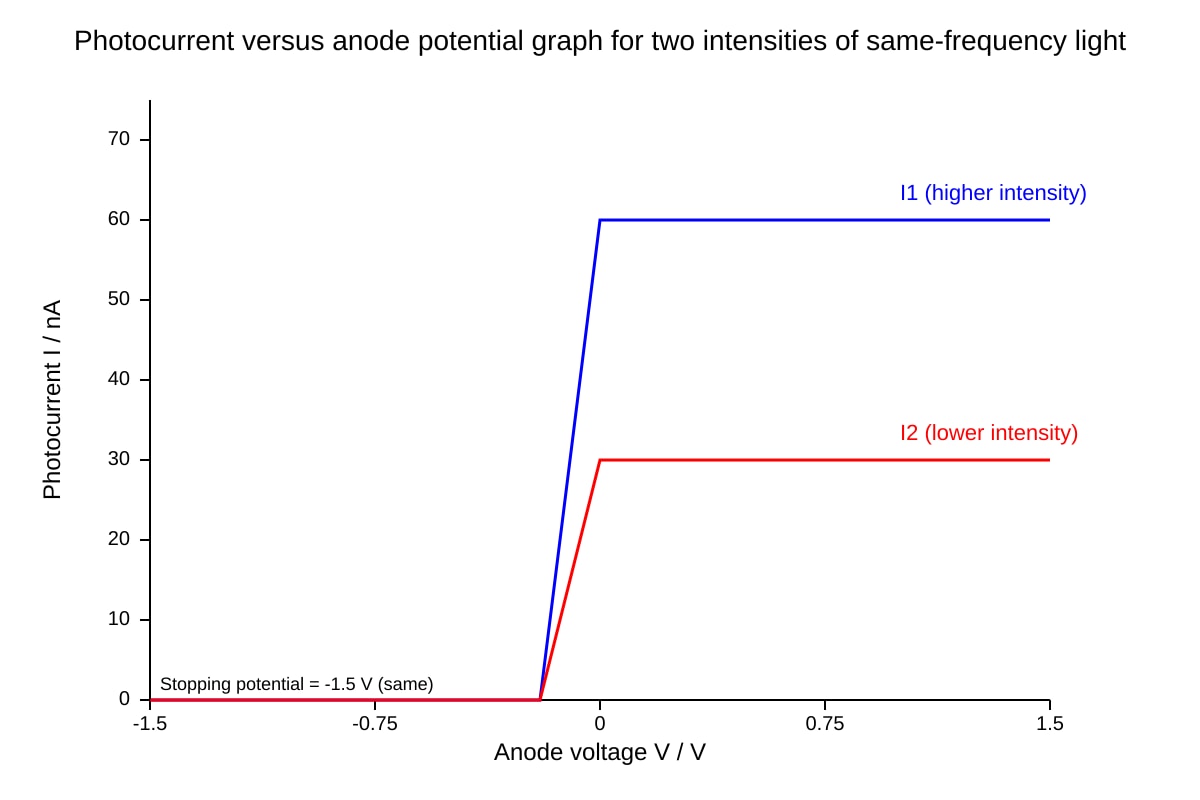
13. The graph below shows photocurrent against anode voltage for two light intensities.
Image pending generation: graph for Q13.
State what the graph shows about the effect of light intensity on stopping potential and saturation current. [2]
14. Calculate the energy, in MeV, equivalent to a mass defect of 0.00850 u. [2]
15. Explain how the existence of a threshold frequency in the photoelectric effect supports a particle model of light. [2]
Section D: Mixed Modern Physics (Questions 16–20)
16. A nucleus 714N captures a neutron and emits a proton. Write the resulting nuclide equation. [2]
17. The activity of a sample falls from 800 Bq to 100 Bq in 30 s. Calculate the decay constant λ in s−1. [3]
18. An X-ray photon has wavelength 0.100 nm. Calculate its momentum. [2]
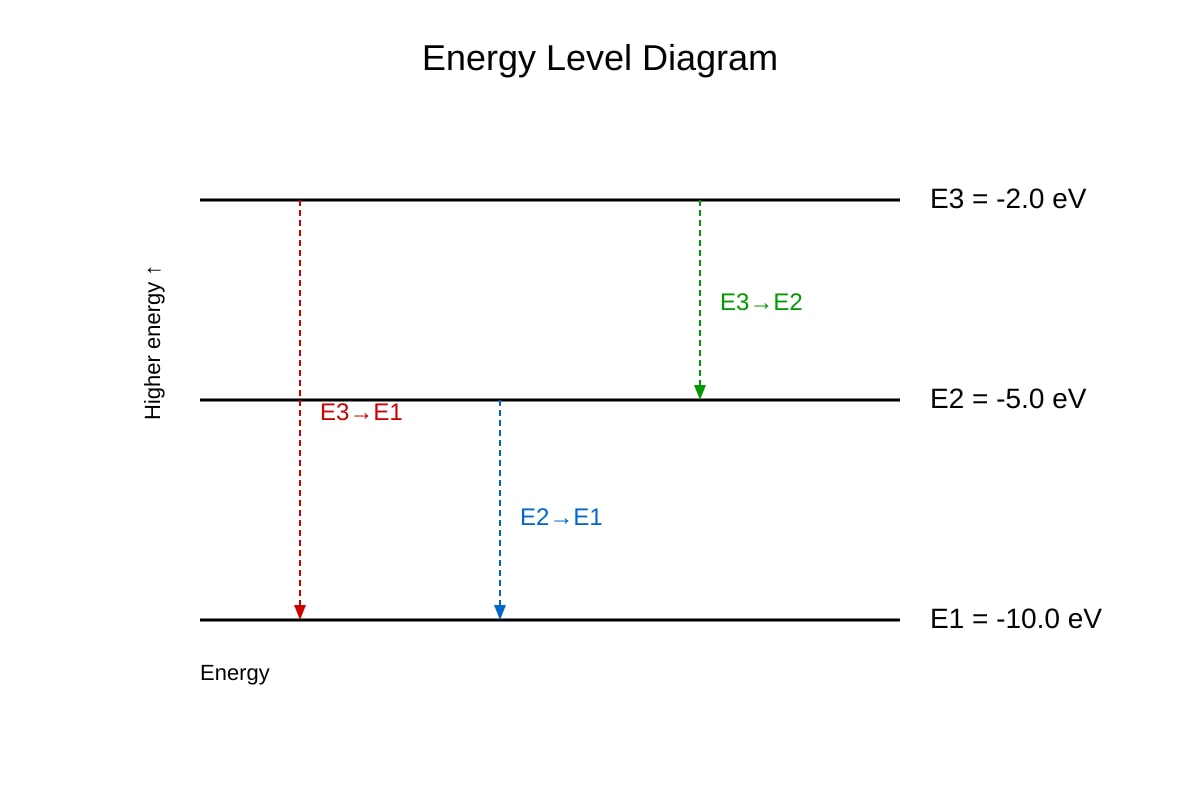
19.
Image pending generation: diagram for Q19.
Calculate the wavelength of the photon emitted in the transition E3 → E1. [3]
20. State one piece of experimental evidence for the wave nature of matter. [1]
Answers
A-Level Physics H2 Quiz - Modern Physics (Answer Key)
Total Marks: 40
Syllabus-first practice content from LLM-inferred templates; not official past-year derived.
Section A: Photons and Matter Waves
1. [3 marks]
Work function ϕ=2.10 eV=2.10×1.60×10−19=3.36×10⁻¹⁹ J.
Photon energy E=hf=(6.63×10⁻³⁴)(9.00×10¹⁴)=5.97×10⁻¹⁹ J.
Kmax=E−ϕ=5.97×10⁻¹⁹−3.36×10−19=2.61×10⁻¹⁹ J.
In eV: 2.61×10⁻¹⁹/1.60×10−19=1.63 eV.
Answer: 1.63 eV (accept 1.6 eV).
Teaching note: Use E=hf−ϕ. Convert eV to J if needed; here final in eV so divide by e.
2. [2 marks]
λ=ph where λ = de Broglie wavelength, h = Planck constant, p = momentum of particle.
Answer: equation + definitions (1+1).
Common mistake: writing p=mv only without stating λ.
3. [3 marks]
Kinetic energy gained Ek=eV=150 eV=150×1.60×10−19=2.40×10⁻¹⁷ J.
p=2meEk=2(9.11×10⁻³¹)(2.40×10⁻¹⁷)=6.61×10⁻²⁴ kg m s−1.
λ=h/p=6.63×10−34/6.61×10−24=1.00×10−10 m=0.100 nm.
Answer: 0.100 nm.
Marking: 1 for KE, 1 for p, 1 for λ.
4. [2 marks]
A wave model predicts energy depends on intensity, so higher intensity should eject electrons at any frequency; but experiment shows no emission below threshold frequency regardless of intensity, and emission is instantaneous. This implies energy is quantised in photons.
Answer: any two correct points.
5. [2 marks]
E=hc/λ⇒λ=hc/E=(6.63×10−34)(3.00×108)/(3.98×10−19)=5.00×10−7 m=500 nm.
Answer: 500 nm.
Section B: Nuclear Physics and Radioactivity
6. [2 marks]
92238U→90234Th+24α.
Marking: 1 for daughter nucleus, 1 for alpha particle with balances.
7. [2 marks]
36.0/12.0=3 half-lives. N=N0(1/2)3=4.80×1020×1/8=6.00×1019.
Answer: 6.00×10¹⁹.
8. [1 mark]
Binding energy is the minimum energy required to separate a nucleus into its constituent protons and neutrons.
9. [3 marks]
Mass of 2p + 2n = 2(1.00728)+2(1.00867)=4.03190 u.
Mass defect Δm=4.03190−4.00260=0.02930 u.
Answer: 0.0293 u.
Marking: 1 for constituent mass, 1 for subtraction, 1 for value.
10. [1 mark]
A neutron changes into a proton with emission of an electron (β−) and antineutrino; atomic number increases by 1.
Section C: Quantum and Wave-Particle Duality
11. [1 mark]
dsinθ=λ (or dsinθ=h/p for first order, n=1).
12. [3 marks]
Δx=λD/a=(632×10−9)(1.50)/(0.200×10−3)=4.74×10−3 m=4.74 mm.
Answer: 4.74 mm.
Marking: 1 formula, 1 substitution, 1 answer.
13. [2 marks]
Stopping potential is the same for both intensities (photon energy unchanged); saturation current is larger for higher intensity (more photons per second).
From image: both curves hit zero at -1.5 V; I1 saturates higher.
14. [2 marks]
1 u=931.5 MeV. E=0.00850×931.5=7.92 MeV.
Answer: 7.92 MeV.
15. [2 marks]
Below threshold frequency no electrons are emitted no matter how intense the light; this shows light energy is delivered in discrete packets (photons) with E=hf, so only f matters, not wave amplitude.
Section D: Mixed Modern Physics
16. [2 marks]
714N+01n→614C+11p.
Resulting nuclide is carbon-14.
17. [3 marks]
A=A0e−λt⇒100=800e−30λ⇒1/8=e−30λ.
ln(1/8)=−30λ⇒−2.079=−30λ⇒λ=0.0693 s−1.
Answer: 0.0693 s−1.
18. [2 marks]
p=h/λ=6.63×10−34/(0.100×10−9)=6.63×10−24 kg m s−1.
Answer: 6.63×10⁻²⁴ kg m s−1.
19. [3 marks]
ΔE=E3−E1=−2.0−(−10.0)=8.0 eV=8.0×1.60×10−19=1.28×10⁻¹⁸ J.
λ=hc/ΔE=(6.63×10−34)(3.00×108)/(1.28×10−18)=1.55×10−7 m=155 nm.
Answer: 155 nm.
20. [1 mark]
Electron diffraction (e.g. by crystal) or Davisson-Germer experiment.
Free quiz and exam paper access
Enter your details to view this paper
Your access is remembered on this device.