AI Generated Quiz
A Level H2 Physics Mechanics Quiz
Free A Level H2 Physics Mechanics quiz, HY3 AI version, with questions, answers, and A Level-style practice for Singapore students.
These static practice materials are generated from the site's syllabus and paper-generation workflow, with source and model context shown so students and parents can evaluate the material before use.
Questions
A-Level Physics H2 Quiz - Mechanics
Name: ___________________________
Class: ___________________________
Date: ___________________________
Score: _______ / 40
Duration: 60 minutes
Total Marks: 40
Topic: Mechanics (Section II: Topics 5–9 of Syllabus 9478)
Instructions:
- Answer all 20 questions.
- Show your working clearly for calculation questions.
- Use the data booklet values where needed: g=9.81 m s−2, G=6.67×10⁻¹¹ N m2 kg−2, ME=5.97×1024 kg, RE=6.37×10⁶ m.
- Marks are indicated at the end of each question.
Section A: Short Structured Questions (1–10)
1. State the principle of conservation of linear momentum. [2]
2. A ball of mass 0.20 kg is thrown vertically upward with initial speed 12 m s−1. Neglecting air resistance, calculate the maximum height reached. [3]
3. A projectile is launched horizontally from a cliff of height 45 m with speed 20 m s−1. Calculate the time taken to reach the ground. [2]
4. Define the term centripetal force. [1]
5. A car of mass 1000 kg moves around a circular track of radius 50 m at constant speed 15 m s−1. Calculate the centripetal force acting on it. [2]
6. State Newton's law of gravitation in words. [2]
7. A mass-spring system oscillates with simple harmonic motion of amplitude 0.05 m and angular frequency 4.0 rad s−1. Calculate the maximum acceleration. [2]
8. For a body executing simple harmonic motion, state the relationship between displacement x and acceleration a. [1]
9. A satellite orbits Earth at a distance of 2RE from Earth's centre. Given g at surface is 9.81 m s−2, calculate the gravitational field strength at that orbit. [2]
10. Describe what is meant by resonance in the context of forced oscillations. [2]
Section B: Calculation and Application (11–15)
11. A trolley of mass 2.0 kg moving at 3.0 m s−1 collides head-on with a stationary trolley of mass 1.0 kg. After the collision the 2.0 kg trolley moves at 1.0 m s−1 in the same direction. Calculate the velocity of the 1.0 kg trolley after collision. [3]
12. A ball is projected at 30∘ above the horizontal with speed 25 m s−1. (a) Calculate the horizontal component of the initial velocity. [1] (b) Calculate the time of flight assuming it lands at the same height. [2] (c) Calculate the range. [2]
13. A pendulum of length 1.2 m performs SHM with small amplitude. (a) Calculate its period. [2] (b) If the maximum angular displacement is 0.10 rad, find the maximum linear speed of the bob. [2]
14. A 500 kg satellite circles Earth at radius 7.0×10⁶ m. (a) Calculate the gravitational force on it. (ME=5.97×1024 kg) [2] (b) Hence find the orbital speed. [2]
15. A mass of 0.40 kg on a spring (k=160 N m−1) oscillates with amplitude 0.10 m. (a) Calculate the total energy of the oscillation. [2] (b) Calculate the speed when displacement is 0.06 m. [2]
Section C: Data Interpretation and Extended Reasoning (16–20)
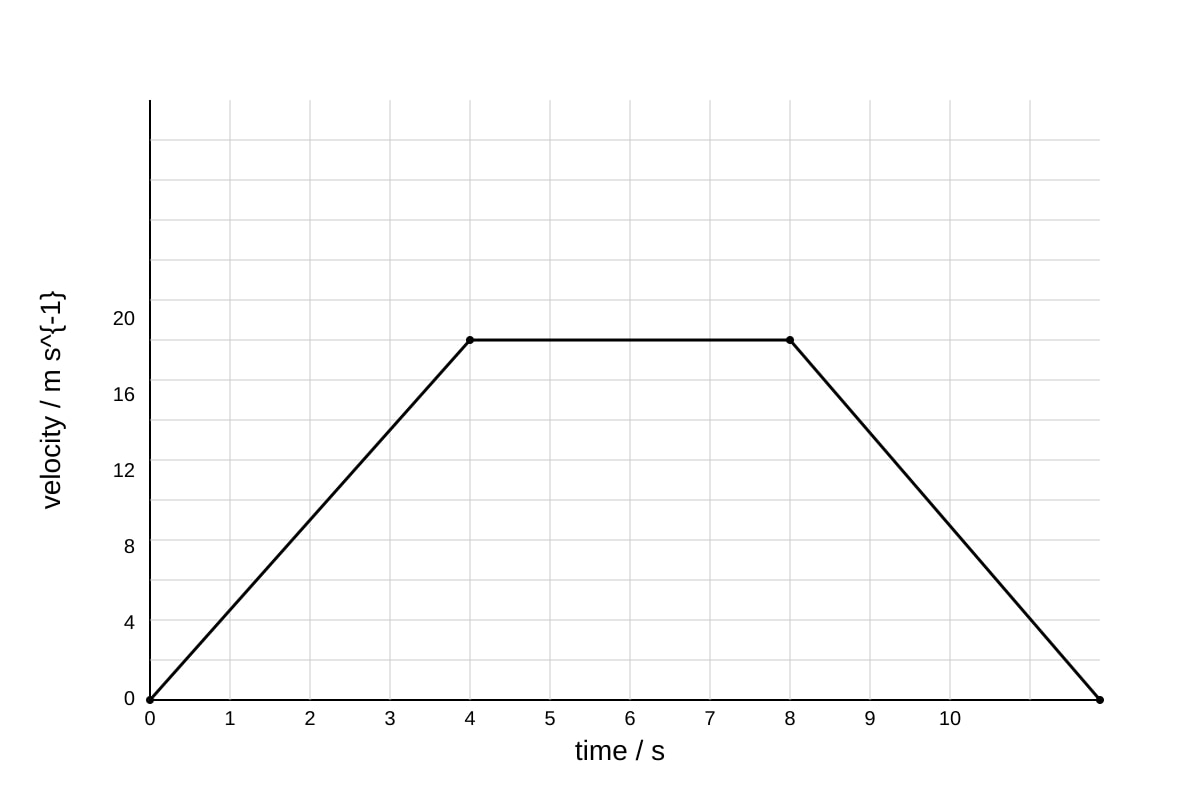
16. The velocity-time graph below shows the motion of a drone.
Image pending generation: graph for Q16.
(a) Calculate the acceleration during the first 4 s. [2] (b) Calculate the total distance travelled. [2]
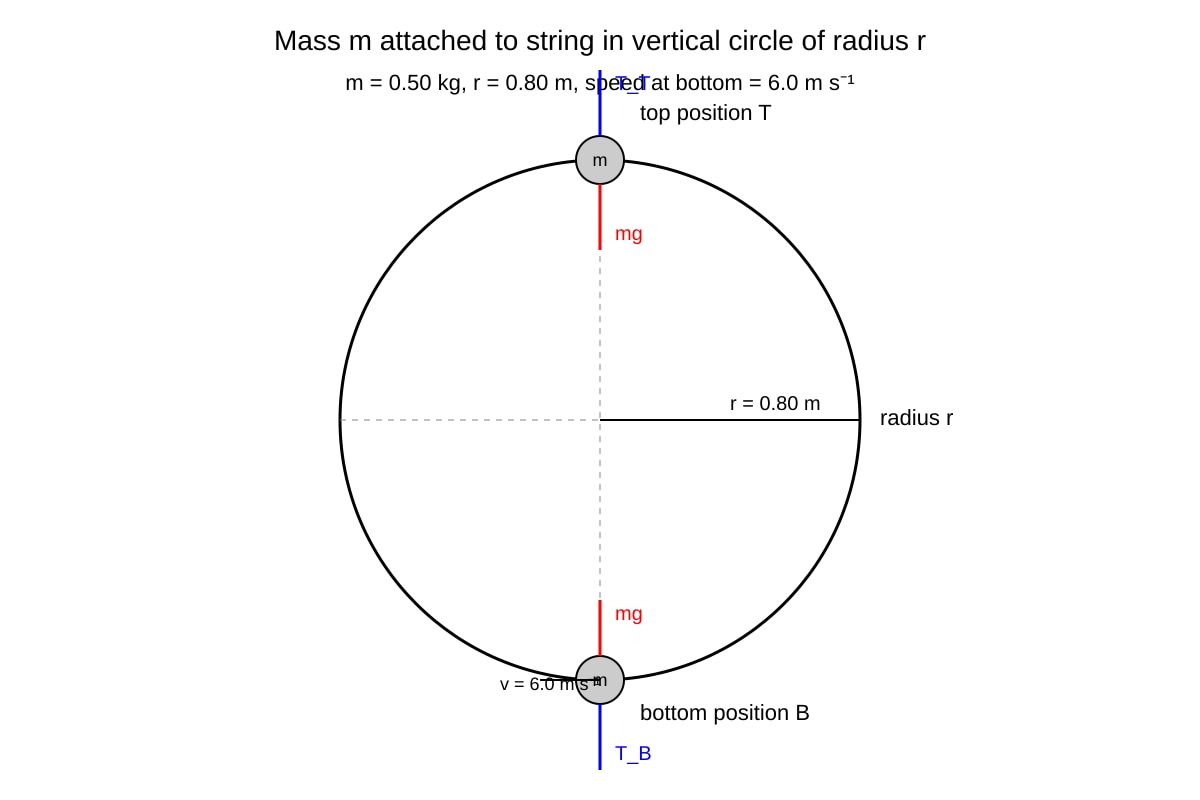
17. The diagram shows a mass m attached to a string moving in a vertical circle of radius r.
Image pending generation: diagram for Q17.
(a) Calculate the tension at the bottom of the circle. [3] (b) State and explain whether the string is more likely to break at the top or bottom. [2]
18. A student investigates damped oscillations of a spring-mass system. (a) Distinguish between light damping and critical damping. [2] (b) Suggest one practical application where heavy damping is desirable. [1]
19. Two stars of masses M and 2M are separated by distance d. (a) Show that the gravitational field strength at the midpoint between them is zero. [2] (b) A test mass placed at the midpoint is displaced slightly toward the smaller star. State the nature of the resultant force and explain. [2]
20. A geostationary satellite orbits above the Equator. (a) State two conditions necessary for a satellite to be geostationary. [2] (b) Calculate the orbital radius of a geostationary satellite given Earth's rotation period is 24.0 h and GME=3.99×10¹⁴ m3 s−2. [3]
Answers
A-Level Physics H2 Quiz - Mechanics: Answer Key
Topic: Mechanics (Syllabus 9478, Section II)
Total Marks: 40
Section A: Short Structured Questions
1. [2 marks]
Principle: In a closed (isolated) system, the total linear momentum remains constant provided no external net force acts.
Teaching note: Must state "closed system" and "before = after" or "constant if net external force zero". Common mistake: omitting external-force condition.
2. [3 marks]
Use v2=u2+2as with v=0, u=12, a=−9.81:
0=122+2(−9.81)s
s=144/19.62=7.34 m
Marks: 1 for correct eqn, 1 substitution, 1 answer with unit.
3. [2 marks]
Vertical motion: s=21gt2 → 45=0.5×9.81×t2
t=90/9.81=3.03 s
Horizontal speed irrelevant to fall time.
4. [1 mark]
Centripetal force is the resultant force directed toward the centre of a circular path, causing centripetal acceleration.
5. [2 marks]
F=mv2/r=1000×152/50=4500 N
6. [2 marks]
Newton's law: Force between two point masses is directly proportional to product of masses and inversely proportional to square of distance between them, directed along line joining them.
7. [2 marks]
amax=ω2x0=4.02×0.05=0.80 m s−2
8. [1 mark]
a=−ω2x (acceleration proportional to displacement, opposite direction).
9. [2 marks]
g∝1/r2; at 2RE: g=9.81/4=2.45 m s−2
10. [2 marks]
Resonance occurs when driving frequency equals natural frequency, causing large amplitude buildup. Need mention frequency match and amplitude growth.
Section B: Calculation and Application
11. [3 marks]
Conservation of momentum: 2.0×3.0+0=2.0×1.0+1.0×v
6=2+v → v=4.0 m s−1
Marks: eqn (1), sub (1), ans (1).
12. [5 marks total]
(a) [1] ux=25cos30∘=21.7 m s−1
(b) [2] tflight=2uy/g=2(25sin30∘)/9.81=2.55 s
(c) [2] Range =ux×t=21.7×2.55=55.3 m
13. [4 marks]
(a) [2] T=2πl/g=2π1.2/9.81=2.20 s
(b) [2] vmax=ωLθmax=(2π/T)×1.2×0.10=0.343 m s−1
14. [4 marks]
(a) [2] F=GMm/r2=(6.67×10−11×5.97×1024×500)/(7.0×106)2=4.06×103 N
(b) [2] F=mv2/r → v=Fr/m=4060×7.0×106/500=7.53×103 m s−1
15. [4 marks]
(a) [2] E=21kA2=0.5×160×0.102=0.80 J
(b) [2] v=ωA2−x2, ω=k/m=20; v=200.102−0.062=1.60 m s−1
Section C: Data Interpretation and Extended Reasoning
16. [4 marks]
(a) [2] a=Δv/Δt=16/4=4.0 m s−2
(b) [2] Area: triangle 0.5×4×16=32; rect 4×16=64; triangle 0.5×2×16=16; total =112 m
17. [5 marks]
(a) [3] At bottom: TB−mg=mv2/r → TB=0.50×9.81+0.50×6.02/0.80=4.91+22.5=27.4 N
(b) [2] Bottom: tension larger due to adding weight; more likely break at bottom.
18. [3 marks]
(a) [2] Light: amplitude decays gradually, oscillates many cycles; critical: returns to equilibrium in shortest time without oscillating.
(b) [1] e.g. car shock absorber.
19. [4 marks]
(a) [2] Field from M: GM/(d/2)2 left; from 2M: 2GM/(d/2)2 right; equal magnitude opposite → net zero.
(b) [2] Toward smaller star (M): nearer M so its attraction stronger; net force toward M.
20. [5 marks]
(a) [2] (i) period = 24 h, (ii) above Equator, (iii) same direction as Earth rotation. (any two)
(b) [3] r3=GMET2/4π2; T=86400 s; r=(3.99×1014×864002/4π2)1/3=4.23×107 m
Free quiz and exam paper access
Enter your details to view this paper
Your access is remembered on this device.