From Real Exams Quiz
A Level H2 Physics Waves Sound Light Quiz
Free A Level H2 Physics Waves Sound Light quiz, LongCat Exam version, with questions, answers, and A Level-style practice for Singapore students.
These static practice materials are generated from the site's syllabus and paper-generation workflow, with source and model context shown so students and parents can evaluate the material before use.
Questions
Free quiz and exam paper access
Enter your details to view this paper
Your access is remembered on this device.
Answers
A-Level Physics H2 Quiz - Waves Sound Light
Answer Key
Section A: Multiple Choice
1. C. 4.0 m s⁻¹ [2]
Working: The wave equation relates speed , frequency , and wavelength by . Substituting: m s⁻¹.
Teaching note: The fundamental wave equation applies to all wave types. Frequency is the number of complete oscillations per second, and wavelength is the distance over which the wave repeats. Their product gives the distance the wave travels per second, i.e., the wave speed.
2. C. They all travel at all travel at the same speed in a vacuum. [2]
Teaching note: Electromagnetic waves are transverse waves that do not require a medium. In a vacuum, all electromagnetic waves travel at the speed of light m s⁻¹. They can be polarised because they are transverse. Option A is wrong (they are transverse); B is wrong (no medium needed); D is wrong (transverse waves can be polarised).
3. A. 0.03 m [2]
Working: The general form of a wave equation is , where is the amplitude. Comparing , the amplitude m.
Teaching note: The amplitude is the coefficient of the sine function — it is the maximum displacement from the equilibrium position. The angular frequency rad s⁻¹ and the wave number rad m⁻¹ are not the amplitude.
4. B. A dark fringe (destructive interference) [2]
Working: Constructive interference occurs when the path difference is (where ). Destructive interference occurs when the path difference is . Since , this corresponds to destructive interference, producing a dark fringe.
Teaching note: When two coherent waves arrive at a point, they interfere. If the path difference is a whole number of wavelengths, the waves arrive in phase and reinforce (bright fringe). If the path difference is a half-integer number of wavelengths, they arrive out of phase and cancel (dark fringe).
5. C. 4 [2]
Working: The grating equation is . The maximum order occurs when (i.e., ). The slit spacing mm m. Then . Since must be an integer, the highest observable order is .
Teaching note: The maximum diffraction order is found by setting (the maximum possible value). The result is then rounded down to the nearest integer because cannot exceed 1. Common mistake: rounding up to 5, which would require (impossible).
Section B: Structured Questions
6. (a) [2]
Answer: In a transverse wave, the oscillations of the particles are perpendicular to the direction of wave travel. In a longitudinal wave, the oscillations are parallel to the direction of wave travel. Example of transverse: electromagnetic wave / wave on a string. Example of longitudinal: sound wave in air.
Mark scheme: 1 mark for correct description of the difference (perpendicular vs. parallel). 1 mark for one correct example of each.
Teaching note: The key distinction is the direction of particle oscillation relative to the direction the wave energy travels. Transverse waves have "side-to-side" motion; longitudinal waves have "back-and-forth" (compression and rarefaction) motion.
(b) [3]
Answer: Polarisation is the phenomenon in which the oscillations of a wave are restricted to a single plane (or direction). Only transverse waves can be polarised because their oscillations are perpendicular to the direction of propagation, meaning the oscillation direction can be selected (e.g., using a polarising filter). Longitudinal waves cannot be polarised because their oscillations are along the direction of propagation, so there is no preferential transverse direction to filter.
Mark scheme: 1 mark for definition of polarisation (restriction to one plane/direction). 1 mark for stating only transverse waves can be polarised. 1 mark for explanation (oscillations perpendicular to propagation direction allows filtering; longitudinal waves oscillate along propagation direction).
Teaching note: Polarisation is a defining property that distinguishes transverse waves from longitudinal waves. A polaroid filter only allows the component of oscillation in one direction to pass through.
7. (a) [1]
Answer: Amplitude m.
Working: Comparing with , the amplitude is the coefficient: m.
(b) [2]
Answer: Hz.
Working: From the equation, rad s⁻¹. Since , we have Hz.
Teaching note: The angular frequency is the coefficient of in the wave equation. The relationship converts between angular frequency (rad s⁻¹) and frequency (Hz).
(c) [2]
Answer: m.
Working: From the equation, rad m⁻¹. Since , we have m.
Teaching note: The wave number is the coefficient of in the wave equation. It represents the spatial frequency of the wave — how many radians of phase change occur per metre.
(d) [2]
Answer: m s⁻¹.
Working: m s⁻¹.
Alternative: m s⁻¹.
8. (a) [2]
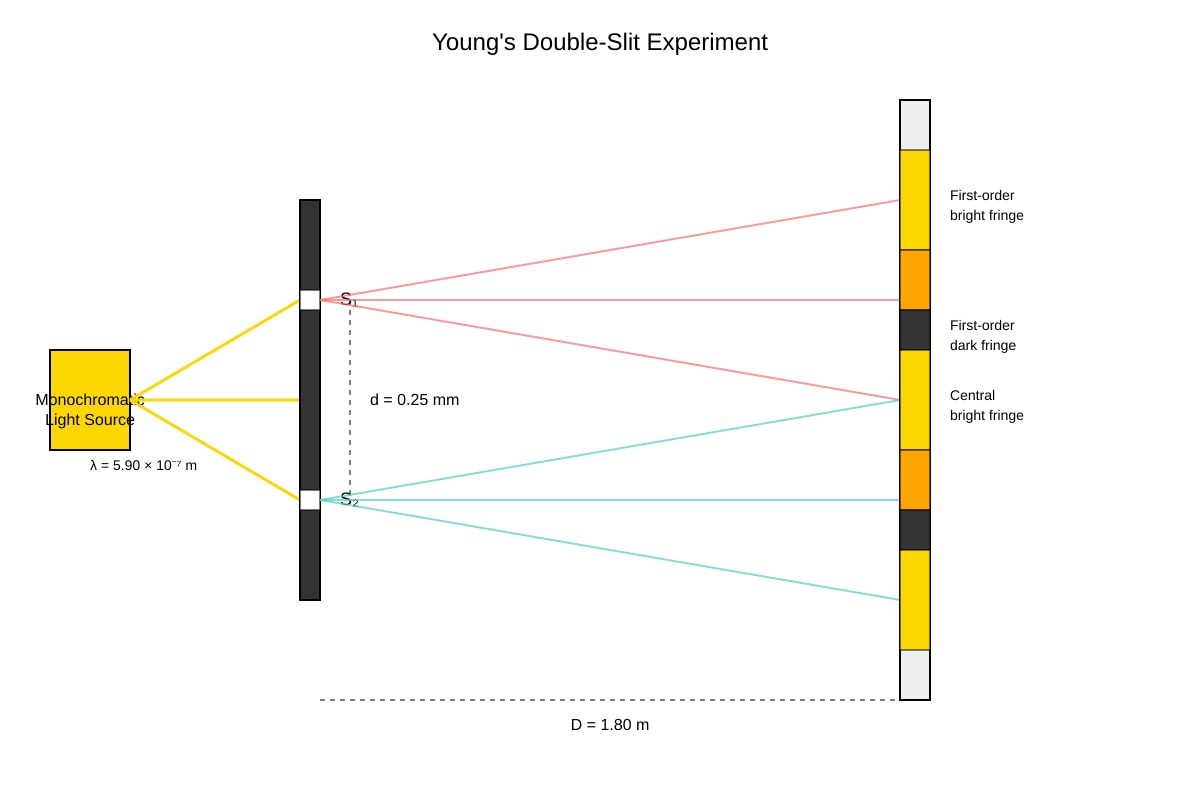
Answer: At the central point, the path difference between the waves from the two slits is zero. Therefore, the waves arrive in phase and undergo constructive interference, producing a bright fringe.
Mark scheme: 1 mark for stating path difference is zero. 1 mark for stating waves arrive in phase / constructive interference occurs.
(b) [3]
Answer: Fringe separation m mm.
Working: The fringe separation formula for Young's double-slit experiment is:
Substituting: m mm.
Mark scheme: 1 mark for correct formula. 1 mark for correct substitution. 1 mark for correct answer with unit.
Common mistake: Forgetting to convert slit separation from mm to m. mm m.
(c) [2]
Answer: The fringe separation decreases. Since , a shorter wavelength gives a smaller . The fringes become closer together.
Mark scheme: 1 mark for stating fringe separation decreases. 1 mark for correct explanation referencing the formula.
9. (a) [2]
Answer: Amplitude m; Wavelength m.
Working: From the graph, the maximum displacement (crest) is 0.20 m, so amplitude m. One complete cycle spans from to m, so wavelength m.
Mark scheme: 1 mark for amplitude. 1 mark for wavelength.
(b) [2]
Answer: m s⁻¹.
Working: m s⁻¹.
(c) [3]
Answer: The wave at s is shifted to the right by one-quarter of a wavelength compared to the wave at .
Working: The period s. At s , the wave has advanced by a quarter period. For a wave travelling in the direction, this means the entire waveform shifts to the right by m.
Mark scheme: 1 mark for calculating period. 1 mark for determining the phase shift is (quarter period). 1 mark for sketch showing correct rightward shift of 0.25 m with correct shape.
Expected sketch features: The new wave should look identical in shape to the original but shifted right by 0.25 m. The crest that was at m should now be at m, etc.
10. (a) [2]
Answer: In a progressive wave, energy is transferred from one point to another, and all points oscillate with the same amplitude. In a stationary wave, there is no net transfer of energy; points oscillate with different amplitudes (nodes have zero amplitude, antinodes have maximum amplitude), and there is a fixed pattern of nodes and antinodes.
Mark scheme: 1 mark for energy transfer distinction. 1 mark for amplitude variation / node-antinode description.
(b) [2]
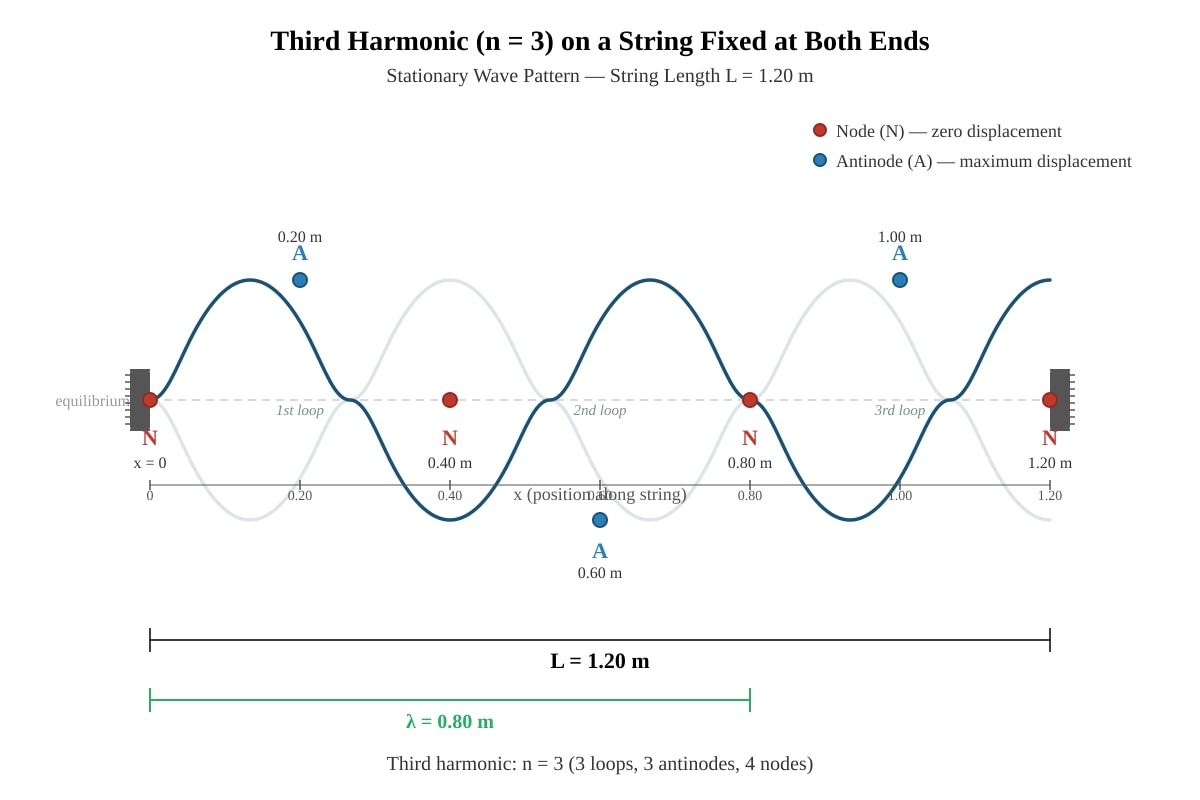
Answer: m.
Working: For the third harmonic on a string fixed at both ends, there are 3 loops. The relationship is , so m.
Teaching note: For a string fixed at both ends, the th harmonic has loops and ... more precisely, , so .
(c) [2]
Answer: m s⁻¹.
Working: m s⁻¹.
11. (a) [3]
Answer: m.
Working: Using the diffraction grating equation with :
Mark scheme: 1 mark for correct formula. 1 mark for correct substitution. 1 mark for correct answer.
(b) [2]
Answer: 625 lines per mm.
Working: Number of lines per metre lines per m lines per mm.
Mark scheme: 1 mark for correct conversion. 1 mark for correct answer with unit.
Section C: Longer Structured Questions
12. (a) [1]
Answer: The Doppler effect is the change in observed frequency of a wave when there is relative motion between the source and the observer.
(b) [3]
Answer: Hz.
Working: For a source moving towards a stationary observer:
Wait — let me recalculate with the correct values. Hz, m s⁻¹:
Mark scheme: 1 mark for correct formula. 1 mark for correct substitution. 1 mark for correct answer (552 or 553 Hz accepted).
Teaching note: When the source moves towards the observer, the observed frequency is higher than the emitted frequency. The denominator is because the source is "chasing" its own wavefronts, compressing them.
(c) [2]
Answer: Hz.
Working: For a source moving away:
Mark scheme: 1 mark for correct formula. 1 mark for correct answer.
(d) [2]
Answer: When the source moves towards the observer, each successive wavefront is emitted from a position closer to the observer. This reduces the effective wavelength (wavefronts are compressed), so more wavefronts reach the observer per second, increasing the observed frequency. When the source moves away, the opposite occurs — wavefronts are stretched, the effective wavelength increases, and the observed frequency decreases.
Mark scheme: 1 mark for explaining compression/stretching of wavefronts. 1 mark for linking to change in frequency.
13. (a) [3]
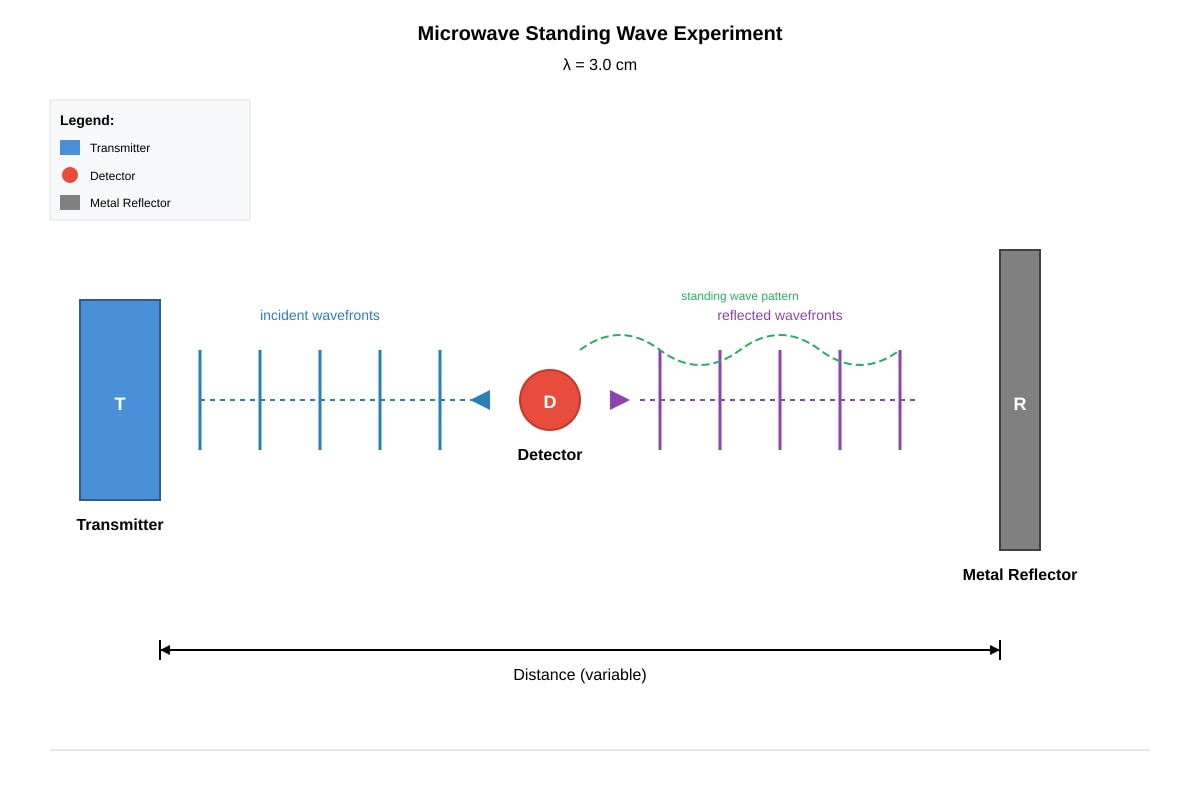
Answer: The incident microwaves from the transmitter are reflected by the metal reflector. The incident and reflected waves superpose to form a stationary wave pattern between the transmitter and the reflector. At nodes, the waves cancel (destructive interference) and the detector reads a minimum. At antinodes, the waves reinforce (constructive interference) and the detector reads a maximum. As the reflector moves, the positions of nodes and antinodes shift, so the detector alternately passes through nodes and antinodes, registering maxima and minima.
Mark scheme: 1 mark for stating incident and reflected waves superpose. 1 mark for explaining nodes (minima) and antinodes (maxima). 1 mark for explaining that moving the reflector changes the stationary wave pattern.
(b) [3]
Answer: Adjacent minima in a stationary wave are separated by . When the reflector moves by , the node/antinode pattern shifts such that the detector moves from one minimum to the next minimum. Given cm, cm, which matches the observed distance. This confirms the wavelength is 3.0 cm.
Mark scheme: 1 mark for stating adjacent minima are apart. 1 mark for calculating cm. 1 mark for confirming consistency with the given wavelength.
(c) [2]
Answer: In the microwave experiment, the stationary wave is formed by the superposition of two progressive waves travelling in opposite directions in air (or free space). The nodes are points of zero amplitude where destructive interference occurs. On a stretched string, the stationary wave is formed by the superposition of waves reflecting from the fixed ends. The nodes on the string are at the fixed ends where the string cannot move. Alternatively: the microwave stationary wave exists in three dimensions while the string wave is one-dimensional.
Mark scheme: 2 marks for any two valid differences. 1 mark for one valid difference.
14. (a) [2]
Answer: m.
Working: mm m.
(b) [3]
Answer: .
Working: Using with :
Mark scheme: 1 mark for correct formula. 1 mark for correct substitution. 1 mark for correct answer.
(c) [2]
Answer: .
Working: , so .
(d) [3]
Answer: A diffraction grating produces a spectrum by interference and diffraction. Different wavelengths are diffracted at different angles according to , so longer wavelengths (red) are diffracted more than shorter wavelengths (violet). The grating produces multiple orders of spectra. A prism produces a spectrum by refraction — different wavelengths have different refractive indices in glass (dispersion), so they are refracted by different amounts. Violet light is refracted more than red light in a prism (opposite order to a grating). A prism produces only one spectrum (first order), while a grating can produce multiple orders.
Mark scheme: 1 mark for explaining grating spectrum (interference/diffraction, longer λ diffracted more). 1 mark for explaining prism spectrum (refraction/dispersion, shorter λ refracted more). 1 mark for noting the order is reversed or that grating produces multiple orders.
15. (a) [3]
Answer: Hz.
Working: For a pipe open at both ends, the fundamental has a node at each end and an antinode in the middle... actually, for open-open pipe, the fundamental has antinodes at both ends and one node in the middle. The fundamental wavelength is m.
Mark scheme: 1 mark for correct formula ( for fundamental of open-open pipe). 1 mark for correct substitution. 1 mark for correct answer.
(b) [2]
Answer: Hz.
Working: For a pipe open at both ends, all harmonics are present: . The second harmonic is Hz.
(c) [3]
Answer: m.
Working: For a pipe closed at one end, the fundamental wavelength is . The fundamental frequency is . Setting this equal to 200 Hz:
Mark scheme: 1 mark for correct formula for closed pipe fundamental. 1 mark for correct substitution. 1 mark for correct answer.
(d) [2]
Answer: The fundamental mode of a closed pipe has a node at the closed end and an antinode at the open end. The standing wave pattern fits one-quarter of a wavelength within the pipe length. The sketch should show a single quarter-wave pattern: zero displacement at the closed end (node), maximum displacement at the open end (antinode).
Mark scheme: 1 mark for correct shape (quarter sine wave). 1 mark for labelling node at closed end and antinode at open end.
16. (a) [2]
Answer: m.
Working: m.
(b) [2]
Answer: The student would hear alternating loud and soft sounds as they walk along the line. At points where the path difference from the two speakers is a whole number of wavelengths, constructive interference occurs (loud). At points where the path difference is a half-integer number of wavelengths, destructive interference occurs (soft).
Mark scheme: 1 mark for stating alternating loud and soft. 1 mark for explaining in terms of path difference and constructive/destructive interference.
(c) [2]
Answer: At the central axis (directly ahead of the midpoint), the distances to both speakers are equal, so the path difference is zero. Since the path difference is , constructive interference occurs and the student hears a maximum (loud sound).
Mark scheme: 1 mark for stating path difference is zero. 1 mark for stating constructive interference occurs.
17. (a) [2]
Answer: Intensity increases by a factor of 4.
Working: Since , if doubles, changes by a factor of .
(b) [4]
Answer: When two coherent waves of equal amplitude interfere constructively, they are in phase. The resultant amplitude is the sum of the individual amplitudes:
Since intensity is proportional to the square of amplitude:
The intensity of each individual wave is . Therefore:
The resultant intensity is four times the intensity of each individual wave.
Mark scheme: 1 mark for stating waves are in phase for constructive interference. 1 mark for resultant amplitude . 1 mark for squaring to get . 1 mark for concluding .
Teaching note: This is an important result: two identical waves interfering constructively produce four times the intensity of one wave alone, not twice. This is because intensity depends on the square of amplitude.
18. (a) [3]
Answer: m s⁻¹.
Working: For a string fixed at both ends, the fundamental wavelength is m.
Mark scheme: 1 mark for . 1 mark for correct substitution. 1 mark for correct answer.
(b) [3]
Answer: Hz.
Working: The new fundamental wavelength is m.
Mark scheme: 1 mark for correct new wavelength. 1 mark for using same wave speed. 1 mark for correct answer.
(c) [3]
Answer: When the string is plucked, a wave travels along the string and reflects from the fixed end. The incident wave and the reflected wave superpose (overlap) according to the principle of superposition. At certain frequencies, the superposition produces a stable pattern — a stationary wave — where some points (nodes) remain stationary and others (antinodes) oscillate with maximum amplitude. This occurs when the string length is an integer multiple of half-wavelengths, allowing the reflected wave to be in phase with newly generated waves, creating resonance.
Mark scheme: 1 mark for stating waves reflect from fixed ends. 1 mark for stating incident and reflected waves superpose. 1 mark for explaining the formation of a stable stationary wave pattern at resonant frequencies.
19. (a) [3]
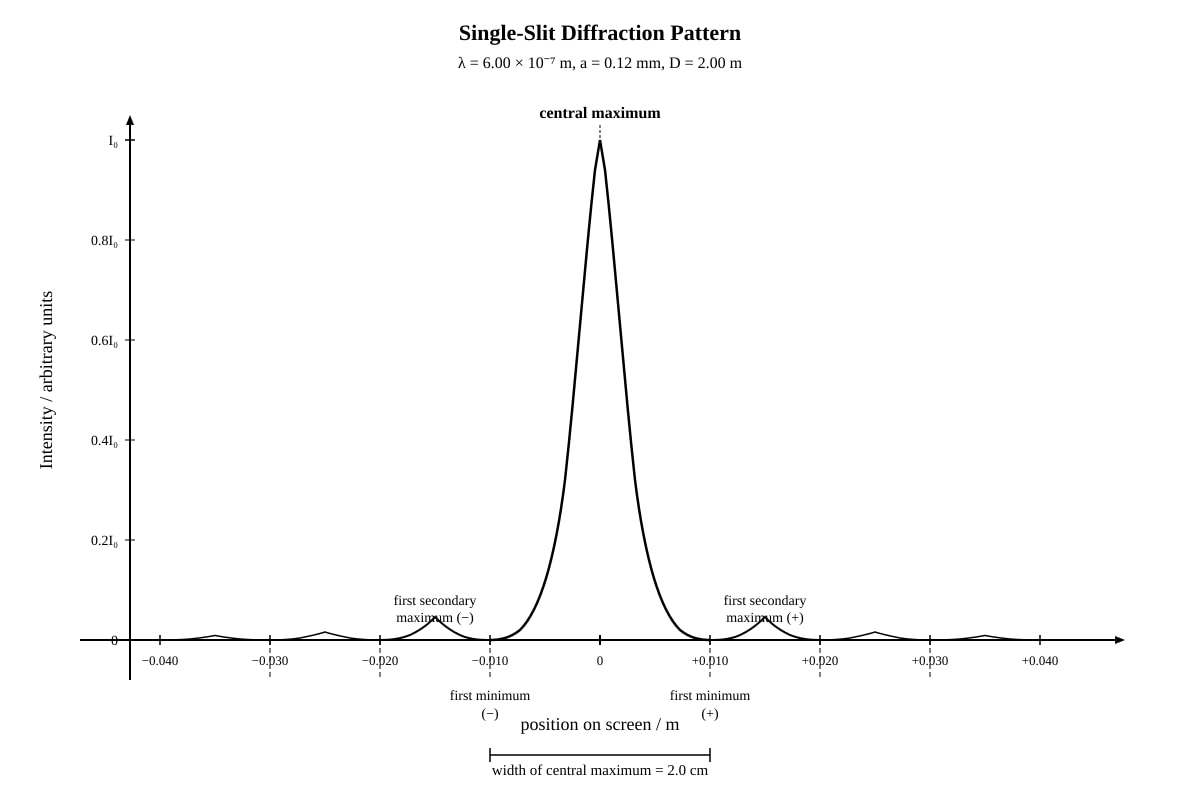
Answer: Angular width rad.
Working: The angular width of the central maximum is the angle between the first minima on either side. The angular position of the first minimum is given by:
For small angles, , so:
The full angular width (from first minimum on one side to first minimum on the other) is:
Mark scheme: 1 mark for correct formula. 1 mark for correct substitution. 1 mark for correct answer.
(b) [2]
Answer: Linear width m cm.
Working: The linear width of the central maximum on the screen is:
Mark scheme: 1 mark for correct method. 1 mark for correct answer with unit.
(c) [2]
Answer: The width of the central maximum doubles. Since , halving the slit width doubles the angular width. The central maximum becomes wider. This is because a narrower slit causes more diffraction (greater spreading of the wave).
Mark scheme: 1 mark for stating the width doubles/increases. 1 mark for correct explanation (inverse relationship between slit width and diffraction angle).
20. (a) [3]
Answer: Hz.
Working: For a source moving towards a stationary observer:
Mark scheme: 1 mark for correct formula. 1 mark for correct substitution. 1 mark for correct answer (755 or 756 Hz).
(b) [2]
Answer: Hz.
Working: For a source moving away:
Mark scheme: 1 mark for correct formula. 1 mark for correct answer.
(c) [4]
Answer: The driver will hear a beat frequency. The driver is in the car (moving with the source), so the direct sound from the siren is heard at the emitted frequency Hz (no Doppler shift for the driver relative to the siren, since they are in the same reference frame). The sound reflected from the wall can be treated as follows: the moving car emits sound that hits the stationary wall. The wall "receives" a Doppler-shifted frequency and then reflects it. For the wall as a stationary observer receiving sound from an approaching source:
The wall reflects this frequency, acting as a stationary source emitting Hz. The driver (moving towards this stationary source) hears:
The beat frequency is:
Mark scheme: 1 mark for stating the driver hears the direct sound at 700 Hz (same reference frame). 1 mark for calculating the frequency received by the wall (755.6 Hz). 1 mark for calculating the frequency heard by the driver from the reflected sound (810 Hz). 1 mark for calculating the beat frequency (110 Hz).
Teaching note: This is a two-step Doppler effect problem. First, the wall acts as an observer receiving sound from a moving source. Then the wall acts as a stationary source reflecting that frequency, and the driver is a moving observer approaching it. The beat frequency arises from the superposition of two waves of slightly different frequencies.
End of Answer Key